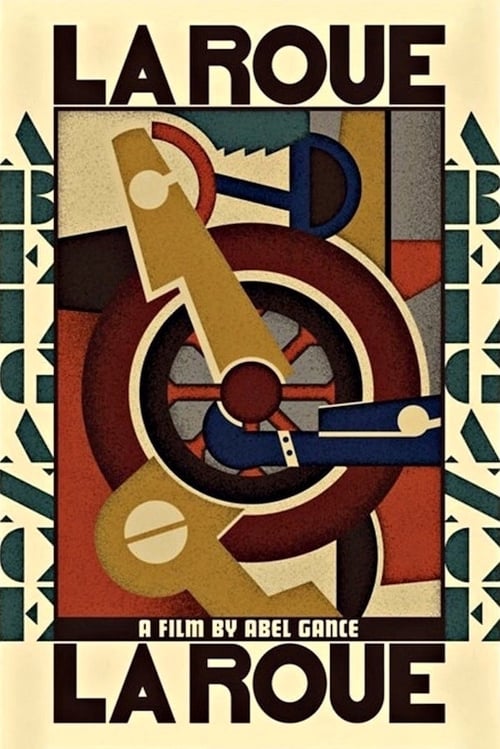
La Roue
1923 · Abel Gance
For when you want to go deep — a monumental silent epic to surrender an evening to, more pilgrimage than comfort watch. Reach for it when you're curious where the language of movies actually comes from.
What it's about
A railway engine driver pulls an orphaned girl from the wreckage of a train crash and raises her as his own, alongside his son. Years pass in the soot and steam of the rail yards, and as Norma grows into a young woman, Sisif is torn apart by feelings he can't admit and by the question of whether to tell her the truth about where she came from. It's a family melodrama built on rails — locomotives, signals, and the wheel of fate turning over one man's life.
The experience
Overwhelming and strange in the best way: raw, outsized emotion driven by editing that accelerates like a runaway engine. It's long and operatic, alternating slow-burning domestic anguish with passages of pure kinetic rush that still feel startlingly modern.
The craft
This is the film where rapid-fire editing was essentially invented as an expressive tool: Gance cuts faster and faster until pistons, rails, and faces blur into pure sensation, and he points the camera from the locomotive itself so you ride inside a man's panic. The machine imagery — wheels, smoke, signals — is composed with a painter's eye, and the montage sequences hit hardest at full attention on a big screen.
Why it matters
Filmmakers across Europe and the Soviet Union studied it like a textbook, and its accelerating-montage sequences reshaped how movies handle speed, machinery, and inner turmoil. It stands between Gance's war cinema and his later epics as the moment his ambition rewired the medium.
Snapshot
La Roue is the great transitional monument of European silent cinema: a railway melodrama of almost operatic crudity welded to a formal experiment so radical that it reorganized the grammar of the medium. Abel Gance shot it between 1919 and 1921, in the shadow of the war film that had made his name (J'accuse, 1919) and before the imperial ambition of Napoléon (1927). Its plot is a naturalist fable: Sisif, an engine driver, pulls an orphaned child from a wreck, raises her as his daughter, and is destroyed by a desire he cannot name. Around this melodramatic armature Gance built sequences of accelerating montage, subjective camera, and machine-portraiture that were studied, almost immediately, as textbooks — by the Soviet montage school, by the French Impressionists, by Fernand Léger. The film has never quite escaped the split it opened: contemporaries and successors alike admired the cutting and winced at the story. What survives is a work whose ambition — to make a locomotive's acceleration legible as rhythm, and rhythm legible as emotion — outran everything around it.
Industry & production
Gance came to La Roue with unusual leverage. J'accuse had been an international success, and Charles Pathé backed the new project through Pathé Consortium Cinéma, with Gance's own production entity attached. The scale was extraordinary by French standards of the moment: filming ran across roughly two years, with a long campaign in the railway yards around Nice — Gance secured access to working locomotives, sheds, and track — followed by a second, mountain-set movement shot in the Mont Blanc massif around Chamonix, including the Mer de Glace and the funicular lines. The film was, by common account, among the most expensive French productions of its era; specific budget figures in circulation are unreliable and are best left unquoted.
The production was also marked by extraordinary personal calamity, and this is well documented rather than legend. Gance's companion Ida Danis was gravely ill with tuberculosis; the move south was undertaken partly for her sake, and she died in 1921 during the production. Séverin-Mars, who plays Sisif and who had also starred in J'accuse, was in poor health throughout and died in July 1921, not long after completing his work. The film's funereal weight — its sense of a man grinding himself down — is inseparable from these circumstances, though the biographical reading should not be pushed into causation it cannot bear.
Post-production stretched into 1922. Gance assembled a first version of enormous length: reports vary, and the commonly cited figures range from roughly seven to nine hours across some thirty-odd reels. No single authoritative running time for that first assembly can be stated with confidence. The film reached Paris audiences across the winter of 1922–23, with the principal release in early 1923 in multiple parts screened over successive weeks — a serial-style exhibition strategy that French distribution could accommodate but that no market could sustain indefinitely. Gance then cut the film repeatedly: to a version of around four and a half hours, and later far shorter. For most of the twentieth century La Roue was known chiefly through mutilated prints of two hours or less, and an abridged sound reissue circulated in the 1930s. Restoration work by French and other archives progressively recovered material; the Fondation Jérôme Seydoux-Pathé restoration presented in 2019, running close to seven hours, is the most complete version to have circulated in modern times. Any critical account of the film must therefore be provisional about proportion and pacing: for decades, scholars were writing about a torso.
Technology
The film is a product of hand-cranked 35mm nitrate practice at its most inventive. Gance's team worked with the standard French professional apparatus of the period — Debrie and Pathé cameras — and the technological interest lies less in novel hardware than in what Gance forced conventional equipment to do. Cameras were mounted on and beside moving locomotives to obtain track-level and cab-level views; lenses were masked, veiled, and vignetted in-camera; multiple exposures were built up in the camera and at the printing stage to superimpose faces on machinery, memory on present action.
Color is integral, not decorative. Like most major silent features, La Roue was released with applied color through tinting and toning — the industrial bath processes of the Pathé laboratories — and the restorations have worked to recover this scheme. Fire-orange for the furnace, cold blue-green for night and snow, sepia for interiors: the palette does structural work, separating the smoke-blackened rail world of the first movement from the white world of the second. Reading La Roue in black and white, as generations did, flattens one of its principal expressive systems.
The other technology at issue is the projector, and behind it the frame. Gance's montage exploits the fact that cinema is a discrete series: he cuts to durations of a few frames, and at times to single frames, on the assumption that the eye registers such flashes as texture and pulse rather than as legible images. That is a technological argument as much as an aesthetic one, and it is why the film was so useful to theorists who wanted to define the medium's specificity.
Technique
Cinematography
Léonce-Henri Burel led the camera team, working with collaborators including Gaston Brun, Marc Bujard, and Maurice Duverger. Burel — later the cinematographer of Bresson's Diary of a Country Priest and Pickpocket — brings to the railway material an almost documentary attention to grime, steam, and metal, then permits Gance to violate it. The film alternates two registers: a hard, textural naturalism of the yards, and a lyric-subjective register in which the image is softened, doubled, masked, or fragmented.
Two habits are decisive. The first is the extreme close-up of the non-human: connecting rods, pistons, valve gear, gauge dials, rails, wheel rims. Gance treats machine parts as faces, giving them the same scale and duration he gives Sisif's eyes. This is photogénie in its most literal form — the claim, central to French film theory of the period, that cinema reveals a latent expressive life in objects. The second is the subjective view: as Sisif's sight fails, the frame is fogged, blotched, and constricted, so that the audience is placed inside a damaged perception rather than told about it. In the mountain sections, the alpine landscape is shot for scale and blankness, an inversion of the yards' claustrophobia.
Editing
This is the film's historical claim. Gance, cutting with his long-term collaborator Marguerite Beaugé, developed what became known as montage rapide — sequences in which shot length contracts progressively toward the single frame, so that the cutting rate itself becomes the carrier of meaning. The runaway train and crash material is the locus classicus: the acceleration of the engine is not merely depicted but enacted, the audience's perceptual system driven to the same threshold as the machine's. Elsewhere the same principle serves psychology, with memory images, faces, and objects interleaved at increasing frequency as Sisif's mind disintegrates.
Two further points deserve emphasis. First, Gance's montage is musical in conception — organized around measure, accelerando, and refrain — rather than analytic in the later Soviet sense; the association of shots is rhythmic before it is dialectical. Second, the rapid passages are islands within a very long, otherwise conventionally paced melodrama. The film's reputation has often been built from anthology excerpts, which is precisely what made it so portable as a lesson and so misrepresented as a whole.
Mise-en-scène / staging
Gance shot substantially on location, and the railway environment does much of the staging for him: the geometry of tracks, the vertical bars of signal gantries, the enclosure of the cab, the horizon-obliterating bulk of the engine. Interiors are cramped, cluttered, low-ceilinged — a working-class domesticity from which the machinery is never absent. The compositional motif announced by the title is pursued with almost programmatic insistence: driving wheel, funicular sheave, roulette of fate, and finally the ring of dancers in the closing farandole, which resolves the mechanical circle into a human one.
The two-movement structure — the black world of the rails, the white world of the mountain — is a staging decision before it is a narrative one. Gance moves his characters from an environment of noise, labor, and soot into one of silence, altitude, and snow, and lets the physical contrast carry the moral trajectory from appetite to renunciation.
Sound
La Roue is a silent film, exhibited with live accompaniment, and Gance conceived it in explicitly musical terms. Arthur Honegger contributed original music for the film's presentation — one of the earliest engagements of a major concert composer with French cinema — though, as was standard practice, what audiences heard was substantially a compiled score into which original material was set. Much of Honegger's contribution is lost, and precise claims about what was played on which night should be treated with caution. The 2019 restoration circulated with a score reconstructed and arranged from Honegger's surviving material.
The persistent story that Honegger's orchestral movement Pacific 231 (1923) was composed for La Roue is a legend the composer himself disowned; the piece stands as an independent concert work. That the legend attached itself so firmly is nonetheless telling — the film and the music belong to the same machine-age impulse to make locomotion audible as form.
Within the image, Gance renders sound graphically: whistle blasts as flares of white, escaping steam as a visual event, the hiss and hammer of the engine as cutting rhythm. The film is one of the strongest arguments that late silent cinema was not waiting for sound but had built its own equivalent.
Performance
Séverin-Mars gives Sisif a heavy, granitic performance in the nineteenth-century tragic manner — large gestures, held postures, a face made for suffering — and the mode is not naturalistic. Its power comes from Gance's willingness to hold on it in close-up until the theatrical becomes monumental. Ivy Close, the English actress cast as Norma (and the mother of the cinematographer and director Ronald Neame), plays in a lighter, more pictorial key: she is frequently framed as an image others project upon, which is dramatically apt and expressively limiting. Gabriel de Gravone's Elie, the violin-maker son, supplies the film's strain of doomed lyricism, and Pierre Magnier's de Hersan is the melodrama's engine of class antagonism. The acting is the element of La Roue that has aged least well, and honest criticism of the film has said so since 1923.
Narrative & dramatic mode
The mode is melodrama in its full nineteenth-century sense: coincidence, secret parentage, a villain with social power, deathbeds, renunciation. Gance layers onto it an explicit classical scaffolding. The names do the announcing — Sisif for Sisyphus, condemned to repetition; the blinding that arrives as both industrial injury and Oedipal punishment; a desire for a daughter who is not a daughter, which the film circles for hours without ever letting anyone speak it plainly. The secret of Norma's parentage is not withheld for suspense but for guilt: what tortures Sisif is that the truth would license the feeling he must not have.
The dramaturgy is one of accumulation rather than development. Situations recur with variation; the wheel turns. This is why the original length was not simply excess — the repetition is the argument — and why the short prints reduced a philosophical structure to a plot. Against the melodrama, the montage sequences operate almost as arias, moments where narrative suspends and pure sensation takes over.
Genre & cycle
La Roue belongs to the railway film, one of cinema's founding genres, and pushes it from spectacle toward tragedy. Its literary ancestor is French naturalism's fascination with the machine — most obviously Zola's La Bête humaine, with its driver, his engine, and its coupling of locomotion to sexual compulsion; Renoir's 1938 film of that novel is the clearest descendant on the same track. It also participates in the machine-age modernism of the early 1920s, the cycle running from Futurist and Purist painting through Ballet mécanique (1924) to Metropolis (1927), in which industrial motion is treated as an aesthetic object.
Within French production, it sits inside the cycle of long, serially released prestige features that the domestic industry used to compete with American imports — an economic strategy as much as an artistic one, and one that La Roue's commercial difficulties helped discredit.
Authorship & method
Gance is the auteur in the strong sense: he wrote, directed, and controlled the cutting, and the film's excesses and its innovations come from the same temperament. His method was one of maximalism — shoot enormously, then discover the film in the editing room over many months, treating montage as composition rather than assembly. He worked from a conviction, shared with his generation of French theorists, that cinema was a new language capable of lyric and symphonic effects, and he was willing to subordinate coherence to that conviction.
The key collaborators: Léonce-Henri Burel as chief cinematographer, whose technical range made the subjective effects possible and who would carry a version of this rigor forward into Bresson's cinema; Marguerite Beaugé at the editing bench, Gance's essential technical partner across this period and into Napoléon; Arthur Honegger supplying original music, in a rare early alliance between the French concert avant-garde and film; and — a detail that captures the film's cultural position — the poet and novelist Blaise Cendrars, who worked as an assistant on the production. Cendrars, whose own writing was saturated with trains, speed, and simultaneity, was exactly the right modernist to have on the payroll of a railway epic.
Movement / national cinema
La Roue is a central document of French Impressionism — the première vague of Gance, Louis Delluc, Germaine Dulac, Marcel L'Herbier, and Jean Epstein — the movement that theorized photogénie and pursued the visual rendering of interior states. The film supplied that movement with its most spectacular demonstrations: subjective distortion, superimposed memory, rhythmic cutting, the expressive close-up of the object.
It also marks the movement's internal fault line. The Impressionists wanted cinema freed from theater and literature; La Roue delivers the liberated technique while remaining bound to a melodrama of the crudest theatrical type. Critics in the movement's orbit said so at the time. René Clair, then writing criticism, admired the visual invention and openly regretted the story it was harnessed to — an assessment that anticipates nearly every subsequent verdict. Meanwhile the more radical wing drew the opposite lesson: strip away the plot and what remains, the pure rhythm of machines, is the film worth making. Fernand Léger, who wrote enthusiastically about Gance's treatment of the machine fragment, pursued precisely that in Ballet mécanique.
Era / period
The film is a post-war object. France in 1919–23 was rebuilding, and the machine — which had just industrialized slaughter — was being re-enchanted as an emblem of modernity and labor. Gance had made J'accuse out of the war's horror; La Roue turns to the machine as a site of work, class, and fate rather than destruction, but the fatalism carries over. Sisif is a skilled worker destroyed by his trade: blinded by his engine, demoted, exiled to a mountain railway. The class antagonism with de Hersan, the industrialist figure, is explicit.
Industrially, the period is one of French anxiety about American dominance of the domestic market, and of Pathé's retreat from expensive production toward distribution and equipment. La Roue is a late, spectacular instance of the French bid for large-scale prestige cinema, and its commercial fate contributed to the argument against such bids.
Themes
The wheel is the organizing figure: repetition, mechanism, fortune, and the impossibility of escape. Sisyphus's boulder returns as a driving wheel that goes round forever without arriving.
Beneath it runs the incest taboo, handled with real seriousness. Both father and son desire Norma; the father's desire is illegitimate and unspeakable, and the film's long silences and evasions dramatize repression as effectively as any pre-Freudian melodrama in cinema. Blindness is the film's central metaphor — punishment, protection, and the enforced blindness of not-knowing that Sisif imposes on Norma and on himself.
There is also a sustained meditation on labor and the body's absorption into the machine: the driver becomes an extension of his engine, is discarded when worn out, and finds no world outside the work. And there is the ascent structure — from soot to snow, from appetite to renunciation — in which the mountain functions as a space of purification that is also, unmistakably, a space of death. The closing farandole, the round dance turning while Sisif's life ends, makes the film's final claim: the wheel is indifferent, and it goes on turning.
Reception, canon & influence
Contemporary reception was divided along the fault line already described. The film was widely seen and widely discussed in France; critics associated with the emergent film culture — among them Émile Vuillermoz, Léon Moussinac, and the circle around Ricciotto Canudo's writings on cinema as an art — engaged it seriously, praising the visual and rhythmic invention while objecting to the melodramatic scenario and the length. Commercially it was hampered by its own scale, and Gance's successive abridgements were a response to exhibition reality rather than second thoughts about form.
The influences running into the film are legible: French naturalism's machine-and-fate tradition; Griffith's parallel montage and close-up practice, which Gance knew and pushed further; the serial's episodic architecture; nineteenth-century stage melodrama; and the contemporary avant-garde's cult of speed and simultaneity, to which Cendrars's presence on the crew is a direct link.
The influence running out is the film's real claim on history. The Soviet montage school studied La Roue closely during the years its members were formulating their theories — the film was among the Western works dissected in Moscow as evidence of what cutting could do — and Gance's accelerating rhythmic passages sit visibly behind the machine sequences of Soviet cinema in the mid-1920s. In France it became the reference point for Impressionist practice and, by reaction, for the cinéma pur of Léger and others. Later filmmakers acknowledged the debt directly: Akira Kurosawa recalled the film among the works that impressed him deeply in his formative years. The remark widely attributed to Jean Cocteau — that there is cinema before and after La Roue as there is painting before and after Picasso — is repeated so often as to have become part of the film's reception history in its own right, and should be cited as attribution rather than as documented quotation.
Its canonical position has been unstable for a practical reason: for most of the century, the film could not be seen. The restorations of recent decades, culminating in the near-seven-hour version presented in 2019, have returned the melodrama, the color, and above all the duration that the celebrated fragments were carved out of. The reappraisal is ongoing. What is no longer arguable is the film's standing as the point at which montage stopped being a way of joining shots and became a way of composing time.
A Deleuzian reading
A connecting rod fills the screen.
The full Deleuzian reading of La Roue →
Reception
A sensation in 1923 Paris — its rapid-fire editing electrified filmmakers from the Soviet montage school onward — but for decades it survived only in butchered short versions. The near-complete 2019 restoration (around seven hours) finally let modern audiences see what the fuss was about, and its stock has climbed ever since.
How La Roue was received, from release to now →
How to watch La Roue: what to notice on a first viewing
- Notice how long the camera holds on pistons and gauges. Gance frames connecting rods, valve gear, and dials with the same scale and duration he gives a human face in close-up. Machine parts start to read as expressive as a face, the way the film treats the whole engine as alive.
- Watch the shots get shorter and shorter. Gance and Beaugé cut a sequence down from twelve frames to six to three, until some shots last only a single frame, speeding the engine by speeding the edit. You don't watch the machine accelerate. Your own eye gets driven to the same threshold the machine reaches.
- Notice the color change between the rail yard and the mountain. The film was tinted at the lab: fire-orange for the furnace, cold blue-green for night and snow, sepia for interiors. The color shifts scene to scene, not randomly. The color tells you which world you're in before anything in the story does.
- Watch for shots that seem to ride the engine itself. Gance bolted cameras to the locomotive and its running gear, so some shots are not framed by a person at all, just carried along by the machine's own motion. For a few shots nobody is looking through the camera. The machine is simply moving and recording as it goes.
- Watch how long Gance holds Séverin-Mars's face in pain. The performance is big and theatrical, large gestures and held postures out of nineteenth-century stage tragedy, not naturalism. Gance holds the close-up until the theatrical tips into monumental. The acting style is old-fashioned on purpose. Duration is what turns a stage pose into something cinema alone can do.
The whole guide to watching La Roue, with the keys for a rewatch →
Influences: the films it descends from and the films it influenced
- The Haverstraw Tunnel (1897) — The phantom ride's camera bolted to the front of a moving locomotive — the frame itself carried into the tunnel — is the direct technical precedent for Gance and Burel mounting cameras on the engine and its running gear so the machine, not an operator, dictates the movement.
- The Great Train Robbery (1903) — Establishes the railway film's working grammar — shooting on live track, staging action on and atop moving rolling stock, cross-cutting cab, car and pursuit — the genre scaffolding Gance later fills with Impressionist rhythm.
- Intolerance (1916) — Griffith's accelerating parallel montage, shot lengths contracting as the rescue converges, is the principle Gance drives past its limit into two-, three- and single-frame cuts, so that rhythm rather than narrative carries the climax.
- La Dixième Symphonie (1918) — Gance's earlier attempt to build a film around a musical composition, with cutting patterned on symphonic development, is the rehearsal for La Roue's accelerando structure and its commissioned Honegger score.
- J'accuse (1919) — The first sustained Gance–Burel laboratory for in-camera superimposition, masking and optical distortion; the returning-dead sequence's tricks are refined into Sisif's failing-vision blurs and Norma's ghostly overlays.
- Fièvre (1921) — Delluc turns his doctrine of photogénie into practice — inanimate bar-room details held in close-up until objects carry emotional charge — the exact operation Gance extends to pistons, pressure gauges and coupling rods.
- Ballet mécanique (1924) — Léger, who wrote publicly on La Roue's revelation of the machine fragment as plastic object, strips the method of narrative entirely — gears, pistons and shutters cut to metric rhythm — making cinéma pur the reaction La Roue provoked.
- Battleship Potemkin (1925) — The Soviet school dissected La Roue in Moscow while formulating montage theory; the Odessa Steps' systematic contraction of shot length and the engine-room fragments convert Gance's intuitive accelerando into a dialectical system.
- Ménilmontant (1926) — Kirsanoff takes Gance's short-shot cutting to its endpoint in the murder montage — shots of a few frames, and not a single intertitle in the film — proving cutting rhythm alone can carry narrative.
- Napoléon (1927) — Gance's own sequel in method, with Marguerite Beaugé again at the bench: single-frame cutting industrialized across the snowball fight and Convention storm, and the wheel's rotational motif scaled up to cameras strapped to horses, pendulums and sleds.
- Turksib (1929) — An entire railway epic built on Gance's terms — locomotive filmed from track level and from the footplate, cutting rate climbing in lockstep with the machine's speed toward a purely rhythmic climax.
- Man with a Movie Camera (1929) — Vertov's flicker passages and machine-tempo cutting drop frame counts until motion registers as pulse rather than movement, making Gance's accelerando the organizing principle of a whole film, camera again riding moving rolling stock.
- La Bête humaine (1938) — Renoir opens with a near-documentary Paris–Le Havre run shot from the footplate and the engine's nose, restoring Gance's camera-on-locomotive and his welding of driver, machine and fatal melodrama into one mechanism.
- Pacific 231 (1949) — Mitry cuts locomotive footage frame-by-frame to Honegger's Pacific 231 — composed in the immediate wake of the La Roue music — realizing Gance's musical-accelerando premise as a pure image-to-score exercise with no story left.
- Diary of a Country Priest (1951) — Léonce-Henri Burel carries his La Roue discipline into Bresson's cinema: the same insistence that objects and hands bear expressive weight equal to faces, now stripped of superimposition into flat gray austerity — photogénie by subtraction.
- Cairo Station (1958) — Cuts to locomotive rhythm — accelerating shot lengths on wheels, rails and signal apparatus — while making the older rail worker's hopeless desire for a younger woman the engine of that montage.
- El Dorado (1921) — L'Herbier's in-camera soft focus and selective blur to externalize a character's mental state is the same subjective-camera device Burel achieves optically at the lens for Sisif's encroaching blindness.
- Cœur fidèle (1923) — The fairground sequence cuts superimposed close-ups at a rising tempo until the carousel becomes a machine of vertigo — the identical rhythmic strategy Gance applies to the locomotive, produced the same year inside the same Impressionist workshop.
- La Souriante Madame Beudet (1923) — Superimposition, slow motion and distorting lenses render a wife's interior life directly on the image, sharing La Roue's premise that optical effects are a grammar of subjectivity rather than spectacle.
Similar films
- Battleship Potemkin (1925) — influence & lineage · often watched together
- J'Accuse (1919) — influence & lineage · often watched together
- Napoleon (1927) — influence & lineage
- Man with a Movie Camera (1929) — influence & lineage
- Diary of a Country Priest (1951) — influence & lineage · often watched together
- Weekend (1967) — often watched together
- L'Âge d'or (1930) — often watched together
- Céline and Julie Go Boating (1974) — often watched together
All the films related to La Roue →
Watch it with: curated runs of related films
- Mutilated Masterpieces — Watch these monumental silent-era and epic behemoths together — each one butchered by a studio or a censor and only later reclaimed as a monument — when you want cinema at its most ruinous, obsessive, and grand.