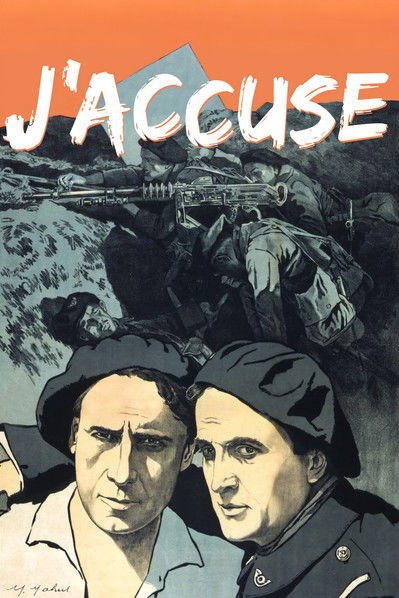
J'Accuse
1919 · Abel Gance
For when you want to feel the weight of history firsthand — a film to watch when you're ready for something demanding, furious, and genuinely haunting rather than a comfortable classic.
What it's about
In a sunlit village in the south of France, a poet loves a woman married to a brutal husband — then the First World War arrives and sends both men to the same trenches. What begins as a love-triangle melodrama becomes a furious indictment of the war itself, made by a director who shot parts of it at the front while the fighting was still going on.
The experience
Startlingly raw for a silent film — the domestic drama has an old-fashioned sweep, but the war sequences hit with documentary force, and the anger underneath keeps building toward images of real visionary power. It leaves you shaken rather than entertained.
The craft
Abel Gance shot with the French army during the war itself, folding real soldiers and real front-line footage into his fiction, and his staging grows increasingly bold as the film's fury mounts. Its most famous passages have a scale and audacity that still land a century later, especially with a good live or recorded score.
Why it matters
Released in 1919 to audiences of survivors and the bereaved, it stands as one of the first great anti-war films — an accusation aimed at the filmmaker's own society, not the enemy — and it made Gance's reputation as silent cinema's great visionary.
Snapshot
Abel Gance began shooting J'Accuse while the Western Front was still killing men and finished it after the Armistice, which means the film occupies a position almost no other work of art holds: it is a war film made inside its war, by a man attached to the army that was fighting it, and released to an audience composed largely of survivors and the bereaved. Its title is borrowed from Zola's 1898 open letter on the Dreyfus Affair — an accusation lodged not against an enemy nation but against one's own society — and that borrowing is the key to the film's peculiar politics. What Gance built around it is a provincial melodrama of the most conventional kind: a poet, a woman, her brutal husband, a triangle in a sunlit Midi village. The war then arrives and grinds the melodrama into something the melodrama cannot contain, and the film's final movement abandons narrative altogether for a vision — the dead of France rising from the battlefields and walking home to ask the living whether their deaths were justified.
That sequence, staged with soldiers on leave from the front, is one of the founding images of European cinema's engagement with mass death. Around it Gance assembled a technical arsenal — rapid montage, superimposition, masking, extreme close-up, real combat footage cut against fiction — that would be refined into La Roue (1923) and Napoléon (1927) but was already, in 1919, unlike anything else in French production. The film was an enormous popular success at home and, championed by D. W. Griffith, reached American screens in a substantially shortened form. It is also, on inspection, a deeply contradictory object: an anti-war film containing atrocity propaganda, made with the cooperation of the army whose war it indicts.
Industry & production
Gance came to J'Accuse through the Société du Film d'Art, the prestige production arm operating within Charles Pathé's orbit, where Louis Nalpas had given him unusual creative latitude on a run of increasingly ambitious features — Mater Dolorosa (1917) and La Dixième Symphonie (1918) among them. Those films made money and made Gance's reputation as French cinema's most technically restless director; J'Accuse was the project on which Pathé let him spend accordingly. It is a Film d'Art production distributed by Pathé, and it was released in France in 1919 in multiple parts, in the episodic exhibition pattern then normal for long French features.
The production's decisive asset was official cooperation. Gance's own war service is a tangled record — he was discharged on health grounds, then attached in 1917 to the Section Cinématographique de l'Armée, the French army's film unit — but the outcome is not in dispute: he had access to matériel, to troops, and, in September 1918, to an actual battle. Gance and his cameramen filmed the Saint-Mihiel offensive alongside American forces, and fragments of that documentary footage are cut into the fiction. Very few narrative films of the period contain photographed combat; fewer still integrate it into a dramatic structure rather than presenting it as attraction.
The other production fact everyone repeats — and it is repeated because Gance himself repeated it, most durably to Kevin Brownlow decades later — concerns the resurrection sequence. The "returning dead" were played by serving French soldiers, granted leave from the front and lent to the production in the hundreds; Gance's account, delivered in old age, was that a large proportion of them were killed in the fighting that followed. The precise numbers are Gance's, not a documented muster roll, and should be held loosely. What is not in doubt is that the men on screen are real soldiers, that they were photographed in the middle of the war that was killing them, and that the sequence's power derives from an audience in 1919 knowing exactly that.
Location work was carried out in the south of France for the village material, with the war scenes drawn from a mix of army terrain, staged battlefields and the Saint-Mihiel footage. The poet Blaise Cendrars — who had lost his right arm at Champagne in 1915 — worked as Gance's assistant on the film and continued with him into La Roue, a collaboration that mattered less for any specific credited task than for the fact that Gance's closest working companion on an anti-war film was a mutilated veteran of it.
Technology
J'Accuse is a silent film shot on orthochromatic nitrate stock with hand-cranked cameras of the type standard in French production of the period — the Debrie Parvo being the workhorse instrument. Orthochromatic emulsion's insensitivity to red is visible throughout: skies blow out, skin tones darken, and the Midi exteriors take on the high-contrast, chalk-and-charcoal look that Gance exploits when the film turns hallucinatory.
Color was applied chemically, as it was on nearly all prestige releases of the era, through tinting and toning of release prints — amber for interiors and sun, blue for night, and the rest of the standard vocabulary. Modern restorations attempt to recover this scheme, and the film's tonal shifts are considerably harder to read in the black-and-white dupes that circulated for decades.
Gance's technical ambition ran mainly to optical and in-camera effects rather than laboratory work: multiple exposure achieved in the camera, masks and mattes cut for the lens, irises, distorting and prismatic elements, and superimpositions layered to a density that French laboratories of 1918 were not routinely asked to support. He was also already thinking about the projection end of the apparatus — the multi-screen Polyvision of Napoléon is eight years off, but the impulse toward an image larger and more assaultive than the standard frame is legible here in the sheer scale of the massed compositions.
For the film's sonic dimension, see below; it is worth noting that Gance's later technological preoccupations ran directly into sound, and that by the mid-1930s he was developing a stereophonic system he called Perspective Sonore with the equipment manufacturer André Debrie — the same technical lineage that had supplied his cameras in 1918.
Technique
Cinematography
Léonce-Henri Burel is the principal cinematographer, working with Marc Bujard and Maurice Forster. Burel is the single most consequential technical collaborator of Gance's silent career — he shot Mater Dolorosa, La Dixième Symphonie, J'Accuse and La Roue — and his later career gives the credit a long echo: he became Robert Bresson's cinematographer on Diary of a Country Priest (1951), A Man Escaped (1956), Pickpocket (1959) and The Trial of Joan of Arc (1962). The austerity Burel achieved for Bresson is not obviously continuous with the pictorialism of 1919, but the underlying discipline — absolute clarity of the human face in a plain frame — is.
The film's photographic register is deliberately split. The village passages are lyrical and painterly: soft-lit interiors, foliage-framed exteriors, the sun used as an active compositional element. The front is flat, gray, cluttered and frequently obscured — smoke, wire, earth. Gance moves between these registers without transition, and the shock of the cut is the argument.
Two devices recur. The first is the extreme close-up, held far longer than French practice of the period generally permitted, isolating hands, eyes, mouths, a dead man's face; Gance uses the enlarged fragment as an accusatory address to the audience. The second is superimposition, deployed not decoratively but as a mode of consciousness — the dead layered over the living, memory ghosting the present frame, the interior life of a character made photographic.
Editing
J'Accuse is where Gance began seriously working out the accelerated montage that would make La Roue a founding text for European editing theory. Sequences build by shortening: shots of six frames, then four, then two, cut against each other until the image becomes rhythm rather than description. The technique is applied to combat, to Jean Diaz's mental collapse, and to the visionary passages, and it does something quite specific — it removes the viewer's ability to locate themselves in space, which is precisely the experience the film is arguing about.
Gance cut with a close hand, and J'Accuse belongs to the beginning of his long working relationship with the editor Marguerite Beaugé, whose collaboration is securely documented on La Roue and Napoléon; the precise division of labor on J'Accuse itself is not something the record settles cleanly, and I won't assign it.
The film's most radical editorial gesture is the juxtaposition of documentary and fiction. Photographed corpses and photographed actors occupy adjacent shots. In 1919 this was not a formal experiment but an ethical one, and it remains the film's most disquieting element.
Mise-en-scène / staging
Gance stages in two incompatible modes. The domestic drama is staged theatrically — proscenium-ish interiors, furniture-anchored blocking, the gestural vocabulary of French stage melodrama. The war material is staged in mass: hundreds of bodies moving through open terrain, arranged for the camera in patterns that read as design rather than as documentary chaos.
The film opens with an emblem of that second mode — soldiers arranged in the landscape so that their massed bodies spell out the title, a living intertitle composed of the men the title is written on behalf of. It states the film's whole method in one image: individual human beings converted into a legible sign.
The resurrection sequence is the culmination. The dead rise from the fields, bandaged, mutilated, moving in loose columns across open country toward the villages they came from — not as monsters but as a census. Gance shoots it in long, wide, slow compositions that let the scale register, then cuts inward to faces. The effect on an audience of 1919 is not difficult to reconstruct.
Sound
J'Accuse is silent, and accompaniment in 1919 was a matter of exhibition rather than authorship — cue sheets, house orchestras, and arrangements varying by venue. I have no confident attribution of a definitive original score to offer and won't invent one. Modern restorations have carried newly composed or compiled scores; the widely circulated restoration issued on disc by Flicker Alley in 2008, drawing on European archival material, carries a score by Robert Israel.
The film's relationship to sound is nonetheless worth noting in two directions. Its rhetoric is fundamentally vocal — the title is a spoken accusation, and Jean Diaz's climactic address is written as oratory, delivered to the camera with intertitles standing in for a voice the technology could not carry. And Gance returned to the material in 1938 with a sound remake, also titled J'Accuse, in which Victor Francen's Jean Diaz summons the dead again — this time as an explicit warning against the war visibly approaching. The 1938 film uses recorded speech to deliver what the 1919 film could only gesture toward, and Gance was by then working with his own stereophonic sound system.
Performance
Séverin-Mars plays François Laurin, the husband — a heavy, brooding, physically imposing performance in a register close to nineteenth-century stage tragedy, and the same instrument Gance would use to shattering effect as Sisif in La Roue. Romuald Joubé plays Jean Diaz, the poet, in a lighter and more interiorized style; the contrast between the two men's acting idioms is itself part of the drama, brute against sensitive. Maryse Dauvray plays Edith, on whom the plot's cruelties are visited, and Maxime Desjardins plays her father, Maria Lazare.
Gance's direction of actors in this period favours held expression over gesture — the camera pushed close and the performer asked to sustain a state rather than illustrate it. Joubé's descent into madness in the final movement is played almost entirely in the eyes, and it is the film's most modern piece of acting. The soldiers, by contrast, are not acting at all, and Gance knows it; he uses their faces as documents.
Narrative & dramatic mode
The structure is melodrama detonated from within. Jean Diaz, a poet, loves Edith, who is married to the coarse and jealous François Laurin. Edith is sent away to her family in Lorraine for safety and falls into German hands; she returns later, having been raped, with a daughter, Angèle. The two rivals meet at the front, where the war strips their antagonism of meaning and converts it into comradeship. François dies. Jean, broken, returns to the village and, in a state of visionary madness, summons the dead of France to come home and judge whether the living have been worthy of them. The dead come. And the film ends with Jean turning his accusation outward past every human agency, arraigning the sun itself for having shone on it.
That final escalation is the film's real dramatic argument. The melodrama supplies a chain of blame — the husband, the lover, the enemy soldier — and the war dissolves each link in turn until there is no available defendant left except creation. It is not a political analysis of the war and does not pretend to be; it is a moral one, and its mode is closer to prophecy than to reportage.
The plotting is unashamedly of its period: coincidence, symbol, a woman's violated body used as a national allegory. Modern viewers generally find the first two-thirds creaky and the last third overwhelming, which is a fair reaction and also somewhat misses how the machinery works — the visionary ending lands because the preceding melodrama has trained us to expect resolution on a human scale, and then refuses it.
Genre & cycle
J'Accuse stands at the head of the narrative war film as a form. Wartime production across Europe and America had been dominated by propaganda shorts, newsreels, patriotic serials and atrocity pictures; Gance's film takes the raw material of that production — including its atrocity conventions — and turns it toward mourning. It is simultaneously the last of the wartime films and the first of the post-war ones.
Its immediate cycle is the great international run of Great War features that followed through the 1920s and into the 1930s: King Vidor's The Big Parade (1925), Lewis Milestone's All Quiet on the Western Front (1930), G. W. Pabst's Westfront 1918 (1930), Raymond Bernard's Les Croix de bois (1932), Jean Renoir's La Grande Illusion (1937). Within French cinema specifically, J'Accuse and Les Croix de bois frame the national argument about the war, the first mystical and the second documentary-realist.
It also belongs to a smaller and stranger cycle: films in which the war dead return. Gance's own 1938 remake is the direct descendant, and the motif recurs, transformed, across a century of French cinema concerned with the disparus of 1914–18 — Bertrand Tavernier's La Vie et rien d'autre (1989) among the most direct inheritors of its central conceit that the dead have unfinished business with the living.
Authorship & method
Gance (1889–1981) is the auteur case pushed to its limit: a director whose films are inseparable from an appetite for scale, technical invention and prophetic self-conception that his industry could rarely finance and frequently punished. J'Accuse is the first film in which the mature method is fully visible — enormous ambition attached to material of frank sentimentality, technical experiment used as emotional amplification rather than as distancing, and a habit of escalating from the domestic to the cosmic in a single move.
His method was accretive and improvisatory within a fixed emotional design. He wrote his own scenario and intertitles, worked closely and continuously with his cameramen on effects that had to be achieved in-camera, and built sequences in the cutting room by rhythm. He was also, by every account, a director who talked — to actors, to soldiers, to producers — in the register of a man convinced he was making something world-historical.
The key collaborators are worth naming precisely. Léonce-Henri Burel (cinematography) supplied the photographic intelligence of Gance's entire silent period and carried it forward to Bresson. Blaise Cendrars (assistant), the amputee poet, connects the film to the literary avant-garde and to the war's physical reality at once. Marguerite Beaugé (editing) becomes, across the following decade, the technician through whom Gance's montage theories were actually realized. Séverin-Mars (performance) is the tragic mass at the center of both this film and La Roue, and he died in 1921, shortly after completing the latter. Music is the one department where the 1919 authorship cannot be assigned, for the structural reason that silent-film scoring was not yet an authored function.
Movement / national cinema
J'Accuse is a foundational and slightly awkward member of the French Impressionist school — the "first avant-garde" — that cohered around 1918–24 in the work of Gance, Louis Delluc, Germaine Dulac, Marcel L'Herbier and Jean Epstein. The movement's central concern, theorized by Delluc and Epstein under the term photogénie, was the camera's capacity to reveal a quality in things unavailable to ordinary perception, and its central technical project was the rendering of subjective states — memory, obsession, delirium — through superimposition, distortion, rhythm and the close-up.
Gance fits that program exactly at the level of technique and sits awkwardly inside it at the level of taste. The Impressionists were, broadly, a movement of aesthetic refinement working within commercial French production; Gance was a maximalist with a taste for the biblical. Delluc and his circle admired Gance's technical audacity and were not uniformly persuaded by his sensibility, a critical ambivalence that has followed the films ever since.
Institutionally, the film belongs to French cinema's attempt to reconstitute itself after the war had destroyed its pre-1914 global dominance. Pathé and Gaumont had been the world's dominant film companies in 1913; by 1919 American production had taken the international market, and prestige spectacle of the J'Accuse kind was part of a national industrial answer to that loss — an answer that would run through La Roue, L'Herbier's L'Inhumaine (1924) and, ruinously, Napoléon.
Era / period
The film's date is its meaning. Shot across 1918 and released in 1919, it addresses an audience for whom the war was not history but an open wound with an unfinished accounting: roughly 1.4 million French dead, whole cohorts of young men absent from villages exactly like the one Gance films, and a national ritual of commemoration — monuments aux morts in every commune — only just beginning. The returning dead were not a metaphor in 1919. They were the subject of séances, of legal disputes over the missing, of a mass grief without established form.
The film's politics belong to that moment and are not tidy. It was made with army cooperation, and it retains the wartime iconography of German atrocity — Edith's rape by enemy soldiers is presented in the register of the propaganda that had justified the war effort. Scholars including Richard Abel and Norman King have set out the resulting incoherence carefully: an accusation aimed at war in general, delivered through imagery that indicts a particular enemy, produced by an apparatus with an interest in the outcome. Gance's own later remake resolved the ambiguity in favour of pacifism, but the 1919 film does not.
Themes
Accusation without a defendant. The Zola title promises a named target. The film systematically removes every candidate — the rival, the enemy, the state — until Jean can only accuse the sun. This is either the film's failure of political nerve or its deepest insight, and the critical literature has argued both.
The debt of the living. The resurrection sequence is structured as an audit: the dead return not to avenge themselves but to ask whether their sacrifice was matched by the conduct of those who survived. The villagers' shame is the film's moral center, and it anticipates the entire twentieth-century discourse of commemoration and its inadequacy.
Poet and brute. The Diaz/Laurin opposition begins as melodramatic shorthand and becomes something more interesting: the war destroys both, and the film declines to award sensitivity any protective privilege. Their reconciliation at the front is the only unambiguous good the film locates in the experience.
The violated body as nation. Edith's rape and her resulting child function allegorically in a way that is now difficult to read charitably, and that was entirely conventional in 1919. The film's treatment of her is the element that has aged worst, and it is inseparable from the propaganda vocabulary the film otherwise wants to escape.
Vision as testimony. Jean's madness is the film's epistemology. Only a broken mind can perceive the scale of what has happened; sanity, in J'Accuse, is a failure of imagination. This is a Romantic proposition, and Gance is a Romantic.
Reception, canon & influence
The film was a major popular and critical success in France on release and established Gance internationally. Its reception was inflected by the circumstances of its viewing — an audience of veterans and mourners — and contemporary accounts describe strong emotional reaction to the resurrection sequence in particular. D. W. Griffith saw it, admired it, and was instrumental in its American distribution through United Artists in the early 1920s; the version that reached American screens was shortened substantially, and Anglophone assessment of the film was for decades based on truncated material.
Backward, the film's inheritances are legible. From Griffith, Gance took the parallel montage of The Birth of a Nation (1915) and Intolerance (1916), the enormous crowd tableau, and the license to build a national argument out of a domestic melodrama — Gance's debt to Griffith is acknowledged and structural. From French stage melodrama and the film d'art tradition he took the triangle plot, the acting idiom and the moral schematism. From Zola he took the title and the posture of the individual writer arraigning the collective. From wartime documentary and the Section Cinématographique he took the photographic evidence.
Forward, its influence runs along several channels. Within Gance's own work it is the laboratory for La Roue (1923), whose accelerated montage was studied closely by the Soviet directors and by Jean Mitry, and for Napoléon (1927). Within the war film it establishes the terms — the sunlit before, the gray during, the unassimilable after — that the 1930s cycle inherits and refines. Its resurrection sequence has been quoted, adapted and argued with ever since, most directly by Gance himself in 1938, and it remains the standard reference point for cinema's attempts to make the war dead visible.
Critically, the film has been recovered in stages. Kevin Brownlow's decades-long advocacy for Gance — the interviews, the Napoléon restoration — reopened the silent work to English-language audiences; Richard Abel's French Cinema: The First Wave, 1915–1929 (1984) placed J'Accuse precisely within Impressionist production; Norman King's Abel Gance: A Politics of Spectacle (1984) supplied the ideological reading that treats the film's contradictions as its subject rather than its flaw. Archival restoration work, including material held in Dutch and French collections and the version issued in 2008 on disc with Robert Israel's score, has made a long and reasonably coherent J'Accuse available for the first time in generations.
The film's standing today is secure but qualified. It is not watched for its plot, which is creaky, or for its politics, which are compromised. It is watched because a director stood in a field in 1918 with several hundred soldiers who were about to be killed, asked them to play their own corpses, and produced an image that the twentieth century never managed to get past.
A Deleuzian reading
The men who rise out of the ground in the last act of *J'Accuse* are not extras.
The full Deleuzian reading of J'Accuse →
Reception
A sensation in 1919 France — audiences who had just lived the war wept through it, and it made Gance's name internationally. Today it's overshadowed by his own Napoléon, but the 2008 restoration re-established it as the first great anti-war film, made before the war it condemns had even ended.
How J'Accuse was received, from release to now →
How to watch J'Accuse: what to notice on a first viewing
- Notice how different the village scenes look from the front. The village is shot soft and sunlit, foliage framing warm interiors, while the front is flat, gray, and cluttered with smoke and wire. Gance never eases you between the two worlds. The jump between them is the point, not a mistake.
- Watch the cutting speed up as combat scenes proceed. Gance shortens shots from six frames to four to two, until the images stop reading as pictures and start reading as pure rhythm. The faster the cutting gets, the less you can tell where you are, which is the sensation of combat itself.
- Watch how long the camera holds on a single face. Gance holds extreme close-ups on hands, eyes, and mouths far longer than French films of the period generally allowed. The held face stops being information and starts feeling like something aimed straight at you.
- Watch how differently Séverin-Mars and Joubé carry their bodies. Séverin-Mars plays the husband heavy and brooding, in the register of stage tragedy, while Joubé plays the poet lighter and more interior. The two styles of acting stand for two ways of being a man, brute force against sensitivity.
- Watch the opening shot of soldiers arranged into the film's title. Gance opens with massed soldiers' bodies spelling out the word J'Accuse, turning the men into the letters of the accusation itself. Before the story even starts, the film has already turned real men into a message.
The whole guide to watching J'Accuse, with the keys for a rewatch →
Influences: the films it descends from and the films it influenced
- L'Assassinat du duc de Guise (1908) — The film d'art template Gance works inside — Comédie-Française tragedians playing in sustained full-figure tableaux against painted depth, with a commissioned symphonic score — supplying the declamatory gestural idiom Séverin-Mars uses and the moral schematism of the triangle plot.
- The Birth of a Nation (1915) — Gance takes Griffith's accelerating cross-cut rescue structure and the massed battlefield tableau staged in depth, and with them the license to argue a national case entirely through a village love triangle.
- La Folie du Docteur Tube (1915) — Gance's own optical laboratory — distorting mirrors and lens deformations achieved wholly in camera on set with the operator rather than in a lab — establishing the working method that J'Accuse extends into superimposed ghost armies and hallucinated skulls.
- Intolerance (1916) — The four-strand parallel construction whose shot lengths shorten toward a converging climax, plus crowd choreography by the hundreds, which Gance rebuilds as the sunlit-village / trench / resurrection alternation.
- Civilization (1916) — The immediate precedent for staging the war dead as accusers — a resurrected Christ walks the warmaking king through fields of corpses to indict him — a moral machine Gance secularizes by sending the dead back to their own village to judge the living.
- The Battle of the Somme (1916) — Made front-line actuality photography (staged 'over the top' shot included) a mass vernacular with its own grain and grayness, which Gance cuts directly against his fiction so that Section Cinématographique material authenticates the melodrama around it.
- Mater Dolorosa (1917) — The first sustained Gance–Léonce-Henri Burel collaboration: low-key chiaroscuro and the hard orthochromatic modeling of a face isolated against black, a lighting scheme carried unchanged into J'Accuse's close-ups.
- La Roue (1923) — The direct continuation of the cutting-room method: the rhythmic accelerated montage roughed out in J'Accuse is pushed to two- and one-frame bursts, and it is this refinement that Eisenstein, Kuleshov and Jean Mitry studied as a system.
- The Big Parade (1925) — Codifies the three-part shape J'Accuse invented — sunlit civilian before, gray attritional during, unassimilable maimed return — and stages the advance into fire as a metronomic walking rhythm, mass movement timed like cutting.
- Napoléon (1927) — Scales J'Accuse's devices to the limit: crowd handled as a single choreographed organism, in-camera multiple exposure layered many deep, and text made physical — the human/typographic intertitle sequences grown directly out of the 1919 experiments.
- Verdun, visions d'histoire (1928) — Literalises Gance's production gamble — reenactment shot on the actual Verdun ground with surviving veterans playing themselves, cut against archival footage of the battle they are re-fighting.
- All Quiet on the Western Front (1930) — Ends with the dead superimposed as a marching column that turns to look back at the camera — a direct restaging of Gance's returning dead — with the indictment aimed at the schoolmaster who supplied the recruits.
- Les Croix de bois (1932) — Casts surviving poilus to play their own war as a production principle, and stages the ranks of the dead rising over the field in vision — Gance's non-professional-soldier casting and resurrection imagery adopted wholesale into the sound era.
- J'accuse (1938) — Gance's own sound remake re-shoots the resurrection with the gueules cassées — real facially mutilated veterans — substituted for the 1918 conscripts, arguing with his earlier image by replacing simulated horror with surviving disfigurement.
- Paths of Glory (1957) — Inherits the accusation-against-one's-own-society structure — the antagonist is the French command, tried and answered through a court-martial and execution — and converts Gance's advance-into-fire staging into the unbroken backward tracking shot down the trench.
- Hearts of the World (1918) — Griffith likewise welded footage shot at and near the French front into a village-romance melodrama, making the two films the paired Franco-American test of whether documentary material can be metabolized by fiction — Griffith then pushed J'Accuse into United Artists distribution.
- Cœur fidèle (1923) — The Impressionist parallel case: superimposition and rapid montage deployed to render a character's interior state rather than an event, with the extreme close-up of a face treated as the basic expressive unit.
- La Passion de Jeanne d'Arc (1928) — Builds an entire film from the extreme close-up on unmade-up faces shot on hard stock, so that the face carries the argument the intertitle would otherwise state — the logic of Gance's accusing close-ups made total.
Similar films
- The Birth of a Nation (1915) — influence & lineage · often watched together
- Napoleon (1927) — influence & lineage · often watched together
- The Passion of Joan of Arc (1928) — influence & lineage · often watched together
- All Quiet on the Western Front (1930) — influence & lineage
- Paths of Glory (1957) — influence & lineage
- Muriel, or the Time of Return (1963) — same viewing thread
- La Roue (1923) — influence & lineage · often watched together
- Intolerance: Love's Struggle Throughout the Ages (1916) — often watched together
All the films related to J'Accuse →
Watch it with: curated runs of related films
- Death and the French Auteur — A run of French art films where a sensitive man — an aging poet, a recovering drinker, a screenwriter, a war-haunted soldier — drifts through a world already tilting toward death.