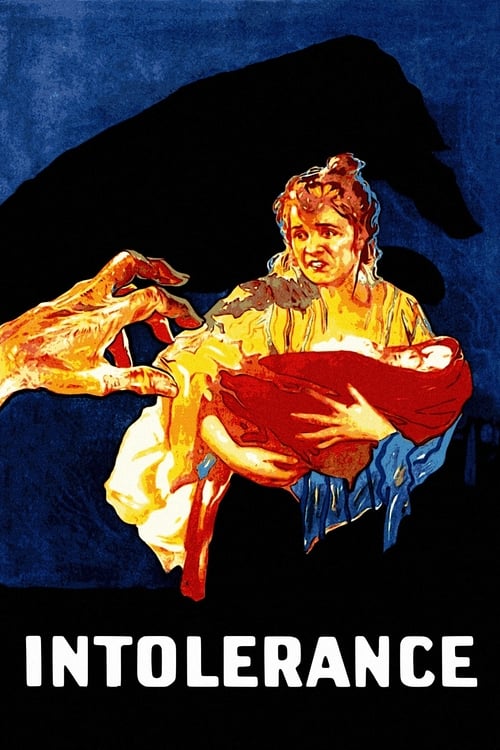
Intolerance: Love's Struggle Throughout the Ages
1916 · D.W. Griffith
For when you're in the mood for a monument — an event-viewing night, ideally with the best screen you have and some commitment. Challenge viewing that repays it with moments of honest wonder.
What it's about
Four stories from four eras — the fall of ancient Babylon, the Passion of Christ, the massacre of French Protestants in 1572, and a modern American tale of a poor young couple torn apart by moralizing reformers and a wrongful conviction — braided into one colossal epic about cruelty committed in the name of righteousness. The film cuts between centuries as if they were happening at once.
The experience
Genuinely awe-inspiring even a century on — the Babylon sequences, with their mountainous sets and armies of extras, still drop jaws, while the modern story builds to real last-minute suspense. It's long and demands patience, but it moves with surprising force.
Performances
Mae Marsh, as the young wife of the modern story, gives the film its beating heart — her courtroom scenes are among the most affecting acting of the silent era.
The craft
The intercutting of four timelines — accelerating as all four races toward their climaxes — was radically ahead of its time, and the Babylon set remains one of the most enormous ever built for a film. Its scale genuinely rewards the biggest screen you can find.
Why it matters
A spectacular commercial failure that nearly ruined Griffith, it nonetheless taught generations of filmmakers — the Soviet montage pioneers studied it obsessively — how editing itself could carry meaning.
Snapshot
Intolerance is D.W. Griffith's colossal four-part epic, a film of staggering ambition that interweaves four stories from different historical eras to dramatize the recurring human capacity for cruelty in the name of righteousness. Released in 1916, roughly a year after The Birth of a Nation, it represents both the apex of Griffith's silent-era achievement and one of cinema's most spectacular commercial failures. Where The Birth of a Nation had been a focused (and notoriously racist) narrative, Intolerance is structurally radical: it cross-cuts among the fall of Babylon, the Passion of Christ, the St. Bartholomew's Day Massacre of French Huguenots in 1572, and a contemporary American melodrama of labor strife, wrongful conviction, and social reformers. These strands are bound by Lillian Gish's recurring image of a woman rocking a cradle — "the cradle endlessly rocking," borrowed from Whitman — a visual refrain meant to figure the continuity of humanity across the ages. The film is most famous for its monumental Babylonian set and for an editing strategy that, in its climax, accelerates all four eras toward simultaneous crisis. It is widely regarded as a foundational work of cinematic form, even as its narrative coherence has been debated for over a century.
Industry & production
Intolerance was produced in the formative years of the Hollywood feature film, when Griffith stood as the American cinema's most prestigious and bankable director, flush with the unprecedented success of The Birth of a Nation (1915). That earlier film's profits — though exact figures are not reliably documented — gave Griffith the leverage and capital to mount an even more extravagant production. The project reportedly grew out of a contemporary social drama Griffith had been developing (often called The Mother and the Law), which he expanded into the multi-era epic after being stung by criticism of The Birth of a Nation's racism; Intolerance is frequently read, at least in part, as his response to those who had attacked him as intolerant.
Griffith financed the film heavily through his own resources and outside investment, and the production became legendary for its scale and cost. The Babylonian set built in Los Angeles — with its towering walls, elephant-topped columns, and vast courts — was among the largest constructed for an American film to that date. Contemporary and later accounts describe enormous numbers of extras and an extended shooting and assembly period. Precise budget and box-office numbers vary widely across sources and should be treated cautiously, but the consensus of film history is unambiguous: the film cost a fortune, underperformed badly at the box office, and left Griffith in financial difficulty for years. Its commercial failure is often cited as a turning point that constrained his subsequent independence within an industry rapidly consolidating into the studio system. Griffith later re-cut and released the modern and Babylonian stories as separate features (The Mother and the Law and The Fall of Babylon) in an effort to recoup losses.
Technology
Intolerance was made on orthochromatic black-and-white film stock, hand-cranked cameras, and the silent-era exhibition apparatus of projection accompanied by live music. Like most prestige films of the period, it circulated in prints that were frequently tinted and toned — different color washes keyed to mood and setting (warm tones for interiors or fire, blue for night), a standard practice that gave silent audiences a far more chromatic experience than surviving black-and-white prints suggest. The film's surviving versions vary, and because Griffith continued to alter it, no single definitive original cut exists; modern restorations have had to reconstruct the film from multiple sources, and any account of its "original" form carries that caveat.
The film's most conspicuous technological feats were achievements of scale and camera mobility rather than of any single new device. The celebrated crane-and-tracking shot sweeping across the Babylonian court is the signature instance: to achieve the gliding descent over the massive set, Griffith and his collaborators reportedly constructed an elaborate elevator-and-track rig — effectively a purpose-built camera platform — to carry the camera through space. The specific engineering is described variously in different histories, so the precise mechanism is best stated in general terms, but the resulting shot was unprecedented in American cinema for its combination of altitude, breadth, and movement.
Technique
Cinematography
The cinematography is credited principally to G.W. "Billy" Bitzer, Griffith's longtime collaborator and the man most responsible for translating Griffith's conceptions into images. (Karl Brown, later a cinematographer and memoirist in his own right, worked as Bitzer's assistant on the production and is an important firsthand source for accounts of the shoot.) The film's visual achievement lies in its range: intimate close-ups in the modern story, vast deep-staged spectacle in Babylon, and the famous mobile camera that descends over the Babylonian feast. Bitzer's work demonstrated the expressive flexibility Griffith had been developing across his Biograph years — the iris-in and iris-out to direct attention, soft framing and vignetting around faces, and the careful modulation of scale between the human and the monumental. The contrast between the enormous Babylonian compositions and the tight, emotionally legible framing of the modern story is itself a deliberate rhetorical device.
Editing
Editing is the dimension on which Intolerance's historical reputation most rests. The film is organized around parallel montage on an epic scale: rather than cross-cutting within a single scene or narrative line, Griffith cross-cuts among four entirely separate stories set centuries apart. As the film builds, the rhythm of intercutting between eras quickens, so that in the climactic movement the modern race-to-the-rescue, the fall of Babylon, the road to Calvary, and the massacre of the Huguenots are braided together at accelerating tempo, their disparate crises made to rhyme through cutting alone. This was a radical extension of the parallel-editing techniques Griffith had refined in his short films, and it pushed the principle to a near-abstract limit: the unifying logic is thematic and emotional rather than spatial or causal. The approach proved enormously influential on later filmmakers' understanding of montage, even as many contemporary viewers found the constant temporal leaping confusing. The cradle image recurs as a punctuating shot, a fixed point of return amid the acceleration.
Mise-en-scène / staging
The film's mise-en-scène is defined by the tension between spectacle and intimacy. The Babylonian sequences are staged in genuine depth, with action distributed across foreground, middle ground, and background of immense sets, populated by large crowds whose movement gives the architecture scale. The staging emphasizes the vertical and the monumental — great walls, broad ceremonial stairways, the celebrated columns. By contrast, the modern story is staged in the cramped, naturalistic spaces of tenements, factories, and courtrooms, its drama carried by the placement and gesture of a few figures. The historical interludes (the Judean and French episodes) are comparatively brief and function more as illustrative refrains than as fully developed lines of action. Throughout, Griffith uses the contrast of register — enormous versus enclosed — to underline his moral argument that the same human passions play out at every scale of history.
Sound
Intolerance is a silent film and was exhibited with live musical accompaniment. For its prestige roadshow presentation, an elaborate score was compiled and arranged (the music for these big Griffith releases drew on existing classical and popular pieces fitted to the action, in the manner of the period's large-scale silent presentations). Because performance practice varied from venue to venue and the original presentation materials survive imperfectly, the precise content of the score as heard in 1916 cannot be reconstructed with full confidence; modern restorations and home-video editions carry reconstructed or newly composed scores. As with all silent cinema, music was integral to the intended experience rather than incidental to it.
Performance
The acting blends the broad, legible expressiveness of the period with moments of remarkable naturalism, particularly in the modern story. Mae Marsh as the Dear One and Robert Harron as her wrongly condemned husband give performances often singled out for their emotional immediacy; Marsh's reactions in the trial and prison sequences are among the most praised pieces of acting in early American cinema. Constance Talmadge brings vigor and charm to the Mountain Girl of the Babylonian story. Lillian Gish appears in the framing device as the woman at the cradle — a symbolic rather than dramatic role. Griffith's method, honed at Biograph, favored restraint and detailed facial expression over the larger theatrical gesturing common in much contemporaneous film, and Intolerance shows that approach applied to a cast managing both intimate scenes and crowd spectacle.
Narrative & dramatic mode
The film's dramatic mode is at once melodramatic and essayistic. Each of the four stories operates in the register of moral melodrama — innocents threatened, love imperiled, injustice and rescue — but the architecture that binds them is closer to an illustrated thesis: a sermon, in moving images, on the destructiveness of intolerance across human history. This is the film's most distinctive and most contested feature. By refusing a single continuous plot in favor of four parallel exempla, Griffith asks the audience to read across the stories thematically, to grasp the pattern rather than follow one fate. Contemporary audiences accustomed to linear narrative often found this structure bewildering, and critics have long divided over whether the cross-cutting produces genuine cumulative power or diffuses dramatic involvement. What is not in dispute is the ambition: Intolerance attempts to make montage itself carry an argument about history, using the juxtaposition of eras as its central rhetorical instrument.
Genre & cycle
Intolerance belongs to the historical epic and the social-problem film simultaneously, and it sits within the early-feature cycle of monumental historical spectacle that flourished in the mid-1910s. Italian super-productions such as Cabiria (1914) are widely credited as a direct spur to the scale and ambition of Griffith's Babylonian sequences, part of an international vogue for ancient-world spectacle. At the same time, the modern story participates in the era's social-conscience cinema, with its concern for labor conflict, poverty, capital punishment, and the coercive overreach of moral reformers. By fusing the grand historical epic with topical social melodrama under a single thematic banner, the film stands somewhat apart from any one cycle — an outsized, hybrid work that few imitators attempted to replicate at the same scale.
Authorship & method
Intolerance is in every sense an auteur production, conceived, financed, and controlled by Griffith, who is often described as having worked without a conventional shooting script, holding the vast structure in his head and directing the enormous enterprise through improvisation and force of will. His key collaborators were central to its realization. G.W. Bitzer, the cinematographer, was Griffith's indispensable technical partner across his most important work. Karl Brown, Bitzer's young assistant, later left a valuable firsthand memoir of the production. The editing — the film's defining achievement — was overseen by Griffith with the assistance of editors who would go on to significant careers; James Smith and Rose Smith are credited among those associated with the cutting of Griffith's films of this period, though the granular division of labor on so monumental a cut is not fully documented. For the music of the roadshow presentation, Joseph Carl Breil — who had worked on The Birth of a Nation — is associated with the score's preparation, in keeping with the compiled-score practice of the era. The screenplay credit belongs to Griffith himself; the modern story drew on his earlier scenario, and the historical episodes were researched from period sources, though Griffith took considerable dramatic license. The method was that of a single controlling vision marshaling immense resources — the model of the director as both artist and impresario.
Movement / national cinema
The film is a landmark of American cinema in the silent era and a foundational text of what would become Hollywood, made at the moment the American film industry was establishing itself as the dominant force in world cinema. Yet its influence ran in a direction that crossed national boundaries in unexpected ways. Intolerance arrived in the new Soviet Union in the early 1920s and made a profound impression on the founders of Soviet montage. Filmmakers and theorists including Sergei Eisenstein and Vsevolod Pudovkin studied Griffith intently; the Soviet montage movement absorbed his parallel-editing techniques and reworked them into a more dialectical, theoretically explicit conception of editing. In this sense Intolerance, though wholly a product of American commercial cinema, became a crucial point of departure for the most influential avant-garde editing movement of the 1920s — a striking instance of cross-national transmission.
Era / period
Intolerance is a product of the mid-1910s, the period in which the feature-length film matured and the American industry shifted from short subjects toward ambitious, prestige-length productions. It belongs to the years just before the consolidation of the studio system, when a single powerful director could still mount an independent production of enormous scale. The film also reflects its immediate historical moment in subtler ways: its theme of tolerance and its anti-war undercurrents resonate with a period overshadowed by the First World War then raging in Europe, and its modern story engages the social anxieties of Progressive-era America — industrial labor conflict, urban poverty, and the activities of moral-reform movements. The film stands as a high-water mark of pre-classical American cinema, made just before the conventions of classical Hollywood storytelling fully crystallized.
Themes
The film's governing theme is announced in its title: intolerance, understood as the persistent human impulse to persecute others in the name of virtue, order, or faith. Across its four eras Griffith dramatizes how self-appointed guardians of righteousness inflict suffering — the priestly intrigue that brings down Babylon, the persecution that leads to the Crucifixion, the religious fanaticism of the St. Bartholomew's Day Massacre, and the sanctimonious reformers and rigid justice of the modern story. A pointed secondary theme is the hypocrisy of moralizing reformers, particularly the "Vestal Virgins of Uplift" of the modern episode, whose meddling philanthropy destroys the very families it claims to save — a barbed critique with clear contemporary targets. Binding all of this is a meditation on historical continuity, embodied in the rocking cradle and its Whitmanian refrain: the conviction that love and cruelty recur eternally, that the same struggle is fought in every age. Underlying the whole is an implicit plea for tolerance and human sympathy — and, given its wartime moment, an undercurrent of pacifism.
Reception, canon & influence
On release, Intolerance drew admiration for its spectacle and audacity but failed to find a wide audience, and it became one of the most famous commercial disappointments of early Hollywood. Accounts generally attribute its failure to the difficulty audiences had with its fragmented four-era structure, its great length, and possibly its sober thematic ambition; specific receipts vary across sources and are not securely documented, but the film's financial damage to Griffith is well attested. Critical estimation, however, rose over time, and Intolerance came to be regarded as one of the central monuments of silent cinema and a foundational work in the history of film editing.
The influences on the film are clearest in its spectacle: the Italian historical epics of the early 1910s, Cabiria foremost among them, helped inspire the scale of its Babylonian sequences, and Griffith's own decade of innovation in the Biograph shorts furnished the editing grammar he now expanded to epic dimensions. Walt Whitman's Leaves of Grass supplied the cradle motif and its incantatory refrain.
The film's influence forward has been immense and is felt above all through the Soviet montage filmmakers, who studied Griffith's parallel cutting and built their own theories of editing in dialogue with it; through this channel Intolerance shaped the course of film theory and practice far beyond America. Its conception of cross-cutting toward a unified climax became part of the basic vocabulary of narrative cinema. The film has been a fixture of critical canons and historical surveys throughout the twentieth and twenty-first centuries, regularly cited as one of the most ambitious and formally important films of the silent era. Its legacy is double-edged: a financial catastrophe that nonetheless permanently enlarged the expressive possibilities of the medium, and a film whose reputation rests less on the success of its grand thesis than on the revolutionary power of the technique with which Griffith pursued it.
A Deleuzian reading
A woman rocks a cradle.
The full Deleuzian reading of Intolerance: Love's Struggle Throughout the Ages →
Reception
A commercial disappointment in 1916 that nearly ruined Griffith — audiences found its four intercut storylines bewildering — it's now enshrined as one of silent cinema's supreme achievements, the film that taught the Soviet montage school (Eisenstein and company studied it obsessively) how editing could think.
How Intolerance: Love's Struggle Throughout the Ages was received, from release to now →
Influences: the films it descends from and the films it influenced
- Cabiria (1914) — Its slow tracking 'Cabiria movement'—a dolly gliding through vast three-dimensional architecture—directly modeled the elevated crane and tracking shots Griffith sends descending over the Babylonian court.
- The Birth of a Nation (1915) — Griffith's own preceding feature, whose last-minute-rescue accelerated crosscut climax he multiplied here into four eras cut in simultaneous parallel toward one convergence.
- A Corner in Wheat (1909) — This Biograph short's parallel cutting between the gorging wheat speculator and the starving bread-line is the embryo of Intolerance's essayistic, editing-as-social-argument montage.
- The Lonedale Operator (1911) — Perfected the accelerated rescue crosscut—progressively shortening shot durations as the climax nears—the durational technique scaled up across Intolerance's converging finales.
- Judith of Bethulia (1914) — Griffith's first feature, his initial experiment in massing extras and biblical-epic spectacle that the Babylonian episode expands to monumental scale.
- Quo Vadis? (1913) — Italian super-spectacle whose monumental built sets and choreographed crowd scenes established the template of epic constructed environments behind Babylon's walls.
- Battleship Potemkin (1925) — The Odessa Steps sequence rebuilds Griffith's suspense crosscutting into collision montage, converting rescue tension into dialectical graphic conflict between shots.
- Strike (1925) — Its intellectual montage—the slaughterhouse intercut with the massacre of workers—extends Griffith's metaphoric parallel cutting into pure conceptual juxtaposition.
- Mother (1926) — Pudovkin derived his 'linkage' editing theory from close study of Griffith, and the ice-floe rescue crosscut openly reworks Griffith's accelerating-parallel climax.
- October (1928) — Essayistic intellectual montage as outright thesis-by-editing—the direct theoretical heir to Intolerance's conception of cutting as historical argument.
- Napoléon (1927) — Pushes Griffith's accelerated cutting and epic spectacle to delirium through ultra-rapid montage and triptych superimposition in the Polyvision finale.
- Metropolis (1927) — Weds monumental constructed-set spectacle to a didactic social-problem allegory of capital versus labor, inheriting Intolerance's fusion of scale and thesis.
- The Godfather Part II (1974) — Intercuts two time periods in sustained parallel toward a unified moral indictment, extending Intolerance's cross-temporal montage into character tragedy.
- The Fountain (2006) — Braids three eras together with a recurring linking image bridging the cuts, a direct structural descendant of the four-era weave and its connective motif.
- Cloud Atlas (2012) — Accelerated-crosscuts six eras toward a single shared thematic climax—the most literal modern revival of Intolerance's parallel-ages architecture.
- The Tree of Life (2011) — Essayistic non-linear intercutting across cosmic time scales, bound by an incantatory recurring motif that functions exactly as Intolerance's rocking-cradle refrain.
- Way Down East (1920) — Griffith's own continued mastery of the accelerating rescue crosscut, the ice-floe climax being a sibling exercise in the same convergence-cutting grammar.
Similar films
- The Birth of a Nation (1915) — influence & lineage · often watched together
- Battleship Potemkin (1925) — influence & lineage · often watched together
- Napoleon (1927) — influence & lineage · often watched together
- The Tree of Life (2011) — influence & lineage
- Metropolis (1927) — influence & lineage
- Modern Times (1936) — often watched together
- J'Accuse (1919) — often watched together
- The Last Laugh (1924) — often watched together
All the films related to Intolerance: Love's Struggle Throughout the Ages →