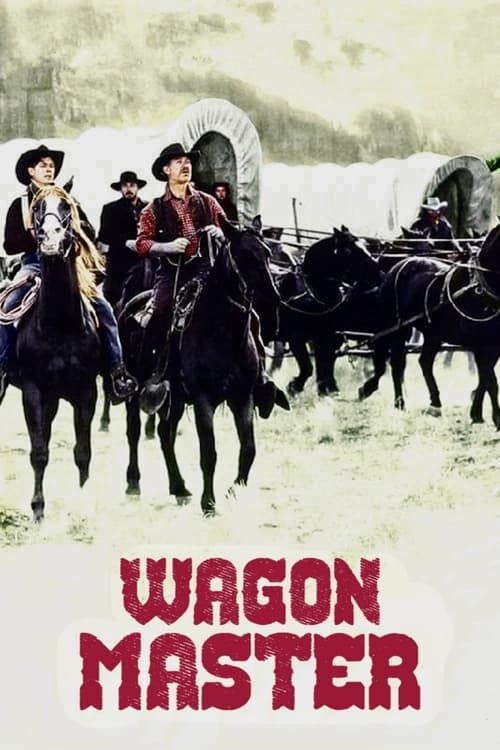
Wagon Master
1950 · John Ford
For an unhurried evening when you want something humane and restorative — comfort viewing with craft, the film equivalent of a long walk at golden hour.
What it's about
Two easygoing young horse traders sign on to guide a Mormon wagon train across rugged desert country to the San Juan Valley. Along the trail the company takes in a stranded medicine-show troupe, passes through Navajo land, and is latched onto by the Clegg gang, a family of outlaws whose threat hangs over the train like weather. The journey itself — river crossings, work, song, and slowly forged trust — is the story.
The experience
Relaxed, warm, and quietly beautiful — less a shoot-em-up than a trail ballad, carried along by music and motion, with menace kept simmering at the edges. It's the kind of western that feels like good company.
Performances
Ben Johnson, a real-life rodeo champion, is wonderfully natural as Travis Blue — his horsemanship and easy, unforced decency made him one of the most authentic presences the western ever had, with Harry Carey Jr. an amiable match beside him.
The craft
John Ford shot it small, cheap, and fast in the Utah desert, and the modesty is the beauty: wagons against rock and sky, river crossings staged like folk memory, the whole thing stitched together with song. It's plain-spoken visual poetry that rewards a big screen more than its scale suggests.
Why it matters
The film Ford himself called closest to his own intentions, it later inspired a hit television series and stands as a touchstone for the western as community-building rather than gunfighting.
Snapshot
Wagon Master is the film John Ford made when nobody was watching — small, cheap, starless, shot fast in the Utah desert between two prestige projects — and it is the one he repeatedly named as closest to his own intentions. Two itinerant horse traders, Travis Blue (Ben Johnson) and Sandy Owens (Harry Carey Jr.), are hired to guide a Mormon wagon train toward the San Juan valley. Along the way the company absorbs a stranded medicine-show troupe, passes through Navajo country, and is parasitized by the Clegg family, outlaws who attach themselves to the train under a threat of violence that is never quite spoken aloud. That is the whole plot. What fills the ninety-odd minutes is movement, weather, work, song, and the slow constitution of a community out of people the settled world has expelled.
The film is best understood as Ford's ballad — literally, since Stan Jones's songs, sung by the Sons of the Pioneers, carry much of the narrative burden that dialogue would ordinarily bear. It abandons the cavalry pageantry and the psychological darkening that were becoming the Western's twin fashions in 1950, and substitutes something closer to folk art: episodic, unhurried, resolutely unpsychological, more interested in a river crossing or a square dance than in a showdown. The showdown, when it finally comes, is over in seconds and is filmed almost as an embarrassment. Commercially it went largely unnoticed. Critically it has become, for a certain kind of viewer, the Ford film — the one that shows what his cinema looks like with the plot machinery stripped away.
Industry & production
Wagon Master was produced by Argosy Pictures, the independent company Ford had formed with Merian C. Cooper, and released through RKO Radio Pictures in the spring of 1950. Argosy's postwar model — an autonomous production entity financing pictures and negotiating distribution — was emblematic of the era's structural loosening: the 1948 Paramount consent decrees were dismantling the studios' theatrical monopolies, and top-tier directors were increasingly incorporating themselves. That autonomy cut both ways. Argosy's expensive art film The Fugitive (1947) had failed badly; the cavalry pictures Fort Apache (1948) and She Wore a Yellow Ribbon (1949) restored the balance sheet. Wagon Master was made in that recovered breathing room, deliberately as an inexpensive picture: black-and-white rather than Technicolor, no marquee star, a short location schedule.
Casting Ben Johnson and Harry Carey Jr. as leads was the boldest economy. Johnson was a former rodeo competitor who had come to Hollywood as a wrangler and stuntman and had been promoted through 3 Godfathers and She Wore a Yellow Ribbon; Carey was the son of Harry Carey, the star of Ford's Universal shorts and features of 1917–21. Neither could open a picture. Around them Ford assembled his repertory — Ward Bond, Jane Darwell, Russell Simpson, Alan Mowbray, Hank Worden, Ruth Clifford — with Joanne Dru carried over from Yellow Ribbon and a young James Arness among the Cleggs, years before Gunsmoke.
Ford chose to shoot in the Moab region of southeastern Utah rather than his signature Monument Valley: the Colorado River, Professor Valley, and the red-rock benches above them. The decision had lasting consequences beyond the film. Moab's emergence as a production center — it established one of the earliest local film commissions in the United States — traces directly to Ford's arrival, and he returned to the area for Rio Grande later the same year. The precise budget and rental figures for Wagon Master are not well documented in the public record, and the honest summary is that the film returned little; it was neither a hit nor a disaster, and it collected no Academy Award nominations. Argosy's relationship with an RKO then convulsing under Howard Hughes soon frayed, and the company's subsequent pictures — Rio Grande, The Quiet Man — went out through Republic.
Charles Kemper, unforgettable as the smiling patriarch Uncle Shiloh Clegg, died in a car accident in May 1950, weeks after the picture's release.
Technology
The film sits at the last moment before the American cinema's technological panic. Television was cutting into attendance; CinemaScope and the widescreen arms race were still three years away. Wagon Master is therefore an Academy-ratio (1.37:1), black-and-white, monaural picture at a time when the Western was drifting decisively toward color — Ford's own She Wore a Yellow Ribbon had just won an Oscar for Winton Hoch's Technicolor photography. Monochrome here is not merely thrift. Panchromatic stock renders the Moab sandstone as tonal mass rather than postcard red, and it lets Ford work in the register of nineteenth-century photography and of his own silent films.
The production benefited from the postwar maturation of location shooting: lighter camera support, faster emulsions, more portable sound recording, and a body of crew experience built up during the war, when Ford himself ran the Field Photographic Branch and shot combat footage for The Battle of Midway (1942). Process photography and rear projection are conspicuously scarce. Wagons genuinely ford the river; teams genuinely climb the shale; horses genuinely fall. The songs were recorded separately and laid against the images, which frees the picture from the awkward on-set staging that sung passages usually require and turns the Sons of the Pioneers into a disembodied chorus rather than a band of characters.
Technique
Cinematography
Bert Glennon — who had shot Stagecoach, Young Mr. Lincoln, and Drums Along the Mohawk — photographs the wagon train as a graphic event. The camera sits low, dropping the horizon so that riders and canvas tops break against open sky; figures are frequently reduced to silhouette or to a frieze of dark shapes across a pale ground. Deep focus keeps the train legible in depth, so that a single composition can hold a man in the foreground, the column stretching behind him, and the rock wall that will have to be climbed. The river crossing is staged near water level, the camera taking the wagons' point of view rather than a safe eminence, and the ascent of the ledge is shot for weight and friction — ropes, braced shoulders, sliding hooves. There is a documentary patience to it: Ford lets an action take the time the action takes.
Editing
Jack Murray cut the picture, working within Ford's famous practice of "cutting in the camera" — shooting minimal coverage, so that the assembly is effectively predetermined and the studio has little raw material with which to reshape the film. The consequence is a picture built from held shots and clean, unfussy joins rather than from accumulation. The exception proves the rule: the movement passages set to Stan Jones's songs are montages in the older, lyrical sense — wheels, hooves, dust, sky, faces — organized by the music's meter rather than by continuity logic. The film closes by reprising images already seen, a stanzaic return that treats the whole picture as a ballad with a repeated refrain.
Mise-en-scène / staging
Ford stages Wagon Master around thresholds and circles. The wagon is a mobile doorway, framing figures the way the cabin door frames them elsewhere in his work; the camp is a ring; the dance is a figure that turns the group into a single organism. The two dances are the film's structural pillars — a Mormon square dance, and a Navajo dance the travelers are invited to witness — and the Cleggs' intrusion is registered precisely as the breaking of a circle. Ford draws his sympathies through composition: the Mormons, the medicine-show players, the horse traders, and the Navajo are all grouped and lit as belonging within the frame; the Cleggs are consistently placed as an intrusion at its edge. The treatment of the Navajo, whatever its period limits, is markedly hospitable by 1950 standards — they are hosts and neighbors, and the film's sharpest act of justice is the whipping of a Clegg for assaulting a Navajo woman.
Sound
This is the film's genuine formal innovation. Stan Jones's songs — including "Wagons West" and "Song of the Wagon Master" — performed by the Sons of the Pioneers, function as omniscient narration: they announce, summarize, editorialize, and elegize, doing the work of exposition so that the characters need not explain themselves. Richard Hageman's underscore, folk- and hymn-inflected, fills the interstices without pressing. Around the music Ford builds a sound world of harness, wind, water, and hoof, punctuated by the running gag of Jane Darwell's Sister Ledeyard and her hunting horn — a comic sonic signature that becomes, by the end, a kind of civic instrument. Dialogue is sparse and often deliberately non-informational; Ward Bond's Elder Wiggs runs an entire comic subplot on the arrested profanity of a man who keeps beginning oaths he is forbidden to finish.
Performance
Ben Johnson gives the performance the film is built on: laconic, physically fluent, entirely without actorly emphasis, a man whose authority is legible in how he sits a horse. Harry Carey Jr. plays the greenness against him. Ward Bond is the film's engine of bluster and decency. Alan Mowbray's Dr. A. Locksley Hall is a lower-rent cousin of his touring Shakespearean in My Darling Clementine, and Joanne Dru gives the show-woman Denver a bruised pragmatism. Charles Kemper's Uncle Shiloh is a study in genial menace — courteous, avuncular, and never once raising his voice while the threat of the family's guns organizes everything around him. It was Johnson's only lead for Ford; the two fell out afterward, and Johnson did not appear in a Ford film again until Cheyenne Autumn (1964).
Narrative & dramatic mode
Wagon Master is picaresque, not dramatic. It has no goal-driven protagonist with a defined lack, no reversal structure, no third-act crisis in the conventional sense. It is organized by the trail: a sequence of encounters and obstacles — a desert, a river, a cliff, a band of outlaws, a foreign camp — strung on the line of the journey. Ford refuses nearly every opportunity for suspense. The Cleggs' violence is deferred and deferred, and when Travis, who has said he has never used a gun on a man, finally does, the killing is over almost before it registers: no duel, no ritual, no music. What the film builds instead is accretive — the gradual conversion of a set of strangers into a body politic capable of judging its own members. The mode is closer to folk ballad and to the road film that would emerge decades later than to the well-made play.
Genre & cycle
In 1950 the American Western was pulling in two directions: toward the psychological and the revisionist (Broken Arrow, Devil's Doorway, The Gunfighter, all released that year) and toward color spectacle. Wagon Master declines both. It belongs to the migration Western — the lineage of The Covered Wagon (1923) and Ford's own The Iron Horse (1924) and Three Bad Men (1926) — but scaled deliberately down from epic to chamber piece. Within Ford's postwar output it sits deliberately apart from the Cavalry Trilogy that surrounds it: no institution, no uniform, no bugle, no elegy for a military order. Its subject is not the conquest of the West but the passage of people through it, which is a materially different genre proposition and one the Western had largely stopped making.
Authorship & method
The screenplay is by Frank S. Nugent and Patrick Ford — Ford's son — from Ford's own story. Nugent, a former New York Times critic whom Ford recruited and trained, wrote much of the director's best late work (Fort Apache, She Wore a Yellow Ribbon, The Searchers, The Quiet Man), and his gift here is restraint: he writes scenes that end early. Glennon's photography, Hageman's score, Jack Murray's cutting, and James Basevi's production design constitute the standing Argosy craft team, and the continuity of that team is inseparable from the film's unforced quality — everyone already knew what Ford wanted.
The method is Ford's characteristic combination of tyranny and improvisation: minimal coverage, scenes worked out on the ground, a stock company that could be directed by a look. What distinguishes Wagon Master within the authorship is the absence of a star to organize the film around, which throws the weight onto the ensemble and the landscape. Ford told Peter Bogdanovich, in the interviews published as John Ford (1968), that along with The Fugitive and The Sun Shines Bright, Wagon Master came closest to what he had wanted to achieve — a remark now inseparable from the film's reputation, and one that says a good deal about the gap between Ford's self-understanding and his public image.
Movement / national cinema
The film is classical Hollywood at its most confident and least ostentatious, made under the emerging independent-production model that reshaped the industry after the consent decrees. Its location realism belongs to a broader postwar current — the American semi-documentary, and, at a distance, the international prestige of neorealism — but Ford's route to it was his own wartime documentary service rather than any imported aesthetic program. Nationally, the picture participates in the Western's function as American mythography while performing an unusual act within it: the community whose formation it celebrates is a religious minority historically persecuted within the United States, guided by drifters and joined by show people and a Navajo band. The nation being founded on screen is a coalition of the marginal.
Era / period
1950 is a hinge year. Television was expanding rapidly; the studios were divesting theaters; and the blacklist was tightening. That October — months after Wagon Master opened — Ford spoke at the Screen Directors Guild meeting in which Cecil B. DeMille's faction sought a mandatory loyalty oath and the recall of Joseph L. Mankiewicz, an intervention widely credited with turning the room. Ward Bond, the film's Elder Wiggs, was among the era's most active anti-Communist figures in Hollywood. None of this is legible in Wagon Master as content, but the film's insistence that a society is made by shared labor and mutual toleration rather than by policing sits in an interesting relation to the moment that produced it.
Themes
The governing theme is the constitution of community out of exiles. Every faction in the wagon train is déclassé — Mormons driven out of settled towns, medicine-show performers stranded without water, horse traders with no fixed address — and the film's real action is their negotiation into a functioning body. Against this stands the Clegg family, a rival social form: kinship organized around predation, which mimics the wagon train's structure while inverting its ethic.
Beneath that run Ford's persistent preoccupations: work as the ground of dignity; the dance as the central civic ritual, where a society performs its own coherence; the crossing as a moral as well as physical threshold; and the refusal of the gun. Travis's reluctance to shoot is not pacifism but an understanding that violence, once used, defines you — and Ford's clipped, unglamorous staging of the climax makes the point formally rather than rhetorically. The picture is also, quietly, about hospitality: who is taken in, who is turned out, and what a community owes to strangers who are not like it.
Reception, canon & influence
Contemporary reception was respectful and small. Reviewers noted the scenery, the songs, and the absence of stars; the picture did modest business and was quickly overshadowed by Ford's more commercial work. Its reputation was built retrospectively, largely by the auteurist criticism of the 1950s and 1960s — Ford's British champion Lindsay Anderson, the Cahiers generation, Andrew Sarris in the United States, and above all Peter Bogdanovich, whose interview book gave wide currency to Ford's own preference for the film. The most sustained scholarly treatment is Tag Gallagher's John Ford: The Man and His Films (1986), which reads Wagon Master as one of Ford's purest and most fully realized works; Joseph McBride's Searching for John Ford (2001) situates it within Argosy's economics and Ford's temperament. Harry Carey Jr.'s memoir Company of Heroes (1994) is the essential first-hand account of the shoot.
Looking backward, the film draws on the wagon-train tradition inaugurated by James Cruze's The Covered Wagon (1923) and on Ford's own silents, particularly Three Bad Men; the presence of Harry Carey Jr. makes that continuity almost genealogical, since his father was Ford's first great collaborator. Its historical referent is the Mormon colonizing expedition to the San Juan of 1879–80 — the Hole-in-the-Rock crossing — though the film treats this as atmosphere rather than as reconstruction, and makes no claim to documentary fidelity.
Looking forward, the most direct legacy is institutional: the NBC series Wagon Train (1957–65) grew out of the film's premise and starred Ward Bond as its wagon boss, and Ford himself directed one episode, "The Colter Craven Story" (1960), which incorporates footage from the feature. Within Ford's own work, the ballad-as-narration device recurs most famously in The Searchers (1956), whose title song was again written by Stan Jones and sung by the Sons of the Pioneers. More diffusely, Wagon Master stands as the founding text for the anti-spectacular trail film — the Western as ethnography of movement, hardship, and provisional society rather than as duel. Later pictures that work in that register, from Kelly Reichardt's Meek's Cutoff (2010) to the wagon-train episode of the Coens' The Ballad of Buster Scruggs (2018), inhabit the same formal territory; the documented chain of citation is thin, and the honest claim is one of affinity and shared lineage rather than direct descent.
What has kept the film alive is precisely what made it commercially invisible: it is a Western that trusts landscape, labor, and song to carry meaning, and that treats the arrival of a wagon in a valley as a sufficient ending.
A Deleuzian reading
A man has a rope over his shoulder and is leaning into it.
The full Deleuzian reading of Wagon Master →
Reception
In 1950 it passed as a minor, starless B-western between Ford's cavalry pictures and made little noise; today it's the connoisseur's Ford, routinely reappraised as one of his most personal and lyrical films.
How Wagon Master was received, from release to now →
How to watch Wagon Master: what to notice on a first viewing
- Watch how low the horizon sits against the riders' silhouettes. Glennon drops the camera near the ground so wagons and riders break against open sky, often reduced to dark shapes on pale ground. The land feels enormous and the people feel provisional against it, before the plot says why.
- Listen for the songs that narrate instead of the dialogue. The Sons of the Pioneers sing what the characters never explain, announcing and summarizing the story so the dialogue stays sparse. The film hands its own narration to a chorus that isn't standing anywhere in the story.
- Notice how often the group forms a circle, in camp or dance. Ford stages a Mormon square dance and a Navajo dance as the film's real set pieces, gathering the whole company into one turning shape. A whole community becomes visible as one moving body, more clearly than any single line of dialogue could show it.
- Watch how much Johnson says just by sitting a horse. Johnson plays Travis with no actorly emphasis at all, his authority carried entirely in posture and how he moves through the terrain. The performance trusts physical ease to do what a big speech would do in another Western.
- Notice how long the camera holds a shot before it cuts. Ford shoots minimal coverage and lets an action run its full length, the river crossing and the ledge climb held in single sustained compositions. The scene doesn't need a cut to build tension, because the real difficulty is happening in front of you.
The whole guide to watching Wagon Master, with the keys for a rewatch →
Influences: the films it descends from and the films it influenced
- Straight Shooting (1917) — Established the Carey/Ford house style of underplayed, hands-in-pockets frontier performance built from behavior rather than dialogue — a persona Harry Carey Jr. carries into Sandy directly, making the film's casting a literal continuation of Ford's first collaborative method.
- The Covered Wagon (1923) — Invented the wagon-train procedural set piece — river fording and descent staged in extreme long shot with real stock and real teams, the camera holding on the labor of the crossing — which Ford reprises at the Hole-in-the-Rock ledge as work rather than spectacle.
- Three Bad Men (1926) — Supplied the structural premise of drifting outlaws who attach themselves to a wagon company and are redeemed by escorting it, plus the low-horizon, sky-heavy framing of massed wagons moving laterally across the frame.
- The Iron Horse (1924) — Set Ford's production method of moving an entire company onto remote location to live there for the shoot and to cast the surrounding populace as unbilled bodies in the frame — the working basis for Moab in 1950.
- Stagecoach (1939) — Bert Glennon's deep-focus, floor-level camera with the horizon pushed to the bottom of the frame, married to an episodic journey in which an ensemble of social types is defined by its stops — the exact photographic and narrative grammar Glennon reuses here.
- The Grapes of Wrath (1940) — Made migration itself the narrative engine and placed the Weedpatch dance at the film's moral center, treating a community's ability to organize a square dance as the proof of its survival — the device Wagon Master repeats twice, at the Navajo camp and the wagon circle.
- My Darling Clementine (1946) — Perfected the deflated showdown — the OK Corral dispatched as brisk, unglamorous business — while giving the church-floor dance the emotional weight the gunfight refuses, the same inversion of ceremony and violence that governs the Cleggs' end here.
- She Wore a Yellow Ribbon (1949) — Promoted Ben Johnson and Harry Carey Jr. from support to carriers of the picture on the strength of Johnson's actual horsemanship, and normalized scoring long riding montages to sung ballad rather than orchestral underscore.
- The Searchers (1956) — Carries the Stan Jones title ballad performed by the Sons of the Pioneers into full narration function — the song opening the door, framing the years, and commenting on the rider — the device Wagon Master had run for an entire feature.
- Wagon Train (1957) — Direct institutional descendant: built from the film's premise with Ward Bond reprising the wagon-boss function, and Ford's own episode splices Wagon Master footage into the series, making the borrowing literal on the cutting bench.
- The Ballad of Cable Hogue (1970) — Adopts the picaresque-episodic Western scored and structured by song, letting lyrical montage replace plot and refusing the duel the genre promises — Peckinpah working the same anti-showdown register with Ford's stock-company faces.
- The Emigrants (1971) — Troell operating his own camera and cutting his own footage produces the same ethnography of transit — the crossing rendered as an accumulation of tasks, weather, and illness — with plot subordinated to the physical procedure of getting there.
- Heaven's Gate (1980) — Extends Ford's dance sequence into the film's structural spine — the immigrant roller-skating hall staged in long takes as the community's self-definition — treating collective ritual, not gunplay, as the scene that must be filmed at greatest length.
- Meek's Cutoff (2010) — The anti-spectacular trail film in its purest form: wagons lowered and hauled in real time, threat defused rather than discharged, and an ending that withholds arrival — inverting Wagon Master's premise that a wagon entering a valley is a sufficient conclusion.
- The Rider (2017) — Casts nonprofessional Western workers as versions of themselves and builds scenes around demonstrable physical competence with horses, extending Ford's use of Ben Johnson's real riding as the thing the camera is actually there to record.
- The Ballad of Buster Scruggs (2018) — Its wagon-train chapter reproduces the trail film's ethnographic register — camp routine, the wagon boss's authority, hazard arriving as accident — inside a song-and-chapter structure that literalizes the ballad-as-narration frame.
- Rio Grande (1950) — Shot months later with the same Argosy team, it institutionalizes the prerecorded-playback method — the Sons of the Pioneers performing on set to their own pressings as diegetic regimental singers — that Wagon Master used for its trail songs.
- The Sun Shines Bright (1953) — Ford's companion 'favorite': again no star to organize the picture, again the climax is a procession rather than a confrontation, with the moral resolution carried by who joins the line of march and where the band stops playing.
- Fort Apache (1948) — Ford strips the same repertory method to a migrating community defined by song, dance, and communal ordeal, distilling Fort Apache's community-as-organism into its purest form.
Similar films
- Stagecoach (1939) — influence & lineage · same viewing thread
- The Searchers (1956) — influence & lineage · same viewing thread
- The Grapes of Wrath (1940) — influence & lineage
- My Darling Clementine (1946) — influence & lineage
- 3:10 to Yuma (1957) — same viewing thread
- Rio Bravo (1959) — same viewing thread
- Red River (1948) — shared sensibility
- The Man Who Shot Liberty Valance (1962) — shared sensibility
All the films related to Wagon Master →
Watch it with: curated runs of related films
- The Classical Hollywood Frontier — Watch these to see the American Western at its studio-era height — from Ford's frontier poetry to the tight one-room standoff — the bedrock that Leone and everyone after would later inherit and invert.