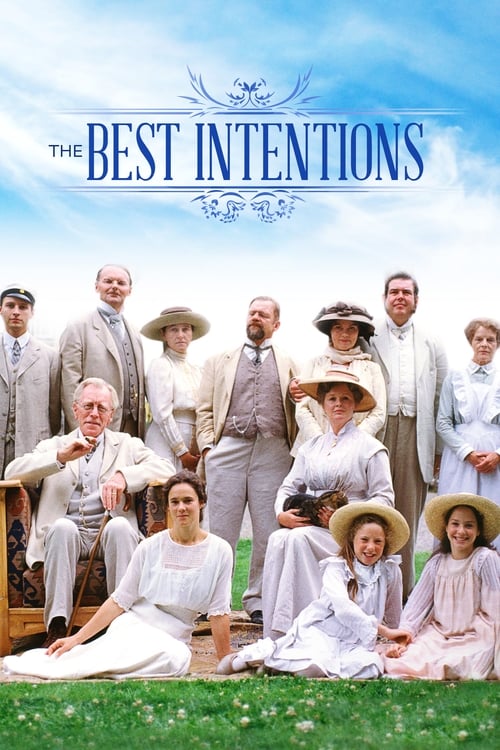
The Best Intentions
1992 · Bille August
For a long winter afternoon when you want to sink into a big, serious love story with real weight — a slow-burn epic for patient viewers rather than a light romance.
What it's about
In Sweden in the years before the First World War, Henrik, a poor and prickly theology student, falls in love with Anna, the willful daughter of a wealthy family that wants nothing to do with him. Against everyone's better judgment they marry, and he takes up a priest's post in a remote northern parish — where love, class, faith, and two stubborn temperaments grind against each other. It's the story of Ingmar Bergman's own parents, written by Bergman from family letters and diaries.
The experience
Stately, handsome, and emotionally exacting — a long, novelistic film that earns its running time by making every argument and reconciliation between the couple feel lived-in. It's tender and bruising in equal measure, the way honest portraits of a marriage are.
Performances
Pernilla August won Best Actress at Cannes for her Anna, a portrait of willfulness and longing that carries the film; Samuel Fröler matches her as the wounded, rigid Henrik, and Max von Sydow is superb as her formidable father.
The craft
The screenplay is Bergman's own — his parents' lives reconstructed from archives — but filmed at one remove by Bille August, whose burnished period craft gives the psychology room to breathe. The turn-of-the-century Sweden it builds, from bourgeois drawing rooms to a snowbound northern parish, is gorgeous on a big screen.
Why it matters
It won the Palme d'Or at Cannes in 1992 and stands as one of the peaks of Nordic cinema of its era — Bergman's late reckoning with his family, entrusted to another director's hands.
Snapshot
The Best Intentions (Swedish: Den goda viljan) is a period marriage drama that reconstructs the courtship and early union of Ingmar Bergman's parents in Sweden in the years before the First World War. Its unusual authorship defines it: the screenplay is by Ingmar Bergman, drawn from his own family history and from archival letters and diaries, but the direction was entrusted to the Danish filmmaker Bille August. The result is a film about the deepest of personal subjects made at one remove from the person to whom it belongs — Bergman writing his parents' lives, another director filming them. It exists in two forms, a theatrical feature of roughly three hours and a longer television serial produced for Swedish television, and it stands as one of the major achievements of Nordic cinema of the early 1990s, crowned with the Palme d'Or at Cannes in 1992 and the festival's Best Actress prize for Pernilla August. It is at once an intimate chamber piece about class, faith, and incompatibility and a foundational "origin story" for the Bergman sensibility that would haunt twentieth-century art cinema.
Industry & production
The film emerged from the Nordic public-broadcasting model that has long underwritten prestige drama in Scandinavia. It was a co-production centered on Swedish television (SVT) with participation from other Nordic and European broadcasters, conceived from the outset in the dual format that has become characteristic of the region: a multi-part television serial and a condensed theatrical cut. The television version runs well over five hours across several episodes; the theatrical release was compressed to approximately 180 minutes. This dual-format strategy allowed the production to pursue novelistic breadth for the small screen while still competing on the international festival and art-house circuit as a feature.
The project's genesis lies with Ingmar Bergman himself. Having largely withdrawn from feature directing after Fanny and Alexander (1982), Bergman turned in his later years to writing — autobiography (The Magic Lantern), screenplays for others, and the memoiristic reconstruction of his family. He wrote The Best Intentions as a full screenplay and also published it as a book, then declined to direct it, selecting Bille August instead. August was a natural choice: a Dane who had already won the Palme d'Or and the Academy Award for Best Foreign Language Film with Pelle the Conqueror (1987), and who commanded exactly the kind of measured, humane realism the material seemed to call for. That Bergman handed his own parents' story to another filmmaker — and to a non-Swede — is among the more striking authorial gestures in modern European cinema.
The production values are those of high-end European heritage filmmaking: extensive location work in Sweden, meticulous period reconstruction of Uppsala bourgeois interiors and the bleak northern parish country, and a company of leading Scandinavian actors. Precise budget and box-office figures are not something I can reliably state, and the film's commercial life was in any case shaped more by television broadcast and festival prestige than by wide theatrical returns.
Technology
Technologically the film is conventional for an ambitious 35mm European production of its era, and it makes no claim to innovation on this front. It was shot photochemically on film, using naturalistic lighting and largely classical coverage; there is no significant use of optical or, at that early date, digital effect. The one genuinely notable "technological" fact about it is structural rather than optical: it was engineered to exist simultaneously as television serial and cinema feature, which conditioned choices of pacing, scene length, and the modularity of its narrative. The longer broadcast version can let scenes breathe and accumulate; the theatrical version relies on compression and ellipsis. Anyone studying the film should be aware that "the film" is really two related objects, and that judgments about its rhythm depend on which version one has seen.
Technique
Cinematography
The photography is by Jörgen Persson, one of the most distinguished Swedish cinematographers of his generation, whose credits include Elvira Madigan, My Life as a Dog, and August's own Pelle the Conqueror. His work here is characterized by a restrained naturalism keyed to northern light: pale, cool interiors, the low sun and long shadows of the Swedish landscape, and a palette that favors muted earth tones, blacks, and the whites of snow and linen. Persson tends toward composed, stable framing and unhurried camera movement rather than showy technique; the images have the density and tonal control of period painting without tipping into mere prettiness. The visual contrast between the well-appointed Åkerblom bourgeois world and the raw, impoverished parish in the north is carried substantially by light and texture — warmth and clutter against cold and bareness.
Editing
The editing is by Janus Billeskov Jansen, August's long-standing collaborator (again, Pelle the Conqueror). The cutting is classical and unobtrusive, prioritizing legibility of performance and the slow escalation of emotional situations over montage effect. Because the material originated as a long-form serial, the editorial intelligence of the theatrical version lies especially in compression — deciding which scenes to keep whole and which threads to elide — so that a three-hour feature can still register as a complete arc rather than a digest. The pacing is deliberate throughout, trusting the accumulation of small domestic tensions.
Mise-en-scène / staging
Staging is where the film's period discipline is most visible. Interiors are dense with the furniture, fabrics, and social choreography of turn-of-the-century Swedish bourgeois life; the Åkerblom household in particular is a stage for hierarchy, propriety, and maternal control. The film stages class as physical space — the ordered, upholstered rooms of Uppsala against the plain, cold rooms of the northern parsonage — and it stages the marriage as a series of confrontations across dinner tables, in doorways, in bedrooms. August's direction of actors within these spaces is patient and blocked with theatrical clarity, letting glances and withheld words do much of the dramatic work.
Sound
The score is by Stefan Nilsson, another veteran of Pelle the Conqueror, whose music is used sparingly and lyrically rather than as continuous emotional underscoring. Much of the film's soundscape is naturalistic — the quiet of interiors, weather, church acoustics, the textures of a pre-electric world. Restraint is the governing principle; the film resists musical manipulation, allowing silence and ambient sound to carry the weight of scenes.
Performance
Performance is the film's central achievement. Pernilla August (then Pernilla Östergren) plays Anna Åkerblom with a combination of warmth, willfulness, and gradually souring disappointment that earned her the Best Actress award at Cannes; her Anna is neither villain nor victim but a woman of vitality miscast into a life of provincial hardship. Samuel Fröler plays Henrik Bergman as a proud, wounded, emotionally rigid young clergyman, a man whose insecurity curdles into severity. The supporting playing is exceptionally strong: Max von Sydow — himself a defining Bergman actor — appears as Anna's father Johan Åkerblom, and Ghita Nørby plays the formidable mother Karin, whose disapproval of the match is one of the engines of the drama. The ensemble's rootedness in the Scandinavian theatrical and cinematic tradition gives the film its gravity.
Narrative & dramatic mode
The narrative is a novelistic chronicle of a relationship over roughly a decade, from first meeting through courtship, familial opposition, marriage, and the strains of married life in a remote northern parish. Its dramatic mode is realist and psychological rather than plotted: there is no external engine of suspense, only the slow revelation of two temperaments that love each other and are nonetheless fundamentally unsuited. The film builds through domestic confrontation and reconciliation, cycles of tenderness and injury. Its emotional intelligence lies in refusing to assign blame — both partners are sympathetic and both are impossible — and in tracing how good intentions (the title is exact) fail to translate into a workable life. Because Bergman wrote it knowing the outcome — this is the marriage that produced him, and the coldness that shaped him — the story carries a retrospective, almost fated weight, even as it is scrupulously fair to both parents.
Genre & cycle
The film belongs to the prestige period drama and the literary biographical film, but more specifically it is part of a distinct cycle: Bergman's late autobiographical reckoning with his own family. That cycle includes Fanny and Alexander (1982), which he directed, and two further screenplays he wrote for others to direct — Sunday's Children (1992), directed by his son Daniel Bergman, which portrays Bergman's own boyhood, and Private Confessions (1996), directed by Liv Ullmann, which returns to his mother. The Best Intentions is effectively the first chapter of that family saga, the parents' story that precedes the child's. Read together these films constitute one of the most sustained acts of autobiographical filmmaking in the medium, distributed across multiple directors under a single authorial imagination.
Authorship & method
The film's authorship is genuinely double, and this is its most important critical fact. Ingmar Bergman is the author of the material — its characters, its confessional purpose, its sense that a marriage's private weather can determine a soul. He worked from family documents and memory to reconstruct his parents' early life with a novelist's freedom, fictionalizing names (his father Erik becomes Henrik, the family Bergman and Åkerblom are reshaped) while pursuing emotional truth. But the direction is Bille August's, and August brings a sensibility measurably different from Bergman's own: more externally realist, less given to expressionist rupture, dream, and metaphysical anguish, more trusting of restraint and behavioral observation. The collaborators reinforce this: Persson's naturalistic camera, Billeskov Jansen's classical cutting, Nilsson's spare score, all belong to the humane realist tradition August had honed on Pelle the Conqueror. The fascination of the film lies precisely in this productive tension — Bergman's material filtered through a temperament that is not Bergman's, so that the most Bergmanian of subjects arrives without Bergman's characteristic stylistic signature.
Movement / national cinema
The Best Intentions is a landmark of Swedish and broader Nordic national cinema, and it sits at the intersection of two traditions. It descends from the towering legacy of Ingmar Bergman and, behind him, the classic Swedish cinema of Sjöström and Stiller, with their attention to landscape, moral seriousness, and the inner life. At the same time it belongs to the pan-Scandinavian, publicly funded prestige filmmaking of the late 1980s and early 1990s — the milieu that produced Pelle the Conqueror and Babette's Feast — in which Danish and Swedish talent worked across borders on internationally successful literary adaptations. That a Danish director and a mixed Scandinavian cast realized this quintessentially Swedish story is itself emblematic of that regional, collaborative moment in Nordic film.
Era / period
The film depicts Sweden in the years bracketing the First World War, roughly the 1900s and 1910s — a society still governed by rigid class distinction and by the moral authority of the Lutheran church, on the cusp of modernization. Its portrait of a poor northern parish, a bourgeois university city, and the social gulf between them is historically specific and carefully observed. It was made, by contrast, in the early 1990s, at the end of Bergman's life and career and near the high-water mark of Nordic art cinema's international standing. The distance between depicted era and era of production is part of the film's meaning: it is an old man looking back across nearly a century to the moment before his own birth.
Themes
The film's governing themes are class incompatibility, the difficulty of love between fundamentally different temperaments, and the question of whether good intentions can survive contact with real life. Faith and vocation run throughout — Henrik's Christianity is both his identity and a form of self-punishing pride — as do the burdens of family, the tyranny and love of parents, and the transmission of emotional patterns across generations. Underlying everything is an inquiry into origins: the film asks where the coldness, severity, and longing that Bergman diagnosed in himself came from, and locates the answer in the unhappy accommodation of two people who loved each other badly. It is a film about how a marriage becomes a fate.
Reception, canon & influence
Critically and on the festival circuit the film was received as a major work. It won the Palme d'Or at the 1992 Cannes Film Festival — Bille August's second, making him one of the few directors to win the festival's top prize twice — and Pernilla August was named Best Actress there. It was broadly praised for the intelligence and fairness of its script, the richness of its performances, and its restrained craftsmanship, though some critics registered the inherent challenge of its length and deliberate pace, and debate has always attended the split between its television and theatrical forms.
Its influences run backward to Bergman's entire body of work and to the Scandinavian literary-realist tradition, and outward to the family documents on which Bergman based his reconstruction. Its most significant forward influence is as the cornerstone of the multi-film Bergman family cycle — alongside Sunday's Children and Private Confessions — a body of work that reframes how audiences and scholars understand the biographical roots of Bergman's cinema. For film history it stands as a rare case study in divided authorship: a master screenwriter's most personal material realized by another director's hand, and thus a lasting object lesson in the difference between writing and directing, between the origin of a story and its style on screen. Its canonical standing rests less on stylistic innovation than on the depth of its human observation and the singularity of its place in the Bergman legend.
A Deleuzian reading
Notice where Bille August keeps putting people.
The full Deleuzian reading of The Best Intentions →
Reception
It won the Palme d'Or in 1992 — Bille August's second, after Pelle the Conqueror — to real acclaim, yet today it sits among the least-revisited Palme winners, mostly kept alive by Ingmar Bergman completists working through his autobiographical script cycle.
How The Best Intentions was received, from release to now →
Influences: the films it descends from and the films it influenced
- Scenes from a Marriage (1973) — Establishes the method the film's dossier calls a marriage's 'private weather' — anatomizing a couple through sustained, unadorned two-hander dialogue scenes of shifting power, which becomes Best Intentions' central dramaturgical engine.
- Fanny and Alexander (1982) — Sets the template of reconstructing autobiographical family memory as a warm, novelistic period chronicle (in both TV and theatrical cuts) that Best Intentions extends backward one generation to the parents' courtship.
- Winter Light (1963) — Its austere, unsentimental country-pastor-in-crisis is the direct vocational and tonal model for Henrik's clergyman calling and the film's spare treatment of religious duty.
- Wild Strawberries (1957) — Victor Sjöström's restrained, behavioral lead performance and the reckoning-with-parents structure exemplify the humane-realist acting register August's cast inherits over Bergman's expressionist mode.
- Cries and Whispers (1972) — Sven Nykvist's compositions derived from period painting and precise emotional close-ups define the 'painterly-composition' lineage that Persson translates into a cooler naturalist key here.
- The Phantom Carriage (1921) — Founding work of Swedish literary-realist adaptation (Selma Lagerlöf), it anchors the moral-realist Nordic tradition — restraint over spectacle — that Best Intentions descends from through Bergman.
- Pelle the Conqueror (1987) — August's own prior film assembled the exact craft method reused here — Jörgen Persson's naturalist available-light camera, Max von Sydow's weathered patriarch, and class rendered as physical, spatial fact.
- Faithless (2000) — Ullmann directs a late Bergman confessional screenplay, carrying forward the film's defining lesson — Bergman's most personal material realized through a directorial temperament other than his own.
- Kristin Lavransdatter (1995) — Ullmann's own Nordic literary period epic applies the same painterly-naturalist, class-bound novelistic-chronicle craft to a canonical Scandinavian source.
- The House of the Spirits (1993) — August's immediately following prestige literary-family chronicle extends his multi-decade novelistic method and classical compression to another epic source novel.
- Jerusalem (1996) — August adapts Selma Lagerlöf directly, returning the craft to its Nordic literary-realist origin with the same restrained period staging and sparse scoring.
- Everlasting Moments (2008) — A turn-of-the-century Swedish working-class chronicle built on painterly natural-light composition and understated performance — the northern-naturalist period craft continued a generation on.
- The Emigrants (1971) — A contemporaneous Swedish period chronicle with von Sydow and Ullmann using naturalist landscape photography and novelistic scale to dramatize class and hardship — the same period-realist mode from a parallel hand.
- Sunday's Children (1992) — The second panel of the Bergman family cycle — Ingmar's screenplay realized by another director (his son), repeating the divided-authorship experiment on the childhood chapter.
- Private Confessions (1996) — Third panel of the cycle: Bergman's screenplay of his mother's affair directed by Ullmann and again starring Pernilla August as Anna, extending the split writer/director model within the same characters.
Similar films
- Wild Strawberries (1957) — influence & lineage · same viewing thread
- Fanny and Alexander (1982) — influence & lineage
- Cries and Whispers (1972) — influence & lineage
- The Emigrants (1971) — influence & lineage
- Winter Light (1963) — influence & lineage
- Out of Africa (1985) — same viewing thread
- Autumn Sonata (1978) — shared sensibility
- Scenes from a Marriage (1974) — shared sensibility
All the films related to The Best Intentions →
Watch it with: curated runs of related films
- Love, Memory, and the Long Journey — A run of love films where a journey — by car, by rail, or through memory — quietly lays bare what two people are, or were, to each other.