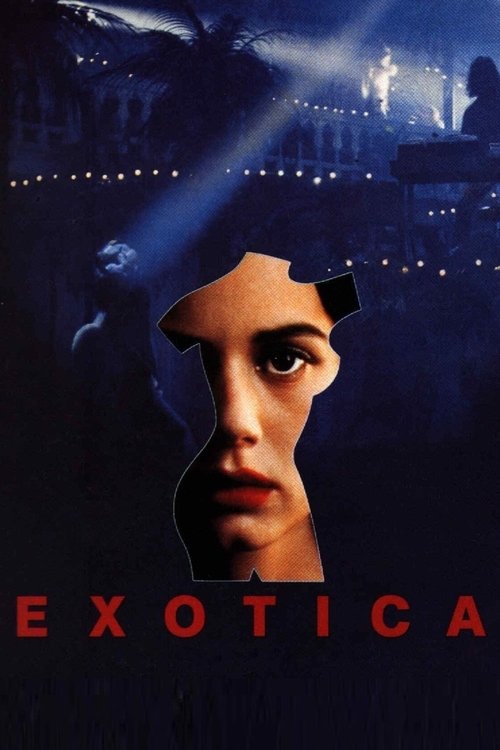
Exotica
1994 · Atom Egoyan
When you want a film to chew on for days — a slow, mysterious mood piece for a quiet, attentive night. Challenge viewing that ends up unexpectedly moving.
What it's about
Inside an upscale Toronto strip club decorated as a painted jungle, a handful of strangers circle each other in rituals no one explains. A depressed tax auditor buys the same table dance from the same young dancer night after night; the club's MC watches her from his booth with wounded jealousy; the pregnant owner surveys the floor through a one-way mirror; and a pet-shop owner smuggling rare eggs is about to be pulled into their orbit. Why these people need each other is the film's slowly opened secret.
The experience
Hypnotic and sad rather than salacious — a puzzle film that withholds its connections until they land with real emotional weight, turning what looks like a story about desire into one about grief. It asks patience and repays it; the last stretch recontextualizes everything you've watched.
Performances
Bruce Greenwood does extraordinarily delicate work as Francis, letting you sense an ocean of pain beneath a polite, ruined surface; Mia Kirshner and Elias Koteas are both mesmerizing, and Koteas's onstage patter — seduction curdling into incantation — is unforgettable.
The craft
Egoyan builds the film like a lock, cross-cutting timelines and doling out information so that scenes replay in your head with new meaning. The club itself is a stunning piece of production design — humid, jungle-painted, dreamlike — scored to Leonard Cohen's 'Everybody Knows' and a haunting Mychael Danna soundtrack heavy with atmosphere.
Why it matters
The film that broke Atom Egoyan internationally, winning major festival attention and becoming a defining work of 1990s Canadian cinema and the arthouse puzzle drama. Its structure — mystery as a container for grief — has echoed through ambitious indie filmmaking since.
Snapshot
Atom Egoyan's fifth feature is a chamber film built like a lock. Six people circle each other inside a Toronto strip club decorated as a painted jungle, and for most of its running time the film refuses to explain why any of them are there. A tax auditor, Francis (Bruce Greenwood), buys the same table dance from the same dancer, Christina (Mia Kirshner), night after night; she performs in a schoolgirl kilt to Leonard Cohen's "Everybody Knows." The club's MC, Eric (Elias Koteas), introduces her from an overhead booth with a patter that curdles from seduction into wounded incantation. Zoe (Arsinée Khanjian), the pregnant proprietor who inherited the room from her mother, watches the floor through a one-way mirror. Thomas (Don McKellar), a pet-shop owner smuggling rare eggs through customs, is audited by Francis and drawn into the club's gravity.
What binds them is a murdered child. Francis's daughter Lisa was killed; Christina was her babysitter; Eric was the volunteer who found her body in a field. Egoyan withholds this armature until the final movement, so that the film's rituals — the paid dance, the paid babysitter, the nightly introduction — read first as pathology and only later as grief with nowhere to go. Exotica premiered in competition at Cannes in 1994, took the FIPRESCI critics' prize, and became Egoyan's international breakthrough and one of the most widely discussed Canadian films ever made. Roughly 103 minutes, 1.85:1, and structured so that the last shot is chronologically the first.
Industry & production
Exotica was produced through Ego Film Arts, the Toronto company Egoyan has used since the early 1980s, with Camelia Frieberg producing. Like nearly all English-Canadian features of the period, it was assembled from public and quasi-public money — Telefilm Canada, the Ontario Film Development Corporation, and broadcaster participation — rather than from private equity. This funding architecture matters to the film's form: Egoyan came up in a system that underwrote low-budget authorial work on the condition that it be recognizably Canadian, which insulated him from the commercial pressures that would have sanded down a script whose premise is deliberately illegible for an hour.
Distribution is where the film crossed over. Alliance handled Canada; Miramax took the United States, at the height of its run as the company that made subtitled and difficult films into specialty-market events. Miramax's campaign leaned on what the film could be made to look like in a trailer — a strip club, a schoolgirl uniform, an obsession — positioning Exotica adjacent to the early-1990s erotic thriller. The mismatch between that pitch and the actual film is part of its reception history: audiences arrived for Basic Instinct and got Pinter. The precise box-office record is not something I can give with confidence in numbers, but the film performed strongly for a Canadian art feature and outgrossed Egoyan's previous work by a wide margin.
Awards consolidated the position. Beyond Cannes, Exotica swept the 1995 Genie Awards, taking Best Motion Picture and Best Direction among others, and it has placed consistently in the periodic critics' polls of the best Canadian films of all time run out of the Toronto International Film Festival.
Technology
Shot on 35mm, finished photochemically, in a period just before digital intermediates would have made the film's color separation easy. Sarossy and Egoyan had to get the club's aquarium blue-green and the field's bleached daylight in-camera and in the lab, through stock, gel, and filtration.
The more consequential technology is the film's subject. Egoyan's earlier features are built around consumer video: Family Viewing (1987) on VHS home movies taped over, Speaking Parts (1989) on a video mausoleum and video dating, Calendar (1993) on a photographer's camcorder. Exotica marks a deliberate turn away from the monitor. Its surveillance is optical and architectural: the one-way mirror at Pearson airport customs where two officers watch arriving passengers, which opens the film and states its thesis — that you must imagine what brought a person to this point; the one-way mirror in Zoe's office overlooking the floor; the elevated DJ booth from which Eric sees everything and touches nothing. The club itself is an interface. Its cardinal rule, no touching, is a protocol governing a transaction in looking, and the plot's crisis is a protocol violation. When Francis is banned and needs a proxy inside, he blackmails Thomas into going in for him, wired — the film's one moment of concealed electronics, and it arrives as a desperate downgrade from the mirror to the microphone.
The pet shop supplies the technological rhyme: aquaria, heat lamps, incubators, cages — engineered climates for imported life. The club is the same machine tuned for people.
Technique
Cinematography
Paul Sarossy, Egoyan's cinematographer since Speaking Parts and through The Sweet Hereafter, Felicia's Journey, and Ararat, gives the film two irreconcilable palettes. The club is a hothouse: saturated blues and greens washing over painted fronds, amber pools around the tables, faces isolated in shallow focus against foliage that the lighting never quite lets you confirm as fake. The camera moves laterally and slowly through this space on long gliding takes, drifting past tables the way a patron's attention would, so that the audience's viewing position is structurally identical to Francis's. The film implicates by camera placement before it says anything about voyeurism.
Against this, the field: overexposed, hazy, drained, shot in a flat wide light that gives the searchers no shadows to hide in. The visual grammar tells you these two spaces belong to different orders of reality long before the narrative concedes that one caused the other. Domestic interiors — Francis's preserved house, Harold's home — sit between them in a neutral, chilled register that reads as depopulated even when occupied.
Editing
Susan Shipton, Egoyan's editor across the body of his major work, is the film's structural author as much as anyone. Exotica cross-cuts between scenes that appear to be happening at once and are not, and it withholds establishing information at exactly the joints where a conventional thriller would supply it. The result is what later criticism would call a modular or puzzle narrative: sequences function as discrete tiles whose adjacency generates meaning that neither tile contains.
Two editorial habits stand out. The first is rhythmic subordination to Mychael Danna's score — Egoyan and Shipton frequently cut on musical phrase rather than on action, which gives long stretches a processional quality. The second is the treatment of the Cohen sequence, where Christina's dance is intercut with three separate watchers, folding Eric's jealousy, Zoe's proprietorship, and Francis's grief into a single performance without a word of dialogue. The film's final gesture is a reverse-chronological reveal: the last scene is the earliest event, Francis dropping the babysitter Christina at her own troubled house, and the closing exchange retroactively reframes every transaction that preceded it.
Mise-en-scène / staging
Production designers Linda Del Rosario and Richard Paris built the club as an explicit fiction of the tropical — painted jungle backdrops, draped fabric canopies, a raised stage under a false forest. Nothing in Exotica is exotic; everything is a rendering of exoticism for domestic consumption, which is precisely the film's argument about the fantasies being sold there. Costume design by Linda Muir does the corresponding work on the body: Christina's schoolgirl kilt and blouse, worn nightly for a man mourning a schoolgirl; Zoe inheriting and wearing her dead mother's dresses as she inherits the room.
Staging is ritualistic. Francis sits in the same chair; Christina approaches from the same angle; Eric speaks from above. Egoyan blocks repetition so that small deviations register as catastrophe. Francis's house is staged as a museum of an interrupted life, its emptiest room the one where Tracey (Sarah Polley) is paid to sit while he is out — a babysitter with no child, performing the shape of an evening that can no longer happen.
Sound
Mychael Danna, Egoyan's composer since 1987, built a score of drones, Middle Eastern woodwind and reed timbres, and hand percussion, hybridized with synthetic textures — an idiom that refuses both Hollywood strings and club-realist source music, and that carries its own charge of the borrowed-exotic. It scores the club as sacred space rather than sexual space.
The Cohen needle-drop is the film's most quoted sound decision, and it works because "Everybody Knows" is a song about open secrets played over a scene in which everyone in the room is keeping one. Eric's amplified introductions form a second, disembodied narration; his voice arrives from above the frame, and its slide from professional lasciviousness into something close to elegy is one of the film's cleanest emotional through-lines. Elsewhere Egoyan uses near-silence: the customs mirror scenes are quiet enough that the voiceover feels like thought.
Performance
Egoyan's actors speak in a deliberately flattened register — lines delivered as recitation, courtesy stretched over violence, affect withheld. It is the Bressonian pole of his method, and it is why the film's few unguarded moments detonate. Bruce Greenwood plays Francis as a man holding a shape together from the inside; the performance made him internationally visible. Mia Kirshner gives Christina a blankness that reads simultaneously as erotic surface, professional armor, and dissociation, and refuses to arbitrate among them. Elias Koteas finds the wound under Eric's smarm. Arsinée Khanjian — Egoyan's wife and his collaborator across his entire filmography — plays Zoe as someone administering an inheritance she did not ask for. Don McKellar, himself a central figure of the Toronto scene as writer and director, gives Thomas a furtive comic precision, including the film's driest running device: buying two ballet tickets and offering the spare to a man. Sarah Polley, then a teenager known from Canadian television, plays Tracey with the flat exasperation of a child conscripted into adult mourning; she and Greenwood would reunite for Egoyan on The Sweet Hereafter.
Narrative & dramatic mode
Exotica runs melodrama's machinery — a murdered child, an adulterous brother, a fatal car crash, a paternity insinuation, a coincidence that binds strangers — through modernist ellipsis. Every plot element would be at home in a 1950s weepie; none is delivered with a weepie's timing. Egoyan strips the causal connective tissue and leaves the ritual behind, so that behavior arrives before motive and the audience is put in the position of the customs officer at the mirror: asked to reconstruct what brought this person to this point.
Crucially, the film is not a whodunnit. Lisa's killer is never identified and the investigation is not the plot. The mystery is relational rather than criminal: what is the line between these people? This is the structural move that made Exotica influential. It borrows the detective story's delay while discarding its solution, so the payoff is recognition rather than justice — Francis and Eric in the rain at the end, the man who lost the child and the man who found her body, holding onto each other because there is no other available gesture.
Genre & cycle
The film sits at a junction of three cycles. It arrived inside the 1990s erotic thriller boom and was sold against it, which produced a durable critical framing of Exotica as the anti-erotic film about eroticism. It belongs to the mid-decade wave of art films set in and around sex work, where the club functions as a stage for questions about labor, looking, and performance. And it is an early, influential entry in the 1990s puzzle-film and network-narrative cycle — Short Cuts (1993), Pulp Fiction (1994), later Magnolia and 21 Grams — though Egoyan's version is quieter than any of them and organized around trauma rather than coincidence-as-cosmology.
Authorship & method
Egoyan wrote, directed, and produced through his own company, and Exotica is the clearest statement of a method he had been refining since Next of Kin (1984): a scenario in which characters hire each other to perform family roles, a plot delivered as withheld information, and a formal interest in the machines and rooms that mediate intimacy. His theatrical and operatic sensibility — he would go on to direct opera for the Canadian Opera Company and Beckett for the Beckett on Film project — is legible in the staging's frontality and the dialogue's ceremonial cadence.
The authorship is genuinely collective in personnel, if not in vision. Sarossy (camera), Shipton (editing), Danna (music), Khanjian (performance), Del Rosario and Paris (design) constitute a repertory that carried across a decade of features, and the consistency of Egoyan's world owes as much to that continuity as to his scripts. Camelia Frieberg's producing work through this stretch is the underrecognized element; she held together the financing model that made an uncommercial script possible.
Movement / national cinema
Exotica is the signature achievement of the Toronto New Wave — the cohort of Egoyan, Bruce McDonald, Patricia Rozema, Don McKellar, Peter Mettler, John Greyson, and Jeremy Podeswa that emerged through the 1980s on Ontario and federal funding and through the orbit of the Toronto festival. Egoyan's own position is diasporic: born in Cairo to Armenian parents, raised in Victoria, British Columbia, educated at the University of Toronto, and preoccupied throughout his career with inherited loss and with the Armenian genocide, which he would address directly in Ararat (2002). The exiles' theme of a homeland accessible only through representation is not incidental to a film about a fake jungle.
Within English-Canadian cinema, Egoyan and Cronenberg formed the two poles of international legibility in the 1990s — clinical affect, bodies mediated by systems, a national cinema whose art films were colder than its neighbors'. Exotica, followed by Cronenberg's Crash (1996) and Egoyan's own The Sweet Hereafter (1997), constituted the moment when Canadian art cinema became a fixture of Cannes competition and the American specialty market.
Era / period
The film is precisely of 1994: the Miramax specialty boom, the festival-to-arthouse pipeline at its most efficient, and a pre-internet surveillance culture in which watching still required a mirror, a booth, or a body in a room. Francis is a tax auditor in a recessionary early-1990s Ontario, a functionary of a state apparatus that examines private lives for a living — the same activity the film asks its audience to perform. Thomas's cruising, staged with wariness and coded ritual, belongs to the AIDS decade without the film ever announcing it. And the club economy itself — the table dance as a discrete priced unit of attention — reads now as an early consumer model for what the following two decades would make ubiquitous.
Themes
Grief as ritual is the engine: every character has converted a loss into a repeatable procedure, and the procedures are indistinguishable from perversion until you know their cause. Surrogacy runs through all of it — Christina standing in for the dead daughter, Tracey hired to babysit an absent child, Zoe conceiving a child to continue her mother's line, Eric fathering it by arrangement. The economy of looking supplies the film's ethics: the no-touch rule makes desire safe and makes consolation impossible, and Egoyan's camera puts the viewer inside the same bargain. Captivity and the exotic bind the club to the pet shop — imported creatures kept alive in fabricated climates, sold as wonder. And beneath everything, the withholding of narrative is itself figured as a symptom: these people cannot say what happened, so the film cannot either, until it can.
Reception, canon & influence
Critical reception was strong and durable. The FIPRESCI prize at Cannes gave the film a critical imprimatur that its Miramax campaign then converted into art-house business; it appeared on year-end lists, dominated the Genies, and established Egoyan as a major figure rather than a promising regional one. Some contemporaneous dissent focused on the film's chill and on whether its structural withholding was substance or trick — a debate that has followed Egoyan's work generally. It has since become one of the most written-about Canadian films in the academic literature, anchoring the standard Egoyan references, including Jonathan Romney's BFI study of the director and the essay collection Image and Territory: Essays on Atom Egoyan (Tschofen and Burwell, eds.).
Backward, the lineage is legible even where Egoyan has not spelled it out. Antonioni's L'Avventura supplies the unresolved disappearance that reorganizes the survivors instead of being solved. Resnais — Hiroshima mon amour, Last Year at Marienbad — supplies traumatic memory as formal principle and ritualized repetition as dramatic structure. Bresson underwrites the flattened delivery and the attention to hands, objects, and transactions. Pinter is the closest dramaturgical ancestor: the buried past, the menace inside politeness, the reverse-chronological reveal. Hitchcock's Vertigo hovers over the central conceit of a man paying to have a lost girl re-embodied, and Nabokov over the schoolgirl costume's deliberate discomfort. The most direct influence, though, is Egoyan on himself — Family Viewing and Speaking Parts had already established the hired-surrogate premise and the mediating machine; Exotica is where the method finds a story large enough to carry it. (The often-repeated account that Wim Wenders passed his festival prize money to Egoyan after seeing Family Viewing belongs to that early trajectory.)
Forward, the clearest legacy is The Sweet Hereafter (1997), which Exotica's success made financeable and which reassembled the same team — Sarossy, Shipton, Danna, Polley, Greenwood — to take another dead-child story to the Cannes Grand Prix and two Academy Award nominations. Beyond Egoyan, Exotica is a load-bearing precedent for the puzzle-film and trauma-narrative cycle that dominated ambitious drama from the late 1990s into the 2000s, and for a subsequent body of films about surrogate re-enactment of childhood harm. It made Mychael Danna's hybrid scoring idiom internationally audible, launched Sarah Polley's adult career, and — with Cronenberg — made Canadian art cinema a recognized export category rather than a domestic subsidy program. The claim that everyone in the room already knows the secret, and that the ritual continues anyway, remains the film's most imitated idea.
A Deleuzian reading
Two officers stand behind one-way glass at Pearson airport customs, watching passengers come off a flight.
The full Deleuzian reading of Exotica →
Reception
A Cannes sensation in 1994 — it took the FIPRESCI critics' prize and became Egoyan's international breakthrough — Exotica was then slightly eclipsed by The Sweet Hereafter, and now gets steadily rediscovered as the sultrier, stranger jewel of 90s art-house.
How Exotica was received, from release to now →
How to watch Exotica: what to notice on a first viewing
- Notice the club's saturated blue and green light. Sarossy washes the club in blues and greens over painted fronds and amber pools at the tables, made deliberately hothouse and artificial. The club is lit like a world sealed off from the ordinary one outside it.
- Notice who watches the floor from behind glass or above. Zoe watches through a one-way mirror in her office, Eric watches from an overhead booth, and customs officers watch through glass at the airport. Everyone in this film is positioned to look without being touched.
- Watch Francis take the same table every single night. Christina always approaches from the same angle, Eric always speaks from above, and the whole club runs on staged, unvarying repetition. Once a ritual is this fixed, the smallest deviation would read as a small catastrophe.
- Listen to Eric's voice arrive from above the frame. His amplified introductions form a second narration that slides from professional charm into something closer to grief as the film goes on. The voice is doing emotional work the dialogue below it never states directly.
- Notice Thomas buying two tickets and offering the spare one. The pet-shop owner repeats this small gesture more than once, a stranger's kindness or a pickup line the film never fully resolves. It is a small ritual of its own, as deliberate as anything happening in the club.
The whole guide to watching Exotica, with the keys for a rewatch →
Influences: the films it descends from and the films it influenced
- L'Avventura (1960) — Establishes the disappearance that is never solved but instead becomes the organizing pressure on everyone left behind — Egoyan borrows the structural refusal to deliver the missing-girl plot and lets the search rituals substitute for resolution.
- Hiroshima mon amour (1959) — Converts traumatic memory into an editing principle, cutting from present bodies to past images on the cadence of a voice rather than on a narrative cue — the exact grammar of Exotica's field-search inserts arriving unannounced under dialogue.
- Last Year at Marienbad (1961) — Lateral tracking through an ornamental interior while a disembodied narration recites a scenario that keeps being replayed with variations; Sarossy's glides across the club floor and the nightly repetition of Christina's schoolgirl routine are the same device relocated to a strip bar.
- Pickpocket (1959) — The flattened, affect-drained line reading plus close attention to hands completing a transaction — money, tickets, contraband passing between palms — which Exotica adopts for Francis handing bills to Eric and for the customs-table shots of goods being opened.
- Vertigo (1958) — The core conceit of a man paying to have a dead girl re-embodied by a living woman, with costume as the instrument of resurrection; Christina's tunic and pleated skirt function as Judy's gray suit does — a garment the client requires and the performer submits to.
- The Servant (1963) — Pinter's dramaturgy of menace inside impeccable politeness, staged through mirrors and reflective surfaces that let one character watch another unseen — the one-way glass of Zoe's booth is the same blocking logic made literal architecture.
- Betrayal (1983) — Pinter's reverse-chronological construction, where scenes are withheld and then played late so that the audience finally sees the innocent origin of a corruption it has already watched metastasize — Exotica's closing flashback to Eric finding the body is that structure's payoff.
- Family Viewing (1987) — Egoyan's own prototype: a character hires a sex worker to perform a family role by telephone, and the mediating machine (here videotape) both preserves and erases the past — Exotica keeps the hired-surrogate premise and swaps the machine for a one-way mirror.
- Speaking Parts (1989) — Refines the surrogate economy into a paid ritual conducted through glass and screen, with a video mausoleum where mourners address the dead; Exotica's booth rule — you may look and speak but not touch — is a direct restatement of that interdiction.
- The Sweet Hereafter (1997) — Reassembles the identical crew — Sarossy, Susan Shipton, Danna, Polley, Greenwood — to run the Exotica method on another dead-child story, braiding three time frames without signposting and again withholding the accident's true cause until the last reel.
- The Ice Storm (1997) — Exports Danna's Exotica idiom wholesale: gamelan, Native American flute and processed ethnic percussion laid over affluent North American anomie, so the score reads as ceremonial observation rather than emotional underlining.
- Memento (2000) — Takes Exotica's reverse-chronological reveal from art-house device to genre engine, making the withheld first cause a moral rather than merely formal payoff — the puzzle-film cycle Exotica made financeable and legible to distributors.
- Caché (2005) — Builds a whole film on Exotica's premise that a surveillance apparatus delivers no revelation, only the fact of being watched, and that the buried childhood harm is known to the participants long before it is stated to the audience.
- The Duke of Burgundy (2014) — Extends the contracted, scripted erotic ritual repeated with small deviations — with the paying/served party revealed as the more desperate one — and uses a commissioned score as structural scaffolding rather than accompaniment, exactly Exotica's arrangement.
- Last Night (1998) — Egoyan's Toronto interiors, where grief is conducted as private ritual and backstory is withheld from the audience by design, gave McKellar — who acts in the film — the cool, non-explaining performance register he later warms and slows down.
- The Adjuster (1991) — Same repertory (Sarossy, Danna, Khanjian) working the two-palette contrast between an antiseptic institutional world and an over-saturated staged one, and the same fixed-frontal blocking of characters performing rehearsed roles for a paying observer.
- I've Heard the Mermaids Singing (1987) — The Toronto New Wave's other signature move — a first-person voice speaking outside the scene it describes, addressing an unseen listener — deployed to reframe images the viewer has already seen; Exotica's DJ patter over the runway is the depersonalized version.
- Crash (1996) — Toronto's other anti-erotic film: sexual acts staged with clinical framing and affectless delivery, repeated as a ritual meant to recover an original wound, so that the erotic surface is drained precisely to expose the compulsion underneath.
- Three Colours: Blue (1993) — Cuts and blackouts timed to musical phrase rather than dramatic beat, letting the score dictate where the edit falls in a story of a parent surviving a child's death — the same music-as-structure logic behind Danna's cues carrying Exotica's transitions.
Similar films
- L'Avventura (1960) — influence & lineage
- Last Year at Marienbad (1961) — influence & lineage
- Millennium Mambo (2001) — often watched together
- Interrogation (1989) — often watched together
- Burning (2018) — shared sensibility
- Queer (2024) — shared sensibility
- Under the Skin (2014) — shared sensibility
- Love Is the Devil: Study for a Portrait of Francis Bacon (1998) — shared sensibility