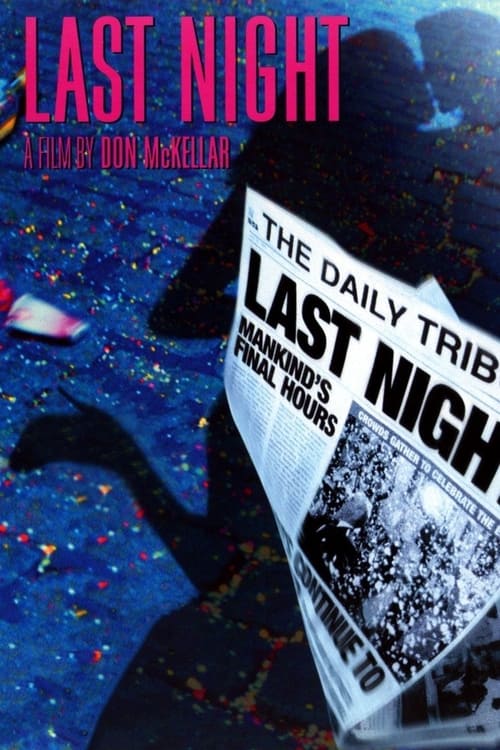
Last Night
1998 · Don McKellar
For when you want dark comedy with a real heart underneath — something small, talky, and human that earns its emotion honestly. Good for a reflective night; it will make you think about what you'd do with six hours.
What it's about
The world ends at midnight — everyone in Toronto knows it, nobody says why, and the sky stays eerily bright. With six hours left, the city's citizens attend to their final logistics: a family throws one last out-of-season Christmas dinner, a man works through a checklist of experiences he never had, a gas-company executive personally phones customers to promise service until the very end, and a widower who planned to die alone finds a stranger in his apartment who needs his help.
The experience
Dry, deadpan, and quietly devastating — it plays the apocalypse for wry Canadian comedy for an hour and then, without warning, becomes one of the most tender things you've ever seen. The lack of panic is the whole point; the calm gets under your skin.
Performances
Don McKellar directs himself as the prickly widower and lets Sandra Oh, as the stranger stranded in his apartment, carry the film's emotional weight — her performance builds from comic exasperation to something piercing. David Cronenberg's dry turn as the dutiful gas-company man is a small marvel of straight-faced absurdity.
The craft
McKellar's directing debut treats doomsday as a scheduling problem, and the script's discipline — never explaining the end, never showing chaos beyond street level — is what makes it work. The perpetual daylight gives the whole film an uncanny glow, and the interlocking stories click together with the precision of a good short-story collection.
Why it matters
A defining film of the 1990s Toronto new wave and a cult favorite of the pre-Y2K moment, it quietly rewrote what an apocalypse movie could be: no spectacle, all people.
Snapshot
Last Night is an apocalyptic film with no apocalypse in it. Toronto has six hours until the world ends — the mechanism is never named, the sky is permanently bright, and nobody in the film asks why. What remains is logistics: a family holds a Christmas dinner out of season because there won't be another; a man works his way methodically through a list of sexual experiences; a gas-company executive telephones every customer to promise service until the end; a widower plans to die alone and finds a stranger in his apartment instead. Don McKellar, until then known chiefly as an actor and as co-writer of Bruce McDonald's Roadkill and Highway 61 and of Atom Egoyan's Exotica, made his directing debut with a film that treats the end of everything as a scheduling problem.
The film emerged from 2000, Seen By…, a French-initiated commissioning series in which producers at Haut et Court invited directors from different countries to make features about the approach of the millennium for broadcast and release around 2000. McKellar's contribution was the Canadian entry. That origin matters: the budget was small, the delivery window fixed, and the brief — the millennium — was one nearly every participant answered with irony. McKellar answered it with an emotional literalism that most of the other entries did not attempt.
It premiered at Cannes in 1998 in Un Certain Regard, where it won the Prix de la Jeunesse, and it swept a substantial share of that year's Genie Awards in Canada. It remains the film by which McKellar is primarily known as a director, and one of the small number of English-Canadian features of the 1990s to have entered the international art-house conversation on its own terms rather than through a festival-circuit auteur already established there.
Industry & production
The 2000, Seen By… series was structured as a set of low-budget, contractually constrained commissions — roughly ten films from roughly ten countries, produced for European television with theatrical windows in some territories. Participants included Hal Hartley (The Book of Life), Tsai Ming-liang (The Hole), Alain Berliner, Daniela Thomas and Walter Salles, Miguel Albaladejo, and others; the exact roster and the sequencing of releases varied by territory, and the series has never been distributed as a coherent set in North America. McKellar's film was made in Canada with Canadian production partners — the credited producers include Niv Fichman and Daniel Iron of Rhombus Media, the Toronto company then best known for arts documentaries and for The Red Violin — in coproduction with the French side.
Rhombus is the key institutional fact. The company had built a reputation on classical-music films and performance documentaries, and its production culture was oriented toward craft economy: small crews, controlled schedules, a strong relationship with Toronto's technical trades. Last Night was shot in Toronto on a compressed schedule, and the film's most conspicuous production constraint — that the apocalypse is entirely off-screen and unexplained — is inseparable from its budget. There is no effect that could not be achieved with a lighting decision, a crowd of extras, or a practical fire. Whether McKellar arrived at the no-spectacle conception for aesthetic reasons and found it convenient, or arrived at it because a Canadian commission film could not afford anything else, is not a question the historical record settles; both pressures plainly pointed the same way.
The film's Canadian financing sat within the funding architecture of the period — Telefilm Canada, provincial agencies, and broadcast presales were the ordinary components of an English-Canadian feature at this budget level — and its distribution followed the standard art-house pattern: Cannes premiere, festival circuit, Lions Gate handling North American release. It was a critical and awards success rather than a commercial one; specific grosses are not something I'd assert without the figures in front of me.
Casting drew almost entirely on the Toronto and Canadian film community rather than on imported names, with two deliberate exceptions: Sandra Oh, then early in a career built substantially in Canadian film and television, in the central female role, and David Cronenberg, in a substantial supporting performance as the gas-company executive. Cronenberg's casting is a coup that only reads fully from inside Canadian cinema — the country's most internationally legible director, playing a middle manager who keeps his appointments as the world ends. Callum Keith Rennie, Sarah Polley, Geneviève Bujold, Roberta Maxwell, and Tracy Wright fill out an ensemble that functions partly as a survey of the acting talent then working in English Canada.
Technology
Last Night is a 35mm film from the last years in which that was simply the default for a theatrical feature rather than a choice. It carries almost no technological signature of the late-1990s digital transition: no compositing of consequence, no digital intermediate (which was still a year or two from becoming available at all), no effects work beyond what a camera crew and a location could produce.
The one technological decision that organizes the entire film is the light. The end of the world in Last Night arrives at midnight, but the sky is daylight-bright throughout — a permanent, unexplained brightness that erases the ordinary cinematic signal of time passing. This is achieved photographically and through location and schedule management rather than through any post-production intervention, and it commits the production to a specific and difficult regime: interiors and exteriors must all read as lit by an impossible sun, and the film cannot use the standard grammar of dusk and darkness to communicate that the clock is running down. Instead, characters tell each other the time. The absence of one technology (effects) forces a redistribution of narrative work onto another (performance and dialogue).
The film's relationship to communications technology is more pointed. The telephone is the apocalypse's principal instrument. Cronenberg's character sits in an office working through a customer list, delivering a scripted reassurance about continuity of gas service; other characters use phones to reach people they will not see again, or fail to. In 1998 this is a landline world — the film sits just before mobile telephony became universal — and the fixedness of the phone is dramatically load-bearing: to make a call you must be somewhere, and being somewhere at the end costs you the chance to be somewhere else. The film's most-remembered technological image is bureaucratic rather than futuristic: a utility company maintaining its call sheet past the point of any conceivable purpose.
Technique
Cinematography
Douglas Koch shot the film. The photographic scheme is built on the perpetual daylight already described, and its consequences run through everything: a flat, even, unromantic brightness that refuses the visual signals of doom. There is no red sky, no ash, no chiaroscuro. The apocalypse is photographed in the register of a clear afternoon.
Framing is generally unshowy — medium shots, a camera that stays close to eye level, coverage that favors the actors' faces over the geography of the crisis. Koch shoots Toronto as a recognizable, mid-density North American city: streets, apartments, a rooftop, a car. Crowd scenes are handled at a scale the budget permits, and the film is careful not to attempt vistas it cannot deliver; when the streets fill, we see them at street level, in fragments, from inside the characters' immediate space rather than from any vantage that would organize the chaos into spectacle.
The single deviation from this restraint is the film's final movement, which shifts into a much more intimate and formally deliberate register — a sustained closeness that the preceding film has been withholding. The effect depends on the plainness of everything before it.
Editing
Reginald Harkema cut the film. The structural task is the standard one of the multi-strand ensemble picture — intercut several parallel lines so that they converge — but with an unusual constraint: the film has a hard external clock, and the audience must always know roughly how much time is left. Harkema's cutting solves this partly through repeated, explicit time markers and partly through an accelerating rhythm, so that the intercutting quickens as midnight approaches and the strands begin to intersect physically as well as thematically.
The film is not aggressively cut. Scenes are allowed to play, particularly the family-dinner sequence and the two-hander scenes between Oh's and McKellar's characters, and the comedy depends on holding shots long enough for social awkwardness to become unbearable. The editing's real achievement is tonal management: Last Night moves between farce and grief within single sequences, and the cutting has to make those transitions without signposting them.
Mise-en-scène / staging
The production design is deliberately unaltered. Apartments look like apartments; the family house looks like a family house; the gas company office looks like an office. Nothing has been dressed to indicate catastrophe. The apocalyptic content is carried almost entirely by behavior — what people do in unchanged rooms — and by small, precisely chosen incongruities: the out-of-season Christmas dinner with its tree and its gifts, staged with full domestic correctness in what is not December.
Streets are staged as a spectrum of end-of-world behaviors running in parallel: celebration, looting, religious observance, violence, indifferent walking. The film treats these as background texture that characters pass through rather than as set pieces. McKellar's staging principle throughout is that the world's ending is a public event happening to a lot of people at once, and the film's job is to stay with a few of them rather than to survey it.
Sound
The sound design commits to ordinariness in the same way the image does. There is very little score in the conventional sense; the film's most prominent music is diegetic, most memorably a countdown radio broadcast working through a list of the greatest songs of all time, which supplies both a clock and a running ironic commentary. The choice of Pete Shelley's "Ever Fallen in Love (With Someone You Shouldn't've)" as a recurrent presence gives the film a specific pop-cultural anchor — a song about misdirected desire, playing over a night in which everyone's desires are being redirected by a deadline.
Alexina Louie and Alex Pauk are credited with the film's music. The scoring is sparing, arriving mainly at the end, and the restraint through the body of the film is what allows the final passage to land. Ambient sound does much of the work elsewhere: street noise, telephone rings, the flat acoustics of interiors.
Performance
The acting is the film's central technique. McKellar directs a large ensemble toward a shared register of understatement, and the comedy and the grief both emerge from what characters decline to say.
Sandra Oh's Sandra is the film's motor — a woman with a plan (get home to her husband, die with him as agreed) whose plan is defeated by traffic and circumstance, and whose increasing desperation is played as competence under strain rather than as hysteria. McKellar's own Patrick is the counterweight: a widower who has decided on solitude, played with a withholding flatness that the film gradually reveals as grief rather than affect. The pairing works because neither performance reaches for the emotion; the film arranges circumstances until the emotion becomes unavoidable.
Cronenberg's Duncan is the film's most quoted performance — a man performing customer service into the void, delivered with an absolute absence of irony that makes it funny and then makes it unbearable. Callum Keith Rennie's Craig, working through a sexual checklist, is played as a project manager rather than a libertine. Sarah Polley, Geneviève Bujold, and Roberta Maxwell contribute sharply defined smaller turns. Tracy Wright, a fixture of Toronto's theater and independent film scene, brings the specific deadpan that ran through much of that community's work.
Narrative & dramatic mode
The film's structure is a countdown ensemble: multiple loosely linked characters, a fixed and publicly known deadline, intercut strands that converge. What distinguishes it is the completeness of its refusal to explain. We are never told what is ending the world, when it was announced, or how long people have known. The film begins at roughly six hours to midnight and simply proceeds. This is not coyness — the mechanism is not withheld for a reveal — it is a structural axiom. The catastrophe is treated as a given, like weather, and the drama is entirely about arrangements.
That axiom generates the film's dramatic mode, which is comedy of manners under terminal conditions. The characters' problems are almost all social: how to have a last conversation, how to get across town, how to decline an invitation, how to tell someone something you should have told them years ago. Politeness persists. People apologize. The family dinner is a masterclass in the survival of familial irritation past the point of any consequence.
Tonally the film runs multiple registers at once and refuses to resolve them into a single key. It is genuinely funny — the sexual checklist, the gas company calls, the mother's fixation on gifts — and genuinely devastating, and it moves between these without transitional signaling. The ending, which I won't describe in detail, resolves the central pairing in a way that has been much discussed; its power comes from the film having earned an emotional register it spent ninety minutes declining to use.
Notably, the film has no heroism available to it. Nothing anyone does can change the outcome, which removes the engine of nearly every other apocalyptic narrative. What replaces it is the question of how to spend the remaining time, which is a question about values rather than action.
Genre & cycle
Last Night arrives at the crest of the late-1990s millennial apocalypse cycle, and defines itself against it. 1998 was the year of Armageddon and Deep Impact, both organized around the premise that catastrophe can be averted by American technical competence and sacrifice. The broader pre-Y2K moment produced a run of films preoccupied with endings, simulation, and the turn of the millennium — The Truman Show and Dark City the same year, The Matrix and eXistenZ the next, Strange Days a few years earlier with its own New Year's Eve countdown.
Against this, Last Night belongs to a much smaller tradition of apocalypse-as-domestic-drama: films where the end is certain, unopposable, and the subject is conduct rather than survival. Its clearest antecedent is Stanley Kramer's On the Beach (1959), which likewise handles annihilation through the manners of people waiting for it. There are affinities with the intimate-scale nuclear films of the 1980s in their attention to ordinary households, though Last Night has none of their political address — no cause is named, so no one is to blame.
Its other generic home is the multi-strand urban ensemble film of the 1990s, the mode Altman revived and Anderson, Haggis and others would extend. Last Night uses that architecture but declines its usual payoff: the strands converge without any revelation of hidden connection, because the connection is simply that everyone is in the same city on the same night.
The film's forward influence within its own genre is legible. Seeking a Friend for the End of the World (2012) works substantially the same premise — a known, unopposable apocalypse, a road-and-romance structure, comedy giving way to sincerity — in a Hollywood register. Melancholia (2011) and Perfect Sense (2011) share the certainty and the domestic scale, arriving at very different tones. Whether these constitute direct influence or convergent solutions to the same premise is not something the record establishes in every case; the resemblance to Seeking a Friend is close enough that the comparison became a critical commonplace on that film's release.
Authorship & method
McKellar came to directing through writing and acting, and Last Night is legible as the work of a writer-performer. His screenwriting credits before it — Roadkill (1989) and Highway 61 (1991) with Bruce McDonald, in both of which he also acted, and Exotica (1994) with Atom Egoyan, in which he appeared — place him at the center of the Toronto New Wave, the loose cohort of English-Canadian filmmakers who emerged through the 1980s and 1990s. He would go on to direct Childstar (2004) and The Grand Seduction (2013), and to work extensively in theater and television, but neither directing credit has displaced Last Night as his signature.
His method here is essentially dramaturgical: build a premise that forces characters into their last honest conversations, then get out of the way. The direction shows minimal interest in visual authorship for its own sake, and considerable interest in tone, timing, and ensemble.
Douglas Koch (cinematography) was and remained a significant figure in Canadian film and television photography, with a body of work including Picture Claire, The Way of the Fish, and extensive series work. His contribution here is a discipline of restraint — the daylight scheme and the refusal of expressive lighting are the film's most consequential formal decisions.
Reginald Harkema (editing) cut for the Toronto independent scene through this period, including work with Bruce McDonald, and later directed his own features (A Girl Is a Girl, Monkey Warfare, Leslie, My Name Is Evil). His editorial sensibility — attentive to performance, willing to let scenes sit — matches the film's needs precisely.
Alexina Louie and Alex Pauk (music) are Canadian concert-music figures rather than career film composers; Louie is one of the country's most performed contemporary composers, and Pauk is a conductor and founder of the Esprit Orchestra. Their involvement reflects Rhombus Media's roots in classical-music filmmaking, and the score's sparseness and its late arrival are consistent with a compositional rather than a functional-scoring approach.
Niv Fichman and Daniel Iron (production, Rhombus Media) supplied the institutional frame. Rhombus's willingness to back a first-time director on an internationally commissioned feature is the reason the film exists in this form.
The recurring collaborative fact is that these are all figures of the same Toronto milieu, working within a scene small enough that everyone had worked with everyone. The film's texture — its deadpan, its dislike of grandiosity, its ensemble comfort — is a scene's texture as much as a director's.
Movement / national cinema
Last Night belongs to the Toronto New Wave and, more broadly, to the English-Canadian art cinema that became internationally visible in the late 1980s and 1990s through Egoyan, Cronenberg, Patricia Rozema, Bruce McDonald, Guy Maddin (from Winnipeg, on a separate track), and later Vincenzo Natali. McKellar is a connective figure in that group — writer for McDonald, writer and actor for Egoyan, actor for Cronenberg's eXistenZ the following year, and now director in his own right, with Cronenberg acting for him.
The film's Canadianness is not thematic in any declarative way; nobody discusses the nation. It is instead a matter of scale and affect. The film's mode — quiet, ironic, suspicious of American emotional and narrative bigness, set in a Toronto that is allowed to be Toronto rather than standing in for New York — reads as a specific position in the long-running Canadian argument about whether the national cinema should compete with Hollywood or define itself against it. Last Night is unambiguously the latter. Made in the same year that Hollywood released two asteroid movies, it is a film in which the disaster has no cause, no hero, and no third act rescue, shot on Toronto streets that the industry usually disguises.
The international coproduction frame is equally characteristic. English-Canadian features of this budget class routinely depended on European partners and broadcast money; 2000, Seen By… gave McKellar access to a European commissioning structure that Canadian financing alone would not have supplied, and simultaneously placed the film in a comparative international context at Cannes.
Era / period
The film is precisely dated in ways that have only become more visible. It is a pre-Y2K film, made during a period of genuine, widely reported anxiety about the century rollover and the technical failure of infrastructure — an anxiety the film absorbs and abstracts. It is a landline film, made at the last moment when a phone was a place. It is a film in which television and radio are the mass media of record; the countdown broadcast structures the night in a way no post-broadcast media environment could reproduce.
It is also, unmistakably, a pre-9/11 apocalypse film. Its catastrophe has no perpetrator, no politics, and no security dimension. Nobody is responsible; there is nothing to be defended against; the state is essentially absent except as a utility company that keeps calling. Apocalyptic cinema after 2001 could rarely maintain that innocence, and later viewings of Last Night often register this as the quality that most clearly locates it in its moment.
Within Canadian film history it sits at the high-water mark of the 1990s English-Canadian art cinema, after Exotica (1994) and The Sweet Hereafter (1997) had established that the country's directors could compete at Cannes, and before the industry's structural shift in the 2000s toward service production and a different funding environment.
Themes
Time as the only remaining resource. With outcome fixed, everything becomes allocation. Characters ration hours the way people ordinarily ration money, and the film's moral scheme is entirely about what they choose to spend the remainder on — sex, family, work, solitude, a stranger.
The persistence of the ordinary. The film's central observation is that people do not become other people under extremity. The mother still cares about the gifts. The gas executive still honors his commitments. Manners, embarrassment, irritation, and politeness all survive intact into the final hour. This is presented as neither absurd nor heroic; it is simply what people are like.
Work as a form of meaning. Duncan's calls are the sharpest expression: labor continued past all utility, which the film treats simultaneously as absurdist joke and as genuine dignity. Craig's sexual list is the same impulse in another key — a project undertaken because having a project is preferable to not having one.
Grief and the refusal of consolation. Patrick's widowerhood is the film's emotional foundation, and his plan to spend the end alone is a form of grief management. The film's arc dismantles that plan, arguing quietly that connection is not chosen but arrives.
Intimacy with strangers. The Sandra–Patrick strand proposes that under a deadline, the distinction between intimate and stranger collapses. Two people who have known each other for hours are able to do something for each other that neither could do with the people they had planned to be with.
Apocalypse without meaning. Most end-of-the-world narratives supply a cause, and causes supply meaning — sin, hubris, war, ecology. McKellar withholds the cause and therefore withholds the meaning. What is left is not a judgment on humanity but a set of people, which is the film's implicit argument about what apocalyptic stories are usually avoiding.
Reception, canon & influence
Critical reception was strong from the Cannes premiere onward. Un Certain Regard selection and the Prix de la Jeunesse gave the film an international profile that a Canadian first feature would not otherwise have reached, and reviews consistently identified its distinguishing move: the choice to make an apocalypse film about behavior rather than event, arriving in the same season as Hollywood's asteroid pictures. The Cronenberg performance was singled out almost universally. At home the film was a major Genie presence, taking a substantial share of that year's awards including recognition for McKellar's direction and writing and for the supporting performances; the precise category list is a matter of record I'd want to check before enumerating.
The film's canonical standing in Canada is secure. It appears consistently on rankings of the best Canadian films — it has placed on the Toronto International Film Festival's periodic critics' polls of the top Canadian films of all time — and it is a standard text in Canadian cinema courses, generally taught alongside Exotica, The Sweet Hereafter, and Highway 61 as part of the Toronto New Wave unit.
Influences on the film (backward). The most direct antecedent is On the Beach (1959) and the wider tradition of waiting-for-annihilation drama. Structurally, the film draws on the multi-strand urban ensemble tradition that runs from Nashville through Short Cuts, and its handling of intercut strangers converging in a city on a single night has clear affinities with that mode. Within McKellar's own formation, the deadpan comic register and the tolerance for characters who explain nothing are recognizably continuous with the McDonald films he wrote and with Egoyan's cool handling of grief in Exotica — though McKellar's film is warmer and considerably funnier than either. The Buñuelian tradition of the dinner party as social crucible is audible in the family-dinner sequence, and Chekhov is a reasonable reference for the film's method of putting people in a room and letting them fail to say what matters.
What it shaped (forward). Last Night became the reference point for the intimate apocalypse, the film critics reach for whenever a small-scale end-of-the-world drama appears. The comparison was made repeatedly around Seeking a Friend for the End of the World (2012), which shares its premise closely enough that the resemblance was hard to ignore, and it recurs in discussion of Melancholia, Perfect Sense, These Final Hours, and the strain of television and film that treats catastrophe as domestic. Whether these are influences in the strict sense or independent arrivals at the same idea is not always determinable, and I'd rather state the resemblance than assert a lineage the record doesn't support.
Its Canadian influence is clearer. The film demonstrated that an English-Canadian feature could take on a genre premise entirely on its own terms — no American stars, no disguised Toronto, no spectacle — and succeed internationally, and it consolidated the working relationships and the deadpan sensibility of the Toronto independent scene into a film that circulated widely. For McKellar himself it remains the defining credit; for Sandra Oh it stands as an early lead role in a career that would become far more internationally visible; and for Cronenberg it is the strangest and most touching thing in his acting filmography.
The film has never had a large commercial afterlife, and its home-video availability has been intermittent, which has kept it somewhat under-seen outside Canada relative to its reputation. Among those who have seen it, it has the durable quality of a film that got a large subject exactly right by making it small.
A Deleuzian reading
David Cronenberg sits at a desk in a gas company office with a customer list in front of him.
The full Deleuzian reading of Last Night →
Reception
Landed in 1998 as the pointed art-house counterpoint to that summer's Armageddon and Deep Impact — the apocalypse as a quiet Toronto character piece — and it's since grown into a bona fide cult classic, rediscovered by a new wave of viewers during the pandemic as the end-of-the-world movie that actually felt true.
How Last Night was received, from release to now →
How to watch Last Night: what to notice on a first viewing
- Watch how bright and flat the sky stays all night. Douglas Koch shoots the six hours before midnight in the same even daylight throughout: no dusk, no red sky, no sign of how close the end is. The film refuses cinema's usual clock, a darkening sky, so you cannot see time passing; you can only hear people say it.
- Watch the family hold a full Christmas dinner, tree included. McKellar stages the meal with complete domestic correctness even though it is not December, and lets the scene run long enough for ordinary family irritation to surface. Manners and old grudges outlive any reason to have them; extremity does not transform people, it reveals who they already were.
- Watch the gas company man call every customer, one by one. David Cronenberg plays Duncan with total sincerity, courteous and on script, working through a call list that has no purpose left except itself. Work continued past all use becomes its own kind of dignity, absurd and genuine in the same gesture.
- Listen for the radio counting down the greatest songs ever. A countdown broadcast works through a list of all time favorites as midnight nears, doubling as both a clock and a running ironic commentary. The film has almost no score of its own; ordinary pop culture is left to carry the feeling instead.
- Follow how the separate storylines cut faster as midnight nears. Reginald Harkema intercuts several unconnected lives across Toronto, and the rhythm quickens as the deadline closes in, though the strands never resolve into one plot. The stories cross without anyone's actions changing the outcome, so watching becomes less about suspense and more about what people choose to do.
The whole guide to watching Last Night, with the keys for a rewatch →
Influences: the films it descends from and the films it influenced
- On the Beach (1959) — Kramer never puts the radiation cloud on screen and dramatizes annihilation entirely through calendar, ration-issued suicide pills and preserved social ritual — the wardroom, the Grand Prix, the last party — establishing the template Last Night follows in letting a countdown be carried by manners rather than by the phenomenon itself.
- The Exterminating Angel (1962) — Buñuel's guests are held by a rule the film flatly refuses to explain, and the formally set table becomes the arena where etiquette outlives its purpose — both halves of that device recur in Last Night's out-of-season Christmas dinner.
- The Bed Sitting Room (1969) — Lester plays post-nuclear Britain as a comedy of preserved decorum — class etiquette and BBC-style announcements continuing amid ruin — which is the direct genre precedent for apocalypse staged as a manners comedy instead of a survival thriller.
- Nashville (1975) — Altman's method of running a dozen unconnected urban lives on parallel tracks and tightening the crosscutting as they funnel toward one shared public event is the structural chassis of Last Night's approach to midnight.
- Testament (1983) — Littman keeps the entire nuclear exchange off screen and confines the film to one household's chores, school play and shrinking routines, shot in ordinary domestic light — the anti-spectacle apocalypse Last Night widens from a single house to a whole city.
- Miracle Mile (1988) — The apocalypse arrives by misdialed payphone and is thereafter managed entirely over landlines; De Jarnatt makes telephony the countdown's delivery system, the same device Last Night runs through Sandra Oh's hunt for a working phone and Cronenberg's courtesy calls to customers.
- Highway 61 (1991) — McKellar wrote it and played its lead, and the flat comic timing, the protagonist who withholds motive, and the small-town-Ontario affect are the screenwriting voice he carried intact into his own direction.
- Short Cuts (1993) — Altman modulates from farce to devastation inside a single cut and closes on an unexplained catastrophe that resolves none of the strands — the tonal modulation and the refusal of causal accounting that Last Night adopts wholesale.
- Exotica (1994) — Egoyan's Toronto interiors, where grief is conducted as private ritual and backstory is withheld from the audience by design, gave McKellar — who acts in the film — the cool, non-explaining performance register he later warms and slows down.
- 4:44 Last Day on Earth (2011) — Ferrara confines the last hours to one lived-in apartment and lets broadcasts and video calls running in the background carry the countdown — the diegetic-radio device updated to screens, with the same undressed interior doing the work of a set.
- Melancholia (2011) — The bulk of the film is a wedding dinner conducted under strict etiquette while the planet closes in, subordinating event to behavior and withholding the collision until the final seconds — the same refusal to let spectacle displace the manners study.
- Perfect Sense (2011) — An unexplained pandemic is measured only by what it does to eating, touching and coupling, covered at street level among crowds rather than in institutional or governmental scenes — Last Night's method of scaling catastrophe to sensory domestic detail.
- Seeking a Friend for the End of the World (2012) — The closest formal restatement: a precisely dated announced impact, a diegetic radio counting it down, an office and a dinner party carrying on regardless, and two near-strangers pairing off as the comic register modulates into tenderness in the last movement.
- It's a Disaster (2012) — Berger holds his entire apocalypse inside a couples' brunch, where social scorekeeping and passive aggression continue past the point of absurdity — the purest extension of the apocalyptic comedy of manners.
- These Final Hours (2013) — Hilditch runs a hard clock toward a firestorm in flat Australian daylight, accelerating the crosscut between a hedonistic party and a domestic obligation — Last Night's celebration-versus-obligation structure played without the comedy.
- The Saddest Music in the World (2003) — McKellar co-wrote and stars, bringing the same deadpan delivery of an absurd premise played entirely straight and the same characters who never state a feeling outright, transposed into Maddin's melodrama pastiche.
- Blindness (2008) — McKellar's own adapted screenplay applies his rule at feature length — an epidemic whose cause is never named, dramatized through the collapse and improvisation of social manners inside confined interiors rather than through any depiction of the event.
- Coherence (2013) — A dinner party in one undressed house is disordered by a passing comet the film never explains, registering the cosmic event only through the guests' deteriorating manners and improvised rules — the Buñuel dinner-crucible device executed with no visual effects at all.
Similar films
- Donnie Darko (2001) — shared sensibility
- The Last Wave (1977) — shared sensibility
- Late Night with the Devil (2024) — shared sensibility
- The Dead (1987) — shared sensibility
- Die Hard (1988) — shared sensibility
- Final Destination (2000) — shared sensibility
- Don't Look Up (2021) — shared sensibility
- Christmas in August (1998) — shared sensibility