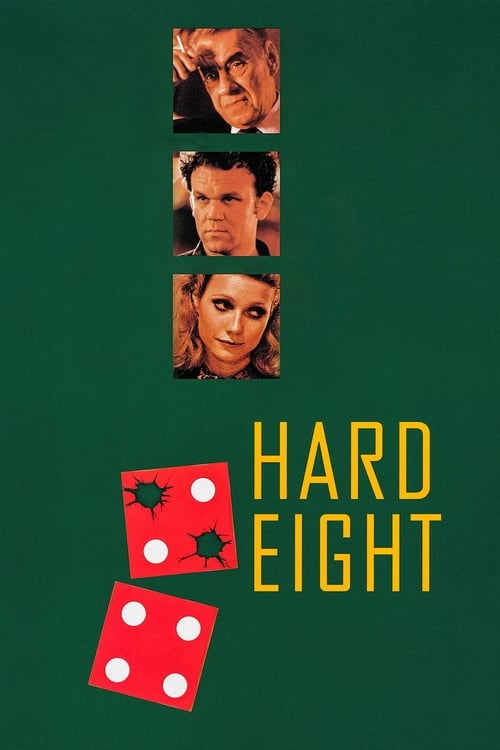
Hard Eight
1997 · Paul Thomas Anderson
For a late-night, low-key mood when you want a small, perfectly made crime story instead of fireworks — neon, cigarette smoke, and people talking softly about serious things. Comfortable to sink into, with a knot of tension underneath.
What it's about
Outside a Nevada diner, an aging, impeccably mannered gambler finds a young man broke and grieving, buys him coffee, and teaches him how to live off the casino economy without ever losing his cool. Years on, the kid has married a cocktail waitress who turns tricks on the side and befriended a loudmouth hustler — and one violent night forces his quiet mentor to reveal how far his protection goes, and why he offered it.
The experience
Hushed, patient, and quietly gripping — long conversations in coffee shops and casino lounges that keep tightening without you noticing. It's a slow burn built on watching one dignified man hold his composure while everything around him threatens to crack it.
Performances
Philip Baker Hall is the whole reason to watch: a masterclass in stillness, playing Sydney's courtliness as both armor and confession. John C. Reilly's guileless warmth and Samuel L. Jackson's needling menace orbit him perfectly, with Gwyneth Paltrow bruised and touching as Clementine.
The craft
Paul Thomas Anderson's debut is astonishingly assured — long unbroken takes, unhurried camera moves, and dialogue that reveals character while withholding backstory until it hurts. The Reno-Vegas world of felt tables and parking lots at dawn has a lonely glow that rewards patience.
Why it matters
The debut that launched one of the defining American directors of his generation and assembled the first version of his repertory company, announcing his gifts for surrogate-family stories in miniature.
Snapshot
Hard Eight is Paul Thomas Anderson's feature debut: a spare, controlled chamber drama in the guise of a casino crime picture. An aging, courtly gambler named Sydney (Philip Baker Hall) discovers John (John C. Reilly), broke and grieving outside a Nevada diner, and quietly takes him in, teaching him to live off the margins of the gaming economy. Years later, John has married a cocktail waitress who works the side as a prostitute, Clementine (Gwyneth Paltrow), and fallen in with a loud, menacing casino hanger-on, Jimmy (Samuel L. Jackson). A violent off-night involving Clementine forces Sydney to intervene, and the film gradually reveals the buried debt that explains his paternal generosity. Built from long takes, hushed conversations, and a deliberately withheld backstory, the film announces nearly every concern Anderson would pursue across his career — surrogate fatherhood, guilt and atonement, the makeshift families that form among the rootless — while remaining the most classical and restrained work he would make. It is small by design, and its reputation rests less on commercial impact than on what it inaugurated.
Industry & production
The film grew directly out of Anderson's 1993 short Cigarettes & Coffee, which screened at the Sundance Institute and centered on Philip Baker Hall in a diner; Anderson expanded that material into the feature, with Hall reprising the older-mentor figure. The production was financed through Rysher Entertainment and shot largely in and around Reno and Las Vegas. Anderson's preferred title was Sydney, after his protagonist.
The most consequential fact of the production is the conflict between the first-time director and his financiers. Anderson has discussed, in interviews over the years, that the company recut the picture and changed its title to the punchier, more genre-suggestive Hard Eight (a craps term) over his objections. By his account he fought to restore his version, reportedly going to considerable personal financial lengths to assemble a cut he could stand behind and to get that cut seen. The film was selected for the Un Certain Regard section at the 1996 Cannes Film Festival before its 1997 theatrical release in the United States. Distribution came through the Samuel Goldwyn Company.
The episode became part of Anderson's origin story: a young director clashing with a studio over final cut, an experience widely credited with hardening his insistence on creative control — leverage he secured immediately afterward with the much larger, self-evidently authored Boogie Nights (1997). Commercially, Hard Eight was a negligible performer; precise figures are best left to the trade record, but it is uncontroversial to say the film did not recoup attention until Anderson's subsequent success sent viewers back to it.
Technology
Hard Eight is a photochemical 35mm production made in the mid-1990s, before digital intermediates and digital capture reshaped independent filmmaking. Its technological profile is conventional for an American independent of its moment: anamorphic-minded widescreen composition, location and practical-light shooting in real casino and motel interiors, and optical/analog post. The film's interest is not in technical novelty — there are no effects set pieces — but in the disciplined use of standard tools: available and motivated light, long lenses and long takes, and a sound design built from room tone and the ambient electronic hum of slot floors rather than spectacle. In that sense the "technology" of the film is best understood as craft restraint, a deliberate refusal of the flashy.
Technique
Cinematography
The film marks the beginning of Anderson's long partnership with cinematographer Robert Elswit, who would shoot most of his work through Inherent Vice. Here Elswit's photography is notably patient and unshowy compared to the kinetic camera Anderson and he would unleash in Boogie Nights. Casino interiors are rendered in warm, slightly sour artificial light — the gold-and-amber palette of carpeted gaming floors, diner fluorescents, and motel-room lamps. The camera favors sustained framings and slow, motivated moves that hold on faces during long stretches of dialogue, trusting performance and composition rather than cutting for emphasis. Two-shots and over-the-shoulder framings dominate the central mentor relationship, visually binding Sydney and John together; the widescreen format lets Anderson place figures in tense relation across the frame, isolating them within the deadening symmetry of casino architecture.
Editing
Barbara Tulliver edited the film. The cutting is unusually restrained for a debut, privileging duration over momentum: scenes are allowed to breathe, conversations to play out close to real time, with information parceled out slowly. The film's dramatic engine is withholding — the editing strategy keeps the central question (why is Sydney doing this?) suppressed until late, so that the structure itself enacts the theme of buried debt. This patience stands in deliberate contrast to the accelerated, propulsive cutting that became an Anderson signature months later.
Mise-en-scène / staging
The film is essentially a series of interiors: diners, casino floors, hotel rooms, a coffee shop. Anderson stages action within these enclosed, transactional spaces, using the gaming environment as both literal setting and moral metaphor — a world of odds, comps, markers, and small cons where survival is a matter of working the system politely. Sydney's impeccable manners, his suits, his ritualized courtesy at the tables, are staged as a code of conduct in a place that has none. The blocking repeatedly frames Sydney as a still center against the restless figures of John and Jimmy, dramatizing the difference between composure and appetite.
Sound
The soundscape leans on the ambient drone of casinos — the electronic chirp of machines, the murmur of floors — to create a low-grade unease beneath the dialogue. The score is the work of Michael Penn and Jon Brion, collaborators who would recur in Anderson's early films (most prominently on Magnolia). Their contribution here is comparatively spare, supporting the film's melancholy rather than driving it. Dialogue and the texture of voices — Hall's measured cadence, Jackson's aggression, Reilly's puppyish uncertainty — carry the sonic weight.
Performance
Performance is the film's true subject and its greatest strength. Philip Baker Hall, a veteran character actor finally handed a lead, gives Sydney a tightly held gravity — courtly, watchful, wounded — that anchors everything; the role is widely regarded as the finest of his long career and the film functions partly as a showcase Anderson built for him. John C. Reilly's John is open-faced, slow, and needy, a register of guileless vulnerability Reilly would refine across his Anderson collaborations. Gwyneth Paltrow plays Clementine without vanity, bruised and transactional. Samuel L. Jackson's Jimmy supplies the film's menace, a vulgar, insinuating presence who weaponizes the secret at the story's core. Philip Seymour Hoffman appears in a brief, memorable scene as a brash craps player — an early instance of the repertory company Anderson would build around himself.
Narrative & dramatic mode
The film operates in a mode of withheld revelation. Superficially it follows the rhythms of a crime drama — a mentorship, a marriage, a killing, a cover-up, a blackmail — but its real structure is that of a slow moral disclosure. The audience is given Sydney's kindness long before it is given his motive, and the gap between the two generates the film's suspense. The dramatic mode is essentially tragic and confessional: a man performing penance whose generosity is revealed to be expiation. Anderson favors a deliberately oblique exposition, letting the audience assemble the situation from elliptical exchanges rather than stating it. The climactic confrontation between Sydney and Jimmy crystallizes the film's terms — a quiet man forced to act decisively to protect the surrogate family he has assembled to atone for the family he destroyed.
Genre & cycle
Hard Eight sits at the intersection of the casino/gambling picture and the character-driven American independent drama of the 1990s. It draws on the iconography of the gaming film — Reno and Vegas, markers and comps, the grift — but subordinates genre mechanics to character study. It belongs to the broader 1990s American indie cycle of talky, performance-forward crime dramas operating in the long shadow of the post-Reservoir Dogs moment, yet it pointedly rejects that cycle's irony and stylistic swagger in favor of a melancholic classicism. Within Anderson's own filmography it is the outlier of restraint, the chamber piece against which his later expansive ensembles measure themselves.
Authorship & method
The dossier here can be specific because the film is so clearly a foundational text in an auteur's development. Anderson wrote and directed, expanding his own short and building the project around an actor he admired. His method is already visible: writing roles for specific performers, assembling a recurring company (Reilly, Hall, Hoffman), and partnering with key technicians he would keep for decades — cinematographer Robert Elswit and composers Michael Penn and Jon Brion. Editor Barbara Tulliver cut this early work. The thematic preoccupations that organize his entire career — fathers and surrogate sons, guilt and the search for absolution, improvised families among the marginal — are present in concentrated, unembellished form. What distinguishes Hard Eight methodologically from what follows is its discipline: where Boogie Nights and Magnolia announce a maximalist sensibility, this film demonstrates that Anderson could also subtract, hold, and wait. The studio conflict over the cut and title is itself part of the authorship story, marking the moment Anderson resolved to fight for final control.
Movement / national cinema
The film is a work of American independent cinema of the 1990s, made within and against the institutional ecosystem of that movement — Sundance-incubated short, festival exposure (Cannes Un Certain Regard), independent financing and distribution. It is also legible as an early entry in the generation of American auteurs who emerged in the mid-to-late 1990s and reshaped Hollywood's relationship to the personal film. Geographically and culturally it is a Western American picture, rooted in the desert gambling economies of Nevada, a landscape Anderson treats as a moral as much as a physical territory.
Era / period
Produced and released in the mid-1990s, Hard Eight is contemporary to its moment — there is no period reconstruction. It captures a specific texture of pre-corporate-spectacle Reno and Las Vegas gambling culture: the world of solitary players, cocktail-waitress economies, motel rooms, and table-side etiquette, before the full theme-parking of the Strip dominated screen depictions of the city. The film thus has acquired, with time, an incidental documentary value as a record of a particular American milieu at a particular hour.
Themes
The governing theme is atonement: Sydney's paternal generosity toward John is gradually revealed as restitution for a past wrong, making the entire narrative an act of penance. Around this core cluster the related concerns that would define Anderson's cinema — surrogate fatherhood and the longing for a redemptive father figure; the improvised, chosen families that form among the lonely and the broke; guilt as a structuring force in a life; and chance, luck, and the gambler's relationship to fate as a metaphor for moral accounting. The casino is the film's central image of a universe governed by odds, where a man tries to buy back his soul one careful wager at a time. Dignity and codes of conduct — Sydney's manners as a form of self-imposed grace — run throughout, set against the appetite and crudity embodied by Jimmy.
Reception, canon & influence
On release the film was a commercial non-event and received comparatively modest attention, overshadowed almost immediately by Boogie Nights later the same year. Critically, however, it was received as a strikingly assured debut, with particular and lasting praise reserved for Philip Baker Hall's performance, frequently cited as a career-best for a long-underused actor. Over time its reputation has grown precisely as Anderson's stature has, and it is now read less as a minor film than as the essential first chapter of a major body of work.
Its influences backward are most clearly the American character-driven crime and gambling traditions and the lineage of patient, performance-centered filmmaking — the kind of acting showcase that values held shots and human texture over plot machinery; Anderson's own short Cigarettes & Coffee is its literal source.
Its legacy forward is chiefly internal to Anderson's career: it established his recurring repertory of actors (Reilly, Hall, Hoffman), his enduring technical partnership with Robert Elswit, his collaboration with composers Penn and Brion, and the thematic DNA — fathers, sons, guilt, and makeshift kinship — that recurs through Boogie Nights, Magnolia, and beyond. The bruising experience of losing control over the cut also shaped Anderson's subsequent insistence on authorial autonomy, which in turn helped model a path for director-driven American filmmaking at the turn of the century. As a film about debt and the long labor of repaying it, Hard Eight turned out to be the debt Anderson's later work would repay, the modest origin from which an outsized career was dealt.
A Deleuzian reading
He finds the kid sitting on the ground outside a diner off the highway, broke and beaten and going nowhere.
The full Deleuzian reading of Hard Eight →
Reception
It came and went in 1997 — barely released after a bruising studio fight, grossing almost nothing — but once Boogie Nights and Magnolia made PTA a name, cinephiles circled back and found a remarkably assured debut hiding in plain sight.
How Hard Eight was received, from release to now →
Influences: the films it descends from and the films it influenced
- The Killing of a Chinese Bookie (1976) — Builds its drama from a debt-bound proprietor through long, observational takes that privilege behavioral texture over plot machinery — the repertory-actor naturalism and held-shot patience Anderson adopts for Sydney.
- California Split (1974) — The unglamorized gambling-milieu two-hander with overlapping ambient floor sound; Hard Eight's casino-drone soundscape and Reno-table realism descend directly from Altman's dense, naturalistic mix.
- The Hustler (1961) — Widescreen gambling-hall composition wedded to a mentor/protégé moral education — the surrogate-father transmission of a hustler's professional craft that Sydney enacts with John.
- Atlantic City (1980) — Grants an aging small-time gambler (Lancaster) dignity and a late shot at absolution; the surrogate-fatherhood-as-atonement arc is the exact emotional engine Anderson centers on Sydney.
- The Friends of Eddie Coyle (1973) — Stages weathered criminals in low-key, transactional interiors lit by motivated practical sources and withholds exposition — the muted, talk-driven crime texture Hard Eight inherits.
- Mean Streets (1973) — Works Catholic guilt and penance through a small-time gambling-and-debt milieu, modeling the atonement-through-makeshift-kinship theme that organizes Anderson's film.
- Secret Honor (1984) — The single-actor Philip Baker Hall tour de force that convinced Anderson to write a lead role expressly for Hall, founding his method of building films around specific performers.
- The Gambler (1974) — A restrained character study of gambling as compulsion rather than caper spectacle, supplying the interior, performance-first approach to the casino picture that Anderson refines.
- Mikey and Nicky (1976) — Long-take, actor-driven nocturnal crime built on improvisatory naturalism and withheld backstory — the patient staging of two men in transit that Hard Eight echoes.
- Boogie Nights (1997) — Carries forward the same repertory (Reilly, Hall, Hoffman) and Robert Elswit's camerawork, expanding Hard Eight's improvised-surrogate-family-among-the-marginal into a maximalist ensemble.
- Magnolia (1999) — Scales the fathers-sons-guilt DNA and Anderson's Penn/Brion scoring partnership into a city-wide mosaic, repaying the thematic debt Hard Eight first dealt.
- The Master (2012) — Extends the withholding structure and the charged surrogate-father bond into a two-hander of mentorship and dependency, the mature form of Sydney and John's relationship.
- Owning Mahowny (2003) — A Philip Seymour Hoffman gambling-addiction study staged in flat, transactional casino interiors with affect deliberately subtracted — the restraint Hard Eight proved Anderson's company could sustain.
- Mississippi Grind (2015) — A patient gambling road two-hander built on surrogate mentorship and ambient, unglamorous naturalism, descending from the same California Split lineage Hard Eight refracts.
- The Cooler (2003) — The explicit kinship the dossier names: a casino-floor chamber drama built on a paternal old-pro and a marked, luckless younger man, played in long quiet takes on weathered faces rather than gambling spectacle.
- Croupier (1998) — A casino-interior neo-noir governed by withheld revelation and a controlled professional's detached perspective — the same year's sibling exercise in gambling-as-character rather than spectacle.
- Uncut Gems (2019) — Generates dread from sustained gambling tension and an immersive ambient-drone soundscape, the maximalist heir to Hard Eight's casino-floor sound design and debt-and-repayment structure.
Similar films
- Boogie Nights (1997) — influence & lineage
- The Master (2012) — influence & lineage
- Magnolia (1999) — influence & lineage
- The Killing of a Chinese Bookie (1976) — influence & lineage
- The Hustler (1961) — influence & lineage
- Revanche (2008) — shared sensibility
- The Driver (1978) — shared sensibility
- Donnie Brasco (1997) — shared sensibility
All the films related to Hard Eight →