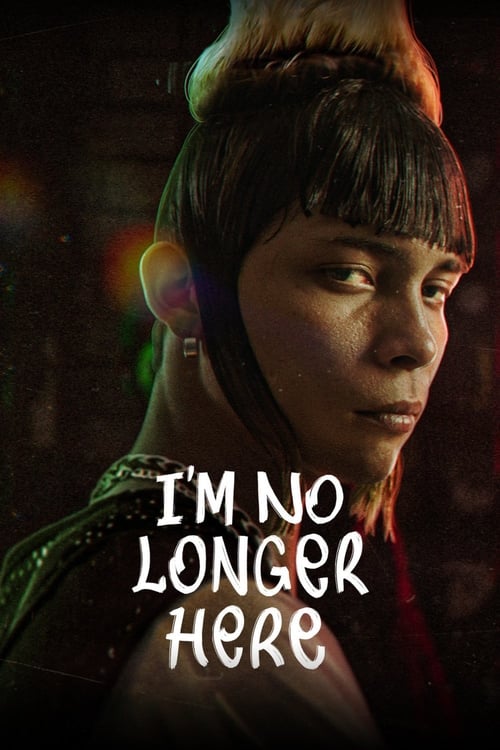
I'm No Longer Here
2019 · Luis Fernando Frías de la Parra
For when you want to be transported into a world you've never seen and come out aching a little — a film about belonging and displacement that rewards patience and an open heart. Emotional, not heavy-handed.
What it's about
In the hillside barrios of Monterrey, teenage Ulises leads Los Terkos, a crew whose whole world is cumbia rebajada — Colombian cumbia slowed to a woozy crawl — and the elaborate hair, clothes, and dancing of their subculture. A misunderstanding with local cartel power forces him to flee alone to Queens, New York, where nobody speaks his language, literally or culturally. The film moves between his exile and the home he can't stop missing.
The experience
Melancholy and immersive, moving to the languid rhythm of the music itself — it takes its time and trusts you to feel the homesickness rather than be told about it. The dance scenes are joyous; the loneliness in between is quietly devastating.
Performances
Juan Daniel García Treviño, a first-time actor, carries the film as Ulises with a guarded, watchful presence that cracks open only when he dances — you understand everything about him from how he moves.
The craft
The film is built on its soundtrack — slowed-down cumbia that sets the pace of the editing itself — and on a vivid documentary-like eye for the cholombiano subculture's style, from sculpted sideburns to baggy gear. The time-shuffled structure mirrors a mind living in two places at once; good speakers make the music hit the way it should.
Why it matters
It swept Mexico's Ariel Awards and became an international breakout for director Fernando Frías, putting the kolombia subculture on the world's screen and marking a high point of the recent wave of Mexican cinema about migration.
Snapshot
Ya no estoy aquí — released internationally as I'm No Longer Here — is a Mexican drama written and directed by Fernando Frías de la Parra (credited in some materials by his fuller name, Luis Fernando Frías de la Parra). Set principally in the working-class hill neighborhoods of Monterrey, Nuevo León, around the turn of the 2010s, it follows Ulises Samperio, the teenage leader of a small crew called Los Terkos ("the stubborn ones"), whose lives revolve around dancing to cumbia rebajada — Colombian cumbia slowed down to a narcotic crawl — and cultivating an elaborate youth subculture known as cholombiano or kolombia. When Ulises is caught on the wrong side of a misunderstanding involving local narco power, he is forced to flee to Queens, New York, where the film's second, exilic register unfolds. The picture cross-cuts between Monterrey and New York, so that the promise of migration is shadowed from the start by an ache to return.
The film is significant for at least three reasons. It is one of the most fully realized cinematic portraits of a genuine, ephemeral Mexican subculture; it reframes the migration narrative around cultural rather than purely economic loss; and it became a notable success within Mexico's awards ecosystem and on Netflix's global platform while pointedly not advancing at the Oscars, a discrepancy that itself became part of its story.
Industry & production
Ya no estoy aquí is an independent Mexican production that reached a mass audience through Netflix, which handled its wide distribution and made it available for streaming in 2020. The film premiered on the festival circuit in 2019 — the Morelia International Film Festival (FICM) is the venue most consistently associated with its Mexican bow — before its platform release the following year. I would treat any precise premiere-date and festival-award particulars with caution unless checked against a primary source, as the exact circuit itinerary is easy to misstate.
The production was mounted by a consortium of Mexican independent companies; PPW Films and Panorama Global are the entities most often named in connection with it, though I cannot confirm the full producing structure or financing breakdown with certainty and will not invent figures. No reliable budget or box-office numbers should be attributed to it here: as a largely non-theatrical, streaming-forward release, it does not carry the kind of transparent gross that a wide theatrical title would, and I have no verified figures to cite.
Institutionally, the film sits at the intersection of two support systems that have shaped recent Mexican cinema: state and quasi-state film funding (the ecosystem of IMCINE, FOPROCINE/EFICINE-type mechanisms that historically underwrite auteur-driven Mexican work) and the streaming capital that Netflix began pouring into Mexican production in the late 2010s. The film's afterlife — awards prominence plus a large, borderless streaming audience — is characteristic of this hybrid moment.
Technology
The film was shot digitally, the default for a production of this scale and period, and its images bear the flexibility of a modern digital workflow: available-light and low-light interiors, handheld mobility, and a wide tonal range from the sun-blasted hillsides of Monterrey to the gray, boxed-in light of New York. I do not have a verified record of the specific camera and lens package, so I will not name a system; the look is consistent with contemporary large-sensor digital capture rather than film origination.
Technologically, the more meaningful "apparatus" of the film is sonic and cultural rather than photographic. Cumbia rebajada is itself a technology of listening: the practice, rooted in Monterrey's sonidero (mobile sound-system) culture, of playing Colombian cumbia cassettes and records at reduced speed, deepening the pitch and stretching time. The subculture the film documents is inseparable from this manipulation of recorded sound, and the film's aesthetic — its sense of slowed, suspended time — is in effect an audiovisual translation of that analog practice.
Technique
Cinematography
The cinematography is credited to Damián García, whose work here is central to the film's identity. García distinguishes the two worlds visually: Monterrey is rendered with warmth, elevation, and openness — the crew perched on rooftops and hillsides above the sprawl, framed against big skies — while the New York passages are cooler, more enclosed, and more frontal, emphasizing Ulises's confinement and social invisibility. The camera favors a mix of composed, almost documentary observation and closeness to the performers, and it treats the dance sequences as events of real duration rather than montage fodder, letting the body move within the frame. The elevated Monterrey vistas do double duty as social geography, situating the cholombiano world in the marginal, self-built neighborhoods on the city's slopes.
Editing
The film's structure is built on parallel montage between past (Monterrey) and present (New York exile), and the editing carries much of the film's meaning: the intercutting steadily reveals what Ulises has lost by placing memory against displacement. The editor most commonly associated with the film is Yibran Asuad, a prominent figure in contemporary Mexican editing; readers should verify the credit against the film's titles, but the non-linear, memory-driven cutting is the film's defining formal gesture regardless of attribution. Crucially, the editing resists a tidy cause-and-effect chronology, so that the "mix-up" that triggers exile is disclosed gradually, keeping the emphasis on feeling and consequence rather than plot mechanics.
Mise-en-scène / staging
The mise-en-scène is dense with the material culture of cholombiano identity: the sculpted, gravity-defying hair and long sideburns, the oversized plaid and sportswear, the religious and pop iconography, the customized personal style that turned poverty's limits into flamboyant self-authorship. The staging privileges the group as a social body — Los Terkos are almost always framed collectively, sharing space, gesture, and rhythm — so that Ulises's later isolation in New York registers as a violence done to a way of being together, not just to an individual. Real Monterrey locations ground the film, and the film's costuming and grooming function less as decoration than as the argument of the film: that style is a form of dignity.
Sound
Sound is arguably the film's protagonist. Cumbia rebajada is the connective tissue of the whole picture, and the slowed, low, elongated music is both diegetic (the parties, the dances, the earphones) and structuring (it sets the film's tempo and mood). The contrast between the saturated soundworld of Monterrey and the comparative silence, or foreignness, of New York's soundscape dramatizes exile as a sensory deprivation. I do not have a confident record of a credited original composer, and given how thoroughly the film is built on pre-existing cumbia recordings and sound-system culture, I will not assert one; the "score," in practical terms, is the subculture's own music.
Performance
The film is carried by a largely non-professional cast drawn from or near the world it depicts, a choice consistent with the film's neorealist leanings. Juan Daniel García Treviño plays Ulises, and the performance is remarkable precisely for its interiority: Ulises is often near-silent, watchful, and self-contained, and García Treviño conveys longing, pride, and dislocation through posture, dance, and expression more than dialogue. The ensemble around him performs the crew's collective ease with a naturalism that reads as lived rather than acted, which is essential to the film's documentary charge.
Narrative & dramatic mode
The dramatic mode is realist and elegiac rather than plot-driven. Formally, the film is a non-linear diptych: an exile-present in New York braided with a Monterrey-past, the two timelines illuminating each other. Its through-line is not suspense about the cartel incident but the emotional logic of displacement — the discovery that "home" is not a place one can simply return to, because the subculture that made Ulises who he is is itself being ground down by violence and time. The migration story is thus inverted: where the conventional narrative arcs toward arrival and assimilation, this one arcs toward the impossibility of return and the quiet catastrophe of belonging nowhere. The ending resists redemption, favoring an ambivalent, open register in keeping with the film's melancholy.
Genre & cycle
Nominally a drama, the film sits at the crossroads of several cycles. It belongs to the coming-of-age tradition and to the international art-cinema strain of youth-subculture films, but it revises the Latin American "youth on the margins" cycle — long associated with hard-edged crime and violence realism — by centering dance, music, and style rather than criminality. It also participates in, and critiques, the migration film and the U.S.-Mexico border narrative, and it belongs to a lineage of music-driven films where a musical subculture is the film's subject and structuring principle. Against the dominant Mexican export image of narco-violence, it uses the drug war as an off-screen pressure rather than a spectacle.
Authorship & method
Fernando Frías de la Parra both wrote and directed the film, and it is unmistakably an authored work: a director's sustained attention to a specific, disappearing world, researched and reconstructed with evident care. His method here is ethnographic in spirit — building the film around a real subculture, casting from close to that reality, and letting music and milieu, not genre machinery, dictate form. Frías had previously worked in both fiction and documentary registers, and that hybrid sensibility is legible in the film's mixture of observational texture and constructed, memory-based structure.
Among key collaborators, cinematographer Damián García shapes the film's two-world visual grammar; the editing (associated with Yibran Asuad, subject to verification against the credits) realizes its temporal architecture; and the film's musical identity rests on cumbia rebajada and Monterrey sonidero culture rather than on a conventional composed score. The screenplay is Frías's own. Where I cannot confirm a specific below-the-line credit, I have flagged it rather than guess.
Movement / national cinema
The film is a product of twenty-first-century Mexican cinema, and specifically of its regional turn: it is emphatically a norteño film, rooted in Monterrey and Nuevo León rather than in the Mexico City–centric mainstream. It extends the tradition of socially engaged Mexican realism — the lineage that runs through the country's neorealist-influenced festival cinema — while giving voice to a subculture that had been documented in photography and journalism but rarely centered on screen. It should be read alongside the wave of Mexican films of the 2010s that combined auteurist form with attention to marginalized youth and to the human costs of the drug war, and within the broader movement of Latin American cinema that treats music and vernacular culture as sites of resistance and identity.
Era / period
The film's setting corresponds to roughly the early 2010s, the peak years of Mexico's militarized drug war, when Monterrey — long a prosperous industrial city — was convulsed by cartel conflict. That historical pressure is the film's hinge: the intensifying violence is what makes the cholombiano street world untenable and what forces Ulises out. The film is also, self-consciously, an elegy for a subculture that had largely faded by the time of production, so it operates as a period reconstruction of a very recent past — recent enough to be memory, distant enough to be already gone.
Themes
The film's central themes are displacement and belonging: the idea that identity is bound to a specific community, music, and place, and that to be removed from them is a kind of death of the self. Related threads include youth and self-invention (style as dignity and authorship under conditions of poverty); the drug war as an ambient, life-deforming force rather than a plot; the failure of the migration dream, reframed as loss rather than opportunity; and cultural memory — the film as an act of preservation for a subculture on the verge of disappearing. Music functions thematically as home itself: cumbia rebajada is not merely soundtrack but the sensory homeland Ulises carries and cannot fully recover.
Reception, canon & influence
Critical reception. The film was widely and warmly received as a distinctive, deeply felt work, praised in particular for its immersion in the cholombiano subculture, its sound design, and Juan Daniel García Treviño's central performance. Its Netflix release amplified its reach far beyond the festival audience typical for a film of its kind.
Awards and canon. Within Mexico, it was a major awards presence, winning heavily at the Ariel Awards (Mexico's national film honors), including in the top categories; it is frequently cited as having swept that ceremony, though the exact number of statuettes should be confirmed rather than asserted. It was selected as Mexico's official submission for the Best International Feature Film Oscar. Its failure to be shortlisted became a minor cause célèbre: leading Mexican filmmakers publicly voiced support for the film and disappointment at its omission, a reaction that reflected the film's standing among peers. (The specific wording of any such statements should be checked against the record rather than paraphrased as quotation.)
Influences on the film (backward). The film draws on the tradition of neorealist and observational realism, on the documentation of cholombiano culture in photography and journalism that preceded it, and on the long history of Monterrey sonidero and cumbia rebajada practice — cultural sources more than cinematic ones. Its structural use of parallel past/present editing places it within the art-cinema tradition of memory-driven, non-linear narration.
Legacy (forward). Its most concrete legacy is the emergence of Juan Daniel García Treviño as a screen actor and the elevation of Fernando Frías's international profile. More broadly, the film stands as a landmark in the visibility of regional Mexican youth cultures on screen and as a counter-model to narco-spectacle: a demonstration that a marginalized subculture can anchor a film of international reach on its own aesthetic and emotional terms. Because it is recent, its full influence on subsequent filmmaking is still taking shape, and I will not overstate a lineage that has not yet fully declared itself.
Reception
It slipped out of the 2019 festival circuit quietly, then exploded when Netflix dropped it worldwide in May 2020 — pandemic word-of-mouth, an Oscar shortlist spot, and a near-sweep at the Ariels turned it into one of the defining Mexican films of its era almost overnight.
How I'm No Longer Here was received, from release to now →
How to watch I'm No Longer Here: what to notice on a first viewing
- Notice how open and elevated the Monterrey scenes look. Damián García shoots the crew on rooftops and hillsides against big skies, warm and open, while framing shifts cooler, tighter, and more frontal whenever the story moves to New York. The two cities get two different cameras, so you feel the confinement before anyone says a word about it.
- Notice the hair, sideburns, and plaid the crew wears. The film lingers on cholombiano style, sculpted hair, long sideburns, oversized plaid and sportswear, treating grooming and costume as carefully as any dialogue scene. The style is presented as its own kind of authorship, dignity built out of very little.
- Notice the crew almost always moves as one group. Los Terkos are framed together, sharing space, gesture, and rhythm, so the film treats the crew itself as a single social body rather than separate individuals. Watching them share a frame is how the film shows you what belonging actually looks like.
- Listen for the slowed, low pull of the cumbia. Cumbia rebajada, cumbia slowed to a narcotic crawl, runs through parties, dances, and earphones alike, setting the film's actual tempo more than any dialogue does. The music is the film's real structure, not a soundtrack laid on top of it.
- Watch how much Ulises says through posture instead of speech. Juan Daniel García Treviño plays Ulises near silent and watchful, carrying longing and pride through his stance, his dancing, and small shifts in expression. You end up reading his whole interior life off his body, since the dialogue rarely offers it directly.
The whole guide to watching I'm No Longer Here, with the keys for a rewatch →
Influences: the films it descends from and the films it influenced
- Bicycle Thieves (1948) — The foundational neorealist protocol Frías inherits — non-professional leads cast for lived texture, real streets over sets, and everyday marginality dictating incident rather than plot machinery.
- Los Olvidados (1950) — Established the Mexican template of the marginalized-adolescent barrio ensemble filmed with real slum youth and without redemptive sentiment, the unsentimental cerro-kid portraiture Frías extends to Monterrey.
- Saturday Night Fever (1977) — The working-class youth for whom the dance floor and one specific music are the only arena of self-worth — the style-as-dignity/dance-as-escape structure Frías transposes from disco to cumbia rebajada.
- Pixote (1981) — Documentary-realist casting of an actual street child whose untrained bodily presence carries the film, the non-professional interiority-through-body Frías draws from Juan Daniel García Treviño.
- Wild Style (1983) — Treats a street subculture's own aesthetics (graffiti, breakdance, MCing) as the film's very form and casts its real practitioners, the precedent for letting cholombiano fashion and dance, not genre, generate the picture.
- The Godfather Part II (1974) — The canonical parallel-montage migration diptych, intercutting an immigrant's arrival in America with a present-day timeline — the two-era/two-place cross-cutting Frías inverts across his Monterrey/Queens structure.
- Do the Right Thing (1989) — The block rendered as a saturated subcultural mise-en-scène whose territory is defined by a character's diegetic boombox, the same music-marks-space logic cumbia rebajada performs for Frías's neighborhood.
- La Haine (1995) — The estate crew moving as a single social body through a stylized youth subculture of dress and argot, the group-as-social-body staging Frías gives Los Terkos.
- Beau Travail (1999) — Renders interiority through choreographed bodies and detonates it in a final solo dance, the interiority-through-body and long-take-dance grammar Frías centers on Ulises.
- In the Mood for Love (2000) — A recurring, tempo-slowed musical motif functioning as the film's emotional-temporal architecture, the diegetic-structuring-music logic that cumbia rebajada's dragged BPM performs for Frías.
- City of God (2002) — Hillside-slum elevated vistas plus a cast drawn from the favela community and time-jumping non-linear structure — the visual-and-casting grammar Frías applies to Monterrey's cerros.
- Rize (2005) — Documents a marginalized-youth dance subculture (krumping) as an explicit assertion of dignity, the style-as-dignity ethos Frías dramatizes through cholombiano dancing.
- Sin Nombre (2009) — A Mexican gang-youth and Central-American-migration film shot with non-professionals on real trains, whose northbound direction Frías deliberately inverts into forced return.
- Güeros (2014) — A Mexican youth-subculture film built on a music-quest structure and expressive form with non-professional energy, part of the same regional new-wave that Frías's film belongs to.
- American Honey (2016) — A non-professional youth ensemble roving as a music-bonded social body, with pop tracks and group choreography structuring scenes rather than plot, close kin to Frías's Terkos.
- The Florida Project (2017) — Non-professional casting of a marginalized community shot in saturated color that finds dignity in milieu without narrative machinery, a direct methodological sibling.
- Roma (2018) — Memory-driven reconstruction of a specific Mexican milieu anchored by a non-professional lead and carried to international awards reach, the contemporaneous Mexican model Frías's film stands beside.
- Atlantics (2019) — Tells a migration story from the vantage of those who stay and return, with non-professional leads, sharing Frías's inverted-migration and displacement-and-belonging framing.
Similar films
- Güeros (2014) — influence & lineage
- Roma (2018) — influence & lineage
- I'm Still Here (2024) — shared sensibility
- The Mysterious Gaze of the Flamingo (2025) — shared sensibility
- I Dream in Another Language (2017) — shared sensibility
- The Currents (2025) — shared sensibility
- Foreign Land (1996) — shared sensibility
- Identifying Features (2020) — shared sensibility