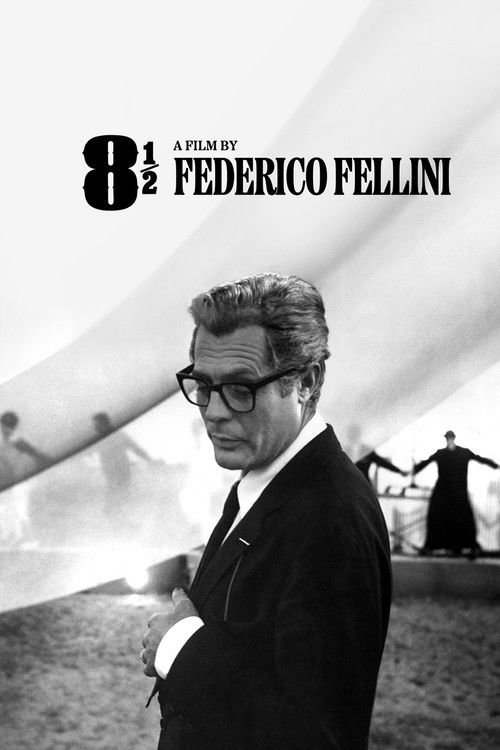
8½
1963 · Federico Fellini
For when you're creatively stuck, or just want to be swept up in something gorgeous and alive — a film to get lost in on a night when you want cinema at full imaginative power. More rewarding than demanding, though it asks you to surrender to its drift.
What it's about
A famous film director arrives at a spa resort to rest and instead finds everyone who wants a piece of him already there: his producer, his wife, his mistress, actors angling for parts, all waiting for a film he has no idea how to make. Cornered, he escapes into daydreams, childhood memories, and fantasies of the women in his life, while the production machine grinds on around him. It's a film about making a film — and about a man taking inventory of his whole tangled life.
The experience
Playful, melancholy, and constantly surprising, it glides between reality, memory, and fantasy without warning — carnivalesque one minute, confessional the next. It's dazzling rather than difficult, and it ends on a note of pure joy.
Performances
Marcello Mastroianni is perfect as Guido — hiding behind dark glasses and charm, weary and boyish at once, making creative paralysis look like the most elegant crisis in the world.
The craft
The black-and-white photography is among the most beautiful ever shot — faces loom, crowds swirl, dreams erupt without a seam — and Nino Rota's circus-tinged score binds it all together. Every cut between fantasy and reality is a small magic trick. Made for the biggest screen you can find.
Why it matters
A permanent landmark: it redefined what personal filmmaking could be, and nearly every film ever made about the creative process stands in its shadow.
Snapshot
A film director named Guido Anselmi, paralyzed by creative doubt and surrounded by the claimants on his imagination — producer, wife, mistress, collaborators, starlets, mother, childhood ghosts — retreats into fantasy and memory while a costly production waits for him to make up his mind. Federico Fellini's 8½ is a self-portrait so candid it becomes an ontological argument: by dramatizing the impossibility of making the film, Fellini makes it. The result is one of the handful of films that permanently altered what cinema thought it could be — a work that folds autobiography, dream-logic, and formal invention into a single unbroken experience, and that has generated serious critical commentary for six decades without exhausting itself.
Industry & production
8½ arrived directly in the wake of Fellini's international breakthrough, La dolce vita (1960), which had been a phenomenon — commercially, culturally, and controversially. Its producer, Angelo Rizzoli, financed the follow-up on the strength of that success, and the pressure Guido feels throughout 8½ to deliver something worthy of his reputation mirrors Fellini's own position almost exactly. The self-referential dimension was not incidental: it was the film's engine.
Pre-production was notoriously unstable. Fellini spent months unable to define a subject and is widely reported to have arrived on set at Cinecittà — the great Roman studio complex that had housed Italian cinema since the Mussolini era — without a complete screenplay. He had assembled sets, cast actors, and begun shooting before the story had fully cohered. What emerged partly from this productive crisis was the film's defining subject: a man who cannot make a film. Fellini retrieved the situation by making it the content.
The screenplay is credited to Fellini, Ennio Flaiano, Tullio Pinelli, and Brunello Rondi — the loose collective that had collaborated on most of Fellini's films since the early 1950s, and whose working method was reportedly discursive and improvisatory rather than blueprint-driven. Flaiano in particular, a novelist and wit, contributed a sardonic intellectual edge; Rondi brought a more philosophical, oneiric sensibility. The dialogue for the Daumier character — the censorious critic who serves as Guido's conscience-in-opposition — is notably literary and precise, suggesting careful construction within what otherwise feels like a free-associative structure.
Technology
The film was shot in black and white at a moment when color was commercially dominant in prestige Italian productions. The choice was aesthetic, not economic. Fellini and his cinematographer Gianni Di Venanzo used the absence of color as a tonal instrument, collapsing temporal and ontological distinctions between present reality, memory, and fantasy into a continuous silver surface — there is no color-coding to warn the viewer that the register has shifted. The spa setting at the film's opening, the gleaming white of the health resort, the steam and the crowds, were composed to be simultaneously luxurious and clinical, specific and dreamlike.
The cameras used were suited to the intimate work Di Venanzo required: controlled low-key lighting within large studio spaces, with the ability to move through crowds and interiors in sequences of considerable length. Several pivotal scenes involve sustained tracking moves through architecturally complex sets, particularly the harem fantasy and the processional final sequence.
Technique
Cinematography
Gianni Di Venanzo is one of the central technicians of Italian modernist cinema. His work on 8½ represents the height of his powers: a black-and-white palette of unusual sophistication, capable of rendering the thermal springs as a purgatorial limbo, the childhood flashbacks as soft and enveloping, and the fantasies as charged with a theatrical brightness that is somehow still part of the same visual world as the "real" scenes. Di Venanzo did not rely on contrast alone to distinguish registers; instead, texture and depth of field modulate the emotional temperature without ever providing the viewer a stable grammar by which to decode what is "really happening." He died in 1966, aged forty-three, cutting short one of the major careers in European cinematography.
The film's most celebrated shot is its first: Guido trapped inside a car filling with gas, then lifting through the car's roof into the open sky — a fantasy of escape immediately punctured when a line attached to his ankle drags him back to earth. Di Venanzo achieves the sequence with studio construction and precise lighting rather than optical trickery, giving it a peculiar material weight.
Editing
Leo Catozzo edited the film, working in close collaboration with Fellini. The editing is deceptively fluid: sequences transition not on narrative logic but on emotional or associative logic, and the cuts between present action and memory or fantasy are often unmarked by conventional devices (dissolves, iris wipes) that would signal a mental departure. This was a deliberate and consequential formal decision. Fellini wanted the viewer to experience the intercutting the way Guido experiences his own mind — not as a departure from reality but as the continuation of it by other means. Catozzo's cutting rhythm shifts register between the sequences: the fantasy and memory passages tend toward longer takes, while the scenes with the producer, the journalists, and the test-screen entourage have a more agitated tempo.
Mise-en-scène / staging
Piero Gherardi, who had designed the costumes and sets for La dolce vita, returned in the same dual role. His production design for 8½ is organized around contrasts of mass and geometry: the crowds that fill nearly every "present" sequence — the spa visitors, the production staff, the relatives — versus the open spaces of dream and memory where Guido moves alone. The harem sequence, in which all the women of Guido's life inhabit a single white-walled house and serve him in domestic harmony, is Gherardi's most elaborate construction: a fantasy of total sovereignty staged with operatic excess, then systematically dismantled when the women revolt.
The film's most formally audacious staging occurs in the test-screen sequence, where Guido watches potential cast members emerge from darkness into harsh white light while a microphone captures and amplifies their voices. The sequence has the quality of an interrogation and a judgment simultaneously — Fellini turns the apparatus of film production into an instrument of exposure.
Sound
Nino Rota's score is inseparable from the film's identity. Rota had been Fellini's composer since Lo sceicco bianco (1952), and their working relationship was among the most productive in postwar European cinema. For 8½ he composed a suite of thematic fragments rather than a unified score: the circus march that recurs throughout is jaunty and slightly sinister, evocative simultaneously of festivity and compulsion. The famous waltz fragment, used in the harem sequence and at several other emotional pivots, carries the quality of a half-remembered popular song — nostalgic without being sentimental. Rota's music for Fellini consistently positions itself between diegetic and non-diegetic sound, as though the characters might themselves be hearing the music.
The film also uses actual musical sources in the soundtrack — Rossini fragments, the spiritual "La passerella di addio" — in ways that blend with Rota's original material. The final sequence, in which the characters from Guido's life form a parade and march together, is almost entirely music-driven, a formal resolution that substitutes emotional affirmation for narrative closure.
Performance
Marcello Mastroianni, at the height of his early-1960s prominence following La dolce vita and Antonioni's La notte (1961), plays Guido with a passivity that is itself a form of performance. He smiles, he defers, he escapes. The physical gestural repertoire is one of evasion and charm deployed as evasion — he moves through the film as someone who has made seductiveness into a survival strategy. Mastroianni has said in interviews that he modeled certain mannerisms directly on Fellini himself.
Anouk Aimée as Luisa, the wife, and Sandra Milo as Carla, the mistress, are positioned as contrasting archetypes who are also fully individuated people — the film's emotional credibility depends on neither character being simply a symbol. Claudia Cardinale appears in a role that blurs the boundary between character and idealization: she is simultaneously an actress Guido is trying to cast and a vision of purity he projects onto that actress. The degree to which Fellini intended this ambiguity to be resolved is part of what keeps the film active on repeated viewing.
Narrative & dramatic mode
8½ works through accretion and association rather than cause-and-effect plotting. Its time scheme is deliberately unstable: we are given no reliable map of how much calendar time the story occupies, and the intrusions of memory and fantasy are not flagged as departures from a "true" present. The film is often described as stream-of-consciousness, and the analogy is broadly accurate, though Fellini was working cinematically rather than literarily — the concerns are visual and rhythmic as much as psychological.
The dramatic mode owes something to the European theatrical tradition of the self-conscious artist: the film is in conversation with Pirandello's theater, with its awareness that performance pervades experience, and with the Proustian project of recovering the past through involuntary memory. But it strips the conventional theatrical device of the play-within-a-play of its ironic distance: Guido's fantasies are not cynically presented as consolatory illusions but as real experiences with real moral weight.
Genre & cycle
8½ is the defining example of what critics have called the "artist's block" film — a genre in which the problem of creation becomes the subject of the work. It inaugurated a cycle that proved durable: Bob Fosse's All That Jazz (1979) is the most obvious American descendant, structured almost identically around a self-destructive director-surrogate forced to confront his life through the lens of an impending production. Woody Allen's Stardust Memories (1980) is an explicit homage, sometimes verging on pastiche.
More broadly, 8½ belongs to the wave of European modernist art cinema that included Antonioni, Bergman, Resnais, and Godard, and that collectively remade the terms on which "serious" filmmaking was understood in the 1960s. Within that wave it occupies a particular position: it is the most autobiographical, the most formally exuberant, and the least despairing. Where Antonioni's films of the same period (L'avventura, La notte, L'eclisse) articulate estrangement as a condition without remedy, 8½ ends — however ambiguously — in something like acceptance.
Authorship & method
Fellini's method during this period was explicitly anti-schematic. He distrusted the written script as a blueprint and preferred to develop scenes through rehearsal, accident, and conversation on the set. The distance between the shooting script and the finished film was considerable, and Fellini has spoken of the editing period as a second act of discovery rather than a reduction of previously assembled material.
His relationship with Gianni Di Venanzo was more exploratory than prescriptive: Fellini set the emotional parameters of a sequence, and Di Venanzo solved the lighting problems with corresponding freedom. The result was a working relationship closer in spirit to the classical Italian tradition of the director-as-absolute-author than to the more collaborative models developing in France at the same time.
Nino Rota's contribution extended to thematic architecture. Fellini would often work to pre-existing Rota sketches rather than commissioning a score after picture lock — music helped generate the sequences rather than illustrating them after the fact.
Movement / national cinema
8½ stands at a complex point within Italian cinema. Fellini had emerged from neorealism — Paisà (1946), on which he worked as a writer for Rossellini — but by the mid-1950s his stylistic commitments had diverged sharply from neorealism's location-shooting, non-professional-actor, documentary-adjacent aesthetics. 8½ is in some sense the definitive refusal of neorealism: set almost entirely in studios and resort locations, built around a wealthy bourgeois protagonist, concerned with the inner life of an artist rather than the social conditions of ordinary workers, and formally self-conscious in ways that neorealism specifically rejected.
Yet the Italian context remains legible: the Catholic imagery throughout, the guilt-laden relationships with women, the provincial memory sequences, the character types drawn from commedia dell'arte — the blustering producer, the intellectual who cannot create — all belong to a specifically Italian cultural repertoire that Fellini had internalized from Rimini, from Rome, from the Church.
Era / period
1963 was the apex year of Italian cinema's international prestige. Il gattopardo (Visconti) won the Palme d'Or at Cannes that same year. The economic miracle of the late 1950s had transformed Italian society and provided the material and cultural conditions for an expansive, internationally competitive film industry centered at Cinecittà. 8½ appeared at the moment when that confluence of talent, resources, and cultural confidence was at its height — and also, as the decade progressed, at its culmination.
Themes
The film's animating preoccupation is the relationship between creative authority and moral evasion. Guido's inability to commit to a subject is also an inability to commit to a version of himself, to his wife, to any particular account of his own experience. The film asks whether these are the same failure or related ones.
The women in Guido's life — mother, wife, mistress, ideal — function less as characters in a social drama than as different modes of relation to the past. The childhood sequences, particularly the night in which the young Guido visits the beached prostitute Saraghina and is punished by his school, establish a pattern of desire, shame, and nostalgia that the film traces into adult life without resolving.
Catholicism — its rituals, its architecture of guilt, its specific vocabulary of transgression and absolution — permeates the film. The cardinal who dispenses gnomic wisdom at the spa, the mother transformed in fantasy into a vessel of impossible cleanliness, the confessional structure of memory itself: these are not external decorations but load-bearing elements of the film's moral architecture.
Reception, canon & influence
8½ won the Academy Award for Best Foreign Language Film at the 1964 ceremony and Best Costume Design (black and white). It received widespread critical acclaim upon release in Europe and, slightly more slowly, in the United States, where it became a touchstone for the American art-house audience developing in the early 1960s.
The film's critical reputation has been continuous and, if anything, has deepened over time. It appears among the highest-ranked films in every major critical survey, including the Sight & Sound decennial polls. Its status as the exemplary statement of meta-cinema — a film about filmmaking that transcends the limitations of that category — has never seriously been contested.
Looking backward, 8½ absorbed Bergman's introspective mode (particularly Wild Strawberries, 1957, in which an aging professor undertakes a retrospective journey through memory), Proustian principles of involuntary memory, and the surrealist tradition's legitimization of the dream as a primary rather than secondary reality. It also drew on Jungian psychology — the anima figures, the shadow, the confrontation with an integrated self — in ways that Fellini acknowledged obliquely and that commentators have pursued extensively.
Looking forward, the film's influence is everywhere in the subsequent history of art cinema. Fosse's All That Jazz is the closest structural echo. Woody Allen returned to the template multiple times, most directly in Stardust Memories. Paolo Sorrentino's The Great Beauty (2013) — another Rome-set account of an aging Italian artist stocktaking his life — is inconceivable without Fellini's example. Charlie Kaufman's Synecdoche, New York (2008) engages the meta-theatrical dimension from a very different cultural position but inhabits the same conceptual territory. The Broadway musical Nine (1982), adapted into a film by Rob Marshall in 2009, is a direct musicalization of 8½'s plot and thematic concerns.
The film also influenced a generation of filmmakers less interested in explicit homage than in its formal permission: the demonstration that personal, memory-driven, non-linear material could be handled with structural rigor and mass appeal simultaneously. In this sense 8½ is one of the founding documents of the international art cinema that developed through the 1960s and 1970s, and its formal strategies — the unmarked transition into fantasy, the use of music as emotional argument, the protagonist as unreliable narrator of his own inner life — have been so thoroughly absorbed into the general language of film that they are no longer recognizable as innovations. That is the usual fate of the truly transformative work.
A Deleuzian reading
Start with the traffic jam.
The full Deleuzian reading of 8½ →
Reception
No flop-to-classic story here — it won the Best Foreign Film Oscar and the Moscow festival's grand prize right out of the gate, though some early critics grumbled it was chaotic self-indulgence. That minority report lost: it's now a permanent fixture of Sight & Sound's top ten and the default answer to 'greatest film about filmmaking.'
How 8½ was received, from release to now →
Influences: the films it descends from and the films it influenced
- Wild Strawberries (1957) — Bergman's intercutting between the present-tense journey and involuntary memory-flashbacks without optical dissolves established the grammar of consciousness-as-cinema that 8½ deploys; Guido's daydreams erupt into waking scenes using Bergman's same unmarked cuts, treating interior time as spatially continuous with exterior reality.
- Hiroshima mon amour (1959) — Resnais's associative editing juxtaposing present lovemaking and traumatic memory without conventional transition signals pioneered the register-shift grammar 8½ deploys for Guido's intercutting of production reality and private reverie; Catozzo's cutting in 8½ is unintelligible without this precedent.
- Last Year at Marienbad (1961) — Resnais dissolved any stable boundary between experienced, imagined, and remembered by stripping dissolves and iris wipes entirely; Fellini absorbed this license to make fantasy and present cinematographically indistinguishable in 8½, warming the formal radicalism with autobiographical content.
- Voyage in Italy (1954) — Rossellini's abandonment of neorealist event-plotting for a protagonist's psychological disintegration as cinema's sole subject — rendered through location texture and performance rather than scripted action — established the Italian art-cinema template 8½ perfects and explicitly departs from neorealism toward.
- I Vitelloni (1953) — Fellini's method of autobiographical self-examination through a surrogate protagonist who cannot commit or mature — the dreaming provincial who watches rather than acts — is the behavioral template from which Guido Anselmi is directly descended; the evasive passivity Mastroianni embodies was first sketched here.
- La strada (1954) — Nino Rota's circus march as recurring emotional memory anchor — the theme returning to signal deeper feeling beneath surface action — established the leitmotif-as-consciousness device 8½'s recurring march exploits; the traveling-performer troupe as metaphor for creative community and isolation carries directly into 8½'s final carnival processional.
- La dolce vita (1960) — Mastroianni's evasive observer-protagonist at the center of an episodic spectacle-crowd structure without plot resolution is 8½'s direct behavioral template; the contrast between Roman celebrity pageant and private void, and the Cinecittà production grammar for staging crowd-versus-protagonist, carry into 8½ without revision.
- Nights of Cabiria (1957) — 8½ inherits Cabiria's episodic-accumulation editing structure and theatrical framing—staging that positions characters as performers in their own drama—while Nino Rota's leitmotif scoring, developed through Cabiria, becomes the organizing logic of the film's associative architecture.
- The Magician (1958) — Extends The Magician's artist-as-illusionist premise into full self-portrait: the filmmaker simultaneously exposed and protected by his apparatus of illusion, in existential crisis before his audience; Fellini replaces Bergman's Gothic severity with carnivalesque excess but inherits the double-register of imagination and reality as the structural device through which the artist-drama is organized.
- Lola Montès (1955) — Its closing circus-ring procession and its reflexive structure as a show about the making of its own show carry forward Ophüls's circus-as-metaphor and anti-illusionist machinery.
- Limelight (1952) — Advances the total-auteur move of turning the camera on one's own creative exhaustion and self-mythology, the confessional autobiography Limelight pioneered for a supreme entertainer.
- Testament of Orpheus (1960) — The self-portrait film in which the director stages his own creative crisis and gathers his personal cast as figures in a waking dream, Cocteau's 'filmmaker as subject' ethos made canonical.
- Persona (1966) — Bergman pushed 8½'s metafilmic self-reflexivity to rupture: the mid-film frame-melt, the projected grain, the splice — Bergman extends Fellini's gesture of a film examining its own conditions of existence into outright formal violence on the filmstrip itself, making the apparatus visible as 8½ had made the director visible.
- Amarcord (1973) — Fellini extends 8½'s unmarked memory-fantasy integration into collective provincial memory; the harem-operatic staging (the ocean liner Rex emerging from fog; Gradisca's imaginary suitor) directly descends from 8½'s harem sequence, deploying the same crowd-choreography-as-dreamwork with Di Venanzo's visual grammar now absorbed into the house style.
- Day for Night (1973) — Truffaut plays himself as a director named Ferrand managing an anxious production at Victorine Studios, extending 8½'s metafilmic logic while substituting documentary warmth for Fellini's fantasy sequences; the practical question of how a film actually gets made under human pressure replaces Guido's dream-evasion as the structural engine.
- All That Jazz (1979) — Fosse absorbed 8½'s structure of a creator whose work and self-destruction are inseparable: Joe Gideon's musical production numbers function as fantasy sequences in exactly Fellini's grammar, and the film ends with the director's death staged as a spectacular production number — Fosse's literalization of Fellini's metaphor that art and mortality are the same performance.
- Stardust Memories (1980) — Allen deploys Gordon Willis's high-contrast black-and-white cinematography and stages a filmmaker-protagonist besieged by fans, critics, and women in direct formal quotation of 8½; the crowd-versus-creator staging — admirers pressing against Sandy Bates from every angle while he retreats — replicates Di Venanzo's compositional grammar almost shot for shot.
- Irma Vep (1996) — Assayas deploys 8½'s production-crisis-as-film-subject structure: the paralyzed director René Vidal (Michel Piccoli), unable to complete his remake, is surrounded by collaborators and obligations while the project disintegrates around him — 8½'s formal blueprint of artistic breakdown performed in real production time, stripped of fantasy and rendered in the texture of French industry realism.
- Mulholland Drive (2001) — Lynch absorbed 8½'s method of unmarked register shift and extended it to an entire feature architecture: reality and dream interpenetrate without optical signals, and the film's second half retroactively reframes the first as fantasy — Fellini's technique of treating interior time as spatially continuous with exterior reality scaled to a structure of total narrative indeterminacy.
- Synecdoche, New York (2008) — Kaufman's artist's-block film restates 8½'s core formal problem at maximum metaphysical scale: Caden Cotard's theater-within-a-theater staging of his own life mirrors Guido's film-within-a-film, and the collapsing distance between creative work and lived experience — between the artwork and the life it consumes — is 8½'s recursive self-portrait logic run to its terminus.
- The Great Beauty (2013) — Sorrentino replicates 8½'s staging grammar — sustained tracking shots through Roman crowd parties followed by the protagonist's solitary withdrawal into empty dawn terraces — and casts a Mastroianni surrogate (Toni Servillo) whose evasive passivity and creative paralysis recapitulate Guido's structure; Luca Bigazzi's cinematography directly inherits Di Venanzo's crowd-texture-versus-open-space contrast.
- Nouvelle Vague (2025) — The canonical making-of-as-creation film, modeling the genre of process-driven narrative about an artist mid-production that the seed inherits.
- Sentimental Value (2025) — The foundational film-within-a-film about a blocked director mining his own intimate life for material, dissolving memory, fantasy, and production into one reflexive structure.
- La Grazia (2025) — Supplies the aphoristic, reverie-driven interiority and the structure of a powerful man weighing his life in paradoxes — the moral-paradox screenplay grammar Sorrentino reuses at lower volume.
- Contempt (1963) — Made the same year in the same Cinecittà-adjacent milieu with an explicitly blocked director-protagonist (Fritz Lang forced by a philistine producer to betray his vision), Godard's film constitutes a formal counter-argument to 8½: CinemaScope color and Brechtian distance versus Fellini's monochrome interiority — the two films are a dialogue about cinema's ethical obligations to itself.
- Billy Liar (1963) — Released the same year, it dissolves the boundary between a man's fantasies, memories and real life through fluid editing — the international counterpart to Billy's fantasy counterpoint.
- Chicago (2002) — The interpenetration of memory, fantasy, and reality within one protagonist's head — the source Fosse (and later Marshall) drew on for staging inner life as performance.
- White Nights (1957) — A Rota-scored studio fantasia that dissolves illusion into reality, pushing the same artifice-as-emotional-truth and illusion-versus-reality device toward reflexive extreme.
- The Hero (1966) — Turns a celebrated artist's creative and moral crisis inward through interwoven dream, memory, and fantasy — the self-reflexive-star-interiority mode Nayak works in a realist key.
Similar films
- Amarcord (1973) — influence & lineage · same viewing thread
- The Great Beauty (2013) — influence & lineage · same viewing thread
- La Dolce Vita (1960) — influence & lineage
- I Vitelloni (1953) — influence & lineage
- Last Year at Marienbad (1961) — influence & lineage
- Day for Night (1973) — influence & lineage
- La Strada (1954) — influence & lineage
- Contempt (1963) — influence & lineage
Watch it with: curated runs of related films
- The Past Is a Foreign Country — A run of films that reach back through memory — lost summers, vanished friends, the golden light of a place you can never return to — best watched in a row when you're in the mood to ache a little.
Film essays and courses that include it
- The Unreliable Eye: Cinema's First Person
- Fade In to Fracture: The Screenplay from Architecture to Anarchy
- Duration and Doubt: The Art Film from Dreyer to Kiarostami
- Federico Fellini
- Radical Attention: A Century of Art Cinema
- From the Ruins: Italian Cinema's Century of Reinvention
- The Grammar of Dreams: Cinema's Surreal Century
- The Vow and Its Violation: A Century of Marriage on Screen
- God Is Silent, Death Is Certain: Existentialism in World Cinema
- The Necessary Image: Italian Cinema from Neorealism to Now
- The Long Crossing: International Films That Made the World Watch
- The Celluloid Mirror: A Century of Metacinema
- The Crystal and the Trap
- The Parade
- The Melody That Smiles and Weeps