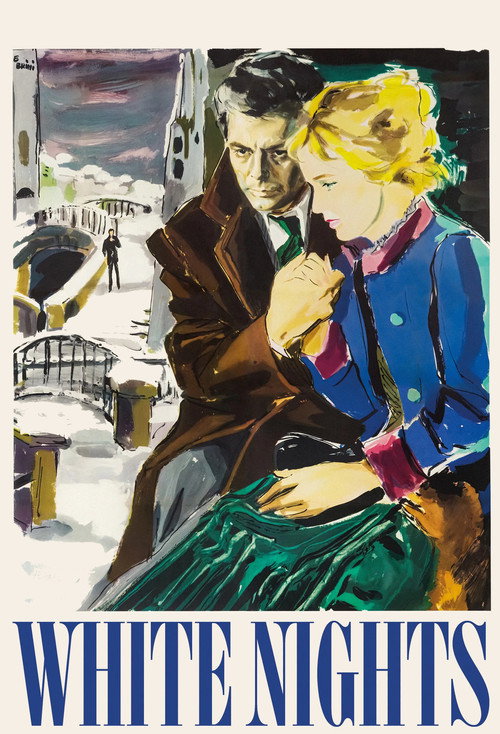
White Nights
1957 · Luchino Visconti
For when you're in the mood to be beautifully sad — a late-night film about unrequited love, best watched alone with the lights low. Melancholy comfort rather than hard challenge.
What it's about
Over four winter nights in a fog-bound Italian port city, a lonely clerk meets a young woman weeping on a canal bridge. She's waiting for a lover who promised to return in a year; the clerk falls for her anyway, and their nighttime wanderings become a fragile, flickering possibility of another life. It's Dostoevsky's short story transplanted to postwar Italy — a chamber piece about hope, loneliness, and loving someone who's looking past you.
The experience
Dreamlike and aching — tender one moment, quietly cruel the next, with a dance-hall sequence that briefly floods the melancholy with joy. It leaves you with the specific bittersweetness of a connection that might never have been real.
Performances
Marcello Mastroianni, young and touchingly unguarded, plays the clerk's hope with none of his later suavity; Maria Schell gives the waiting woman a feverish, almost troubling radiance — you understand exactly why he can't walk away.
The craft
Visconti built the entire city — canals, bridges, falling snow — on studio soundstages, and the deliberate artificiality is the point: it looks like a dream of a city, photographed in silvery, fog-soaked black and white. Few films use a set's unreality this expressively.
Why it matters
One of Visconti's most influential experiments, its studio-built romanticism echoing through later cinema's stylized city-of-lovers films, and an early showcase for Mastroianni before his stardom.
Snapshot
Le notti bianche is Luchino Visconti's fourth feature and one of his most deliberately artificial: a chamber film adapted from Fyodor Dostoevsky's 1848 short story "White Nights," transposed from imperial St. Petersburg to a wintry, fog-bound modern Italian port city (the production drew on Livorno, though the film's world is almost entirely a Cinecittà construction). Over four consecutive nights, a lonely, displaced clerk named Mario (Marcello Mastroianni) encounters a young woman, Natalia (Maria Schell), weeping on a canal bridge as she waits for the lover (Jean Marais) who promised to return for her after a year. Mario falls for her; she uses his companionship to sustain her hope in the absent man; and the film watches, with mounting tenderness and cruelty, as the possibility of a shared life flickers and is extinguished. Released between the neorealist landmark La terra trema (1948) and the operatic melodramas Rocco and His Brothers (1960) and The Leopard (1963), White Nights is a pivotal transitional work — the film in which Visconti most openly repudiated location realism in favor of theatrical stylization. It won the Silver Lion at the Venice Film Festival in 1957.
Industry & production
The film was produced by Franco Cristaldi's company, associated with Vides, a firm that would become central to postwar Italian art cinema and to Cristaldi's later collaborations with directors including Francesco Rosi and, eventually, Giuseppe Tornatore. It was a modestly scaled production by Visconti's standards — an intimate two-hander (with a strong supporting presence from Marais and Clara Calamai) rather than the sprawling ensemble pieces that bookend it in his filmography. The most consequential production decision was Visconti's choice to build the film's city entirely inside a studio. Rather than shoot on the real streets of a port town, he had a stylized urban quarter — bridges, canals, arcades, snow, a café, a demolition site — constructed on the Cinecittà soundstages in Rome. This was an expensive and unusual approach in an Italian industry still shaped by neorealism's economics of location shooting, and it signaled that Visconti was pursuing a controlled, hermetic mood rather than documentary authenticity. Precise budget and box-office figures for the film are not something I can cite reliably, and I will not invent them; contemporary accounts generally treat it as a prestige art-house release whose reputation rested on its Venice prize and on Visconti's standing rather than on commercial performance.
Technology
White Nights was made with the standard professional apparatus of late-1950s Italian studio production: 35mm black-and-white film, a roughly Academy (1.37:1) frame, and post-synchronized sound, the dominant Italian practice in which dialogue and effects were recorded and dubbed in post rather than captured live on set. The film predates the wide adoption of anamorphic widescreen in Visconti's own work — his later Rocco remained in a narrow ratio while The Leopard embraced Technirama and Technicolor spectacle. Here the technology is deliberately conservative and enabling of intimacy: the near-square frame concentrates attention on faces and on the vertical architecture of bridges and lamp-posts. The decisive "technology," in a sense, is the soundstage itself — the capacity of Cinecittà to fabricate a total artificial environment, with controllable fog, falling snow, and precisely placed practical lights, so that weather and atmosphere became compositional instruments rather than uncontrollable conditions of location work.
Technique
Cinematography
The black-and-white photography is by Giuseppe Rotunno, then early in a distinguished career that would take him through Rocco and His Brothers, The Leopard, and a long partnership with Federico Fellini (Amarcord, Fellini Satyricon). White Nights is one of the significant early showcases of his sensibility. The visual signature is a luminous, high-contrast nocturne: pools of lamplight isolated in surrounding darkness, reflections shivering on canal water, and a persistent haze that softens the studio-built city into something dreamlike. Because the environment was constructed, Rotunno and Visconti could sculpt the light with unusual precision — the film's snowfall, mist, and glistening wet stone read as expressive choices rather than found conditions. The camera favors a fluid, gliding mobility that follows the two lead figures through arcades and across bridges, binding them into the geometry of the set while the surrounding blackness keeps the wider world at bay.
Editing
The film's rhythm is organized around its four-night structure, a temporal scaffolding inherited from Dostoevsky. Editing serves duration and mood more than momentum: scenes are allowed to breathe at the pace of tentative conversation, hesitation, and repetition, mirroring the way Mario and Natalia circle the same emotional ground night after night. The most celebrated set piece — a dance-hall sequence in which Mario, encouraged by Natalia, attempts to shed his awkwardness in a burst of rock-and-roll movement — is cut to release, briefly, the kinetic energy the rest of the film withholds, before the narrative contracts again into longing and disappointment. Against the studio's stylized stillness, these modulations of tempo carry much of the film's feeling.
Mise-en-scène / staging
Mise-en-scène is the film's true subject as much as its method. Trained in the theater and opera, and with a strong grounding in scenography, Visconti treats the constructed city as a stage: bridges function as thresholds and meeting points, the canal as a barrier and a mirror, the falling snow as a curtain. The artificiality is not concealed but embraced — the film's emotional register depends on our sense that these lovers inhabit a world sealed off from ordinary reality, a pocket of time suspended between dusk and dawn. Costume and gesture distinguish the three principals sharply: Natalia's period-inflected, almost fairy-tale reticence; Mario's rumpled modern loneliness; the Lodger's remote, idealized glamour. Visconti stages their encounters with an operatic attention to entrances, tableaux, and the choreography of approach and withdrawal.
Sound
As was standard in Italian production, the soundtrack was built in post. The score is by Nino Rota, the composer indelibly associated with Fellini and, later, with The Godfather, and one of the essential voices of postwar Italian cinema. Rota's music underscores the film's romantic melancholy and its dreamlike suspension without tipping into sentimentality. The dance-hall interlude introduces a jarring, vital pop energy — a rupture in the film's hushed acoustic world — that makes the surrounding quiet feel all the more enclosed. Ambient sound is used sparingly and atmospherically: footsteps on wet stone, the lapping of canal water, the muffling hush of snow.
Performance
Maria Schell, the Austrian actress then at the height of an international career, plays Natalia with a wide-eyed, trembling intensity that some viewers find radiant and others find mannered; her performance embodies the character's near-delusional fidelity to an absent ideal. Marcello Mastroianni, several years before La dolce vita would make him the emblematic face of Italian cinema, gives Mario a bruised, self-deprecating warmth — a portrait of decency defeated that anticipates the wounded modern men he would later refine. Jean Marais, the French star and muse of Jean Cocteau, brings a deliberately unreal, statuesque quality to the Lodger, appropriate to a figure who exists as much in Natalia's imagination as in fact. The film lives in the interplay of these registers: Schell's fevered hope, Mastroianni's rueful realism, Marais's distant idealization.
Narrative & dramatic mode
The dramatic mode is romantic tragedy in miniature, structured as an intimate four-act nocturne. The film is nearly a two-character play, its tension generated not by external events but by the asymmetry of desire: Mario wants Natalia, Natalia wants the Lodger, and the audience is held in the suspense of whether the absent man will return. Dostoevsky's source is a first-person confession narrated by a "dreamer," and Visconti retains that sensibility — the sense that Mario is a man more at home in longing than in fulfillment, and that the entire episode has the fragile, provisional quality of something that could not survive daylight. The ending honors the story's bittersweet logic: a moment of shared possibility is granted and then withdrawn, leaving Mario with the memory of a happiness that was never quite his. It is a drama of thresholds — of people caught between hope and resignation, illusion and reality, and never able to fully cross over.
Genre & cycle
White Nights sits at the intersection of literary adaptation, romantic melodrama, and studio-bound art cinema. Within Visconti's own career it belongs to a cycle of literary transpositions — he would go on to adapt Camus (The Stranger), Thomas Mann (Death in Venice), and Lampedusa (The Leopard) — and it reflects his lifelong movement between realism and stylized melodrama. Genre-wise it can be read as a chamber melodrama in the European tradition, closer in spirit to the intimate, mood-saturated romances of poetic realism than to the social frescoes with which Visconti is more often associated. Its embrace of overt artifice also aligns it, in retrospect, with a broader mid-century impulse among European auteurs to reject documentary realism in favor of consciously theatrical or dreamlike worlds.
Authorship & method
The film is a signal instance of Visconti's dual identity as a man of the theater and opera as well as the cinema. Having helped inaugurate neorealism with Ossessione (1943) and La terra trema, he here turned decisively toward the constructed, the composed, and the operatic — a direction that would culminate in his 1960s masterpieces. The authorship is inseparable from his key collaborators on this project: cinematographer Giuseppe Rotunno, whose luminous nocturnal images give the film its enveloping atmosphere; composer Nino Rota, whose score binds the romantic and the melancholy; and the screenplay, which Visconti developed with Suso Cecchi d'Amico, the great Italian screenwriter who was among his most important and enduring creative partners across many films. Cecchi d'Amico's contribution — shaping Dostoevsky's confessional monologue into a workable two-character drama and relocating it to modern Italy — is central to the film's design. (I am confident of Cecchi d'Amico's collaboration and Rota's and Rotunno's roles; where I am less certain of a specific individual credit I have refrained from naming one.)
Movement / national cinema
Within Italian national cinema, White Nights is best understood as a self-conscious departure from neorealism by one of that movement's own founders. Where neorealism prized nonprofessional actors, location shooting, and contemporary social subject matter, Visconti here chose an international star cast, a total studio construction, and a nineteenth-century Russian literary source. The film thus stands as evidence of neorealism's exhaustion and mutation in the mid-1950s, and of the divergent paths its major figures took as the decade closed — Visconti toward operatic stylization, others toward the psychological and existential modernism soon to be identified with Antonioni and Fellini. It remains, nonetheless, a distinctly Italian film in its craft lineage, drawing on Cinecittà's resources and on collaborators — Rota, Cecchi d'Amico, Rotunno — who define the postwar Italian art-cinema tradition.
Era / period
The film belongs to the late 1950s, a hinge moment in European cinema just before the eruptions of the New Waves and the international art-film boom of the early 1960s. It is contemporary with the emergence of modernist auteur cinema across the continent, and it looks forward to that shift while remaining rooted in an older tradition of literary and theatrical film culture. Its 1957 Venice prize places it firmly within the festival-driven prestige economy that increasingly defined the reception of European art films in this period. In Visconti's own chronology it is the immediate prelude to his great decade, the last of his "smaller" films before the epic ambitions of the 1960s.
Themes
The film's dominant theme is the tension between illusion and reality — the way romantic idealization can be both sustaining and self-destroying. Natalia's fidelity to an absent, idealized lover is a form of willed dreaming; Mario's love for her is a dreamer's love in turn, more attached to the beauty of longing than to its fulfillment. Loneliness and urban alienation run throughout: both protagonists are solitary figures adrift in an impersonal, wintry city. Time is a governing preoccupation — the compression of the action into four nights, the year-long deferral of the Lodger's promise, the sense of a happiness that exists only in a suspended, unreal interval. And there is Visconti's recurring concern with the gap between desire and possibility, with characters who reach for a transformed life and are returned, gently or harshly, to solitude. The pervasive artifice of the setting reinforces the theme: this is a world of dreams, and dreams do not survive the morning.
Reception, canon & influence
On its release, White Nights was recognized at the highest level of the festival circuit, winning the Silver Lion at Venice in 1957. Critical reception has always been divided, and remains so: admirers prize its ravishing photography, its bold embrace of artifice, and its tender melancholy, while skeptics have found Schell's performance overwrought and the film's stylization airless compared with the vitality of Visconti's neorealist and epic work. It is generally regarded as a beautiful minor-to-middle work within a major filmography rather than as a first-rank masterpiece on the level of The Leopard — though its reputation has been buoyed over time by restoration and reappraisal, and it retains a devoted following.
Its influences run backward to Dostoevsky's 1848 tale, to the traditions of European romantic melodrama and poetic realism, and to Visconti's own formation in opera and stage design. Looking forward, the film's most direct descendant is Robert Bresson's Four Nights of a Dreamer (1971), which adapts the same Dostoevsky story in a radically different, austere modern-Parisian key — the two films together making "White Nights" one of the story's touchstone screen incarnations alongside other international adaptations. Within Visconti's career the film matters as the laboratory in which he worked out the move from realism to stylized melodrama that would define his subsequent masterpieces. More broadly, its confident construction of an entirely artificial, mood-saturated city anticipates the studio-built dreamworlds that later filmmakers — Fellini prominent among them, with his own Rota-scored Cinecittà fantasias — would make central to Italian cinema's international identity.
A Deleuzian reading
Snow falls on a bridge.
The full Deleuzian reading of White Nights →
Reception
In 1957 it puzzled critics who saw Visconti's dreamy studio artifice as a retreat from the neorealism he'd helped invent — though Venice gave it the Silver Lion anyway. Now that 'betrayal' reads as the whole point, and it's been reclaimed as one of the great swooning films about loneliness.
How White Nights was received, from release to now →
How to watch White Nights: what to notice on a first viewing
- Notice that every canal, bridge, and street looks built, not found. Visconti constructed the entire wintry city on Cinecittà soundstages, snow, fog, wet stone, and lets the artifice show rather than hiding it. The invented world signals early that this romance belongs to a sealed, dreamlike space of its own.
- Watch how lamplight pools surrounded by total darkness. Giuseppe Rotunno lights the film as isolated cones of light with blackness pressing in around them, reflections shivering on the canal water. Past every pool of light lies a darkness the film never lets you enter or place.
- Watch how still Marais stays next to Schell's trembling. Maria Schell plays Natalia with constant wide-eyed, trembling intensity, while Jean Marais holds the Lodger as a remote, unmoving, almost statuesque figure. One face holds a single fixed quality, the other keeps building toward a break, and you can watch both choices happening.
- Watch the camera glide alongside Mario and Natalia as they walk. The camera moves fluidly with the pair through arcades and across bridges, binding them to the geometry of the built set as they circle the same ground. The mobile camera keeps tying these two people to a world that itself is closed and self-contained.
- Listen for the one burst of pop music at the dance hall. Nino Rota's score stays melancholy and restrained through most scenes, then the dance hall introduces a sudden, vital rock and roll energy. That single rupture in sound tells you how enclosed and hushed the rest of the film actually is.
The whole guide to watching White Nights, with the keys for a rewatch →
Influences: the films it descends from and the films it influenced
- Ossessione (1943) — Visconti's neorealist origin point, whose environmentally-embedded long-take staging he here inverts into a wholly studio-fabricated space — the film is legible as the deliberate repudiation of this method.
- Senso (1954) — His first decisive turn to operatic melodrama with composed, painterly frames and staged emotional crescendos — the immediate precursor of the anti-neorealist stylization White Nights refines in chamber scale.
- Sunrise: A Song of Two Humans (1927) — The template for a studio-built nocturnal city rendered with forced-perspective sets and a roving, unmoored camera, treating the artificial metropolis as an externalized emotional dreamscape.
- Port of Shadows (1938) — French poetic realism's fog-shrouded, Trauner-designed studio port where doomed nocturnal romance unfolds inside enveloping constructed mist — the direct model for a mood-saturated artificial harbor town.
- Le Jour se lève (1939) — A chamber-scale fatalist romance built entirely on studio sets and compressed into a tight temporal frame, precedent for White Nights' miniature, tightly-bracketed melodramatic structure.
- Children of Paradise (1945) — The unabashedly theatrical studio-reconstructed boulevard staged as an open stage, establishing the embrace of frank artifice-as-truth that Visconti adopts wholesale.
- The Earrings of Madame de... (1953) — The waltzing, continuously gliding camera and the dance/ballroom sequence choreographed as an emotional crescendo — the mobile-camera and dance-hall setpiece grammar White Nights draws on.
- Letter from an Unknown Woman (1948) — Sustained confessional romantic obsession organized around remembered nights, modeling the melancholic first-person longing that structures the Dostoevsky monologue's adaptation.
- Four Nights of a Dreamer (1971) — Adapts the identical Dostoevsky tale into austere modern Paris, stripping the melodrama and artifice to their opposite — the story's austere twin and White Nights' most direct screen descendant.
- Rocco and His Brothers (1960) — Applies the stylized-melodrama method rehearsed here to a full operatic family tragedy, confirming White Nights as the laboratory for Visconti's mature composed style.
- The Leopard (1963) — Expands the compact dance-hall setpiece into the celebrated extended ballroom sequence that becomes the film's structural and emotional climax — the same setpiece logic scaled to epic.
- La Dolce Vita (1960) — Builds a nocturnal Rome as a studio dreamworld at Cinecittà bound by a Nino Rota score, extending White Nights' fully-fabricated mood-city into Italian cinema's international signature.
- Saawariya (2007) — An explicit adaptation of Dostoevsky's 'White Nights' staged in an entirely studio-built, blue-drenched artificial nocturnal city — the maximalist heir to Visconti's constructed dreamworld.
- In the Mood for Love (2000) — A chamber-scale romantic-tragedy miniature of thwarted longing sustained through a saturated nocturnal palette and an obsessively repeated musical motif — the mood-over-plot melodrama in modern form.
- 8½ (1963) — A Rota-scored studio fantasia that dissolves illusion into reality, pushing the same artifice-as-emotional-truth and illusion-versus-reality device toward reflexive extreme.
- White Nights (Belye Nochi) (1959) — A near-contemporaneous Soviet adaptation of the same tale rendering the confessional dreamer in a lyrical-romantic key, a parallel screen incarnation of the identical source.
Similar films
- Obsession (1943) — influence & lineage
- Senso (1954) — influence & lineage
- In the Mood for Love (2000) — influence & lineage
- La Dolce Vita (1960) — influence & lineage
- 8½ (1963) — influence & lineage
- Letter from an Unknown Woman (1948) — influence & lineage
- Death in Venice (1971) — shared sensibility
- Nostalgia (1983) — shared sensibility