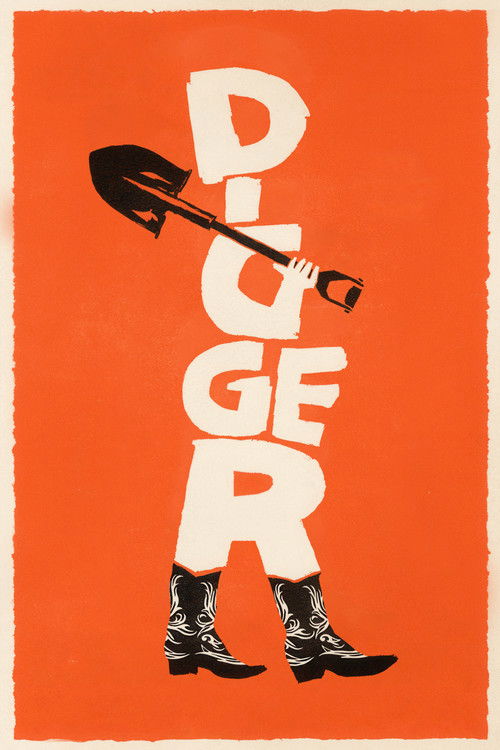
Digger
2026 · Alejandro G. Iñárritu
For when you want something big, angry, and funny about the world as it actually is — a challenge, not a comfort watch. Reach for it when you're in the mood to be provoked and want a film you'll be debating for days.
What it's about
Digger Rockwell is an oil magnate — the most powerful man in the world — whose drilling sets off an environmental catastrophe. Instead of reckoning with what he's done, he launches a frantic campaign to recast himself as humanity's savior, racing the spreading disaster for control of the story. Around him orbits a stacked ensemble of enablers, skeptics, and operators as the tycoon's world and the planet's start to come apart together.
The experience
Loud, grotesque, and relentlessly escalating — a black comedy that plays the apocalypse as farce rather than tragedy. It's abrasive by design: the ego at the center keeps inflating as the stakes do, and the film means to exhaust and provoke you more than soothe you. You come out rattled, amused, and probably arguing about it.
Performances
Tom Cruise, in his first prestige-auteur collaboration in decades, goes deliberately over the top as Rockwell — many critics called it a career best, a performance that turns his four-decade savior persona inside out. He's surrounded by precision character actors including Sandra Hüller, John Goodman, Michael Stuhlbarg, Jesse Plemons, and Riz Ahmed.
The craft
Emmanuel Lubezki shot it on 35mm VistaVision — a huge-negative 1950s format revived here — with his signature wide-angle lenses held close to the actors, and even the film's detractors called the images gorgeous. Cosmo Sheldrake's score, built from field recordings and natural sounds, sets the living world the story is destroying against the machinery destroying it. It was released in IMAX and emphatically rewards the biggest screen and best sound you can find.
Why it matters
One of the most polarizing films of 2026: a rare big-budget, star-led original from a two-time Best Director winner that critics split on violently and audiences largely skipped, making it an instant test case for whether expensive auteur films for adults can still work in theaters. It also marked Tom Cruise's striking swerve away from franchise action.
Snapshot
Digger is Alejandro G. Iñárritu's first English-language feature in a decade, his first film since the autobiographical Mexican fantasia Bardo, False Chronicle of a Handful of Truths (2022). It is an apocalyptic satire that opens as political comedy. Tom Cruise plays Digger Rockwell, an aging oil magnate whose drilling operation in Greenland sets off an ecological catastrophe; as the disaster spreads, Rockwell scrambles to recast himself as the one man who can save humanity from it. The ensemble includes Sandra Hüller, John Goodman, Riz Ahmed, Michael Stuhlbarg, Jesse Plemons, Emma D'Arcy, Sophie Wilde, Burn Gorman and Robert John Burke. Warner Bros. distributed; the film premiered in London on September 22, 2026 and opened theatrically, rated R, on October 2. Emmanuel Lubezki shot it entirely on 35mm VistaVision, reuniting Iñárritu with his Birdman and Revenant cinematographer, and Cosmo Sheldrake contributed his first feature score. Critics split sharply: Rotten Tomatoes settled at 53 percent against a 76 percent audience score, and Metacritic at 46 against a 7.2 user rating. Cruise's heavily prostheticized performance drew the most consistent praise even from detractors, and Lubezki's images were widely admired. Commercially the film was a severe disappointment, opening to about $20 million worldwide — Cruise's weakest opening since Lions for Lambs (2007) — and generating press loss estimates running from roughly $150 million to nearly $250 million.
Industry & production
Digger is a rare case in 2020s Hollywood: an auteur-driven, star-led, big-budget original not based on existing intellectual property, released by Warner Bros. during a period when the studio was making a visible run of director-centered bets on original material. The film also mattered for Cruise. For more than a decade he had worked almost entirely inside the Mission: Impossible franchise and action spectacle; Digger was his first major collaboration with a prestige auteur in that time, and the press repeatedly set it against his work with Paul Thomas Anderson on Magnolia (1999) and Stanley Kubrick on Eyes Wide Shut (1999). Cruise himself described the role to press as outrageous, and coverage noted he was cast sharply against type as a loutish oil baron.
The film shot in the United Kingdom from November 2024 to May 2025, a roughly six-month schedule that fits Iñárritu's known working method of extended rehearsal and painstaking staging.
Commercially, the numbers were stark. The film opened in fifth place domestically with $8 million, adding $12 million internationally for a worldwide start of about $20 million; the second weekend fell 60 percent domestically, leaving roughly $35 million worldwide after two frames and projections of a finish near $50 million. Trade coverage framed Digger as one of the year's biggest box-office failures, with loss estimates — press analysis, not studio accounting — ranging from at least $150 million to about $245 million. Commentators pointed to a climate-satire premise untested with mass audiences and a star deployed against his persona. On those numbers the film has already become a cautionary data point in industry debates about whether expensive original films aimed at adults can work in theaters.
Technology
The film's main technical distinction is its format. Digger was shot entirely on 35mm film in VistaVision, using cameras of the format's 1954 design fitted with very wide vintage Leica lenses. VistaVision is a horizontal-feed format: the negative runs sideways through the camera in an eight-perforation frame, so each image covers roughly twice the area of standard 35mm. Paramount introduced it in 1954 with White Christmas, and in the 1950s Alfred Hitchcock (Vertigo, North by Northwest) and John Ford (The Searchers) used it. It then largely dropped out of feature photography, apart from visual-effects plates, before returning as an origination format in the mid-2020s, most visibly with Brady Corbet's The Brutalist (2024) and Paul Thomas Anderson's One Battle After Another (2025). Digger belongs to that revival, and Iñárritu made the choice an argument: he told interviewers he shot VistaVision because cinema deserves scale, and explained that the format offered a much larger negative than standard 35mm while the cameras remained quieter and lighter than IMAX equipment — a practical advantage for a film this dependent on dialogue.
The choice is also a sharp change for Lubezki, who with Iñárritu was best known for digital work: the ARRI Alexa long takes of Birdman and the natural-light Alexa 65 photography of The Revenant.
Technique
Cinematography
Lubezki's collaboration with Iñárritu is one of the defining director–cinematographer partnerships of the century. It won consecutive Academy Awards for Birdman (2014) and The Revenant (2015), the latter part of Lubezki's unprecedented run of three straight Oscars that began with Gravity (2013). That work rests on wide-angle lenses, a mobile camera that stays very close to the actors, and long, choreographed takes. Digger keeps the signature and slows it down: Brian Eggert of Deep Focus Review described Lubezki's familiar wide-angle lenses paired with a slow-roving camera that gives the film a dreamlike, unsettling quality, and Moviefone's reviewer found the images absolutely beautiful and detailed, with subtle shadings of color and shadow. The long-take discipline survives too — Cruise's monologue before the European Parliament is staged as a single unbroken take. Jim Hemphill, reacting from the premiere, went so far as to rank it among the most visually inventive studio films ever made, and even hostile reviews conceded the film's visual impressiveness.
Editing
Stephen Mirrione edited the film with Conor O'Neill. Mirrione has cut most of Iñárritu's major work, including the fractured multi-strand structures of 21 Grams (2003) and Babel (2006), and Birdman, where his job was largely to hide cuts inside the illusion of a single continuous take. In Digger the cutting serves a deliberately disorienting architecture: the Chilean outlet Emol compared the film to a Rubik's cube whose faces seem disordered at first, and the structure's apparent chaos divided critics, with some finding the film overstuffed and hard to track and others taking the disorder as the design.
Mise-en-scène / staging
The production design, by Dennis Gassner with Richard L. Johnson, is one of the film's most remarked-on elements. Eggert compared its scope to Blade Runner 2049 — Gassner's own Oscar-winning credit — and singled out interiors furnished with taxidermied alligators and infinity mirrors lined with antlers: a tycoon's world built as grotesque excess. The film's opening stretch, as described by Dazed, pairs snappy dialogue with meticulous design and even a comedic puppet cat. The staging is openly theatrical: one ten-minute monologue plays out on a revolving stage surrounded by performers in white makeup, and graffiti reading COMPLIANCE IS FREEDOM marks the production's satirical signage. Iñárritu has framed this theatricality as method, telling Dazed that theater is a way of representing reality, and that the representation can be more real than reality itself. Jacqueline West, who dressed The Revenant, designed the costumes.
Sound
The score is by Cosmo Sheldrake, a British musician known for music built from field recordings and natural sounds — birdsong and other animal voices — here composing for a feature for the first time. Eggert described the result as delightfully bizarre: discordant organ melodies mixed with sounds drawn from nature. Other coverage heard it as lyrical and plaintive, undercut by ominous rumblings. In an ecological satire the choice reads as pointed — a sound world drawn from the living environment that the protagonist's industry is destroying — and it continues Iñárritu's habit of unconventional musical partners, after Antonio Sánchez's solo jazz drumming for Birdman and Ryuichi Sakamoto and Alva Noto's ambient score for The Revenant.
Performance
Cruise plays Rockwell under a heavy physical transformation — fat suit, gray hair, prosthetic nose — designed by Kazu Hiro, the makeup artist behind the Oscar-winning transformations of Darkest Hour and Bombshell. The application initially took about six hours; Cruise reportedly drove the process down to under one. The performance is itself a site of critical dispute. Eggert argued Cruise disappears into the role completely; Priyanka Roy of t2online countered that he leans on the prosthetics, while still praising his sparkling work in the European Parliament monologue. Bill Bria at /Film found the performance lifting the film above its director's self-indulgence, showing range Cruise had not displayed since his 1999 pairing of Eyes Wide Shut and Magnolia. The casting works partly as commentary on Cruise's star image: his four-decade persona as the indefatigable savior, most recently in Mission: Impossible, is turned inside out into a man who causes the apocalypse and then insists on being credited with preventing it.
Around him, Riz Ahmed plays Ganesh, whom Moviefone identified as the film's most principled character; John Goodman is President Compson, played as comic menace; Michael Stuhlbarg is the Vice President; Sandra Hüller, as Emma, struck the same reviewer as underused; and Jesse Plemons, as Kenny, delivers a pivotal monologue.
Narrative & dramatic mode
The film is a satirical tragicomedy of escalation. The premise — a man whose Greenland drilling triggers planetary catastrophe and who then races to be seen as its savior — drives the plot through a feedback loop of disaster and self-promotion. The comedy is black and grotesque rather than gentle, and the film opens in the register of fast political comedy, with the snappy dialogue rhythms of its first act widely noted. Its satire targets how the wealthy and powerful respond to crisis, especially how they convert their own culpability into heroic narrative. The pressured, propulsive shape matches Iñárritu's preference for compressed time, as in the countdown to opening night in Birdman and the survival march in The Revenant, though here the structure withholds as much as it accelerates — the Rubik's-cube quality critics described rewards patience with the film's apparent disorder.
Genre & cycle
Digger belongs to a 2020s cycle of satires about capital, ecology and apocalypse. The closest comparison is Adam McKay's Don't Look Up (2021), another star-heavy satire about elite incompetence in the face of planetary catastrophe. It also shares ground with Ruben Östlund's Triangle of Sadness (2022), "eat the rich" films such as The Menu (2022), and Armando Iannucci's political satires. Its oil-tycoon protagonist links it to a longer American tradition of films about petroleum and power, most famously Giant (1956) and There Will Be Blood (2007); Digger turns that tradition from tragedy toward farce. The comparison critics reached for most often, admiringly or not, was Kubrick's Dr. Strangelove (1964) — Jesse Plemons himself described the script as a kind of modern-day Strangelove — and Peter Bradshaw noted how directly the Arctic-plunder premise resonates with Donald Trump's designs on the region.
Authorship & method
Iñárritu is one of the "Three Amigos" of Mexican cinema, with Alfonso Cuarón and Guillermo del Toro, and he won back-to-back Best Director Oscars for Birdman and The Revenant. His career divides into roughly three phases:
- The "death trilogy" with Guillermo Arriaga (Amores perros, 21 Grams, Babel): fractured, interwoven narratives about chance and grief.
- A turn toward formal bravura and self-reflexive satire (Birdman) and physical ordeal (The Revenant).
- An inward, autobiographical turn (Bardo), along with the VR installation Carne y Arena (2017).
Digger returns to the satirical register of Birdman, now aimed at global power rather than show business. Iñárritu's preparation made his reference points explicit: he screened His Girl Friday for the cast for the timing of its dialogue, a Miloš Forman Firemen's Ball film for its madness and absurdity, and Network for its famous speech, while posters for Cassavetes's Opening Night and Lubitsch's To Be or Not to Be hung on the set walls — screwball pace, ensemble farce, televised prophecy and backstage theater, all legible in the finished film.
The screenplay is credited to Iñárritu, Alexander Dinelaris, Nicolás Giacobone and Sabina Berman:
- Dinelaris and Giacobone shared the Original Screenplay Oscar with Iñárritu (and Armando Bo) for Birdman. Giacobone also co-wrote Biutiful (2010) and Bardo.
- Berman is a prominent Mexican playwright, novelist and journalist, known for satirical work about power. Her involvement adds a distinctly Mexican satirical voice to an English-language production.
Key collaborators:
- Emmanuel Lubezki (cinematography): a long-standing partner, back after Darius Khondji shot Bardo.
- Stephen Mirrione and Conor O'Neill (editing): Mirrione's presence keeps continuity across Iñárritu's major features.
- Dennis Gassner and Richard L. Johnson (production design) and Jacqueline West (costumes): veteran craft leadership, with West returning from The Revenant.
- Kazu Hiro (prosthetics): the transformation specialist behind Cruise's physical reinvention.
- Cosmo Sheldrake (music): a new partner, consistent with Iñárritu's search for unconventional sound.
Movement / national cinema
Digger is a Hollywood studio production shot in Britain. It is also part of the transnational career of a Mexican filmmaker whose work has moved between Mexican and English-language production since 21 Grams. It belongs to the broader story of the post-nuevo cine mexicano generation that rose in the late 1990s and early 2000s and then came to dominate Hollywood prestige filmmaking: Iñárritu, Cuarón, del Toro and Lubezki won a remarkable run of Academy Awards between 2013 and 2018. The film keeps a Mexican creative core — director, cinematographer and two of its writers — making it a typical product of an industrial moment in which "national cinema" lives in the creative team more than in the money or the locations.
Era / period
The film belongs to the mid-2020s. It came out of a post-strike, post-pandemic Hollywood consolidating around franchises while studios like Warner Bros. made selective bets on auteur originals — and its commercial failure immediately fed the argument over whether such bets remain viable. Its subject reflects the era's preoccupations: climate crisis, the immense wealth and public mythmaking of individual tycoons, and the gap between corporate responsibility and corporate self-presentation; critics noted how closely its Arctic-extraction plot tracks the real politics of its moment. Its production method — celluloid in a revived large-negative format — is part of the period's analog revival, in which top filmmakers presented photochemical origination as a mark of theatrical prestige against streaming.
Themes
- Culpability and self-mythology: the central irony that the man who causes the disaster wants credit for averting it.
- Extraction and ecology: oil drilling as the literal "digging" behind the title, with environmental collapse as its consequence. Sheldrake's nature-derived score extends the theme into the film's sound.
- Power, narrative control and complicity: Eggert read the film's guarded structure as an echo of how the powerful control information, tying it to decades of climate denial; Dazed connected it to younger audiences' experience of navigating manipulated information.
- Masculinity and the savior complex: focused through Cruise's star persona, which the film both uses and takes apart.
- Apocalypse as farce: the end of the world played as grotesque comedy rather than solemn tragedy, with Forman's ensemble absurdism and Lumet's Network among the director's declared touchstones.
Reception, canon & influence
Critical reception. Critics were deeply divided from the London premiere onward, and the division became the story. The film holds a 53 percent Rotten Tomatoes score across more than three hundred reviews and a Metascore of 46, against notably warmer audience numbers — a 76 percent Popcornmeter and a 7.2 Metacritic user score — though opening-night crowds graded it a C+ on CinemaScore. Admirers were emphatic: Deadline cast it as a return to the adventurous spirit of 1970s cinema, the Telegraph relished its beauty, daring and extravagance, Anne Thompson called it a brave and gorgeous art film suited to Academy craft voters, and Moviefone and Emol scored it near the top of their scales. Detractors were equally emphatic: The Hollywood Reporter grouped it with bloated auteur misfires like Babylon and Amsterdam, Bradshaw found it laborious and self-satisfied, Variety judged the whole enterprise a tone-deaf monument to its star, and David Crow argued it fails at being funny and loses track of its own argument beneath its self-importance. Empire's middle position — visually impressive, Cruise fully committed, not much underneath — captured the mixed center. The most consistent point of agreement was Cruise, whose performance drew praise even in pans, and Lubezki's photography. Warner Bros. leaned into the split, running an ad that set the insults and raves side by side — a gambit some coverage blamed for alienating mainstream audiences. The recurring critical argument was Kubrick: most who invoked Dr. Strangelove found Digger more didactic and less witty, while Bria argued it earns the comparison.
Influences on the film (backward).
- Iñárritu's own Birdman: satirical register, writing team, ego-driven protagonist, theatrical staging.
- Satires of American power and media: Dr. Strangelove, whose comedy of men causing the apocalypse is the film's most-cited ancestor, and Network, which Iñárritu screened for his cast.
- Screwball and backstage traditions: His Girl Friday, To Be or Not to Be, Opening Night, Forman's ensemble absurdism.
- The oil-and-power lineage running through There Will Be Blood.
- The 1950s VistaVision films whose format it revives.
- Cruise's own filmography: the film depends on audiences recognizing his savior persona in order to subvert it.
Legacy (forward). Weeks after release, the film's lasting influence is unsettled, but its place in film history is already taking shape:
- A test case — now a negative one at the box office — for the commercial limits of expensive auteur originals in the 2020s studio system.
- A significant entry in the revival of VistaVision.
- A turning point in Tom Cruise's career, his first full step outside franchise action in a decade.
Polarizing, ambitious films often get re-evaluated over time — Birdman and Eyes Wide Shut both saw their standing move after release — and the gap between Digger's cool critical consensus and its warm audience ratings suggests exactly the kind of split that later criticism revisits. Whether it follows that path will be settled by time, not first reviews.
A Deleuzian reading
A stage turns.
The full Deleuzian reading of Digger →
Reception
After a polarizing London premiere in late September, where festival reactions ranged from calls of visual audacity to flat dismissal, the October release opened to roughly $20 million worldwide, Cruise's weakest start since Lions for Lambs in 2007, then fell 60% at home in its second weekend. Audiences have stayed notably warmer than critics: a 76% Rotten Tomatoes audience score against a 53% Tomatometer, and a 7.2 Metacritic user score against a Metascore of 46.
How Digger was received, from release to now →
How to watch Digger: what to notice on a first viewing
- Watch how close the wide lens gets to Cruise's face. Lubezki shoots VistaVision with very wide vintage Leica lenses and a slow-roving camera that Eggert found dreamlike and unsettling. The lens pressed up to the face, so skin and landscape share a frame, comes from The Revenant. The camera stays on Rockwell while he sells, never cutting away to expose him or to rescue him.
- Look at the taxidermied alligators and the antler-lined mirrors. Gassner and Johnson furnish Rockwell's world as grotesque excess, on a scope Eggert compared to Blade Runner 2049, and graffiti reading COMPLIANCE IS FREEDOM marks the signage. Lubezki's lenses drift through the rooms as if caught in the reflections. An infinity mirror repeats one man until there is no original, framed by dead animals: a trophy room for an ego.
- Listen for natural sounds under the organ. Sheldrake, in his first feature score, mixes sounds drawn from nature with discordant organ melodies; one summary heard it as lyrical and plaintive, undercut by ominous rumblings. While Rockwell talks, the living world his drilling is wrecking keeps making noise underneath him.
- Watch Cruise's face under the fat suit and prosthetic nose. Kazu Hiro built the transformation, gray hair included, and critics split: Eggert says Cruise disappears into it, Roy says he leans on it. His four-decade savior persona is turned inside out into the man who caused the disaster. Rockwell's power is no use against what he drilled, so he performs, and the makeup is part of the performance.
- Listen for how fast the dialogue runs in the opening scenes. Iñárritu screened His Girl Friday for the cast for its dialogue timing, and reviewers widely noted the snappy rhythms of the first act. Dazed counted meticulous design and a comedic puppet cat among the opening's pleasures. The film opens as screwball political comedy; get used to the tempo, because Rockwell never stops selling.
The whole guide to watching Digger, with the keys for a rewatch →
Influences: the films it descends from and the films it influenced
- Dr. Strangelove or: How I Learned to Stop Worrying and Love the Bomb (1964) — Its model of catastrophic comedy, where men in power cause the apocalypse and the dread comes from deadpan escalation rather than jokes, is the structural template for Digger's eco-satire of a tycoon wrecking the world.
- There Will Be Blood (2007) — It set the modern grammar of the oil-tycoon film (wells, derricks, a monomaniac who mythologizes his own extraction), and Digger turns that iconography into farce.
- Birdman or (The Unexpected Virtue of Ignorance) (2014) — The same writers (Iñárritu, Dinelaris, Giacobone), the same DP (Lubezki) and the same editor (Mirrione) built a satire around an ego-driven star whose self-image becomes the film's subject, and Digger moves that method from show business to global power.
- The Revenant (2015) — Lubezki's ultra-wide lenses pushed right up to the actor's face, so landscape and skin share one frame, are the source of the wide-angle intimacy Digger carries over to celluloid.
- The Tree of Life (2011) — Lubezki's roving wide-angle camera, shot in available light, set human figures against geological and cosmic scale, and Digger's extraction imagery draws on that framing of people against the earth.
- Children of Men (2006) — Lubezki's immersive, close-following camera in a world sliding into collapse is the clearest early form of the Three Amigos' shared method of showing catastrophe at intimate distance.
- Babel (2006) — Mirrione's cross-continental editing, which piles up parallel crises until they collide, is the origin of the escalating-overload rhythm Digger applies to a disaster that feeds its own publicity.
- Magnolia (1999) — Cruise's Frank T.J. Mackey turned his alpha-male charisma into a self-promoting huckster who breaks down on camera, which is the persona inversion Digger's performance is consistently measured against.
- Tropic Thunder (2008) — As Les Grossman, Cruise first used his star image for grotesque comedy about a power broker, a precedent for casting him against his saviour persona in farce.
- Network (1976) — Paddy Chayefsky's escalating satire, in which media spectacle feeds on catastrophe and then becomes the catastrophe, foreshadows Digger's disaster and self-promotion feedback loop.
- North by Northwest (1959) — It is a prime example of 1950s Paramount VistaVision, whose horizontal 8-perf 35mm negative for large-scale clarity Digger revives as an expressive format choice.
- Vertigo (1958) — Its VistaVision photography, with saturated color and studio-built artifice alongside location grandeur, is the classical precedent for combining large-format celluloid with plainly artificial soundstage staging.
- The Brutalist (2024) — Lol Crawley shot it in VistaVision and helped start the mid-2020s revival of the horizontal 8-perf format for auteur originals, the trend Digger joins.
- One Battle After Another (2025) — A big-budget auteur original shot in VistaVision and pitched as a test of whether studios will still fund large, unfranchised films, it shares both Digger's format and its box-office stakes.
- Bugonia (2025) — Robbie Ryan's VistaVision photography serves an abrasive black comedy about corporate power and ecological ruin, a close match for Digger's mix of format revival and eco-satire.
- Don't Look Up (2021) — It applies the Strangelove model to ecological catastrophe through star-led satire of elites who turn the end of the world into a media opportunity, the same register Digger takes on.
- Triangle of Sadness (2022) — Its centerpiece is an escalating physical-comedy disaster aboard the yacht of a fertilizer-and-arms fortune, which shows the same staging of extraction wealth as a farce of bodily collapse.
Similar films
- The Revenant (2015) — influence & lineage
- Birdman or (The Unexpected Virtue of Ignorance) (2014) — influence & lineage
- The Brutalist (2024) — influence & lineage
- Triangle of Sadness (2022) — influence & lineage
- Don't Look Up (2021) — influence & lineage
- Good Luck, Have Fun, Don't Die (2026) — shared sensibility
- 2012 (2009) — shared sensibility
- Dune: Part Two (2024) — shared sensibility