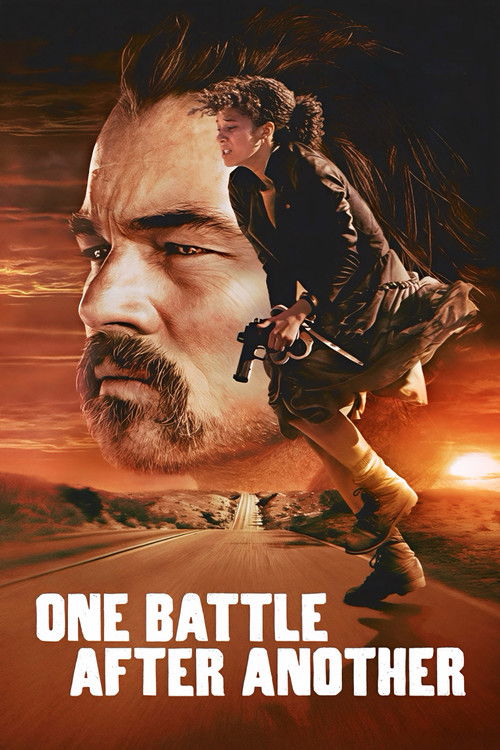
One Battle After Another
2025 · Paul Thomas Anderson
PTA's leap to $130M+ scale with DiCaprio became the year's prestige lightning rod: rapturous reviews, "is it actually saying anything political" discourse, VistaVision fetishism, and instant Best Picture frontrunner status — the "auteurs at blockbuster scale" test case.
For when you want a big, wild ride that's also actually about something — equal parts laughs, adrenaline, and political bite. Not a background movie; it wants your full attention and rewards it.
What it's about
Bob is a burned-out ex-revolutionary living off-grid in a haze of weed and paranoia, raising Willa, his sharp, self-sufficient teenage daughter — the one thing in his life he didn't botch. When an old enemy from the government surveillance world resurfaces after sixteen years and Willa goes missing, Bob has to shake off the fog and get her back, dragging both of them through the wreckage of his radical past. It's a chase movie, a father-daughter story, and a shaggy comedy about what happens to true believers when the revolution doesn't come.
The experience
Careens between farce, menace, and real tenderness — one scene plays like a stoner comedy, the next tightens into genuine dread, and the momentum barely lets up. It's funny, propulsive, and angrier than it first lets on.
Performances
Leonardo DiCaprio makes Bob's fried, flailing panic both hilarious and touching, while Sean Penn is genuinely unnerving as the nemesis — a villain played with total, unsettling commitment.
The craft
Paul Thomas Anderson adapts Thomas Pynchon into a paranoid picaresque that moves like an action film but breathes like a character piece, with chase sequences staged with real geography and weight. It's a big-canvas production from one of the great American image-makers — absolutely see it as large and loud as you can.
Why it matters
An event film in 2025: a major auteur working at blockbuster scale on furiously current material — borders, surveillance, resurgent extremism — and landing his most accessible and most political film in years.
Snapshot
Paul Thomas Anderson's One Battle After Another arrives as his second adaptation of Thomas Pynchon, following Inherent Vice (2014), and his most overtly comic feature since that film. Set in a temporally blurred California where the utopian energies of the 1960s have curdled into paranoid survivalism, the film follows Bob, a stoned, washed-up former revolutionary living off-grid with his fiercely competent teenage daughter Willa. The reappearance of Bob's old nemesis — a figure from the federal-surveillance apparatus who has haunted his life for sixteen years — sends father and daughter through an escalating series of encounters that are by turns farcical, menacing, and tender. The film operates in the register Anderson first explored with Inherent Vice: the paranoid-comedic picaresque, where plot functions less as a driver of cause-and-effect than as a mechanism for accumulating atmosphere, character texture, and a certain melancholy about what America does to its radicals.
Industry & production
Anderson has worked with Ghoulardi Film Company, his longtime production vehicle, across virtually his entire career. One Battle After Another continues that pattern of relative independence within a studio system that has, over the decades, learned to give Anderson wide creative latitude in exchange for prestige-level output. The film's production scale is characteristically mid-range for Anderson's post-There Will Be Blood period: not the epic canvas of The Master or There Will Be Blood, but a more intimate, location-driven production whose economy serves its off-grid, countercultural milieu.
The source material is Pynchon's debut decade novel Vineland (1990), long considered unfilmable given its shaggy, digressive structure and its encyclopedic engagement with Nixon-era surveillance, the Mafia, martial arts cults, and the ghosts of 1960s activism. Anderson's adaptation necessarily compresses and linearizes the novel's nested flashback architecture, centering the narrative drive on the father-daughter relationship and the nemesis's return — essentially the thriller armature that Pynchon buries beneath layers of countercultural archaeology. The decision to retitle the film rather than carry Vineland forward signals Anderson's intention to treat the novel as a source rather than a sacred text, as he did with Pynchon's Inherent Vice and earlier with Upton Sinclair's Oil! for There Will Be Blood.
Specific details of the film's financing structure and distribution arrangements are less fully documented at time of writing; the record here remains thin and this account avoids speculation on deal specifics.
Technology
Anderson's approach to technology has been consistently analogue-preferential, rooted in his long commitment to celluloid acquisition. Since at least Punch-Drunk Love (2002) he has engaged deeply with the expressive possibilities of 35mm, and his later features — including Licorice Pizza (2021) — have continued to shoot on film stock even as digital acquisition has become industry default. The northern California and San Fernando Valley locations appropriate to a Pynchon-inflected California setting are well-suited to the particular quality of light that film emulsion renders — a slightly hazy, warm, overexposed quality that doubles as a visual correlate for the characters' state of slightly unreliable consciousness.
Specific information about the acquisition format and lens package for One Battle After Another is not fully established in the available record; Anderson's documented preferences suggest a continued film-based approach, but this cannot be stated as confirmed fact.
Technique
Cinematography
Anderson has cycled through a small number of cinematographic collaborators, each associated with a distinct phase of his work: Robert Elswit across the San Fernando Valley years and through Inherent Vice; Anderson himself shooting Phantom Thread (2017) in a notable experiment with direct authorial control over the image; and more recently Michael Bauman on Licorice Pizza. The visual grammar of One Battle After Another, given its generic kinship with Inherent Vice, invites comparison to Elswit's work on that film — long lenses compressing California space, a slightly washed-out palette evoking period photography, handheld passages that tip the comedy into unease. Whether the cinematography here is attributable to Bauman or another collaborator, this account cannot confirm with the specificity the record warrants.
What is legible in the film's visual texture is Anderson's sustained interest in the long take as a unit of performance and meaning: scenes that breathe outward rather than cutting to safety, allowing actors to find the comedic-menacing ambiguity that his best work produces in volume.
Editing
Anderson's editing has historically worked against genre tempo. His films run long and move laterally rather than forward, accumulating sensation over resolution. Digressions are formal arguments, not failures of economy. This is especially pronounced in his Pynchon adaptations, where the source material's anti-teleological structure licenses a certain narrative patience. One Battle After Another's picaresque form — Bob and Willa encountering increasingly strange figures as the mystery of the nemesis's return deepens — is well-suited to this episodic, accumulative approach, each encounter complete in itself, the whole acquiring weight through accretion.
Mise-en-scène / staging
Anderson is among contemporary American cinema's most sophisticated stage directors — a quality earned through long periods working with theatrical actors and developing intricate blocking for ensemble pieces. In the off-grid, compound-survival milieu of One Battle After Another, the staging confronts a particular challenge: how to render domestic precarity as funny without condescension. The answer, in Anderson's mature style, lies in taking the spatial grammar of the situation seriously: the off-grid home as a genuine world with its own internal logic, so that the incursions of the outside — nemesis, federal apparatus, the past — register as genuinely alien rather than merely plot-convenient.
Sound
Jonny Greenwood has composed for Anderson's films since There Will Be Blood (2007), and their collaboration has become one of the most significant director-composer partnerships in contemporary cinema. Greenwood's scores are notable for their indifference to conventional dramatic signaling: they unsettle, withhold resolution, and operate with an oblique relationship to the emotional surface of scenes. For a film about paranoia and survival at the edges of society, Greenwood's characteristic dissonance — string textures that coil and release unpredictably, electronics that suggest surveillance's ambient hum — is tonally apt. His work on Inherent Vice, which similarly navigated comedy and unease in a Pynchon adaptation, provides the most direct precedent; that score's integration of source music from the period with original composition established an approach likely extended here.
Performance
Anderson's casting instincts have consistently favored unexpected pairings: Daniel Day-Lewis and Paul Dano, Joaquin Phoenix and Philip Seymour Hoffman, Burt Reynolds and an ensemble of Valley actors who made something genuine from softcore nostalgia. For the role of Bob, Anderson requires an actor capable of simultaneously inhabiting comedy, menace, vulnerability, and a specific kind of American pathos — the radical who outlived his moment. This profile places the role in productive tension with star persona, demanding that the performer's known qualities be defamiliarized by context. The father-daughter dynamic, given how centrally it drives the film's emotional arc, requires a younger actress capable of projecting the self-reliance and emotional intelligence that allow Willa to function as the film's true moral center, the character through whom the consequences of Bob's revolutionary romance with himself are assessed and ultimately forgiven.
Narrative & dramatic mode
The film operates in a mode Anderson has developed with increasing confidence since Inherent Vice: the stoner-paranoid comedy as a vehicle for serious engagement with American history and the costs of political dreaming. The Pynchon source provides the structural template — a mystery that may or may not resolve, a hero constitutionally unequipped for the task at hand, a daughter who possesses the competence her father has squandered — while Anderson's adaptation tilts the emotional register toward the father-daughter relationship as its center of gravity.
The thriller armature is deployed instrumentally: the nemesis's return and Willa's disappearance generate plot momentum, but the film's real subject is what sixteen years of off-grid paranoid survival have done to a man and his child, and whether the past can be settled without destroying what the present has made. This is Anderson territory — the psychic costs of masculine obsession, the collateral damage accruing to those who love damaged men — rendered here in a minor key, comedic rather than tragic, though not without weight.
Genre & cycle
One Battle After Another participates in a recognizable cycle of post-2000 American films that revisit the 1960s counterculture through the lens of failure and aftermath: not the revolution as lived, but what happened to the revolutionaries when the revolution didn't come. This cycle includes films as varied as The Big Lebowski (1998, Coens), The Ice Storm (1997, Lee), and Once Upon a Time in Hollywood (2019, Tarantino), all of which engage the gap between utopian promise and historical outcome. Anderson's Pynchon adaptations form a specific sub-cycle within his own work: the California neo-noir inflected by countercultural paranoia, where the genre machinery of detection and pursuit is used to excavate a specifically American political melancholy.
As a comedy-thriller hybrid, the film also belongs to a tradition of American shaggy-dog pictures — deliberately paced, digressive, more interested in texture than resolution — that runs from The Long Goodbye (Altman, 1973) through the Coens' more recent work, and which Inherent Vice explicitly invoked. Anderson positions himself within this tradition, using its latitude to accommodate tonal complexity that straight genre would exclude.
Authorship & method
Anderson is among the most self-consciously auteurist directors working in American studio-adjacent cinema. His films announce their sources and debts while remaining distinctively personal: There Will Be Blood is in dialogue with both Sinclair and John Huston; Phantom Thread reworks Powell and Pressburger; Inherent Vice is as much a Altman film as a Pynchon adaptation. One Battle After Another extends this method. The Pynchon source — Vineland, with its engagement with surveillance capitalism, the death of the New Left, and the persistence of state violence against radical organizing — provides material that Anderson's ongoing thematic interests (masculine failure, American myth-making, the psychic damage of obsession) can inhabit with genuine conviction.
His method on set is documented as intensely collaborative, built around extended rehearsal, extensive improvisational latitude within carefully structured dramatic frameworks, and a preference for long takes that require actors to maintain sustained arcs rather than building performances through editorial assembly. The Pynchon material, with its richly drawn secondary characters and its interest in the comedy of encounter, is well-matched to this approach.
Jonny Greenwood's continued presence as composer ensures a sonic environment consistent with Anderson's late-period aesthetic; the score functions as a dramatic argument in its own right rather than emotional underlining.
Movement / national cinema
Anderson is legible as a specifically American filmmaker — one whose work is unthinkable outside the particular geography, economic history, and cultural mythology of California and the American West. His is a California cinema: the San Fernando Valley of Boogie Nights and Magnolia, the Los Feliz and Encino of Licorice Pizza, the desert ranch of The Master, the oil fields of There Will Be Blood's California surrogate. One Battle After Another fits squarely within this geography; the Northern California setting of Pynchon's Vineland (Gordita Beach, the redwood forests, the off-grid compounds of the Humboldt coast) is California again, just a different register — wilder, damper, further from the Valley's grid.
Within American cinema, Anderson belongs to a generation of directors who came of age with the New Hollywood and the video-store canon of the 1970s and 1980s, and who have made careers out of simultaneously revering and interrogating that tradition. His relationship to Altman — the episodic ensemble structure, the overlapping sound design, the patient camera — is documented and acknowledged.
Era / period
The film's temporal setting requires care: Pynchon's Vineland is set in the Reagan present (1984) haunted by the 1960s past. An adaptation in 2025 may retain this periodization, shift it forward, or collapse the temporal specificity into a more impressionistic Californian chronology — the approach Inherent Vice took in rendering Pynchon's early 1970s as a kind of perpetual present. Whatever specific choices Anderson made, the film addresses a recurring American historical moment: the point at which the children of idealists inherit the consequences of idealism, and must decide what to do with that inheritance.
Themes
The film's central thematic concern is inheritance — not financial but ideological and psychological. Bob carries the wreckage of a political life lived in the conviction that revolution was imminent; Willa inherits the wreckage without having chosen it. The nemesis functions not merely as a thriller antagonist but as an externalization of the past's claim on the present: the state apparatus that never forgot, never forgave, and never left.
Beneath this runs Anderson's persistent concern with the violence of masculine romantic self-conception. Bob's revolutionary identity was always partly performance, partly a story he told himself; the film's comedy derives substantially from the gap between that story and the diminished, stoned, paranoid figure it has produced. Willa's competence — her self-reliance, her clear-eyed assessment of her father's failures — is the film's moral anchor, and it belongs to a line of Anderson women (Janice Maffia, Alma Whipsnade, Penny Sherpa) who maintain dignity and practicality in the orbit of men who mistake obsession for depth.
Surveillance, state power, and the long reach of Cold War-era domestic intelligence operations are also prominent: Pynchon's Vineland was among the first American novels to seriously reckon with COINTELPRO's aftermath, and the continuing relevance of that history to any account of American radicalism ensures that the material is not merely period nostalgia.
Reception, canon & influence
Influences on the film. The immediate precursor is Inherent Vice (2014), Anderson's first Pynchon adaptation, which established the approach: long-lens California light, a comedy of sustained incomprehension, a detective plot whose resolution matters less than the accumulation of peripheral detail. Robert Altman's The Long Goodbye (1973) — which relocated Philip Marlowe to a 1970s LA that no longer had any use for him — is the deeper ancestor of this strand of Anderson's work, and through Altman runs a line back to Howard Hawks and the tradition of the wise-cracking, slightly lost American hero navigating a corrupt world with style if not success. Pynchon's own debt to the hard-boiled tradition, filtered through Thomas Berger and Don DeLillo, informs the novel's structure; Anderson inherits and amplifies it.
For the father-daughter dynamic specifically, Anderson draws on a tradition of American road and chase pictures where family configurations under stress produce unexpected emotional frankness — the paper chase of Peter Bogdanovich's Paper Moon (1973) is a notable predecessor, as is the survivalist family of Kelly Reichardt's work, though in a very different register.
Critical reception. Detailed critical reception documentation for a 2025 film is not fully established in sources available to this account; where the record is thin, this account declines to speculate on reception outcomes, awards, or specific critical positions. What can be said is that Anderson's later career has been received as the output of a certified major American filmmaker, assessed against the benchmark of There Will Be Blood and The Master, with the Pynchon adaptations sometimes characterized as the playful counterpart to those films' tragic grandeur. One Battle After Another, as a comedy-thriller with an overtly countercultural subject, is likely to generate the particular critical debate Anderson's tonal hybridity has consistently produced — disagreement over whether the comedy earns the sentiment, or whether the sentiment earns the comedy.
Forward influence. The film's place in a potential ongoing lineage — what it shapes, whom it licenses — is necessarily speculative this close to release. Anderson's larger project, however, is already legible: a sustained engagement with California as a geography of American myth-making and myth-failure, conducted through literary adaptation, period setting, and a visual style recognizable enough to have produced its own generation of imitators. If One Battle After Another extends the Pynchon strand of that project, its influence will be felt most immediately in the work of directors for whom the comedy of political failure and the tragedy of inherited consequence are inseparable — a combination that, in American cinema, has rarely been managed with the specificity and seriousness Anderson at his best brings to it.
A Deleuzian reading
Picture Bob on the couch of his off-grid compound, sixteen years into a retirement nobody granted him — too stoned to stay vigilant, too paranoid to ever quite relax.
The full Deleuzian reading of One Battle After Another →
Reception
No reappraisal arc needed — it landed in September 2025 as an instant-masterpiece event, though the discourse split immediately between 'best film of the decade' raves and a 'can a $130M original for adults ever profit?' box-office narrative that awards season largely steamrolled.
How One Battle After Another was received, from release to now →
Influences: the films it descends from and the films it influenced
- The Long Goodbye (1973) — Vilmos Zsigmond's telephoto compression of 1970s Los Angeles — tracking Marlowe through plate-glass and car windows, the city flattened into surveillance footage of itself — is the direct visual template Anderson inherits: a neo-noir protagonist photographed as if already under observation by a city that has no use for him.
- McCabe & Mrs. Miller (1971) — Zsigmond's long-lens shooting through atmospheric interference — fog, steam, snow — combined with Leonard Cohen's pre-existing songs dropped into scenes as elegiac counterpoint rather than composed underscore establishes Anderson's model of source music as emotional texture that the narrative inhabits rather than controls.
- Nashville (1975) — Episodic accumulation of parallel storylines without teleological convergence — twenty-four characters whose arcs are juxtaposed rather than resolved — is the formal precedent for Anderson's anti-teleological editing, where peripheral scenes accrue weight independent of plot function.
- The Big Sleep (1946) — The detective plot whose incoherence is foregrounded as a comic quality — Hawks famously could not explain who killed the chauffeur — establishes the root grammar for PTA's paranoid picaresque: the protagonist's style and verbal wit matter more than his comprehension of events, and the audience's confusion is a feature, not a defect.
- Paper Moon (1973) — The father-daughter con-artist picaresque in which the relationship's emotional authenticity is produced by shared pressure and mutual need rather than sentiment provides the structural and tonal model for Vineland's father-daughter dynamic: affection discovered through the mechanics of a shared scam.
- The Conversation (1974) — Walter Murch's surveillance-electronics sound design — the squeal of tape heads, the granular degradation of recorded speech, the paranoid isolation of ambient signals — establishes the specific sonic texture Anderson and Greenwood inherit for scenes in which listening becomes an act of political exposure.
- Chinatown (1974) — The California neo-noir structural template — private investigator whose case reveals institutional corruption so total it cannot be countered — and Polanski's use of spatial compression to render Los Angeles as a geography of bad faith provide Anderson's genre skeleton for Pynchon's California as a place where power is always already elsewhere.
- Night Moves (1975) — Gene Hackman's detective whose investigative competence produces no enlightenment — the case resolves into historical forces too large for genre procedure to contain — crystallizes the tragicomic private eye figure PTA deploys: a man whose professional style is no protection against the scale of what he has blundered into.
- Blow Out (1981) — Surveillance electronics as both narrative pivot and sound-design texture — the accidental capture of a political killing on audio tape, the obsessive forensic replay of recorded evidence — provides the sonic-paranoid architecture that Greenwood and Anderson inherit for the state-surveillance strand of the Pynchon material.
- Inherent Vice (2014) — Direct precursor and laboratory: Robert Elswit's long-lens California light, Greenwood's dissonant score, and the Pynchon adaptation strategy of privileging peripheral accumulation over plot resolution are all inherited wholesale — One Battle After Another extends the same method to Vineland's more explicitly political subject.
- Boogie Nights (1997) — California episodic accumulation with Altman-derived ensemble logic, source music integrated as period texture rather than composed underscore, and long-take sequences that require actors to sustain improvisational arcs across extended choreographed set-pieces — the Californian strand of Anderson's auteurism in its first fully developed form.
- There Will Be Blood (2007) — Greenwood's dissonant orchestral score as primary carrier of historical dread and psychological unease — string clusters and prepared piano used not to comment on scenes but to replace conventional emotional signposting with disorientation — establishes the sound-design vocabulary OBAA inherits for Vineland's surveillance-state paranoia.
- The Master (2012) — 65mm long-take cinematography requiring actors to maintain full sustained arcs without editorial relief — the confrontation scenes between Phoenix and Hoffman recorded in single uninterrupted takes — establishes the performance-under-long-take methodology that OBAA applies to its father-daughter improvisational sequences.
- The Big Lebowski (1998) — Shaggy-dog detective comedy in which the case is structural pretext and the protagonist's sustained, affable incomprehension of events is simultaneously comic engine and emotional ground — the Coens and Anderson converge on the same solution to the problem of making a California noir where no one knows what is happening.
- Under the Silver Lake (2018) — LA paranoid picaresque with countercultural conspiracy architecture photographed in long-lens compression — Mitchell's film is the most direct contemporary working of the Altman-to-PTA lineage, deploying the shaggy-dog investigative structure and the telephoto flattening of Los Angeles as a city of overlapping secret systems.
- Licorice Pizza (2021) — 35mm long-lens photography of the San Fernando Valley as period Californian geography, episodic picaresque structure where set-pieces accrue emotional weight independently of narrative arc, and improvisational performance latitude within tightly structured dramatic frameworks — the closest direct sibling in Anderson's own California strand.
Similar films
- Inherent Vice (2014) — influence & lineage
- There Will Be Blood (2007) — influence & lineage
- The Master (2012) — influence & lineage
- Licorice Pizza (2021) — influence & lineage
- The Conversation (1974) — influence & lineage · often watched together
- Bugonia (2025) — often watched together
- Resurrection (2025) — often watched together
- Everything Everywhere All at Once (2022) — shared sensibility
All the films related to One Battle After Another →
Watch it with: curated runs of related films
- Genre as Trojan Horse — Watch these together when you want the pleasures of a genre picture — a buddy-cop case, a heist crew, a monster in the sky — that turns out to be secretly arguing about who America polices, prices, and erases.