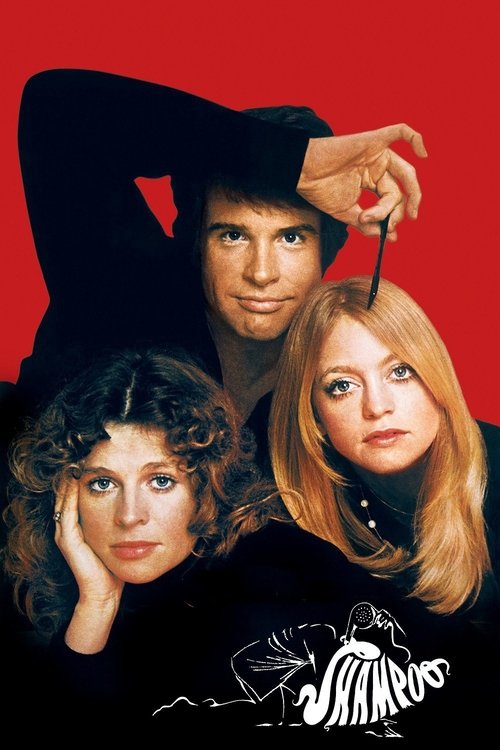
Shampoo
1975 · Hal Ashby
For when you want a smart, sexy period comedy that sneaks up on you — funny enough for date night, sad enough to argue about after. Reach for it when pure fluff won't do.
What it's about
Beverly Hills, November 1968, election eve and Election Day. George Roundy is a genuinely talented hairdresser and compulsive ladies' man juggling a girlfriend, a client-mistress, her wealthy husband, and the woman he never got over — often within the same party — while televisions in every room broadcast Nixon's victory to people too busy misbehaving to watch. Thirty-six hours of bed-hopping farce with an entire decade's reckoning packed inside.
The experience
It plays as a fizzy, fast-moving sex comedy and lands as something mournful — the laughs keep coming while the ground shifts, and by the last scene the whole thing has turned quietly devastating. Few comedies pull off this exact bittersweet trick.
Performances
Warren Beatty gives one of his defining performances as a charmer with talent and no self, and the whole ensemble sparkles: Julie Christie is heartbreaking, Goldie Hawn disarming, Jack Warden hilarious, and Lee Grant won an Oscar as the restless client-mistress.
The craft
The screenplay is a marvel of construction — Restoration farce mechanics mapped onto a single American election day, so every bedroom collision doubles as political commentary. Hal Ashby directs with a loose, warm-blooded seventies naturalism that lets the satire land without ever feeling like a lecture.
Why it matters
One of the New Hollywood's biggest hits and sharpest self-portraits — the film that eulogized the sixties barely five years after they ended, released into the immediate shadow of Nixon's resignation.
Snapshot
Shampoo compresses the American 1960s into thirty-six hours in Beverly Hills, November 4–5, 1968 — election eve and Election Day. Warren Beatty plays George Roundy, a hairdresser of real talent and no self, ricocheting between a girlfriend (Goldie Hawn), a client-mistress (Lee Grant), her husband (Jack Warden), her daughter (Carrie Fisher), and the woman he never got over (Julie Christie), while televisions in every room broadcast Nixon's ascent to a room that isn't listening. The architecture is Restoration farce; the finish is elegy. Released in February 1975 — six months after Nixon's resignation, four months before Jaws — it was among the year's biggest commercial successes and one of the most sharply argued: a sex comedy that a large part of its audience took as smut and a large part took as the New Hollywood's most economical obituary for the counterculture. Both readings were available, which is the film's method. It won Lee Grant an Academy Award for Best Supporting Actress and drew nominations for Warden, for the Robert Towne–Beatty screenplay, and for Richard Sylbert's art direction.
Industry & production
The film is a monument to a specific and brief industrial arrangement: the star as producer-author. Beatty, after Bonnie and Clyde (1967) had proven he could originate and shepherd a picture from the talent side, developed Shampoo over years with Robert Towne, produced it himself, and delivered it to Columbia — the studio that had released Ashby and Towne's The Last Detail the year before. The project therefore arrived at the studio essentially finished as a package, with the financing leverage held by the star. This is the agent-and-talent model that would harden into the norm by the 1980s, glimpsed here in its early, still-artisanal form.
Towne's script had a long gestation, drawing on the Beverly Hills hairdressing world of figures like Jay Sebring and Gene Shacove — men whose access to wealthy women, and the erotic license that came with a profession coded as unthreatening, gave the premise its engine. The authorship of the finished screenplay is genuinely contested. Beatty rewrote substantially; Towne and Beatty each regarded the film as more theirs than the other's, and the accounts that exist — chiefly Peter Biskind's reporting on the period and on Beatty — are partisan by construction, since they rest on the recollections of principals with reputational stakes. The credit reads "Robert Towne and Warren Beatty," and that shared credit is probably the most accurate statement available.
Ashby came to the project as director rather than originator, which is unusual for a filmmaker whose 1970s run — The Landlord, Harold and Maude, The Last Detail, Shampoo, Bound for Glory, Coming Home, Being There — is one of the decade's strongest. Shot in and around Los Angeles in 1974, the production had the resources of a studio picture and the sensibility of an independent one. It carried an R rating, and the frankness of its sexual language — one line, delivered by Christie under a table at a Republican fundraiser, became the most quoted in the film and the most attacked — was itself a product of the post-1968 ratings system, which had replaced prohibition with classification and thereby made adult content a commercial category rather than a liability.
Technology
Shampoo is a late artifact of the photochemical, mono-optical, location-shot New Hollywood, made just before two technological shifts that would reorganize the industry. Fast Eastman color negative and lightweight reflex cameras had by 1974 made it practical to shoot interiors on real locations with available and practical light — the technical precondition for the film's whole texture, which depends on the audience believing these are houses, salons, and restaurants rather than sets. Zoom lenses and long focal lengths, standard equipment in the Kovács toolkit since Easy Rider, permitted coverage from a distance and the compressed, slightly voyeuristic depth that characterizes the film's exteriors. Crystal-sync recording on location made the overlapping, half-audible dialogue of the party sequences feasible.
Two things it does not have are worth naming. Dolby Stereo was only beginning its rollout in 1975; Shampoo is a monaural picture, and its layered sound — televisions, radios, conversation, records — is achieved entirely through mixing rather than spatialization. And it forgoes anamorphic scope, working in the flat frame that had become the American commercial standard, which suits a film built on rooms, doorways, and the geometry of who can see whom.
Its most consequential technological-industrial choice is musical. The licensed pop soundtrack — a business made viable by The Graduate (1967), Easy Rider (1969), and American Graffiti (1973) — allows Shampoo to date itself with total precision at almost no dramatic cost. Paul Simon is credited with original music, a sparse presence beside the period records; the most-cited cues are the Beatles' "Sgt. Pepper's Lonely Hearts Club Band" and the Beach Boys' "Wouldn't It Be Nice," whose title irony requires no gloss.
Technique
Cinematography
László Kovács photographs Los Angeles as a warm, hazy, faintly exhausted place: sunlight through smog, cream and tan and gold interiors, skin rendered soft. The look is the opposite of exposé — it is seductive, and the seduction is the argument. A film that wanted to condemn its characters would have shot them harshly; Kovács makes their world genuinely lovely, so that the viewer shares George's inability to leave it. Long lenses flatten Beverly Hills exteriors into a continuous zone of hedges and driveways, and the recurring motorcycle rides give the film its only sensation of freedom — motion without direction. The final sequence, George on a hillside above the canyon watching a car pull away, reverses the terms: distance, open air, and nothing to do with it.
Editing
Ashby had won an Academy Award for editing In the Heat of the Night (1967) before he directed anything, and his films are cut by a director who thinks in cutting-room terms. Robert C. Jones — who would go on to share the Original Screenplay Oscar for Ashby's Coming Home — cuts Shampoo for social rhythm rather than farcical velocity. The film has farce's structure (converging paths, near-collisions, the wrong person in the wrong room) but declines farce's tempo; it lets scenes sit slightly past their comic point, which is where the melancholy enters. The party sequences are assembled associatively, dialogue overlapping across cuts, so that the fundraiser reads as an environment rather than a scene.
Mise-en-scène / staging
Richard Sylbert's production design and Anthea Sylbert's costumes — the same pairing behind Chinatown the year before — construct a Beverly Hills of interlocking private interiors: the Karpf house, Norman's salon, Jackie's apartment, the restaurant. Mirrors are everywhere and are load-bearing: a hairdresser works in a hall of reflections, and the film's characters are constantly seeing themselves being seen. The salon is staged as a workplace, with genuine attention to craft — George is good at what he does, and the film insists on this, because his competence is the one thing about him that is not performance. Telephones and cars carry the connective tissue; in this Los Angeles, intimacy is a scheduling problem.
Sound
The design is built on a single sustained irony: televisions and radios delivering the 1968 campaign — Nixon, Agnew, the rhetoric of order and respect for law — into rooms where no one turns to look. The political audio is never dramatized, never given a reaction shot that would let the audience off; it is simply present, at the level of furniture. Layered over it is a continuous mesh of half-heard conversation. The effect is documentary in feel and satirical in function.
Performance
Beatty performs the inversion of his own public image: a star universally understood as an object of desire playing a man whose desirability has hollowed him out, and playing it without vanity or apology. Julie Christie — Beatty's McCabe & Mrs. Miller co-star and, as the press of the period noted, a former partner — gives Jackie a brittle, kept-woman desperation that the film treats as clear-eyed rather than pitiable. Goldie Hawn works decisively against the Laugh-In ingénue register, and her final scenes are the film's plainest. Jack Warden's Lester is the great surprise: the cuckolded Republican businessman turns out to be the most candid adult in the picture. Lee Grant's Oscar carries a historical charge worth noting — Grant had been blacklisted for roughly a dozen years in the 1950s and '60s, and the Academy honored her for a film about American political self-deception. Carrie Fisher, in her feature debut, plays Lorna with a hostile precocity that the film neither punishes nor romanticizes.
Narrative & dramatic mode
The film runs on the classical unities: one place, one day, one social circle. Its skeleton is Restoration comedy — the parallel with William Wycherley's The Country Wife (1675) was drawn by critics almost immediately and has become the standard reading. Wycherley's Horner circulates freely among wives because he is believed impotent; George circulates freely because he is a hairdresser and therefore assumed, by every husband in the film, to be gay. The comic machinery is identical: license purchased with a false reputation.
What Ashby and Beatty add is a second spine that is not comic at all. George wants a bank loan to open his own shop, and the loan plot — his rejection at the bank, and eventually Lester's willingness to bankroll him — quietly converts the sexual farce into a story about capital. Every relationship in the film is also a transaction, and George's tragedy is that he is the only participant who has not understood this. The tonal modulation across the last twenty minutes, from bedroom comedy to something closer to loss, is the film's most difficult achievement and the reason it survives its own topicality.
Genre & cycle
Shampoo sits at the intersection of three cycles. It is a post-Code sex comedy, inheriting the sophistication of Lubitsch and McCarey but with the explicitness the ratings system now permitted. It is part of the mid-1970s recent-past cycle — The Last Picture Show (1971), Summer of '42 (1971), American Graffiti (1973), The Way We Were (1973) — films that mined a decade-old America for feeling. And it belongs to the New Hollywood's loser-protagonist tradition, the run of pictures in which a charming man fails to become anything.
Its distinction within the nostalgia cycle is that it refuses nostalgia. American Graffiti looks back at 1962 with affection and a title card of consequences; Shampoo looks back at 1968 in order to identify the exact moment the culture was sold, and its period detail functions as evidence rather than warmth.
Authorship & method
Ashby's method was permissive: a director who trusted actors, tolerated improvisation, shot generously, and resolved the picture in the cutting room. That approach produced Harold and Maude and Being There, and it is visible here in the loose, overheard quality of the ensemble scenes. But Shampoo is the hardest case in his filmography for auteurist attribution, because Beatty was the producer, the star, the co-writer, and the project's origin, with the contractual power to match. The honest account is that the film has at least three authors — Towne's premise and structure, Beatty's rewriting and performance, Ashby's tone — and that partisan memoirs have made the exact division unrecoverable.
The key collaborators repay attention as a group: Kovács (Easy Rider, Five Easy Pieces, Paper Moon), the Sylberts (Rosemary's Baby, Chinatown), Jones (Guess Who's Coming to Dinner, later Bound for Glory). These are the technicians of the Hollywood Renaissance, and their presence marks Shampoo as a studio picture made by people who had learned to shoot like independents.
Movement / national cinema
The film is squarely New Hollywood: a Los Angeles picture made inside the American industry by a generation that had absorbed European art cinema's tolerance for ambiguity and unresolved endings. Its downbeat close — no reconciliation, no punishment, no lesson — would have been unreleasable a decade earlier. The Hungarian-émigré cinematography is itself part of the movement's texture: Kovács and Vilmos Zsigmond brought a European eye to American landscapes throughout the decade.
Era / period
Shampoo is a film about 1968 released in 1975, and it needs both dates. In 1968 the counterculture's political defeat was still arguable; by 1975, with Watergate concluded, Saigon about to fall, and the Bicentennial approaching, it was settled. The film's structure — a day of private appetite under a public catastrophe nobody in the frame notices — is only legible from the far side of Nixon's resignation. Four months after its release, Jaws would inaugurate the blockbuster and begin closing the industrial window that made Shampoo possible. It is very nearly the last moment at which a major studio would finance a mainstream comedy this pessimistic.
Themes
The film's governing idea is the continuity between sex, money, and politics — not as metaphor but as literal exchange. Access is bought, loyalty is priced, and the fundraiser at which the characters converge is simultaneously a political event and a marketplace for everything else. George's sexual generosity is presented as a genuine gift and as an economic dead end; he gives away the only asset he has and can't capitalize the one skill he possesses.
Beneath that runs a study of masculinity without an interior. George cannot say no, cannot lie convincingly, and cannot articulate what he wants until it is too late to have it. Set against him are Lester, who is honest about being a buyer, and Jackie, who is honest about being for sale. The film's sympathy is broadly distributed and its judgment is reserved almost entirely for George — not for promiscuity, which it treats as unremarkable, but for the absence of a self behind it.
Los Angeles is the third theme: a city where surface is not a mask over substance but the substance itself, photographed lovingly enough that the audience is implicated in preferring it.
Reception, canon & influence
Contemporary reception split along predictable lines. The film was a substantial commercial hit — one of 1975's biggest — and drew serious critical defense from writers who saw a social comedy of real ambition beneath the bedroom plotting, alongside dismissals that took it for a slick, vulgar star vehicle trading on Beatty's reputation. The Academy split the difference, honoring the supporting performances and the screenplay while ignoring picture and director.
Its backward influences are unusually legible. Wycherley's The Country Wife supplies the plot logic; classical Hollywood's sophisticated comedy supplies the tone; the immediate American context is Towne's own Chinatown (1974), with which Shampoo forms an informal Los Angeles diptych — one film about the theft of the city's water, the other about the sale of its illusions. Ashby's The Last Detail (1973), also from a Towne script, establishes the register of aimless masculine drift the film refines.
Forward, its legacy is broad and mostly tonal. The one-day-in-a-doomed-year structure, the wall-to-wall period soundtrack, and the ensemble hangout mode recur throughout later American cinema — in Richard Linklater's Dazed and Confused (1993), and more directly in the Los Angeles period films of Paul Thomas Anderson, whose admiration for Ashby is well documented and whose Boogie Nights (1997), Inherent Vice (2014), and Licorice Pizza (2021) all work in territory Shampoo mapped: the industry-adjacent Southern California demimonde, rendered with affection and no illusions. Quentin Tarantino's Once Upon a Time in Hollywood (2019) belongs to the same lineage of 1969-Los-Angeles unease. Within Beatty's own career the film is a hinge in a political sequence running from Bonnie and Clyde through The Parallax View (1974) to Reds (1981) and Bulworth (1998).
Critically, Shampoo has risen. Once read as a period sex comedy, it is now routinely treated as one of the New Hollywood's essential documents — the film that identified, in a single Election Day, the transaction by which the 1960s were converted into something salable. Amy Scott's documentary Hal (2018) contributed to a broader reappraisal of Ashby as the decade's most humane and least self-promoting major director, and Shampoo is the picture in that filmography where his generosity toward people and his pessimism about the country meet on equal terms.
A Deleuzian reading
A man on a motorcycle at nine in the morning, going fast between hedges.
The full Deleuzian reading of Shampoo →
Reception
A genuine smash in 1975 — one of the year's biggest hits and an Oscar winner for Lee Grant — but often dismissed at the time as a racy sex comedy; it's since been reappraised as one of the sharpest political satires of the New Hollywood era, its Election Day 1968 setting landing very differently after Watergate.
How Shampoo was received, from release to now →
How to watch Shampoo: what to notice on a first viewing
- Watch how warm and hazy Los Angeles looks in every shot. Kovács photographs the city as consistently lovely: sunlight through smog, cream and gold interiors, skin rendered soft. A film that wanted to condemn George would shoot his world harshly. Instead you share his reasons for staying.
- Notice how many rooms have a mirror in them. Sylbert's interiors put mirrors everywhere, so characters keep glimpsing themselves while they talk, especially in the salon where George works. The mirrors keep reminding you that everyone here is performing for someone, including themselves.
- Listen for televisions and radios playing Nixon's campaign in the background. The political broadcast runs under scene after scene, and no character ever turns to look at it or reacts to it. The politics sits at the level of furniture, which is exactly how much attention this room pays it.
- Watch George at work in the salon, actually cutting hair. The salon is staged as a real workplace, and George's competence there is treated as genuine rather than another performance. It's the one part of George that isn't an act, set against a man who can't say no to anything else.
- Watch the motorcycle rides between houses and driveways. Kovács shoots them with long lenses that flatten Beverly Hills into one continuous zone of hedges, so the rides never register as travel. It's motion with nowhere to arrive, George's freedom and his aimlessness in the same shot.
The whole guide to watching Shampoo, with the keys for a rewatch →
Influences: the films it descends from and the films it influenced
- The Rules of the Game (1939) — The template for the party as social autopsy — masters and servants circulating through connecting doorways in deep-staged long takes, romantic couplings cross-cut so that the assembly itself rather than any single character delivers the diagnosis of a class about to be swept away.
- Trouble in Paradise (1932) — Supplies the comic grammar of the adulterous arrangement — seduction conducted as a business negotiation, the sexual fact displaced onto doors, mirrors and objects — which Towne keeps as manners while stripping out Lubitsch's elisions.
- The Graduate (1967) — Robert Surtees' long-lens compression flattens affluent Los Angeles into a wall of surfaces stacked behind the actor, while the wall-to-wall licensed pop score runs as continuous ironic commentary instead of underscore — both devices Kovács and Ashby adopt wholesale.
- Bonnie and Clyde (1967) — Established Beatty's star-producer method — the actor who options the material, installs and overrules the director, and rewrites on set — the contractual arrangement that produced Shampoo's unrecoverable authorship; Towne was also its uncredited script doctor.
- Guess Who's Coming to Dinner (1967) — Robert C. Jones's cutting of a single-day, single-house social crisis, built on reaction shots held several beats past the line that provokes them — the precise rhythm he carries into Shampoo's party assembly.
- Rosemary's Baby (1968) — Richard Sylbert's method of dressing an interior as a legible class dossier — furniture, drapes and dressing-table clutter doing the exposition — which he and Anthea Sylbert extend in Shampoo, where each woman's house states her price.
- Easy Rider (1969) — Kovács's available-light location shooting — flares, unmatched color temperatures, a documentary tolerance for the sun — paired with a wall-to-wall licensed record score, granting technical permission for a studio picture to look and sound like a bootleg.
- American Graffiti (1973) — The one-night ensemble structure with the period carried entirely by diegetic radio and closing title cards that reveal the characters' futures — Shampoo compresses the same device into one Election Day and one televised concession speech.
- The Last Detail (1973) — The Ashby/Towne register of aimless masculine drift: profane dialogue written to be overlapped and thrown away, episodic scenes with no plot engine, and location interiors shot fast and flat so behavior rather than staging carries the scene.
- Chinatown (1974) — Towne's structural conceit of Los Angeles as a commodity being quietly transferred, plus the Sylberts' period design built from surviving real locations rather than sets — the water picture and the hair picture as two halves of one thesis.
- Carnal Knowledge (1971) — Robert Towne and designer Richard Sylbert (Carnal Knowledge's own production designer) build a parallel anatomy of compulsive male sexuality as emotional bankruptcy, episodic and refusing moral payoff.
- Dazed and Confused (1993) — Takes the one-day/one-night ensemble with no protagonist and a wall-to-wall licensed period soundtrack, cut by associative party assembly — characters looping into and out of a drifting social space rather than through a plot.
- The Ice Storm (1997) — Ports the key-party device — a single gathering where a sexual economy is publicly settled — against a Watergate broadcast on television as counterpoint, staged in flat, mirror-heavy suburban interiors that quote the Sylberts' class-legible décor.
- Boogie Nights (1997) — Anderson's declared Ashby debt worked out in practice: an industry-adjacent San Fernando Valley ensemble filmed in long roving party takes, with licensed pop sourced diegetically from stereos and car radios rather than scored over them.
- Inherent Vice (2014) — 1970 Los Angeles rendered on long lenses in soft available light, with the counterculture's conversion into real estate and money as the actual plot — Shampoo's Election Day argument stretched to feature length.
- Once Upon a Time in Hollywood (2019) — Constructs 1969 Los Angeles almost entirely from continuous diegetic radio — KHJ jingles, commercials, needle-drops issuing from car dashboards — the same technique by which Shampoo's Nixon broadcasts date and doom every frame they bleed into.
- Licorice Pizza (2021) — Episodic Valley picaresque shot on 35mm in available light, the camera holding on behavior well past the point of narrative usefulness, its ensemble drawn from the industry's fringe of hustlers and service providers.
- American Hustle (2013) — A New Hollywood ensemble of overlapping, semi-improvised behavior set against a precise period-political backdrop, prioritizing actorly spontaneity over locked blocking exactly as Russell does.
- Laurel Canyon (2003) — The LA-bohemia sexual-fluidity ensemble built on behavioral nuance over plot mechanics, a counterculture milieu treated as ambient inheritance rather than subject.
- Risky Business (1983) — The New Hollywood model of a comedy about affluence in which sex is explicitly a service economy and the last scene withholds relief — comic premise, melancholy execution — is the tonal architecture Brickman inherits wholesale.
- Nashville (1975) — Multi-track overlapping dialogue and a political campaign broadcast running continuously beneath the action as diegetic sound, both films using an entertainment demimonde as the instrument for reading an election.
- Being There (1979) — Ashby's editorial signature at full strength — the take held long past the joke's landing until discomfort displaces laughter — with television broadcast used as the ambient political weather of the frame.
- Harold and Maude (1971) — Continues Ashby's post-sixties-comedown satire — naturalistic Alonzo-style light, comic timing built in the cut, and melancholy threaded through social comedy about a culture's exhaustion.
Similar films
- Being There (1979) — influence & lineage
- Easy Rider (1969) — influence & lineage
- Once Upon a Time... in Hollywood (2019) — influence & lineage
- Chinatown (1974) — influence & lineage
- American Graffiti (1973) — influence & lineage
- Nashville (1975) — influence & lineage
- The Graduate (1967) — influence & lineage
- Bonnie and Clyde (1967) — influence & lineage