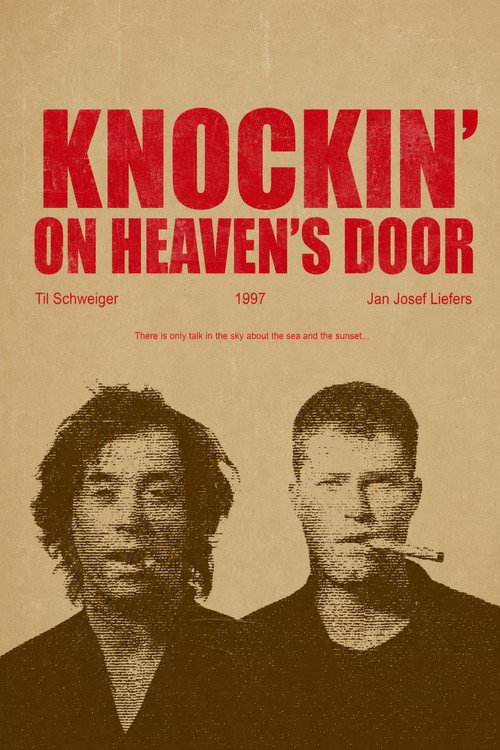
Knockin' on Heaven's Door
1997 · Thomas Jahn
When you want to laugh and feel your chest tighten in the same evening — a live-while-you-can movie for a night that calls for both jokes and a lump in the throat. Comfort food with an expiry date stamped on it.
What it's about
Two strangers meet in a hospital room where each has just learned he's dying. Over stolen tequila they fix on one idea — in heaven, everyone talks about the sea, and Rudi has never seen it — so they steal a vintage Mercedes and drive for the coast. The car, unfortunately, belongs to gangsters, and it isn't empty.
The experience
A tequila-soaked mix of slapstick crime caper and genuinely tender road movie — you're laughing at bumbling hitmen one minute and blindsided by the mortality underneath the next. It moves fast and wears its heart openly.
Performances
Til Schweiger and Jan Josef Liefers have an easy, bickering chemistry as the two dying men — the film's sentiment works because their friendship never feels engineered.
The craft
Thomas Jahn shoots the caper with a loose, Americanized cool unusual for German cinema of its day, welding farce, shootouts and deathbed melancholy into one register. The title song over the finale is the kind of music cue people remember for decades.
Why it matters
One of the defining German box-office hits of the 1990s — it made Til Schweiger a star and remains the template German audiences reach for when they talk about homegrown crowd-pleasers.
Snapshot
Knockin' on Heaven's Door is a German road movie and crime comedy-drama that became one of the defining commercial hits of 1990s German cinema. Its premise is disarmingly simple: two strangers, Martin Brest (Til Schweiger) and Rudi Wurlitzer (Jan Josef Liefers), meet in a hospital room, each having just been told he is dying. Over stolen tequila they arrive at a shared conviction — that in heaven the only thing anyone talks about is the sea — and, on discovering that Rudi has never seen it, they abscond in a stolen Mercedes convertible to reach the coast before they die. The car turns out to belong to gangsters and to contain a large sum of money, and the terminal-illness fable is thus welded onto a farcical crime chase. The film's power lies in that collision of registers: a sentimental meditation on mortality played at the tempo and with the pop-cultural swagger of a post-Tarantino caper. It made Til Schweiger a national star, spawned a hugely popular soundtrack, and lodged its central conceit — "im Himmel, da gibt's nur ein Thema, und das ist das Meer" — in German popular memory.
Industry & production
The film belongs to a moment when German cinema was reasserting its commercial viability at home after years of art-house identification and Hollywood dominance of the domestic box office. Through the mid-1990s a run of homegrown comedies and crowd-pleasers — the so-called Beziehungskomödie (relationship comedy) wave and its neighbors — proved that German audiences would turn out in large numbers for German films with contemporary voices. Knockin' on Heaven's Door arrived as this confidence was cresting and became one of its emblematic successes.
It was very much a Til Schweiger vehicle in the fullest sense: he starred, co-wrote, and was a driving creative force behind the production, which is closely associated with his own producing activities (his company Mr. Brown Entertainment is part of this lineage). Director Thomas Jahn co-wrote the screenplay with Schweiger. The casting reached beyond the German-speaking world for its heavies, most notably Dutch star Rutger Hauer as the crime boss Curtiz — an international-genre signifier that flagged the film's ambitions and its affection for the American crime cinema it pastiches.
On release the film was a substantial domestic hit; it is routinely counted among the most successful German productions of its year and drew admissions in the millions. I would not want to attach a precise box-office figure without documentation, but the scale of its popularity — measured in ticket sales, soundtrack sales, and its afterlife on television — is not in dispute. The film's success also consolidated an ensemble that would remain prominent in German screen culture for decades: Schweiger, Liefers, Moritz Bleibtreu, and Thierry van Werveke among them.
Technology
Knockin' on Heaven's Door was made and released on 35mm as a conventional photochemical production of the late 1990s, before digital intermediate and digital acquisition reshaped mainstream filmmaking. Nothing about its production technology is exceptional or experimental; its craft interest lies in staging and performance rather than in any technical innovation. Its most consequential "technology," in a looser sense, was the popular-music apparatus around it — the marketing and distribution of a hit soundtrack that used a chart-oriented cover of the title song to extend the film's reach into radio and record sales, a synergy typical of studio-style commercial filmmaking of the era.
Technique
Cinematography
The photography serves the road-movie form: it opens the frame to landscape and highway as the pair drive toward the coast, using the movement of the car and the widening horizon to externalize their flight from the hospital's confinement toward the sea. The visual arc runs from cramped, clinical interiors to open air and, finally, to the beach — light and space expanding as the characters approach the thing they are dying to see. The look is glossy and accessible rather than austere, in keeping with the film's commercial address. I do not have a reliably documented director-of-photography credit to cite here, and rather than attach a name I am unsure of, I will simply note that the cinematography's function — the confinement-to-liberation trajectory — is legible on screen regardless of attribution.
Editing
The editing manages the film's central formal problem: alternating between the tender two-hander of the dying men and the propulsive mechanics of the crime chase. It cuts for comic timing in the gangster material and slows for the confessional beats between Martin and Rudi, and the film's success depends on those tonal gear-changes not jarring. The pacing is brisk in the caper stretches and deliberately eased at the coast, where the film finally lets its momentum dissipate into stillness.
Mise-en-scène / staging
Two spaces organize the film. The first is the sterile hospital room where the men receive their death sentences — the enclosure they must escape. The second is the road and, ultimately, the beach — the open destination. Between them the stolen 1960s Mercedes convertible is the film's defining prop and its true stage: a mobile, top-down space that puts the characters literally in the open air, exposed and free, and that visually rhymes their liberation with their vulnerability. The recurring motif of the sea is planted verbally long before it is seen, so that the final coastal image pays off an idea the film has been staging in dialogue throughout.
Sound
Sound and, above all, music are central to the film's identity. The title explicitly borrows Bob Dylan's "Knockin' on Heaven's Door," and the soundtrack's German-scene cover version became a hit in its own right, tying the film's theme of dying and transcendence directly to its most-heard piece of music. The song functions less as underscore than as thesis statement: the act of "knocking on heaven's door" is the whole narrative in miniature. The soundtrack album's popularity was itself part of the film's cultural footprint.
Performance
Performance is where the film earns its emotional credit. Til Schweiger's Martin is the cooler, more reckless of the pair — the charismatic screen presence the film was built to launch — while Jan Josef Liefers's Rudi is the softer, more frightened man who has never lived and is now running out of time. The chemistry between them, swinging between bickering comedy and genuine tenderness, is the film's engine. The surrounding gallery — Bleibtreu, van Werveke, and Hauer among the criminals — plays broad genre types with relish, providing the comic and menacing counterweight to the central intimacy.
Narrative & dramatic mode
The screenplay fuses two well-worn structures. The first is the terminal-illness "last wish" story, whose engine is the ticking clock of a death sentence and whose emotional mode is carpe diem: live fully because the end is certain and near. The second is the crime caper and chase, whose engine is a bag of money, a stolen car, and pursuing gangsters. The dramatic ingenuity is in the join. The men's indifference to consequences — they are dying anyway — makes them fearless in exactly the way the crime plot requires, so the two structures reinforce rather than merely coexist with each other. The narrative is linear and goal-directed (reach the sea), with the destination functioning as both literal terminus and metaphysical one. Its dramatic mode oscillates deliberately between farce and elegy, and the film's identity depends on holding those tones in the same hand.
Genre & cycle
The film sits at a busy generic crossroads: buddy movie, road movie, crime comedy, and terminal-illness melodrama at once. It belongs recognizably to the international post-Pulp Fiction (1994) cycle of stylish, wisecracking crime films with pop-scored violence and voluble lowlifes — a global sensibility that German commercial cinema absorbed and localized in the mid-1990s. In its terminal-diagnosis-turned-liberation premise it also joins the lineage of buddy-and-road pictures in which characters flee toward a coast or a horizon that stands for freedom and finality. Within German cinema specifically, it is part of the decade's wave of confident, audience-facing genre entertainments that reclaimed the domestic box office.
Authorship & method
The film is best understood as a collaboration between director Thomas Jahn and star-co-writer Til Schweiger, who shared the screenplay. Jahn directs for accessibility and tonal control, keeping the crime machinery moving while protecting the emotional core; the film is his best-known feature. Schweiger's authorship is inseparable from the project — as co-writer, star, and a producing force, he shaped it into the vehicle that would define his career and establish the star persona (laconic, handsome, faintly melancholic) he would carry forward.
Among collaborators, the most securely attributable creative signature beyond the two authors is the music: the decision to build the film around the Dylan title and a contemporary German-language cover is a defining authorial choice, and the soundtrack's success shows how central that choice was to the film's reception. For the cinematography, editing, and score composition, I do not have documentation I can vouch for and will not invent credits; the record accessible to me is genuinely thin on the below-the-line names, and I would rather flag that gap than fabricate attributions. What can be said confidently is that the craft was marshalled in service of a clear authorial intent: to make a mortality fable that plays like a crowd-pleasing caper.
Movement / national cinema
This is a work of 1990s German popular cinema, and it is significant precisely as commercial rather than art cinema. It stands apart from the legacy of the New German Cinema of the 1970s — the auteurist, critical tradition of Fassbinder, Herzog, and Wenders — and belongs instead to the subsequent generation's reclamation of genre and entertainment for domestic audiences. Its casting of Rutger Hauer and its embrace of an internationally legible crime idiom mark an outward-looking, export-conscious strain within that national revival: German cinema speaking the lingua franca of American genre while telling a story rooted in German stars and a German pop-music moment.
Era / period
Contemporary in setting, the film is thoroughly of the late 1990s — in its post-Tarantino stylistic reflexes, its soundtrack-driven commercial model, and its faith that German audiences would embrace homegrown genre fare. It captures a specific confidence in German popular filmmaking at the end of the century, and it helped set the template for the star-driven commercial comedy-dramas that would follow, several of them associated with Schweiger himself.
Themes
The governing theme is mortality and the imperative to live in its shadow — a carpe diem fable in which the certainty of death becomes, paradoxically, a source of freedom and courage. The sea is the film's central symbol: an image of the infinite, of heaven, of the one experience worth dying to have, and its long-deferred appearance gives the ending its weight. Male friendship is the film's emotional substance — two lonely, frightened men who become, briefly, everything to each other. Around these run subsidiary motifs of transgression as liberation (theft, joyriding, and crime committed by men with nothing left to lose) and of ordinary life reframed as precious once it is ending. The union of the sublime (the sea, death, heaven) with the profane (gangsters, tequila, a stolen car) is not incidental but the film's very method of meaning-making.
Reception, canon & influence
Critically and commercially, the film landed as a popular triumph. It was embraced by German audiences on a scale that made it one of the signal domestic hits of its moment, and it turned Til Schweiger into a bankable national star — arguably its single most consequential effect on the industry. The soundtrack extended its cultural reach well beyond cinemas, and the film's central line about the sea entered common parlance. Critical opinion has generally treated it as an accomplished, emotionally effective entertainment rather than an art-cinema landmark; its canonization is popular and industrial more than it is a matter of highbrow critical consensus.
Looking backward, its influences are clear: the international post-Pulp Fiction crime-comedy sensibility; the buddy and road-movie tradition of men fleeing toward a horizon; and the long lineage of last-wish, dying-protagonist dramas. The Dylan song supplies both title and thematic frame. Looking forward, its legacy is chiefly the star it minted and the commercial template it helped legitimize: the German audience-facing genre film built around a charismatic lead and a hit soundtrack, a model that shaped much of the Schweiger-associated popular cinema that followed. Its title and premise remain widely recognized reference points in German popular culture. Claims of specific international remakes or direct scene-level imitations I would treat cautiously; where the documentary record is thin I prefer to note the film's secure legacy — a launched star, a beloved soundtrack, and an enduring popular fable of dying men and the sea — rather than overstate its formal influence.
Reception
The highest-grossing German film of 1997 at home, it was largely waved off abroad (and by some critics) as Tarantino-lite — but in Germany it's since hardened into stone-cold cult-classic status, the road movie a whole generation can quote.
How Knockin' on Heaven's Door was received, from release to now →
How to watch Knockin' on Heaven's Door: what to notice on a first viewing
- Watch the hospital's white walls versus the open road. The film moves from a sterile, clinical hospital room to open highway, letting light and space widen as the men go on. The space around them keeps opening up as their time keeps running out.
- Watch the stolen convertible with its top down. The 1960s Mercedes convertible becomes the men's real stage, an open topped car that puts them literally in the air, exposed and free at the same time. Their freedom and their vulnerability turn out to be exactly the same open air.
- Listen for the men talking about heaven and the sea. The men talk about heaven and the sea early and often, planting an idea in dialogue before they ever act on it. The talk gives them a goal, so each scene is shaped by something they want.
- Notice the film switch speeds between the two men and the chase. The editing cuts briskly for the gangster material, then slows down for the quiet, confessional scenes between Martin and Rudi, and the film depends on that switch feeling smooth. You're watching two different movies fused together, and the fusion is the whole trick.
- Watch which of the two men flinches first in an argument. Til Schweiger plays Martin cool and reckless, while Jan Josef Liefers plays Rudi softer and more frightened, and the film's warmth comes from how they bicker into tenderness. Their friction is where the affection actually lives, not in anything either man says outright.
The whole guide to watching Knockin' on Heaven's Door, with the keys for a rewatch →
Influences: the films it descends from and the films it influenced
- Pat Garrett and Billy the Kid (1973) — The literal source of the Dylan song: Peckinpah scores Sheriff Baker's slow death beside the water to 'Knockin' on Heaven's Door,' establishing the exact song-as-thesis-over-a-dying-man device Jahn rebuilds his whole film around.
- Pulp Fiction (1994) — Supplies the crime-comedy grammar the dossier names — garrulous low-level hitmen whose deadpan banter defuses and then detonates violence, and the editing that swings between comic dialogue and sudden brutality (the 'tonal gear changes').
- Butch Cassidy and the Sundance Kid (1969) — The template for the doomed male dyad: two outlaws whose wisecracking mutual ribbing carries the picture while they flee knowingly toward death, chemistry substituting for plot exactly as Schweiger/Liefers' does.
- Thelma & Louise (1991) — The road movie as terminal flight in a convertible, escalating carpe-diem abandon steered toward a symbolic natural edge — the canyon there, the sea here — as the destination that resolves the mortality.
- Easy Rider (1969) — Codifies the road movie whose emotional structure is carried by pop-song needle-drops laid over open-highway cinematography rather than by score.
- Midnight Cowboy (1969) — The mismatched-buddy journey toward a promised destination while one man is visibly dying, the bond deepening as the body fails — the emotional armature under the caper.
- Ikiru (1952) — Founds the dying-protagonist fable in which a terminal diagnosis triggers the inventory of a single last wish, the carpe-diem mortality drama the film crossbreeds with the crime caper.
- True Romance (1993) — The Tarantino-scripted crime-lovers-on-the-run with a pop soundtrack and a bumbling-gangster underworld pursuit, modeling the pulp mechanics that keep Jahn's plot moving beneath the emotion.
- Bang Boom Bang (1999) — Extends the post-Pulp Fiction German crime-comedy into the Ruhrgebiet — bungling criminals, deadpan violence, and tonal gear-changes — inheriting the domesticated-Tarantino register the film legitimized.
- The Bucket List (2007) — Rebuilds the exact buddy-plus-diagnosis structure: two terminally ill men escape the hospital to check off a list of last wishes, the carpe-diem mortality caper stripped to its clearest form.
- Keinohrhasen (2007) — Schweiger's own directorial vehicle extends the laconic, handsome, faintly melancholic star persona minted here, plus the crowd-pleasing genre-film-around-a-charismatic-lead template the dossier calls his chief legacy.
- 50/50 (2011) — Continues the crime-free strain of the same fable — a young man's cancer diagnosis played as a buddy comedy that guards an emotional core, tonally veering between joke and dread just as the film does.
- Wild at Heart (1990) — The crime road-couple picture that fuses the sublime and the profane through pop songs and highway iconography, the same tonal register of tenderness inside sleaze.
- Trainspotting (1996) — The contemporaneous exemplar of the pop-soundtrack-as-narrative-engine, where curated needle-drops rather than orchestral score carry the film's youthful kinetic energy and thesis.
- Run Lola Run (1998) — The other signal work of 1990s German popular cinema engineered for export — genre energy plus a driving pop/techno soundtrack as its calling card, the same commercial formula on a different structure.
- Bandits (1997) — Same-year German audience film building a crime-flight narrative around fugitives and a hit-single soundtrack, sharing the moment's model of pop music as the picture's commercial and emotional spine.
Similar films
- Run Lola Run (1998) — influence & lineage
- Pulp Fiction (1994) — influence & lineage
- Il Sorpasso (1962) — same viewing thread
- The Intouchables (2011) — same viewing thread
- Taste of Cherry (1997) — shared sensibility
- The American Friend (1977) — shared sensibility
- The Last One for the Road (2025) — shared sensibility
- Night on Earth (1991) — shared sensibility
All the films related to Knockin' on Heaven's Door →
Watch it with: curated runs of related films
- Strangers Who Change Each Other — Watch these back-to-back when you want the warmth of two people who shouldn't have met becoming each other's whole world — a ladder from the multiplex hit down to its arthouse ancestors.