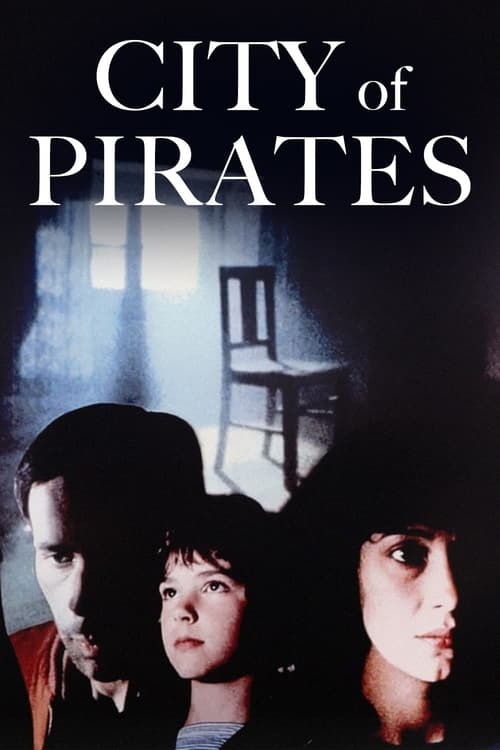
City of Pirates
1984 · Raúl Ruiz
For an adventurous night when you want cinema as pure dream — something beautiful and unnerving that refuses to explain itself. Skip it if you need a story that resolves; reach for it when you want one that haunts.
What it's about
A melancholy maidservant named Isidore, haunted by a voice that may be her own, takes in a small boy who calmly announces he has murdered his family. He carries her — or her own longing does — toward a tiny island of pirates, where she meets a man inhabited by several personalities at once. It unfolds as a dark fairy tale that follows dream logic rather than plot: events repeat, transform, and answer each other like images in a recurring nightmare.
The experience
Genuinely dreamlike — not "quirky" but the real disorienting article, by turns funny, sinister, and ravishing. You stop trying to solve it and start floating in it; images and lines lodge in your head and resurface days later.
The craft
Ruiz shoots on a shoestring like a magician with unlimited means: wide-angle deep-focus shots where enormous objects loom in the foreground, rooms drenched in saturated colored light, dialogue delivered like incantation. Made fast and cheap, it looks more inventive than most films with a hundred times the budget — every frame is composed like a strange painting.
Why it matters
A high point of Ruiz's astonishing early-1980s run, when he was making several features a year, and one of the films that cemented his cult reputation as cinema's great dream-spinner — a touchstone for anyone drawn to surrealism on screen.
Snapshot
La ville des pirates is Raúl Ruiz's most concentrated fairy tale: a French-language film shot in Portugal, in which a maidservant named Isidore, tormented by a voice that may be her own, takes in a small boy who calmly announces that he has murdered his family, and is carried by him — or by her own wish — toward an island where a man is inhabited by several people at once. Made at the crest of Ruiz's early-1980s European surge, when he was producing several features a year on budgets that would barely cover a Hollywood second unit, the film distills the qualities that made him a cult figure among cinephiles: wide-angle deep-focus compositions crowded with looming foreground objects, saturated colored light, dialogue that behaves like liturgy rather than exchange, and a story that advances by association, repetition and dream displacement rather than by cause and effect.
It is not a difficult film so much as a differently organized one. Ruiz treated narrative as a combinatorial machine, and here he sets the family romance — parents, siblings, murder, incestuous longing — spinning until every figure has occupied every position. The result sits at the intersection of Freudian case study, boys' adventure novel, and Latin American baroque fable, made by a Chilean exile working in a Portuguese light that never quite looks like anywhere.
Industry & production
The film belongs to the extraordinary run of work Ruiz made after the 1973 Chilean coup drove him into French exile. Having arrived in Paris with a Chilean filmography largely unseen abroad, he rebuilt a career inside the specific ecology of late-1970s and 1980s European art cinema: state and television patronage (in his case above all the Institut national de l'audiovisuel, which underwrote a long series of his experimental works), small independent producers, festival exposure, and co-production arrangements that let a director shoot in whichever country offered the cheapest infrastructure.
Portugal was that country for Ruiz in the early 1980s, and the connection ran through the producer Paulo Branco, whose Franco-Portuguese operation was then assembling one of the most consequential producer filmographies in Europe — Manoel de Oliveira, Wim Wenders, João César Monteiro, and Ruiz among them. City of Pirates is a product of that arrangement: French dialogue and French leads, Portuguese locations, coastline and crew. Shooting in Portugal gave Ruiz the Atlantic light, the shuttered villas and the sense of a place emptied of its own history that the film converts into an imaginary geography.
The economics matter to the aesthetics. Ruiz made this film fast, cheap and adjacent to other projects; 1983–84 also produced Three Crowns of the Sailor, its closest sibling, along with television work and further features. That tempo is inseparable from the style. Effects had to be achievable in the camera or the lab rather than purchased; sets had to be found rather than built; scenes had to be shot in few takes. What in a better-financed production would be a limitation becomes, in Ruiz, a method: the film is visibly improvising its own marvels out of glass, gels, mirrors and available architecture.
The commercial record is thin and should be stated as such. The film had no meaningful theatrical life outside specialist circuits and festival programming, and no reliable box-office figures or production budget are in the public record. It survived, as most Ruiz films did, through cinémathèques, retrospectives, film-society screenings and — decades later — restoration and streaming.
Technology
The film is 35mm color with post-synchronized sound, the standard technical envelope of European art cinema at the time, deployed in a deliberately artisanal way. Ruiz's signature technological gesture of this period is the use of very short focal lengths at wide apertures of field, which allowed him to hold an object inches from the lens and a figure at the far end of a room in simultaneous focus. The distortion that comes with such lenses — bowed verticals, exaggerated recession, faces that swell as they approach — is not corrected but exploited.
Around this he built a repertoire of pre-digital trickery: colored gels and filters that flood interiors with reds, blues and acid greens; mirrors and reflective surfaces used to fold two spaces into one frame; refracting glass and improvised prisms placed in front of the lens to smear or double the image; forced perspective; and superimposition achieved optically rather than through elaborate post-production. None of it is invisible. The technology is meant to be perceived as technology — as conjuring — which aligns the film with the pre-classical cinema of Méliès and the trick film as much as with the modernist art movie.
Post-synchronization is a technological condition Ruiz turned into a formal principle. Because dialogue was recorded separately, voices could be detached from bodies, given a different acoustic space from the image, or assigned to the wrong speaker. In a film about a man containing several people, that technical fact becomes the subject.
Technique
Cinematography
The photography is credited to Acácio de Almeida, the Portuguese cinematographer whose work with Branco's directors made him one of the essential image-makers of 1980s European cinema. The film's look is built on a small number of insistent devices. Foreground obstruction is the first: bottles, candelabra, banisters, plants, human limbs occupy the near field and partially block the ostensible subject, so that the viewer is constantly aware of the frame as a stacked, layered construction rather than a window. Deep focus keeps every plane legible, which prevents the usual hierarchy of attention — nothing is softened into background.
The second is the oblique, low or otherwise "wrong" camera position: shots taken from floor level, from behind furniture, from angles that a conventional coverage plan would never generate. The third is color as mood-substance rather than realism, with interiors bathed in unmotivated hues and exteriors given the hard, silvery Atlantic light of the Portuguese coast. Together these produce the peculiar Ruizian effect of a space that is precisely described and completely unreliable — you can see every corner of the room and still have no idea how it connects to the next one.
Editing
Cutting in the film follows a poetic rather than dramatic logic. Ruiz's 1980s features were most often edited by Valeria Sarmiento — his wife, a significant director in her own right, and the collaborator who has since taken custody of his unfinished work — and the approach here matches her work across that period: long-held compositions that are allowed to complete a strange internal movement, then abrupt transitions that skip the connective tissue conventional editing exists to supply.
Scenes begin after their beginning and end before their end. Spatial continuity is often violated deliberately, so that a character crosses a threshold into a room that cannot be adjacent. Repetitions and returns — the same gesture, the same phrase, the same location differently lit — do the structural work that plot causality does elsewhere. The cumulative rhythm is closer to the stanza than the paragraph.
Mise-en-scène / staging
Ruiz stages in tableaux. Actors are frequently arranged frontally or in friezes, held still, made to deliver lines to no one in particular. Objects are given the same weight as people: a doll, a knife, a shell, a piece of furniture will be composed as though it were a character, and often photographed with more intimacy. The houses in the film — coastal villas, shuttered rooms, a shoreline dwelling — are treated as containers of memory rather than as functional architecture.
The staging repeatedly returns to thresholds, corridors and windows: figures framed within frames, passing between rooms that behave like separate worlds. This is entirely consistent with the film's psychological content, in which the family home is both refuge and crime scene, and with Ruiz's broader interest in the image as a haunted, permeable surface.
Sound
The soundtrack is one of the film's most radical components. Jorge Arriagada — the Chilean composer who scored the overwhelming majority of Ruiz's films from the 1970s until the director's death, and whose contribution to the Ruiz style is comparable to a cinematographer's — supplies music that is lush, tonal and slightly archaic, often waltzing or elegiac, deliberately at odds with the images it accompanies. The lyricism is not ironic exactly; it functions as a solvent, dissolving horror into reverie.
Around the score, Ruiz builds a field of disembodied voices: whispers, first-person narration that cannot be securely attributed, voices that address Isidore from off-screen or from inside her, dialogue that continues while lips are still. The sea is a near-constant presence in the mix. Because a central character is inhabited by multiple personalities, the film gets to literalize the ventriloquial condition of all sound cinema — a voice is always something added to a body — and it does so without a single special effect.
Performance
Anne Alvaro, as Isidore, carries the film with a performance built from stillness, watchfulness and a kind of somnambulist gravity; her later reputation in French cinema, including her César-winning work in The Taste of Others (2000), was made in a far more naturalistic register, which makes the trance-like control here the more striking. Hugues Quester — later familiar from Rohmer's A Tale of Springtime — takes on the man of many selves, and plays the switches as modulations of a single instrument rather than as caricatural transformation.
The film is also notable as the debut of Melvil Poupaud, cast by Ruiz at around ten years old as the boy Malo. Poupaud would go on to work with Ruiz repeatedly through his adolescence and into adulthood, including as Marcel in Time Regained (1999), making his career one of the longest continuous threads in Ruiz's filmography. His performance here is deliberately affectless — the child announces atrocity in the tone of a boy reporting on his day — and much of the film's disquiet comes from that flatness.
Narrative & dramatic mode
Ruiz was cinema's most articulate opponent of what he called central conflict theory: the assumption, codified by Hollywood screenwriting manuals, that a story must consist of a protagonist who wants something and encounters obstacles. His Poetics of Cinema, published in the mid-1990s and eventually translated into English, argues that this model is a parochial invention masquerading as a universal law, and proposes alternatives drawn from oral storytelling, baroque allegory, shamanic practice and combinatorial games.
City of Pirates is that argument made visible a decade before it was written down. The film has characters, a sequence of events, and something like a plot, but none of them behave the way dramaturgy expects. Desires are stated rather than pursued. Violence occurs without escalation. The narration is unreliable not in the twist-ending sense but structurally — there is no stable level of reality from which the unreliability could be measured. Motifs recur in transformed positions, so that the boy, the man on the island, and the absent father come to seem like permutations of one figure.
The governing mode is the dream, but a dream with the grammar of a fairy tale: an orphaned or servile heroine, a forbidden child, a sea crossing, an island, an ogre with many faces. Ruiz activates the deep structure of the folk narrative while refusing its resolution.
Genre & cycle
The film is unclassifiable in commercial terms and quite legible in art-cinema terms. It draws on the surrealist tradition, on the gothic and the ghost story, on the Freudian case history, and on the boys' adventure novel — the pirate island being lifted, in mood if not in incident, from the Stevensonian imaginary Ruiz loved and returned to explicitly in his Treasure Island.
Within Ruiz's own output it belongs to a distinct cycle: the maritime, ghost-haunted, storytelling-obsessed films of the early 1980s, of which Three Crowns of the Sailor is the twin. Both concern sea voyages that are also passages into the realm of the dead; both use the sailor's yarn as a model for a narrative that keeps generating new frames; both were made in the same burst of Portuguese-facilitated productivity. Read together they constitute Ruiz's fullest statement on exile as a condition of perpetual, unfinishable travel.
Authorship & method
Ruiz (1941–2011) is the rare case of a director whose theory and practice are genuinely continuous. Trained in law and theater in Chile, associated with the cultural ferment of the Allende years, exiled after 1973, he produced a filmography whose sheer size — well over a hundred works, counting television and shorts — is itself an authorial statement: cinema as continuous production rather than as a sequence of monuments. His method favoured speed, improvisation, and a refusal to distinguish sharply between commissioned work, television, and personal projects.
His core collaborators supplied the continuity that his restlessness might otherwise have prevented. Arriagada's music is the constant across four decades. Sarmiento's editing shaped the rhythm of his most important 1980s features and, after his death, she completed projects he left behind. In Portugal, Acácio de Almeida's photography gave a whole run of these films their particular density of light and depth. Ruiz wrote his own scripts, and wrote them in a way that resists the term — texts organized around image ideas, verbal conceits and structural games rather than beats.
The intellectual sources are declared throughout: Borges and the Latin American baroque, the surrealists, Buñuel's Mexican period, Cocteau's poetic-mythological mode, Raymond Roussel's procedural literature, Catholic iconography absorbed and estranged. Ruiz's insistence that images are generative rather than illustrative — that a film should be a machine for producing more images — is the working principle behind every strange composition in City of Pirates.
Movement / national cinema
The film has three national affiliations and belongs entirely to none. It is a French film by industrial classification and language; a Portuguese film by location, crew and producer; and a Chilean film by the sensibility and biography of its director. That triangulation is the point. Ruiz is a foundational figure in what is now discussed as exile or diasporic cinema — work made from a position of displacement, in which the lost country returns as atmosphere rather than as subject.
Within Portugal, the film sits inside the Branco-centred production world that sustained the country's cinema through the 1980s and gave the international art film a durable Iberian base. Within France, Ruiz occupied a position at the outer edge of the post-New Wave avant-garde, adjacent to the theoretical culture of the Paris film journals without being of any school. Within Chilean cinema, he is the great absent presence — a national master whose major work was made elsewhere, and whose repatriation into Chilean film history has largely been posthumous.
Era / period
The early 1980s were the moment when the European art film's institutional supports — public television, national film funds, co-production treaties, the festival network — were at their most generative, and simultaneously the moment when the audience for such films began to contract. Ruiz exploited the supports fully and made no concession to the contraction.
The period also marks a shift in how such films circulated. City of Pirates was made just before home video and, later, DVD and streaming rewired the afterlife of difficult cinema. For roughly two decades it existed mainly as a rumor with occasional screenings attached; its wider availability is a phenomenon of the twenty-first century, which means most of its current audience encounters it as a rediscovery rather than as a contemporary event.
Themes
The family romance is the film's engine: a child who destroys his parents, a woman who becomes mother, sister and lover to him in turn, a man on an island who is simultaneously several members of a family. Ruiz stages Freud's account of childhood fantasy not as psychology to be interpreted but as a landscape to be traversed.
Around that cluster sit the concerns that run through his whole body of work. Exile and statelessness, figured in the pirate — the person who belongs to no nation and lives on the sea between them. Possession and ventriloquism: who speaks when a voice emerges, and whether identity is anything more than a sequence of borrowed personae. The persistence of the dead, who in Ruiz never leave, but move into rooms, objects and other people. The sea as threshold between worlds. And, underneath all of it, an unstated politics — a Chilean's film about murdered families, disappeared parents, and children who cannot say what happened, made a decade into a dictatorship that had made all of those things literal. Ruiz never allegorizes this directly, and it would be a mistake to reduce the film to it; but the pressure is there in every haunted room.
Reception, canon & influence
Contemporary reception was the reception of a cult object. Ruiz had become, by 1983–84, a critical enthusiasm in France and Britain — championed in the Paris journals as a genuine original, promoted in the UK by critics and programmers who saw in him a way past the exhausted opposition between narrative and avant-garde cinema, and supported by festivals such as Rotterdam that specialized in exactly his kind of work. Detailed screening and prize records for this particular title are sparse in the accessible literature, and it is more honest to note that than to supply specifics.
The influences running into the film are relatively legible: Buñuel above all, for the matter-of-fact treatment of the outrageous; Cocteau for the mythic-domestic fairy tale; the surrealists for the logic of displacement; Borges and the Spanish-language baroque for the recursive structures; Stevenson and the adventure tradition for the island and the pirates; and the whole trick-film prehistory of cinema for the delight in visible conjuring.
Running forward, the influence is real but diffuse, and it operates less through direct imitation than through the demonstration that a feature film could organize itself entirely on poetic principles and still be watchable, funny and frightening. Ruiz became a permanent reference point for filmmakers and critics interested in dream logic, unstable narration and the baroque image — the argument he made in Poetics of Cinema, once translated, gave a generation of students a vocabulary for opposing screenwriting orthodoxy. His late-career prestige productions, particularly Time Regained (1999) and Mysteries of Lisbon (2010), sent viewers backward into the 1980s films and made City of Pirates newly visible.
Its most concrete legacy may be the smallest: Melvil Poupaud, discovered here as a child, became a fixture of French cinema and carried the Ruiz connection through his career. Beyond that, the film's canonization has been the slow, curatorial kind — retrospectives after Ruiz's death in 2011, restoration efforts undertaken with the involvement of Valeria Sarmiento and Chilean and French institutions, and the steady advocacy of critics who have argued for decades that Ruiz belongs in the first rank of postwar filmmakers. City of Pirates is increasingly the film cited to make that case: the most complete demonstration of what his cinema could do when nothing constrained it but the budget.
A Deleuzian reading
A bottle stands inches from the lens, swollen, out of scale, in perfect focus.
The full Deleuzian reading of City of Pirates →
Reception
Barely distributed and near-impossible to see for decades, it circulated mostly as a rumor among Ruiz devotees; retrospectives and restorations have since lifted it into the front rank of his 1980s work, now routinely named among his masterpieces.
How City of Pirates was received, from release to now →
How to watch City of Pirates: what to notice on a first viewing
- Notice objects blocking part of the frame while staying in focus. Bottles, candelabra, banisters, and limbs sit in the near field, sharp and unblurred, while the background stays equally sharp, so nothing recedes into scenery. You have to choose what to look at. The frame refuses to choose it for you.
- Watch how often characters are framed inside doorways and windows. Figures keep passing between rooms shown as separate worlds, staged within thresholds, corridors, and windows that frame them again inside the shot. Every doorway makes you unsure whether the next room belongs to the same house at all.
- Listen for voices that seem to come from nowhere in the shot. Whispers and first-person narration drift in that cannot be pinned to a speaker, sometimes addressing Isidore from off-screen or from somewhere inside her. You are never sure whose voice you are hearing, which is exactly the film's subject.
- Watch the boy announce murder in a completely flat, calm voice. Ten-year-old Melvil Poupaud delivers the boy's confession with the same tone he'd use to describe his day, no emphasis, no rising or falling. The flatness is where the disquiet lives, not in anything the boy shouts or cries.
- Notice how unnaturally colored the light in each room is. Interiors are bathed in unmotivated hues while exteriors carry the hard silvery light of the Portuguese coast, color used as feeling rather than realism. The color tells you the emotional weather of a room before anything happens in it.
The whole guide to watching City of Pirates, with the keys for a rewatch →
Influences: the films it descends from and the films it influenced
- A Trip to the Moon (1902) — The substitution splice and painted-flat proscenium — bodies vanishing and multiplying inside a frontally staged tableau — is the exact grammar Ruiz revives when he does his magic in-camera rather than in optical printing, keeping the seam visible as part of the pleasure.
- The Blood of a Poet (1930) — Cocteau's practical trickery — sets built vertically and shot from above so a man 'crawls' a wall, mirrors used as doorways — plus a poet's voice narrating over images it doesn't quite describe, is the template for Ruiz's disembodied narration laid across impossible domestic space.
- L'Âge d'Or (1930) — Buñuel's deadpan continuity cutting applied to outrages (a cow in a bed, a man kicking a blind beggar) teaches the film its governing tone: shot scale, eyeline and match-cut all behave normally while the content refuses to.
- Vampyr (1932) — Dreyer's somnambulist non-professional performances, gauze-diffused light, and geography that will not assemble into a coherent map — plus wholly post-synchronized voice detached from the bodies — is the precise register Ruiz asks of his cast.
- Citizen Kane (1941) — Toland's wide-angle deep focus with a looming object jammed into the near foreground, plus floor-level oblique angles that make ceilings press down, is the lens logic Acácio de Almeida reproduces here on a fraction of the budget.
- Beauty and the Beast (1946) — The mythic-domestic fairy tale staged with in-camera enchantment — living candelabra arms, slow-motion reverse for magical entrances, a house that is both bourgeois interior and enchanted castle — is the direct model for Ruiz's haunted seaside villa.
- Last Year at Marienbad (1961) — Narration that contradicts, precedes or outlives the image it accompanies, cut across statuary tableaux whose spatial relations never resolve, established the discontinuous-space editing grammar Valeria Sarmiento applies here.
- The Exterminating Angel (1962) — Buñuel's Mexican-period structural game — a scene literally repeated with different framing, a premise that generates episodes rather than a conflict to be resolved — is the anti-central-conflict architecture Ruiz would later theorize in Poetics of Cinema.
- The Saragossa Manuscript (1965) — Stories nested three and four deep, with a narrator inside a tale told by a character in another tale, gives Ruiz the recursive baroque form his island-and-pirates fable adopts without ever returning to its outermost frame.
- Treasure Island (1985) — Ruiz immediately re-cast Melvil Poupaud, discovered here, and re-ran the Stevenson adventure source through the same estranging apparatus, extending the child's opaque, affectless delivery into a full lead performance.
- Careful (1992) — Maddin builds an entire alpine world from painted backdrops, iris masks and heavy amber-and-cyan gel washes with post-synchronized declamatory voice — an explicit continuation of the argument that a feature can be assembled from in-camera artifice and dream logic alone.
- Time Regained (1999) — The famous shots where furniture and spectators glide on hidden dollies while the camera holds are the mature, budgeted form of the in-camera spatial trickery improvised here; the prestige of this film is what sent viewers back to the 1984 one.
- Mysteries of Lisbon (2010) — A child protagonist whose parentage triggers a chain of nested narrators, cut by Sarmiento and scored by Arriagada, with the camera repeatedly framing action through doorways and behind foreground furniture — the 1984 devices scaled to four hours.
- Cemetery of Splendor (2015) — Sleeping soldiers bathed in slowly cycling colored light tubes, performances pitched in a flat somnambulist register, and a structure that drifts through episodes with no conflict to resolve — the anti-central-conflict poetics Ruiz argued for, practiced.
- Céline and Julie Go Boating (1974) — A fixed theatrical tableau replayed with variations, entered by ingesting a substance, treats fiction as a physical location one can walk into — the same frames-within-frames device Ruiz uses when scenes are watched from doorways and windows.
- The Hypothesis of the Stolen Painting (1979) — The frontal tableau vivant lit in hard directional color and commented on by an unseen voice, with the camera tracking laterally past obstructing foreground figures, is the same apparatus turned here from painting-analysis onto fairy tale.
- Silvestre (1981) — Shot by Acácio de Almeida in the same Portuguese production milieu, it stages legend against openly painted flats with saturated gel washes and frontal blocking — the shared house style of density-of-light plus declared artifice that Ruiz's film inherits.
- Three Crowns of the Sailor (1983) — Made a year earlier with Almeida, Sarmiento and Arriagada, it runs the identical toolkit — objects and glass shoved against the lens to occlude the frame, chromatic gels changing within a shot, a sailor's tale that keeps digressing into other tales.
Similar films
- Céline and Julie Go Boating (1974) — influence & lineage
- Vampyr (1932) — influence & lineage · often watched together
- Last Year at Marienbad (1961) — influence & lineage · often watched together
- Brazil (1985) — often watched together
- Limite (1931) — often watched together
- The Hypothesis of the Stolen Painting (1978) — shared sensibility
- Post Tenebras Lux (2012) — shared sensibility
- The Criminal Life of Archibaldo de la Cruz (1955) — shared sensibility