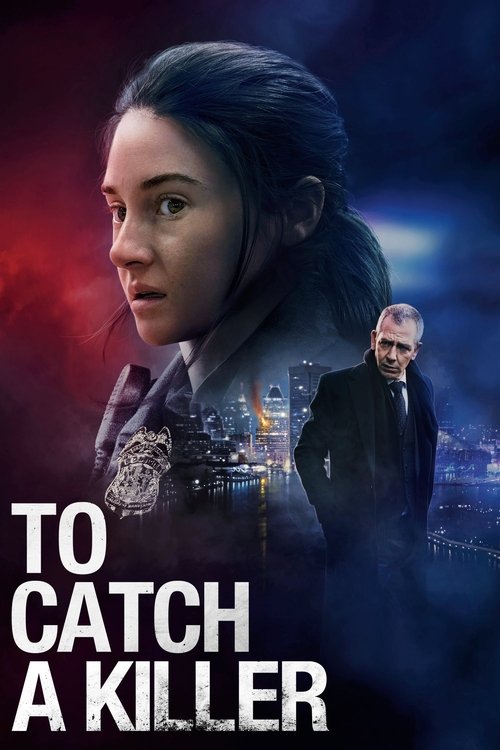
To Catch a Killer
2023 · Damián Szifron
When you want a serious, grown-up manhunt thriller for a dark winter night — one that unsettles rather than entertains. This is a challenge pick, not comfort food.
What it's about
At the stroke of midnight on New Year's Eve, a sniper opens fire on a Baltimore crowd, and the city plunges into a manhunt. Eleanor Falco, a talented but troubled beat cop, is pulled from patrol duty by the FBI's lead investigator, who senses her uneasy gift for thinking her way into the shooter's head. As the investigation grinds on, her identification with the killer becomes both her sharpest tool and her greatest risk.
The experience
Cold, methodical, and quietly dread-soaked — less about jump-out-of-your-seat thrills than the slow pressure of an investigation surrounded by bureaucratic friction and a frightened public. It gets under your skin and stays somber all the way down.
Performances
Shailene Woodley plays Eleanor with a raw, wounded watchfulness, and Ben Mendelsohn is superb as the FBI investigator — worldly, impatient with institutional stupidity, and unexpectedly humane.
The craft
Damián Szifron, the Argentine director behind one of the decade's great dark comedies, makes his English-language debut here and brings a European patience to American procedural material: wide, wintry compositions, restrained editing, and violence staged for horror rather than excitement. The frigid Baltimore atmosphere is practically a character.
Why it matters
A notable case of an acclaimed international director crossing into Hollywood genre filmmaking, and a throwback to the somber, adult-oriented profiler thrillers that studios rarely make anymore.
Snapshot
To Catch a Killer is the English-language debut of the Argentine filmmaker Damián Szifron, whose 2014 anthology Wild Tales (Relatos salvajes) had made him an international name and an Academy Award nominee. Set across a frigid New Year's holiday in Baltimore, the film follows Eleanor Falco (Shailene Woodley), a beat patrol officer with a history of psychiatric fragility and self-harm, who is plucked from the uniformed ranks by the FBI's lead investigator Geoffrey Lammark (Ben Mendelsohn) after a sniper opens fire on a crowd at the stroke of midnight. What begins as a manhunt procedural gradually inverts into a study of identification — the troubled cop's uneasy intuition for the killer's interior life becomes both her investigative gift and the film's moral problem. The picture sits at the confluence of the serial-killer profiler thriller, the contemporary mass-shooting drama, and the character study of institutional outsiders. It was originally developed and shot under the title Misanthrope, a name that more honestly signals its thematic ambitions than the genre-generic release title eventually attached to it. The film is best understood as a transplant: a director steeped in a particular strain of Latin American genre cinema — operatic, morally caustic, attentive to social rage — applying that sensibility to a quintessentially American subject.
Industry & production
The film belongs to the mid-budget adult thriller, a category that in the 2020s has been steadily displaced from theaters into streaming. It was produced through a configuration of independent financiers and sales-driven entities rather than a major studio, with Shailene Woodley attached as both star and producer. Principal photography took place in Montreal, with the Canadian city and its surrounding locations standing in for Baltimore — a now-routine economy of tax-incentivized production in which the depicted American city is rarely the city before the camera. The wintry palette and the desaturated, snow-laden exteriors are partly a function of this geography and partly a deliberate aesthetic choice.
Distribution followed the pattern that has become typical for the form: a limited theatrical or day-and-date release in the United States through an independent distributor, followed quickly by streaming, where the film found a substantially larger audience than its theatrical footprint suggested. Its strong streaming performance — widely reported, though precise figures should be treated cautiously — is itself a data point about the economics of the genre: the profiler thriller remains commercially viable, but increasingly as a home-viewing proposition rather than a theatrical event. The long gestation between Szifron's Wild Tales (2014) and this film, nearly a decade, reflects both the difficulty of mounting an English-language project on a non-Hollywood director's terms and Szifron's own reputation for deliberate, controlled development.
Technology
To Catch a Killer was made with the standard digital toolkit of the contemporary mid-budget thriller, and it neither foregrounds nor disguises that fact. The image is captured digitally and finished through a controlled digital grade that pushes toward cold blues, slate grays, and the sodium-orange of municipal lighting — a register that has become the lingua franca of the modern crime film and that the film deploys with discipline rather than novelty. There is no ostentatious technological signature here; the film's technical interest lies in restraint. Where many contemporary thrillers lean on aerial drone coverage and visual-effects-assisted set extensions, Szifron's film tends to keep its apparatus legible and its spaces grounded. The opening massacre sequence, the film's most technically demanding passage, relies on precise spatial geography and sound design rather than spectacle-driven effects work, with the violence rendered largely through implication, reaction, and the architecture of the rooftop sightline that gives the eventual atlas-style "line of influence" its literal meaning.
Technique
Cinematography
The cinematography is by Javier Juliá, Szifron's longtime collaborator, who shot Wild Tales and has been a defining contributor to the visual identity of recent Argentine genre cinema. Juliá's work here is composed and architectural: wide, carefully balanced frames that situate human figures within civic and institutional spaces — the precinct, the federal field office, the snowbound city — and that reserve the close-up for moments of genuine psychological pressure. The camera favors stability and clean lines over handheld agitation, a choice that lends the procedural its sober, observational authority and that makes the eruptions of violence more shocking by contrast. The winter light is exploited for its flatness and its capacity to drain warmth from human faces; Eleanor is repeatedly framed against gray skies and gray interiors, her isolation rendered spatially. Juliá's compositions are attentive to the geometry of the gaze — who watches whom, from what vantage — which is fitting for a film about a sniper, a profiler, and a protagonist whose talent is seeing as the killer sees.
Editing
The film's construction is methodical, building tension through accumulation rather than acceleration. The cutting holds shots longer than the genre norm, allowing performance and spatial dread to develop, then tightens during the investigative set-pieces and the climactic confrontation. The opening attack is the showcase of the editorial strategy: the massacre is assembled to emphasize geography and consequence — the trajectory of fire, the dispersal of the crowd — over visceral montage. The specific editor of record is not something I can attribute with confidence from the established trade record, and I will not invent a name; the relevant point is the rhythmic sensibility, which prioritizes dread and moral weight over kinetic propulsion.
Mise-en-scène / staging
Szifron stages the film around institutional spaces and the friction between them — local police, FBI, the apparatus of public order under the pressure of a terrorized city. The mise-en-scène is functional and unglamorous: bureaucratic interiors, cluttered investigation rooms, the cold theater of press conferences and political damage control. The director's staging is most expressive in how it isolates Eleanor within these spaces, repeatedly placing her at the margin of the frame or the edge of a group, an outsider tolerated for her usefulness. The eventual entry into the killer's domestic world is staged as a descent into a coherent, terrible interiority — the production design rendering misanthropy as a lived environment rather than a diagnosis.
Sound
Sound is one of the film's most controlled instruments. The opening sequence derives much of its horror from the auditory: the report of gunfire across a winter night, the disorientation of crowd panic, the spatial confusion of an unseen shooter. Throughout, Szifron uses silence and ambient cold as expressive tools, letting the absence of music register the protagonist's dissociation. Against this, Carter Burwell's score (see below) provides a restrained emotional architecture rather than wall-to-wall scoring.
Performance
The film is anchored by Shailene Woodley in a deliberately interiorized, withholding performance as Eleanor Falco — a portrait of competence laced with damage, in which the character's empathy for the killer is played as a vulnerability she cannot fully control. Ben Mendelsohn, as the FBI investigator Lammark, supplies the film's weary institutional intelligence and its mentor dynamic, his characteristically rumpled gravitas grounding the procedural in human fatigue. Strong supporting work comes from Jovan Adepo and Ralph Ineson, among others, populating the institutional world with texture. The performances are pitched low and naturalistic, consistent with the film's sober register; the dramatic charge comes from restraint and the slow disclosure of Eleanor's identification with the man she hunts.
Narrative & dramatic mode
The narrative operates in the dual mode of the profiler procedural and the psychological character study, and its distinctive move is to weight the second over the first. The mechanics of the investigation — evidence, jurisdiction, the bureaucratic and political pressure to produce a suspect — provide the forward engine, but Szifron consistently redirects attention from who and how toward why, and beyond that, to the disquieting question of what it costs the investigator to understand. The dramatic arc is built on identification: Eleanor's ability to track the killer derives from a kinship of alienation, and the film's tension is finally less about apprehension than about how close she can stand to that abyss without falling in. The structure withholds the killer's identity and interiority until late, converting the back half into a confrontation with a worldview rather than a chase. This is a film more interested in the etiology of rage than in catharsis, and it deliberately frustrates the genre's appetite for a clean resolution.
Genre & cycle
The film draws on the serial-killer profiler thriller — the lineage descending from The Silence of the Lambs (1991) and David Fincher's Zodiac (2007) and Mindhunter (2017–19) — in which the act of profiling becomes a form of dangerous empathy, and the female or marginal investigator's intuition is both gift and wound. But it crosses that cycle with the contemporary mass-shooting drama, a comparatively recent and ethically fraught American genre that must reckon with real-world atrocity. The killer here is not the baroque aesthete of the classic serial-murderer film but a figure closer to the modern mass shooter: alienated, ideological in a diffuse way, a product of social conditions. That hybridization is the film's claim to distinctiveness within its cycle — it uses the consoling machinery of the profiler genre to approach a subject the genre's older form was not built to hold.
Authorship & method
The decisive authorial fact is Szifron himself, who co-wrote the screenplay (with Jonathan Wakeham) and directs. To Catch a Killer is legible as the work of the director of Wild Tales in its preoccupation with social rage, its interest in the violence simmering beneath civic order, and its willingness to let moral discomfort go unrelieved — though here the anthology's savage comic register is replaced by sustained gravity. Szifron's method is one of control and slow build, a sensibility carried over from his Argentine work and applied to American material. The continuity of collaborators reinforces the authorial reading: cinematographer Javier Juliá, his partner from Wild Tales, sustains a shared visual grammar across the language barrier. The score is by Carter Burwell, the veteran composer most identified with the Coen brothers and with Todd Haynes, whose contribution lends restraint and a literate emotional intelligence rather than thriller bombast. The screenplay's co-authorship with Wakeham situates the film's American specificity — its Baltimore setting, its institutional textures — as a collaboration between Szifron's outsider perspective and a more locally grounded sensibility.
Movement / national cinema
The film is a hybrid object in terms of national cinema: an American-set, English-language thriller authored by an Argentine director working with an Argentine cinematographer, financed and produced through the transnational independent system and physically made in Canada. It belongs to the broader 21st-century phenomenon of Latin American directors — alongside the celebrated wave of Cuarón, Iñárritu, del Toro, and others — migrating into anglophone production, importing a distinct moral and stylistic sensibility into Hollywood-adjacent genres. Szifron is a less assimilated figure than that famous cohort, and the film's interest partly lies in the friction between his sensibility and the conventions of the American crime thriller. It does not belong to a coherent "movement" so much as to this diasporic pattern of authorship.
Era / period
The film is firmly of its moment — the early 2020s — in both subject and form. Its subject, the mass shooting and the social alienation that produces it, is among the defining anxieties of contemporary American life, and the film addresses it with a directness that earlier eras of the thriller avoided. Its form — the cold digital palette, the mid-budget adult drama routed through streaming, the international authorship — is equally characteristic of the period's production ecology. The decade-long gap since Wild Tales also marks it as a film made in a transformed industry, one in which the kind of serious adult genre picture it represents has migrated almost entirely to the home screen.
Themes
At its center the film is about empathy as peril — the idea that to understand a killer requires standing close enough to share his vantage, and that this proximity is corrosive. Eleanor's psychiatric history is not incidental; it is the source of her investigative talent and the film's argument that the line between the alienated investigator and the alienated perpetrator is thinner than institutions can admit. Around this run the film's social themes: the manufacture of misanthropy by isolation and neglect; the political and bureaucratic pressures that distort the pursuit of justice into the pursuit of a scapegoat; the spectacle and inadequacy of the institutional response to mass violence. The original title, Misanthrope, names the thematic core more precisely than the release title — this is a film about hatred of humankind, its origins, and the people charged with confronting it who carry their own version of that wound.
Reception, canon & influence
Critical reception was mixed-to-respectful. Reviewers consistently praised the central performances — Woodley's controlled interiority and Mendelsohn's weathered authority — and the seriousness of Szifron's ambitions, while a recurring reservation held that the film's grave, deliberate approach and its inversion of genre expectations produced a somewhat unresolved or muted experience, a thriller that withholds the satisfactions it sets up. The disappointment in some quarters was measured against the very high bar of Wild Tales, and the consensus framed To Catch a Killer as an honorable, intelligent, imperfect English-language transition rather than a breakthrough.
Influences on the film (backward): The lineage is clear and acknowledged by the film's own grammar — The Silence of the Lambs for the profiler-and-protégée structure, Fincher's Zodiac and Mindhunter for the sober, procedural, empathy-as-danger treatment of the investigator's mind, and the broader tradition of the alienated-loner character study (the spirit of Scorsese's Taxi Driver hangs over any serious film about American misanthropy and rage). Szifron's own Wild Tales is the most direct authorial antecedent, supplying the thematic obsession with social violence.
Legacy / what it shaped (forward): Because the film is recent, its influence cannot yet be assessed with any historical confidence, and it would be premature to claim a measurable legacy. Its more durable significance may prove sociological rather than aesthetic: as a notable instance of the mid-budget adult thriller finding its real audience through streaming, and as another marker of the continuing migration of Latin American auteurs into American genre filmmaking. Whether it leaves a stylistic mark on the profiler cycle remains an open question that the historical record is, as yet, too thin to answer.
A Deleuzian reading
Midnight, New Year's, Baltimore.
The full Deleuzian reading of To Catch a Killer →
Reception
Arriving nine years after Wild Tales made Damián Szifron an international name, this was greeted with a shrug — mixed reviews and a quiet release — and it hasn't been reappraised so much as absorbed as a streaming-era procedural people stumble onto.
How To Catch a Killer was received, from release to now →
Influences: the films it descends from and the films it influenced
- The Silence of the Lambs (1991) — Supplies the profiler-and-protégée structural template Szifron inverts — the apprentice investigator mentored toward a mind she must inhabit — including its intimate, near-frontal lookups that put the investigator's reactive face at the center rather than the crime.
- Manhunter (1986) — Originates the 'empathy-as-peril' device — the profiler who solves the case by thinking like the killer and is psychically endangered by the proximity — staged within Mann's cold architectural wide framing of institutional and domestic space.
- Zodiac (2007) — The acknowledged model for the sober, procedural, anti-catharsis treatment: a cold digital grade, accumulation of process over thrills, and a refusal to deliver the climactic confrontation the genre promises.
- Se7en (1995) — Establishes the rain-and-cold serial-killer procedural that withholds its antagonist for most of the runtime, letting dread build through environment and the investigators' deteriorating interiority.
- Taxi Driver (1976) — The foundational study of the alienated American loner whose private misanthropy curdles into public violence, built on slow behavioral accumulation rather than incident.
- No Country for Old Men (2007) — Models Carter Burwell's signature here — score withheld almost to silence so that ambient sound and expressive quiet carry the menace — paired with a vision of violence erupting through the membrane of civic order.
- Wild Tales (2014) — Szifron's own direct authorial antecedent and the source of the thematic obsession with social rage and violence beneath civility, shot by the same cinematographer Javier Juliá whose visual grammar carries across the language barrier.
- Elephant (2003) — The formal precedent for the mass-shooting drama that withholds motive and explanation, observing the perpetrator and institutional spaces with deliberate, affectless patience rather than thriller mechanics.
- Joker (2019) — Extends the alienated-loner-to-public-violence character study into the contemporary cycle of social-rage cinema, foregrounding the misanthrope's interiority as the film's primary subject.
- Mindhunter (2017) — Shares the clinical, talk-driven treatment of profiling as a contaminating act — the cost of sustained empathy with violence registered on the interviewer's face — and the same desaturated, controlled institutional visual register.
- Memories of Murder (2003) — Shares the procedural that deliberately refuses resolution, grinding its investigators down without the satisfaction of capture, and stages the hunt across cold, unglamorous institutional and rural space.
- Prisoners (2013) — The closest tonal sibling: a grave, slow-build abduction procedural in cold winter light where moral discomfort is sustained unrelieved and the genre's grim atmosphere is treated with prestige seriousness.
- Sicario (2015) — Centers a woman investigator out of her depth inside an opaque institution, rendered through architectural wide framing and a dread-laden sound design that withholds and then detonates.
- Wind River (2017) — Extends the snowbound, cold-light investigation as character study, using a frozen landscape and interiorized, withholding performances to carry a procedural about violence at the social margins.
- We Need to Talk About Kevin (2011) — Treats mass violence through interiorized aftermath and expressive sound/silence, prioritizing a single withholding consciousness over the spectacle of the act itself.
- Nightcrawler (2014) — Shares the cold nocturnal digital grade and the unblinking character study of an American outsider whose pathology is observed clinically, without moralizing relief.
Similar films
- Manhunter (1986) — influence & lineage
- Wind River (2017) — influence & lineage
- Zodiac (2007) — influence & lineage
- Sicario (2015) — influence & lineage
- Nightcrawler (2014) — influence & lineage
- Memories of Murder (2003) — influence & lineage
- The Rip (2026) — shared sensibility
- Case 137 (2025) — shared sensibility
All the films related to To Catch a Killer →
Watch it with: curated runs of related films
- The Walls Close In — A run of lean 2020s crime thrillers where an ordinary person gets pulled past the point of no return and the pressure keeps ratcheting.