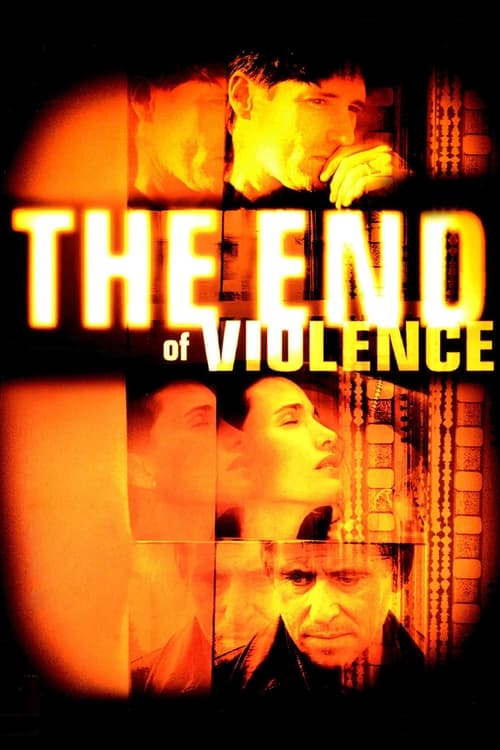
The End of Violence
1997 · Wim Wenders
For when you want an atmospheric slow burn to chew on — questions about surveillance and screen violence wrapped in late-night L.A. haze. Choose it in a patient, contemplative frame of mind; it rewards mood over momentum.
What it's about
A Hollywood producer who has gotten rich on violent action movies survives a botched abduction and simply vanishes — going to ground among the gardeners and day laborers on the city's margins while everyone assumes the worst. Around his disappearance the film braids the lives of his estranged wife, a homicide detective, and a lonely technician running a secret surveillance system that watches Los Angeles from an observatory above it.
The experience
Cool, moody, and meditative — more a nocturne about a watched city than a thriller, though a thriller's skeleton is in there. It drifts, deliberately, and asks you to think about violence and images rather than gripping you by the collar.
Performances
Bill Pullman is interestingly cast against type as the hollowed-out producer, and Gabriel Byrne brings a wounded gravity to the watcher in the observatory.
The craft
Wenders shoots Los Angeles as an outsider bewitched by it — freeways at dusk, the observatory glowing above the grid — and the film's most striking idea is visual: a city seen through the cold eye of its own cameras. It's a gorgeous object even when the story wanders.
Why it matters
Premiering in competition at Cannes in 1997, it was received as one of Wenders' more uneven American works, but its worries about total surveillance and a culture saturated in violent images have only grown more current.
Snapshot
The End of Violence is Wim Wenders' late-1990s Los Angeles drama about surveillance, screen violence, and the moral exhaustion of an image-maker. Bill Pullman plays Mike Max, a wildly successful producer of violent action pictures who, after surviving a botched abduction, vanishes from his own life and goes to ground among the Mexican-American gardeners and day laborers on the city's margins. Around him the film braids several lines: his estranged wife Paige (Andie MacDowell); a surveillance technician, Ray Bering (Gabriel Byrne), running a covert federal monitoring system out of the Griffith Observatory; and a homicide detective (Loren Dean) drawn into the case. The film premiered in competition at the 1997 Cannes Film Festival. It is generally regarded as one of Wenders' lesser-received American works — an ambitious, essayistic thriller whose ideas about the panoptic society outran its dramatic execution. Yet its central conceit — that total surveillance is marketed as the cure for violence — has aged into unusual prescience, and the film now reads as a pre-millennial premonition of the post-2001 surveillance state.
Industry & production
The film was an international co-production, characteristic of Wenders' career-long position as a German director working with European financing on American material. His own company Road Movies (Berlin) was involved, alongside the French outfit Ciby 2000, which had backed a strand of auteur cinema in the 1990s, and Nicholas Klein's Kintop Pictures. This European-financed, American-set arrangement is the same hybrid model that produced Until the End of the World (1991) and would later produce The Million Dollar Hotel (2000).
The screenplay was written by Nicholas Klein, from a story developed with Wenders; Klein would collaborate with Wenders again on The Million Dollar Hotel. The picture received a limited U.S. theatrical release in 1997 through the Samuel Goldwyn Company / MGM distribution apparatus. It did not perform strongly commercially, and I will not assign box-office figures I cannot verify; the consensus account is simply that it was a modest art-house release that underperformed relative to its ambitions. The shoot was located in and around Los Angeles, with the Griffith Observatory serving as Ray Bering's surveillance command post — a location choice that knowingly invokes the city's cinematic memory (the Observatory being indelibly associated with Rebel Without a Cause).
Technology
Surveillance technology is not merely the film's subject but its governing metaphor. The narrative imagines a clandestine government program that blankets Los Angeles with cameras, the premise being that pervasive watching will deter and ultimately abolish violent crime — the literal "end of violence" of the title, achieved through omniscient observation. The film was made at the cusp of the digital-imaging era, when video surveillance, satellite tracking, and networked monitoring were entering public consciousness but had not yet been normalized by the post-9/11 security apparatus or the smartphone. Wenders, who has spent his career thinking about the status and ethics of images, treats the surveillance feed as a degraded, totalizing kind of cinema — the camera divorced from authorship and conscience. The Observatory, an instrument built to look outward at the cosmos, is repurposed to look downward at the citizenry, a neat inversion that the film foregrounds.
Technique
Cinematography
The cinematography (Pascal Rabaud is credited as director of photography; I flag that the technical crew of this film is less thoroughly documented than that of Wenders' canonical works) renders Los Angeles as a luminous, depopulated nightscape — pools of artificial light, glassy interiors, freeway geographies. The visual sensibility is consistent with Wenders' long-standing painterly debt to Edward Hopper, whose lonely, light-struck American interiors Wenders has repeatedly cited as an influence; the film's nocturnal compositions carry that Hopperesque solitude even where I would not claim a specific painting is staged. The surveillance footage offers a deliberate counter-texture: flattened, overhead, anonymous imagery set against the composed widescreen frames, dramatizing the gap between the authored image and the monitoring one.
Editing
Peter Przygodda, Wenders' longtime editor and one of his most important collaborators across decades, is the credited cutter (again, with the caveat that crew documentation here is thinner than for the major films). The editing carries the burden of the film's multi-strand structure, cross-cutting between Mike's disappearance, Ray's isolation in the Observatory, the police investigation, and Paige's parallel story. Critics frequently identified the film's pacing and the looseness of these intersections as its central weakness — the braided structure promises convergence that the film delivers only obliquely.
Mise-en-scène / staging
The staging opposes two Los Angeleses: the glassed, affluent, surveilled world of the film industry and the police, and the open-air, communal world of the Latino laborers among whom Mike hides. Mike's reinvention — the powerful producer recast as an anonymous man among gardeners — is staged as a literal descent from the hills into the working city, a moral geography rendered spatially. The Observatory set isolates Byrne's character in a glowing technological cell, the watcher who is himself the loneliest figure in the film.
Sound
Ryuichi Sakamoto composed the score, lending the film an austere, melancholic electronic-orchestral atmosphere consonant with its themes of isolation and watching. As is typical of Wenders, the soundtrack is curated with attention to contemporary songs alongside the score; I will not enumerate specific tracks I cannot confirm, but the integration of popular music with Sakamoto's composition is part of the film's texture. Sound design also distinguishes the film's registers — the hush of surveillance monitoring against the ambient life of the street.
Performance
Bill Pullman anchors the film as Mike Max, playing the producer's transformation from glib power to chastened anonymity in a notably interior, withdrawn register. Gabriel Byrne brings a haunted gravity to Ray Bering, the technician who comes to recognize the horror of the system he serves. Andie MacDowell's Paige occupies a more peripheral emotional space. The film's most cherished performance, by common account, is a small one: the veteran director Samuel Fuller — one of the great American filmmakers and a figure of immense significance to the New German Cinema generation — appears as Ray's father. Fuller died in 1997, making this among his final screen appearances, and his presence reads as a deliberate, affectionate gesture from Wenders toward the cinema history he venerates. The ensemble also includes Loren Dean, Traci Lind, Rosalind Chao, Daniel Benzali, K. Todd Freeman, Pruitt Taylor Vince, and Udo Kier.
Narrative & dramatic mode
The film operates as an ensemble "network narrative" — multiple protagonists whose lives intersect around a precipitating event (the abduction) — crossed with the conventions of the conspiracy thriller and the essay film. This is a hybrid, and the hybridity is the source of both its interest and its difficulty. Wenders subordinates thriller mechanics (suspense, investigation, resolution) to meditative and thematic concerns, so the genre engine idles while the film thinks aloud about watching, violence, and complicity. The result is closer to a parable than a plot: Mike's disappearance functions less as a mystery to be solved than as an existential withdrawal, a man stepping out of the machine of images he had been feeding.
Genre & cycle
The End of Violence belongs to the late-1990s cycle of surveillance-anxiety films that anticipated, and to some degree diagnosed, the coming security state. Its closest companions are Peter Weir's The Truman Show (1998) and Tony Scott's Enemy of the State (1998), both released the following year, which treated total observation as spectacle and as thriller respectively. Wenders' film is the most overtly philosophical and least commercially calibrated of the group. It also participates in the long tradition of Los Angeles films about the film industry's relationship to violence and illusion, and in the surveillance-paranoia lineage that runs back through Coppola's The Conversation (1974) and Antonioni's Blow-Up (1966) — films about watchers undone by what they observe.
Authorship & method
Wim Wenders is among the central figures of the New German Cinema, the author of Alice in the Cities (1974), The American Friend (1977), Paris, Texas (1984, Palme d'Or), and Wings of Desire (1987). His abiding preoccupations — the moral status of images, American landscape and iconography, displacement and journeying, the tension between European sensibility and American myth — are all present in The End of Violence. By the mid-1990s, following the divisive Until the End of the World (1991) and Faraway, So Close! (1993), his fiction features were meeting cooler receptions, and this film is usually read within that more contested late period.
His key collaborators here form a meaningful authorial cluster. Editor Peter Przygodda was a defining presence in Wenders' filmmaking over many years. Composer Ryuichi Sakamoto brought an international art-music sensibility. Screenwriter Nicholas Klein shaped the surveillance-and-Hollywood conceit and continued with Wenders into The Million Dollar Hotel. And the casting of Samuel Fuller is itself an authorial signature — Fuller had acted for Wenders before (notably in The American Friend), and his recurring presence is part of how Wenders inscribes his cinephile lineage into his work.
Movement / national cinema
Though set in Los Angeles and performed in English, the film is properly understood as a German auteur's American film — a continuation of the New German Cinema's complex fascination with, and critique of, American culture. Wenders' generation grew up under the saturation of postwar American media; his films repeatedly stage the seductions and dangers of American images. The End of Violence turns that lifelong inquiry directly onto Hollywood itself, making the German outsider's perspective on the American image-machine its explicit subject. It thus sits at the intersection of European art cinema and American genre material that defines much of Wenders' transatlantic career.
Era / period
The film is a document of pre-millennial unease. Made before the 2001 attacks transformed surveillance from dystopian fantasy into bipartisan policy, it now reads as anticipatory — its premise of state monitoring sold as public safety arrived, in altered form, within a few years. It also captures a specific late-1990s anxiety about media violence, a live public controversy of the period concerning the effects of violent entertainment. Mike Max, the producer of violent blockbusters who recoils from his own product, embodies that debate in a single figure.
Themes
The film's title states its master idea ironically: violence is to be "ended" not through justice or moral reform but through total visibility — the panoptic dream that to be perpetually watched is to be deterred. Wenders treats this as a bargain with horror, the abolition of violence purchased at the price of freedom and privacy. Bound up with this is the film's reflexive inquiry into images and complicity: a maker of violent fictions and a maker of surveillance images are, the film suggests, kin, both implicated in a culture of looking that has detached the image from conscience. Further threads include disappearance and self-reinvention (Mike's shedding of identity), loneliness and the failure of intimacy, and the moral geography of Los Angeles as a city of watched heights and unwatched margins. The watcher's isolation — Byrne's Ray, alone with his all-seeing apparatus — dramatizes the spiritual cost of omniscient observation.
Reception, canon & influence
Critical reception was decidedly mixed, tending toward disappointment. Reviewers widely praised the timeliness and intelligence of the film's premise and the beauty of its images while faulting its loose, drifting structure, its underpowered thriller mechanics, and a sense that its big ideas were stated rather than dramatized. It is not counted among Wenders' canonical achievements and is typically grouped with the weaker, more searching films of his late-1990s period; I note honestly that sustained scholarly literature on this title is comparatively thin, and I have avoided attributing specific reviews or quotations I cannot verify.
The influences on the film are legible: the surveillance-paranoia tradition of Coppola and Antonioni; the Hollywood self-portrait genre; Wenders' own Hopper-derived painterly eye; and his lifelong dialogue with American cinema, personified by Samuel Fuller's casting. The influence of the film is more diffuse. It did not found a school or launch careers, and its forward legacy is best understood thematically: it was an early, serious cinematic articulation of the surveillance-society critique that would become a dominant cultural preoccupation in the following decade, sharing that diagnostic space with The Truman Show and Enemy of the State and anticipating the post-2001 reckoning with state monitoring. As a record of one of world cinema's most thoughtful image-makers turning his gaze onto the apparatus of looking itself, it retains a documentary and intellectual interest that exceeds its standing as drama.
A Deleuzian reading
A man sits inside the Griffith Observatory at night.
The full Deleuzian reading of The End of Violence →
Reception
Premiered at Cannes in 1997 to shrugs and worse, and got filed under Wenders' post-Wings of Desire slump; decades of mass-surveillance reality later, it keeps getting dusted off as an eerily prescient film that arrived about fifteen years too early.
How The End of Violence was received, from release to now →
Influences: the films it descends from and the films it influenced
- The Conversation (1974) — Establishes the template Wenders inherits directly: a surveillance technician whose professional voyeurism becomes the moral subject of the film, with the apparatus of watching turned reflexively on its operator.
- Blow-Up (1966) — Founds the image-complicity device Wenders extends — a crime glimpsed only through a captured image that must be scrutinized and enlarged, making the act of looking the narrative engine.
- The Passenger (1975) — Supplies the dedramatized, drifting thriller architecture in which a man abandons his identity and the plot dissolves into wandering — the loose structure reviewers flagged in Wenders is lifted from this mode.
- The Parallax View (1974) — Provides the paranoid 1970s conspiracy grammar — the lone man who knows too much, dwarfed by institutional architecture in wide compositions — that underpins the film's surveillance-cabal premise.
- The American Friend (1977) — Originates the Samuel Fuller casting as authorial signature, the device by which Wenders literally inscribes his American-cinema cinephile lineage into the cast list, repeated here.
- Paris, Texas (1984) — Codifies Wenders' Hopper-derived painterly eye for American space — saturated, becalmed compositions of roadside and neon — that returns as the nocturnal LA cityscape here.
- Wings of Desire (1987) — Builds the trope of invisible observers surveying a city from above with benevolent detachment; The End of Violence secularizes that overseeing gaze into the surveillance operative in his observatory.
- Pickup on South Street (1953) — Carries the blunt tabloid-noir method of Fuller himself, the directness and pulp moral economy Wenders imports as homage by casting Fuller on screen.
- The Truman Show (1998) — Extends the surveillance-society critique into total apparatus — a life rendered entirely as monitored image — sharing the diagnostic space the dossier names directly.
- Enemy of the State (1998) — Translates the same NSA/satellite-grid surveillance anxiety into propulsive genre mechanics, dramatizing the camera-and-database network Wenders only sketched as concept.
- The Million Dollar Hotel (2000) — Direct continuation of the Nicholas Klein collaboration and the rooftop/LA moral-geography staging, prolonging the surveillance-and-Hollywood conceit the two developed together.
- Caché (2005) — Perfects the image-complicity premise — anonymously delivered surveillance tapes that indict the watcher's buried guilt — making explicit the moral-status-of-images question Wenders raised but only stated.
- Minority Report (2002) — Develops the pre-emptive surveillance state into full design, with the architect of the watching system becoming its hunted target, echoing this film's operator-turned-fugitive structure.
- The Lives of Others (2006) — Revives the Conversation-lineage figure Wenders reworked — the surveillance operative whose conscience turns against the apparatus he serves — within a state-monitoring frame.
- Strange Days (1995) — Shares the pre-millennial preoccupation with recorded violence as commodity and evidence, implicating the viewer in the consumption of captured atrocity.
- Lost Highway (1997) — Parallel nocturnal-LA dread built around anonymous surveillance videotapes appearing at a private home, fusing Hollywood unease with the threat of being watched.
- Collateral (2004) — Treats nocturnal digital-video Los Angeles as moral geography, the depopulated city at night rendered as luminous canvas, the same staging instinct as Wenders' Hopperesque night exteriors.
Similar films
- The American Friend (1977) — influence & lineage
- Blow-Up (1966) — influence & lineage
- The Conversation (1974) — influence & lineage
- Strange Days (1995) — influence & lineage
- Wings of Desire (1987) — influence & lineage
- Lost Highway (1997) — influence & lineage
- L.A. Confidential (1997) — shared sensibility
- Dark City (1998) — shared sensibility