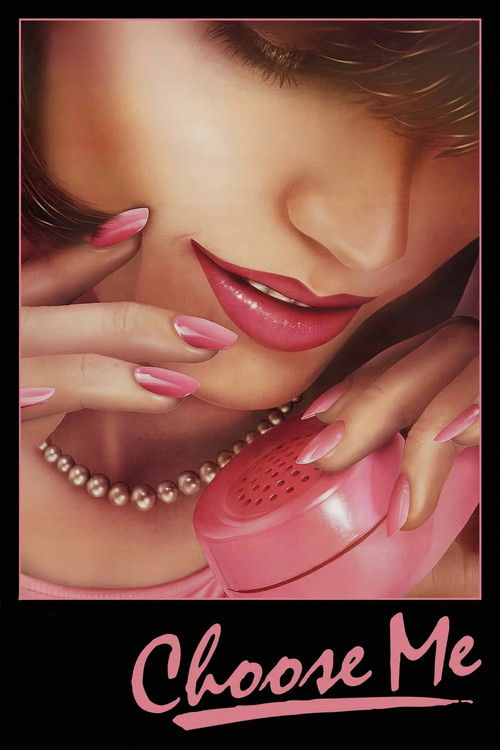
Choose Me
1984 · Alan Rudolph
For a solitary late night when you want something romantic but off-kilter — a film to drift through with a drink, when ordinary love stories feel too tidy.
What it's about
In a neon-washed Los Angeles that seems to exist only after dark, a handful of lonely night owls keep circling each other: the owner of a bar called Eve's Lounge, a radio call-in love therapist who dispenses serene wisdom on air while dodging intimacy off it, and a drifter fresh out of a psychiatric hospital whose tall tales — spy, poet, pilot — might all be true. Coincidence keeps throwing them together, and every conversation about love doubles as a confession.
The experience
Dreamy, funny, and quietly aching — it moves at the unhurried tempo of a late-night phone call, with dialogue that hovers between flirtation and therapy. You sink into its mood the way you sink into a barstool.
Performances
Lesley Ann Warren, Geneviève Bujold, and Keith Carradine make a remarkable triangle — Warren wounded and proud, Bujold serenely split between her radio persona and her private panic, Carradine so calmly sincere you can never decide whether he's lying.
The craft
Alan Rudolph builds an entire hermetic world out of neon, rain-slicked streets, and bar light, and sets it to Teddy Pendergrass on the soundtrack — the film glides between scenes like one long slow song. The writing treats coincidence as fate, and the style is so complete it feels less directed than dreamed.
Why it matters
The film where Rudolph found the voice he'd work in for decades, and a touchstone of 1980s American independent romance — proof that a tiny budget could buy total atmosphere.
Snapshot
Choose Me is the film in which Alan Rudolph found the register he would work in for the next two decades: a nocturnal, hermetically stylized Los Angeles where lonely people talk past each other in dialogue that hovers between confession and performance, and where the plot is less a mechanism than a set of coincidences the film treats as fate. Set almost entirely at night in and around a neon-washed bar called Eve's Lounge, it braids together a nightclub owner (Lesley Ann Warren) who has bought the bar from the woman it was named for; a radio call-in sex therapist, Dr. Nancy Love (Geneviève Bujold), who dispenses serene erotic wisdom on air while being incapable of intimacy off it; and Mickey (Keith Carradine), a drifter recently released from a psychiatric hospital whose grandiose claims — spy, poet, pilot — may all be true. Around them circle a bad-news husband (Patrick Bauchau) and his young wife (Rae Dawn Chong), and the film's romantic geometry rearranges itself in something close to the pattern of a Schnitzler round-dance.
The film matters for three reasons. It is the clearest American instance of a Sirkian-melodrama sensibility rerouted through post-Altman improvisational looseness — Rudolph came up as Robert Altman's assistant director on The Long Goodbye and Nashville, and Choose Me takes the Altman ensemble and shrinks it to chamber scale while replacing Altman's satiric distance with unembarrassed romantic longing. It is a landmark of the mid-1980s American independent sector, financed outside the studios and released by Island Alive, at precisely the moment when that sector was learning it could sustain a director's personal style rather than merely deliver genre product. And its integration of a wall-to-wall pop score — Teddy Pendergrass's Choose Me album, with Luther Vandross production — into the film's emotional argument is a genuine formal experiment, not a soundtrack tie-in, however much the era's commercial logic made the two hard to distinguish.
Rudolph's reputation has always been unstable: a critic's director whose films rarely found audiences, admired intensely by a minority and dismissed by others as arch and airless. Choose Me is the film that most often converts skeptics, and remains the best entry point to his work.
Industry & production
Choose Me was made under the low-budget, fast-shoot conditions that define Rudolph's most personal work. It was produced by Carolyn Pfeiffer and David Blocker for Island Alive, the distribution and production partnership formed by Chris Blackwell's Island Records and Shep Gordon's Alive Films — a company that in the same period handled El Norte, The Ballad of Gregorio Cortez, and Robert Altman's stage-derived chamber films. Island Alive is a crucial piece of the picture's context: it was one of the small distributors that, alongside Samuel Goldwyn, Cinecom, Orion Classics, and Island's own labels, built the mid-decade American specialty circuit that later hardened into the "indie" industry of the 1990s.
The Island connection also explains the film's music, and this is where the industrial and aesthetic accounts converge. A film company owned in part by a record label had a structural interest in soundtracks; Choose Me used a set of Teddy Pendergrass recordings as its near-continuous score. What distinguishes it from the era's typical soundtrack-driven pictures — Flashdance, Footloose, the MTV-synergy model that Hollywood was aggressively pursuing in 1983–84 — is that Rudolph used the songs as an ironic and emotional continuum rather than as detachable single placements. The commercial arrangement produced a formal choice rather than merely decorating one.
Rudolph shot the film quickly and cheaply, on a schedule and budget that kept it entirely within controllable spaces: a bar interior, apartments, a few night exteriors, a radio studio. He has spoken over the years about writing fast and shooting fast on these pictures, and the film's texture bears that out — the compression is legible in the way locations recur and the ensemble stays small. Precise budget and grosses circulate in various secondary sources with enough variation that they should be treated cautiously; what is not in doubt is that the film was made for a fraction of a studio picture's cost and performed respectably in specialized release rather than breaking out.
The production also reflects Rudolph's repertory habit. Keith Carradine had already appeared for him in Welcome to L.A. (1976) and would return in Trouble in Mind (1985) and later films; Geneviève Bujold became a Rudolph regular across Trouble in Mind, The Moderns, and Mrs. Parker and the Vicious Circle. This stock company, cheaper and faster than casting cold, is inseparable from the films' consistency of tone.
Technology
Choose Me is a 35mm anamorphic-era production made without technological novelty, and its interest lies in what it extracts from ordinary period tools. Its dominant technical fact is the film stock–lighting relationship. By 1984, Eastman had introduced faster, finer-grained negative stocks (the 5293/5294 generation followed the landmark 5247), which made it practical to shoot night interiors at low light levels with saturated colored sources without the mud and grain such setups produced a decade earlier. The film's signature look — pools of magenta, cyan, and amber laid over deep shadow, with practical neon and window light doing narrative work — depends on that capability. Jan Kiesser's lighting reads as bold rather than merely dim because the stock could hold color in the shadows.
Two other technologies shape the film indirectly. The first is talk radio itself: the call-in format, and specifically the sex-and-relationships call-in show, was a genuine cultural phenomenon of the late 1970s and early 1980s. Rudolph treats broadcast as a technology of pseudo-intimacy — a one-to-many channel through which strangers confess what they cannot say face to face — and stages Dr. Love's voice as a disembodied presence that saturates the film's spaces. Radio in Choose Me functions the way telephones do in melodrama: a device that connects and isolates in the same gesture.
The second is the phonographic score. Using commercially recorded songs rather than an orchestral score was, by 1984, technologically trivial and legally expensive; the significance is that the record-label ownership of the production made continuous use feasible. The film thus belongs to the moment when the LP and the feature became commercially interlocked, and it is one of the few pictures of the moment to make something aesthetically coherent out of the arrangement.
Technique
Cinematography
Jan Kiesser shot Choose Me, and the film is probably the most influential American demonstration of what would come to be called neon-noir before Blue Velvet and Manhunter. Kiesser's scheme is unabashedly artificial: colored light does not merely fall on the actors, it stains them, and the palette shifts by emotional register rather than by verisimilitude. Eve's Lounge is rendered as a lit stage — the bar's own signage and window neon become key sources — so that the space reads simultaneously as a real dive and as an interior of the mind.
The camera is mobile in a specifically Rudolph way: slow lateral drifts and encircling moves that let figures pass through frame and re-enter, discovering characters rather than announcing them. This is a device Rudolph absorbed from Altman, but he uses it for reverie where Altman used it for satire. Compositions frequently place characters behind glass, mirrors, doorframes, and bar bottles, so that the image is layered and slightly obstructed; reflections in Choose Me are so constant that they function as the film's visual thesis about self-presentation. The result is a picture that looks expensive and dreamed rather than cheap and shot fast, which was central to its critical reception.
Editing
Mia Goldman cut the film. The editing logic is associative rather than causal: scenes are held past the point where information has been delivered, so that a conversation goes on until it becomes strange, then cut away at an angle rather than on a resolution. Transitions frequently ride the music across a scene boundary, letting a Pendergrass track carry from one couple to another and asserting an equivalence between them. The film's chief structural move — the roundelay, in which each character's romantic exchange is answered by another's — is an editorial construction as much as a scripted one; the cutting reveals the pattern by rhyming entrances, gestures, and lines across the ensemble.
The pacing is deliberately unhurried; Choose Me declines the acceleration that its farcical plot would license. Its coincidences are edited as fate rather than as gags, which is what keeps a story of near-vaudevillian contrivance in the emotional register of melodrama.
Mise-en-scène / staging
The film is essentially a chamber piece with three or four principal locations, and Rudolph exploits recurrence: Eve's Lounge functions as a hub through which everyone must pass, so that the geography itself produces the plot's coincidences. Costume and color are keyed to character — Warren's Eve dressed in reds and jewel tones that match the bar's neon, Bujold's Nancy in muted, buttoned, self-protective clothing that visually contradicts the erotic authority of her radio voice. That contradiction between surface and speech is the film's central staging idea, and it is executed almost entirely through wardrobe, décor, and lighting rather than dialogue.
Rudolph's blocking favors characters who talk while not quite facing each other: side by side at the bar, across a room, through a doorway. Direct address is rationed. When two characters finally do occupy the same frame in balanced two-shot, the film treats it as an event.
Sound
The soundtrack is the film's most discussed formal element. Teddy Pendergrass's Choose Me songs run nearly continuously, and Rudolph places them so that the music's smooth romantic confidence sits in ironic counterpoint to characters who are anything but confident. The songs are not diegetically anchored in any consistent way; they wash across the film, sometimes seeming to come from the bar's jukebox, sometimes from nowhere, so that the score becomes a kind of ambient collective fantasy of what love is supposed to sound like — against which the characters' actual fumbling is measured.
Dr. Love's broadcast voice is the second sonic layer, threading through apartments and cars, and it is treated with the same ambiguity: sometimes sourced to a visible radio, sometimes floating free as narration. Between the songs and the broadcast, Choose Me has two continuous voices of romantic authority that neither the characters nor the film fully believes.
Performance
Rudolph's actors work in a heightened, slightly formal register — the dialogue is aphoristic and openly written, and the performances lean into rather than naturalize it. Bujold's Nancy Love is the film's great performance and its structural irony: a woman who speaks about desire with total fluency in one room and cannot manage a conversation in another. Bujold plays the split without signaling it, keeping the radio voice and the private voice in different keys. Lesley Ann Warren's Eve is all exposed nerve and bravado, a performance of considerable physical looseness that earned her the strongest notices of her career to that point. Keith Carradine plays Mickey with an eerie, unhurried sincerity that makes his implausible claims impossible to dismiss — the film's suspense, such as it is, rests on the audience's inability to decide whether he is delusional or simply telling the truth. Patrick Bauchau and Rae Dawn Chong supply the harder, more dangerous edge that keeps the film from floating away entirely.
Narrative & dramatic mode
Choose Me is a roundelay — the La Ronde structure, after Schnitzler's Reigen and Max Ophüls's 1950 film, in which desire circulates through a chain of partners and returns to its origin. Rudolph's variation is to overlay this circular form with the melodramatic premise of mistaken and concealed identity: Nancy Love, the radio therapist, takes a room in Eve's apartment under an assumed name, so that she is simultaneously the anonymous advisor to a woman and her flatmate. The film thus builds its plot from a mechanism farce would use, but plays it for pathos.
The dramatic mode is closer to fable than to realism. Characters announce themselves in declarative statements, coincidence is treated as structure rather than accident, and the film's Los Angeles is a nowhere-place lit like a stage. Rudolph does not ask for belief in the plot's plausibility; he asks for belief in the emotional predicament — that people who theorize love expertly are frequently the worst at it, and that the difference between a liar and a romantic may be unrecoverable. The film's title is its thesis in imperative form: it is about choosing, about the terror of preference, and its ending resolves the romantic geometry without pretending the resolution is earned by anything but wanting it.
Genre & cycle
The film sits at the intersection of three currents. It is a romantic comedy in premise and a melodrama in feeling — a combination that, in 1984, was distinctly out of step with a mainstream romantic comedy cycle that was moving toward the high-concept and the broadly farcical. It is also an early instance of the neon-lit, night-world American picture that would define the second half of the decade: After Hours (1985), Something Wild (1986), Blue Velvet (1986), Manhunter (1986), and, in Rudolph's own filmography, the immediate follow-up Trouble in Mind (1985), which pushes the stylization further into overt fantasy.
Most importantly, Choose Me belongs to the mid-1980s American independent cycle that ran roughly from Stranger Than Paradise (1984) and Blood Simple (1984) through She's Gotta Have It (1986) and Sherman's March (1986) — a set of films distributed by small specialty companies, made for very little, and defined by an authorial voice rather than a genre hook. Within that cycle Rudolph is the anomalous figure: older than the Jarmusch/Lee/Coen generation, formed inside the studio-adjacent Altman orbit rather than in film school or the downtown art scene, and working in romantic rather than ironic terms.
Authorship & method
Rudolph wrote and directed Choose Me, and the film is the clearest statement of his method. He learned filmmaking as an assistant director in the studio system and then as Altman's collaborator — assistant director on The Long Goodbye (1973), California Split (1974), and Nashville (1975), and co-writer of Buffalo Bill and the Indians (1976) — before Altman produced his first personal feature, Welcome to L.A. (1976). What he took from Altman was the ensemble structure, the overlapping-lives architecture, and the willingness to let scenes breathe past their narrative function. What he did not take was Altman's irony. Rudolph's films are sincere about romantic feeling in a way Altman's essentially never are, and the tension between an Altman-derived form and a melodramatic sensibility is the engine of his best work.
His method across the low-budget films of this period was to write quickly, shoot on compressed schedules, use a repertory of trusted actors, and prioritize atmosphere over narrative economy. The films are stylistically consistent — Choose Me, Trouble in Mind, The Moderns (1988), and Love at Large (1990) form a recognizable body — which is exactly what the specialty distributors of the period made possible.
Jan Kiesser (cinematographer) established with this film a colored-light night aesthetic he would continue in Rudolph's Trouble in Mind and later in films including Clean and Sober and Career Opportunities; his work here is the strongest argument for treating the picture as a photographic landmark. Mia Goldman (editor) cut the film's associative, music-carried structure and went on to a substantial editing and directing career. Teddy Pendergrass, with production associated with Luther Vandross, supplied the song score — an unusual credit structure in which a recording artist's album effectively functions as the film's composed music. Rudolph's producers Carolyn Pfeiffer and David Blocker were as central to the run of films as any creative collaborator, since it was their financing structure through Island Alive that made a director-driven series possible at this scale.
Movement / national cinema
Choose Me is an American film with a strongly European sensibility, and the friction between those is part of what critics responded to. Its narrative model is Viennese (Schnitzler), its formal debts include Ophüls's circling camera and the Sirkian use of color as emotional notation, and its interest in the erotics of conversation is closer to Éric Rohmer or the French tradition of the marivaudage than to any American contemporary. Bujold, a Québécoise actor with a career built substantially in French-language and European-inflected cinema, embodies that lineage directly.
Within American cinema it belongs to the post-Altman strain — the group of filmmakers who inherited the ensemble, the drifting camera, and the ambient soundscape from Nashville and applied them to smaller canvases. And it belongs, as noted, to the birth of the American independent sector as a distribution reality rather than merely a production circumstance.
Era / period
1984 is a useful year to place the film against. Hollywood's dominant mode was the high-concept blockbuster and the soundtrack-driven youth picture; MTV was three years old and had rewritten the visual grammar of commercial filmmaking; the specialty distribution circuit that would sustain independent film for the next fifteen years was in its first full year of operation. Choose Me absorbs the era's visual vocabulary — saturated color, music-led sequences, a lacquered surface — and turns it toward material that the era's commercial cinema was not addressing: adults, in cities, at night, failing at intimacy.
The film is also of its cultural moment in its subject. The therapeutic turn in American popular culture — self-help, call-in advice, the professionalization of romantic counsel — was at high tide, and Choose Me is among the sharpest films about the gap between therapeutic language and lived desire. It arrives, too, just before the AIDS crisis fully reshaped American representations of casual sex; the film's easy circulation of partners already has a valedictory quality when viewed from even a few years later.
Themes
The film's governing theme is the incompatibility of expertise and experience in matters of love. Nancy Love can name every dynamic of desire and cannot inhabit one; Eve owns a bar named for a woman whose life she has effectively assumed; Mickey narrates a self so various that his sincerity becomes indistinguishable from fabrication. Each character has a language for love that outstrips their capacity for it.
Beneath that sits a theme of assumed identity. Nearly everyone in Choose Me is passing as someone else — a false name, a bought identity, a borrowed persona, a professional voice — and the film treats this not as deception but as the ordinary condition of romantic self-presentation. Its most generous idea is that a performed self may be a true one, that Mickey's implausible biography and Nancy's radio serenity are not lies so much as offers.
Loneliness in the film is spatial and acoustic: characters are alone in rooms filled with other people's voices. And choice, per the title, is figured as an unbearable demand — the film's tragedy is not that its people cannot find partners but that they cannot bear to prefer one.
Reception, canon & influence
Choose Me was well received on release and is generally regarded as Rudolph's breakthrough with American critics. It was championed particularly by writers sympathetic to Altman-lineage filmmaking, and it gave Lesley Ann Warren and Geneviève Bujold the strongest notices either had received in some time; Warren's performance in particular was widely singled out. It was not a wide commercial success — Rudolph never had one — but it performed as specialty distributors of the period hoped such films would, sustaining a long run in urban art houses and a durable afterlife on video and cable. Detractors then and since have found the film mannered, its dialogue overwritten and its emotions asserted rather than dramatized; that objection is a fair description of the same qualities its admirers value.
Backward influences. The most explicit are Schnitzler's Reigen and Ophüls's La Ronde, for the circular structure of desire; Douglas Sirk and the 1950s Hollywood melodrama, for the use of color and décor as emotional language; and Altman's ensemble cinema, particularly Nashville, for the interleaved-lives architecture and drifting camera. Behind these sits classical film noir, retooled rather than parodied: the night city, the drifter, the bar as sanctuary, the fatalism — with the crime removed and the romantic longing left standing where the plot used to be.
Forward legacy. Its most traceable influence is visual. The colored-light night aesthetic Kiesser realized here entered the American vocabulary and is legible across the neon cinema of the later 1980s and, more recently, in the deliberately retro palettes of films by Nicolas Winding Refn and their many imitators — though direct citation is hard to document, and Choose Me is more plausibly a parallel early instance than a single origin. Structurally, its overlapping-lonely-strangers roundelay anticipates a considerable body of later ensemble romance, from Short Cuts (which returns the form to Altman himself) through Magnolia and the interlocking-lives cycle of the 2000s. Its most immediate legacy, though, is internal: Choose Me established the terms for Rudolph's Trouble in Mind, The Moderns, Love at Large, and Afterglow, and it remains the film through which his sensibility is most often introduced.
Its canonical position is secure but modest. It appears regularly in accounts of 1980s American independent cinema and in critical reassessments of Rudolph, and it has had periodic revivals in repertory and home-video reissue. It has never been absorbed into the general canon of 1980s American film, which tends to reserve its slots for the blockbusters and the more aggressively transgressive independents. The gap between the film's critical standing among specialists and its near-absence from general histories is itself the most accurate summary of Alan Rudolph's place in American cinema.
A Deleuzian reading
Two people sit side by side at a bar, talking about love, not looking at each other.
The full Deleuzian reading of Choose Me →
Reception
A tiny-budget arthouse sleeper that critics adored in 1984, it then slipped into semi-obscurity for decades — until repertory screenings and streaming-era rediscovery recast it as Alan Rudolph's masterpiece and one of the great overlooked American romances of the '80s.
How Choose Me was received, from release to now →
How to watch Choose Me: what to notice on a first viewing
- Notice colored light landing on faces that doesn't match the room. Kiesser's neon doesn't just fall on the actors, it stains them, and the palette shifts by emotional register instead of matching any true source in the room. Color is doing what the dialogue keeps refusing to do, saying how someone actually feels.
- Watch how often characters appear through glass or a mirror. Compositions repeatedly place people behind bar bottles, windows, and doorframes, so the image is layered and obstructed in nearly every scene. You keep seeing a reflected version of someone instead of the person right in front of you.
- Watch how rarely two people face each other directly. Rudolph blocks characters talking side by side at the bar, across a room, or through a doorway, rationing any direct address between them. When two people finally share a balanced frame, the film treats it like a real event.
- Listen for where the music is actually coming from. Teddy Pendergrass songs wash across scenes almost continuously, sometimes seeming to come from the jukebox and sometimes from nowhere at all. The music keeps promising a romantic confidence none of these people can actually manage.
- Watch Bujold's voice change between the radio booth and real life. She speaks about desire with total fluency on the air and cannot manage a real conversation the moment the microphone is off. The two voices never touch, which is exactly the gap the whole film is measuring.
The whole guide to watching Choose Me, with the keys for a rewatch →
Influences: the films it descends from and the films it influenced
- La Ronde (1950) — Supplies the daisy-chain form outright — each partner handed off to the next in a closed circle — plus the mobile camera that literally circles the couples and the emcee-figure who narrates the round from outside it, a function Rudolph reassigns to Dr. Nancy Love's radio voice.
- In a Lonely Place (1950) — The noir template Rudolph strips for parts: a crime plot demoted to pretext so that a chamber romance between two people concealing their real selves becomes the actual subject, staged across a handful of recurring interiors rather than an investigation.
- Written on the Wind (1956) — Russell Metty's saturated gel lighting and Sirk's assignment of a fixed color to each character's costume and room — emotion legible in décor before a line is spoken — is the grammar Jan Kiesser translates into Eve's Lounge's magenta-and-cyan practicals.
- Some Came Running (1958) — The carnival-neon night finale establishes commercial signage as expressionist light source rather than set dressing, and pairs it with color-coded costuming for a woman whose surface reads as tawdry — the exact pairing Rudolph gives Lesley Ann Warren's Eve.
- Petulia (1968) — Antony Gibbs's associative cutting — fragments of past and future spliced into the present by rhyme rather than chronology, with pop music carrying the splice — is the editing logic behind Choose Me's music-bridged, non-sequential transitions between the three strands.
- The Long Goodbye (1973) — Rudolph was AD here: Zsigmond's never-still drifting camera shooting through glass and reflections, and the single title song re-orchestrated as radio, muzak, and band until its diegetic status collapses, are both reproduced in Choose Me as method, not homage.
- Nashville (1975) — The interleaved-lives architecture organized around a few hub venues where strangers keep re-colliding, with the camera panning off the ostensible subject to pick up someone else mid-scene — Eve's Lounge is a one-room compression of Altman's city-wide network.
- Welcome to L.A. (1976) — Rudolph's own first roundelay, where Richard Baskin's song cycle functions as the connective tissue between serially coupling lonely people — Choose Me is the same machine rebuilt with Teddy Pendergrass's songs and a single bar instead of a whole city.
- One from the Heart (1982) — Storaro's studio-built city lit almost entirely by practical neon, plus the Tom Waits/Crystal Gayle duet running as an omniscient sung commentary above a two-hander romance, is the immediate American precedent for both Choose Me's palette and its pop-score-as-continuum.
- Trouble in Mind (1985) — The direct sequel in method — Wanda's café as chamber hub, Rain City as invented noir geography, and Marianne Faithfull's recurring title song used exactly as Pendergrass's is here, as a floating voice that comments on characters who cannot hear it.
- Mystery Train (1989) — Three unconnected strands are stitched by a single hub building, a shared gunshot, and Tom Waits's unseen radio DJ — the radio-voice-as-narration device from Dr. Love's show, doing the same work of binding people who never meet.
- Short Cuts (1993) — Returns the interlocking-strangers roundelay to Altman, retaining the device Rudolph added — a performer (Annie Ross's lounge singer) whose songs run continuously beneath and across the strands as connective scoring rather than diegetic decoration.
- Chungking Express (1994) — Doyle's reflections, foreground obstructions, and smeared handheld drift around a single food-stall hub, with 'California Dreamin'' repeated until it becomes ambient continuum — a lovelorn roundelay of near-misses assembled from precisely Choose Me's toolkit.
- Afterglow (1997) — Kurita's colored-source interiors and Mark Isham's continuous score support a four-hander partner-swap built on the same performance premise Rudolph wrote for Bujold — a woman whose worldly composure and erotic inexperience are played simultaneously, in one register.
- Magnolia (1999) — Extends the music-bridged interlocking-lives structure to its limit: Aimee Mann's songs are not underscore but the film's connective spine, culminating in characters in separate rooms singing the same lyric — the unanchored-diegesis principle pushed past the point of plausible deniability.
- Drive (2011) — Rebuilds the neon-noir surface as deliberate retro palette — magenta/cyan practicals, reflective night glass, synth-pop songs floating free of any source — around a drifter who narrates himself in fabricated identities, the Mickey figure with the romance kept and the crime restored.
- Thief (1981) — Donald Thorin's rain-slicked pavement bouncing colored signage back into frame, scored to Tangerine Dream's unbroken synth bed rather than cue-by-cue underscoring, defines the same neon-noir surface Kiesser arrives at independently three years later.
- Streets of Fire (1984) — Released the same year: a wholly artificial night city of practical neon and wet asphalt, explicitly built as a genre fable rather than a place, with wall-to-wall pop songs carrying the emotional register the dialogue refuses.
Similar films
- The Long Goodbye (1973) — influence & lineage
- Nashville (1975) — influence & lineage
- Short Cuts (1993) — influence & lineage
- Chungking Express (1994) — influence & lineage
- Before Sunrise (1995) — shared sensibility
- Night on Earth (1991) — shared sensibility
- Paris, Texas (1984) — shared sensibility
- Faces (1968) — shared sensibility