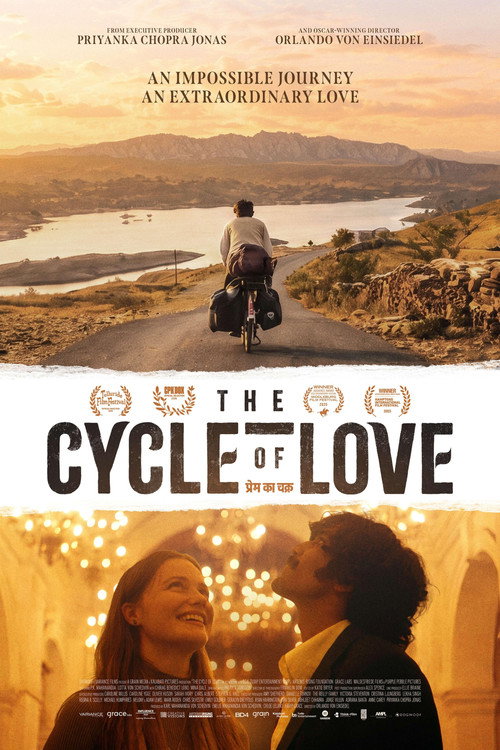
The Cycle of Love
2026 · Orlando von Einsiedel
When you need to feel something good about people — a restorative watch for an evening when you want your faith in love topped up. Pure comfort, and a great pick to share with someone skeptical of documentaries.
What it's about
In 1977, a Delhi street artist named PK Mahanandia got on a second-hand bicycle and rode 6,000 miles — across Asia, across Europe — to reach the Swedish woman he loved and had married in a tribal ceremony after drawing her portrait on the pavement. This documentary retraces that journey and the marriage that has lasted ever since. It's a true story so improbable it plays like a fable, except the couple is real.
The experience
Tender and quietly astonishing — a documentary that feels like a love letter with a map folded inside it. It leaves you moved and a little lighter, the rare film about devotion that earns its warmth with facts.
The craft
Orlando von Einsiedel, a documentarian known for filming inside live crises — war zones, endangered parks, rescue workers under fire — here turns his eye to something gentler without losing his rigor. The journey's sweep across two continents gives the film its scale; the marriage at the end gives it its heart.
Why it matters
It brings one of the most retold true stories in modern travel lore to the screen from an Academy Award–winning documentary team, and shows a director celebrated for conflict films working in a wholly different emotional register.
Snapshot
The Cycle of Love takes as its subject one of the most frequently retold true stories in the modern literature of long-distance travel: the journey of Pradyumna Kumar Mahanandia — PK — who in January 1977 left New Delhi on a second-hand bicycle and rode west across Asia and Europe to reach Charlotte von Schedvin, the Swedish woman he had married in a tribal ceremony after drawing her portrait on the pavement at Connaught Place. He arrived in Sweden roughly four months later. They remained married.
The film is directed by Orlando von Einsiedel, the British documentarian whose work has otherwise been made almost entirely inside live crises: Virunga (2014), an Academy Award nominee shot among the rangers of the Democratic Republic of Congo's Virunga National Park; The White Helmets (2016), which won the Academy Award for Documentary Short Subject; Lost and Found (2019), set in the Rohingya camps of Bangladesh; Convergence: Courage in a Crisis (2021), assembled across continents during the pandemic. The one substantial exception in his filmography is Evelyn (2018), a first-person account of his family's reckoning with his brother's suicide — and it is to Evelyn, not to Virunga, that The Cycle of Love is structurally related. This is a retrospective film about an event that ended half a century before the camera arrived.
A caveat that belongs at the top rather than buried at the bottom. This dossier is written in September 2026, and the documentary record around the film itself — festival itinerary, financing structure, below-the-line credits, critical reception — is not yet settled or reliably accessible. Where this account discusses craft, it reasons from two things that are documented: the demands the material makes on any filmmaker who approaches it, and von Einsiedel's twenty-year working method. Specific crew attributions for this title are flagged as unverified rather than invented, and the same applies to reception.
Industry & production
Von Einsiedel's production base is Grain Media, the London company through which most of his films have passed, and his most consequential professional relationship is with the producer Joanna Natasegara, with whom he shared the Oscar for The White Helmets and who produced Virunga. That partnership has operated within a particular industrial arrangement: British independent nonfiction production, internationally financed, delivered largely to streaming. Virunga was among Netflix's earliest original documentary acquisitions and carried Leonardo DiCaprio as an executive producer; The White Helmets, Evelyn and Convergence also went to the platform. It would be reasonable to expect The Cycle of Love to sit inside a comparable structure, but the financing and distribution of this specific film are not something the available record establishes, and I will not assert them.
The economics of a retrospective film differ sharply from those of the embedded reportage von Einsiedel built his reputation on. There is no danger premium, no long insurance tail, no fixer network in a conflict zone — but there is rights clearance, archive licensing, travel across at least three countries for contemporary photography, and the slow, unbillable labour of finding what survives of 1977. The budget of such a film goes into research and into the edit rather than into the field.
One production constraint is unavoidable and worth stating plainly: the 1977 route cannot be retraced in 2026. PK's line ran through Pakistan, Afghanistan and Iran before crossing Turkey, Bulgaria, the former Yugoslavia, Austria, West Germany and Denmark. Afghanistan and Iran are not open to a British documentary crew on those terms, and several of the political entities he crossed no longer exist. Any visual account of the journey must therefore be built from substitution, archive, and absence. That is not a limitation the film can solve; it is the film's central formal problem.
Technology
Three technological registers converge here. The first is the 1970s amateur image. The overland "hippie trail" that Charlotte von Schedvin travelled eastward was one of the most heavily photographed migrations of its era, documented in Kodachrome slides, Instamatic prints and Super 8 — a private, domestic archive dispersed across thousands of households in Europe, Australia and North America. Whatever period imagery a film like this can obtain comes from that stratum, together with family photographs and official documents: passports, stamps, visas, the paper residue of a border regime.
The second is PK's own hand. Because the protagonist is a portraitist who financed his ride by drawing the people he met, his drawings constitute a primary visual record of the journey — an unusual gift to a documentary, and one that supplies an image-making logic the film can adopt rather than impose. Digitisation and high-resolution scanning of works on paper is the relevant technology here, as it is for the couple's correspondence.
The third is contemporary digital capture, which von Einsiedel has always used at the small, fast end of the scale: compact cinema cameras and DSLRs, minimal crews, and on Virunga a strand of concealed-camera material gathered by the journalist Mélanie Gouby. For this film the same lightweight kit serves a different function — landscape, weather, road, the re-photographed present — and the drone shot, now the standard grammar of the journey documentary, is both the obvious tool for rendering 6,000 miles and the one most likely to flatten it into travelogue.
A note on the numbers, which is a technological question in the sense that measurement is: press accounts of the ride disagree. "Six thousand miles" is the most widely repeated figure, including in the synopsis attached to this film, but published accounts over the past decade have also given distances nearer seven thousand kilometres, and the daily mileage and total duration vary between tellings. This is what happens to a story that has been retold for fifty years. A rigorous film would acknowledge the drift; whether this one does is not something I can confirm.
Technique
Cinematography
The available visual system has three distinct layers, and the interest of the film lies in how they are reconciled. First, the interview: von Einsiedel's practice has favoured subjects filmed in their own environments, in available or lightly shaped light, at conversational proximity rather than in the stylised black-void portraiture of the Morris tradition. Second, the archive and the artwork, which must be shot or scanned and then moved through — the rostrum camera's modern descendants, and the question of whether to animate a still image or let it sit. Third, the present-tense landscape: the road as it is now, in countries that have changed beyond recognition, filmed knowing the viewer will read absence into it.
Von Einsiedel's regular cinematographer across Virunga and subsequent work has been Franklin Dow, whose strength has been handheld responsiveness under pressure. Whether Dow shot this film is not established in sources I can verify.
Editing
The structural problem is that the story has no suspense. Everyone watching knows he arrives; the film's own title and its first minute concede it. Narrative interest must therefore come from texture and from time-scheme rather than from outcome — which is to say, from editing.
The likely solution, and the one von Einsiedel's previous films point toward, is a braided construction: the 1977 ride cross-cut against the fifty years of marriage that followed, so that the journey is continually reframed by its consequence, and the film's real subject becomes duration rather than distance. Virunga was cut by Masahiro Hirakubo — Danny Boyle's editor on Shallow Grave and Trainspotting — and its four-strand construction had a thriller's forward pressure, a pace that this material cannot and should not sustain. Evelyn, by contrast, was cut to the rhythm of walking and talking, with long tolerances for silence and for the incomplete sentence. The Cycle of Love needs the second grammar more than the first. Editing credits for this title are not among the details I can verify.
Mise-en-scène / staging
Objects carry this film: the bicycle, the drawings, the letters, the astrological chart. PK's account has always turned on a horoscope cast in his childhood that predicted he would marry a woman born under Taurus, from a distant land, a musician, and an owner of forest — a prophecy Charlotte's biography appeared to satisfy, her family being Swedish nobility with land. That document, or the memory of it, is a staging opportunity and an interpretive trap: filmed reverently, it makes the marriage fated; filmed sceptically, it makes PK a man who read his own life as a text and then went out and enacted it.
The geographic staging sets two interiors against each other — a Swedish domestic present and an Indian past that exists only in testimony — and the contrast is where a film like this can go wrong, exoticising Odisha and Delhi into colour-saturated memory while Sweden supplies sober reality. Whether The Cycle of Love avoids that inversion is a legitimate critical question I cannot answer from the record.
Sound
Von Einsiedel's films have been scored, repeatedly, by Patrick Jonsson, whose work on Virunga, The White Helmets and Evelyn runs to sustained strings and piano used to underwrite emotion directly rather than ironise it. That is the house sound, and it is a risk on material this sentimental: a romance already at the edge of fable does not need music arguing for it. The more interesting sonic resource is language. This story lives in Odia, Hindi, Swedish and English, and the choice of which tongue PK tells it in — and to whom — is a substantive decision about audience and about whose story it is. A film that lets him speak Odia is making a different claim than one that keeps him in English throughout.
Performance
Documentary performance here means something specific: PK Mahanandia has told this story publicly for decades, in interviews, talks and a book-length account by the Swedish journalist Per J. Andersson, published in Sweden in 2013 and later in English translation as The Amazing Story of the Man Who Cycled from India to Europe for Love. He is a practised and charming narrator of his own life, and the polish is itself a subject. The task for the director is to find the places where the account has not been smoothed — hesitation, contradiction, the detail that does not serve the anecdote. Charlotte von Schedvin has historically been the quieter party in public accounts of the marriage, and how much room the film gives her, in her own words, is the fairest single test of its seriousness.
Narrative & dramatic mode
The mode is romance in the older sense: a quest with a beloved at the end of it, undertaken on faith, across a landscape that tests the traveller. It is also a picaresque — a sequence of encounters with strangers who feed, shelter and sit for the hero — and this episodic structure is what saves the film from the monotony of the road, since each portrait drawn is a small transaction of trust.
Against the quest runs a second, slower narrative: the marriage. A love story that ends at the moment of reunion is a fairy tale; one that continues for fifty years into migration, work, children and ageing is something harder and better. The strongest version of this film is the one that treats the ride as the prologue rather than the climax, and locates its real drama in what two people did with the rest of their lives after the astonishing thing was over.
Genre & cycle
The Cycle of Love sits at the intersection of three active nonfiction cycles. The first is the feat documentary — Touching the Void (2003), Man on Wire (2008), Free Solo (2018) — which reconstructs a singular physical achievement and must solve the problem of retrospection. The second is the stranger-than-fiction archive romance, whose modern template is Searching for Sugar Man (2012) and whose emotional economics the streaming platforms have found reliable. The third is the internationally financed documentary with an Indian subject, a genuine wave over the past decade that includes Period. End of Sentence. (2018), Writing with Fire (2021), All That Breathes (2022) and The Elephant Whisperers (2022) — a body of work that has been both celebrated and criticised in India for the way Western funding shapes which Indian stories travel.
The bicycle brings its own iconography, from Bicycle Thieves (1948) onward: the machine of the person who cannot afford anything else, a vehicle whose dignity in cinema has always been bound up with poverty and with the labour of the body.
Authorship & method
Von Einsiedel (b. 1980) came up through British independent factual production and made his first substantial mark with Skateistan: To Live and Skate Kabul (2011), a short about a skateboarding school in Afghanistan. The through-line of everything since is a consistent thesis rather than a style: ordinary people who behave extraordinarily under pressure, filmed close, with the film's sympathies declared rather than withheld. The Virunga rangers, the Syrian Civil Defence volunteers, Kamal Hussain reuniting lost children in Cox's Bazar — these are all versions of the same protagonist, and PK Mahanandia is plainly another. Von Einsiedel's films are hopeful by design. Critics who find that hope insufficiently complicated have a real argument; it is the same argument one can have with the Griersonian tradition he descends from.
Evelyn is the necessary precedent for this film because it proved he could work without a crisis to point at, and because it is where he developed a method for filming a past that no longer exists: walk the ground, speak to the people who were there, let the landscape hold what the archive cannot.
The collaborators named above — Natasegara, Dow, Hirakubo, Jonsson — constitute his standing unit, and their habits define the plausible shape of this film. I flag again that their presence on The Cycle of Love is not something the accessible record confirms, and the writing credit in particular is unknown to me. Whether Per J. Andersson's book was a source, an option, or simply prior art is likewise unverified; the story's broad availability in the public record means no adaptation right was necessary to tell it.
Movement / national cinema
Three national cinemas meet here without any of them owning the film. The British documentary tradition supplies the authorial position: the socially committed, internationally roving nonfiction of the post-2010 London scene, sustained by BBC Storyville, Film4, the BFI and Dogwoof, and transformed after 2014 by streaming money — a transformation Virunga helped set in motion. Sweden supplies the destination and a strong native documentary culture of its own, though this is a British film about Sweden rather than a Swedish film. India supplies the origin, the caste politics, and a documentary tradition — Anand Patwardhan's decades of work on caste and communalism foremost among it — that this kind of internationally financed production rarely engages directly.
Era / period
The film's 1977 is a precisely dated world. PK left Delhi in the final months of Indira Gandhi's Emergency, the suspension of civil liberties that ran from June 1975 until the elections of March 1977 — so he rode out of a country under authoritarian rule and did not see its restoration. His route crossed the overland trail in its last functioning years: the Iranian Revolution of 1979 and the Soviet invasion of Afghanistan in December of the same year closed that corridor, and it has never fully reopened. A journey that was arduous but administratively possible in 1977 became impossible within thirty months, and that fact gives the film an elegiac dimension nobody at the time could have intended.
Its 2026 is equally specific. A story about a Dalit man from Odisha crossing eight borders on documents he could obtain, and being received into a Swedish family, lands differently in a Europe whose politics have hardened decisively against exactly that mobility. The asymmetry is the point: Charlotte could drive east on a whim, and PK could only pedal west. Whether the film presses on that asymmetry or lets the romance absorb it is the question a serious viewer should bring to it.
Themes
Caste and the body. PK has spoken publicly and repeatedly about growing up as an untouchable, and about what that meant materially — separation at school, exclusion from shared water and shared space. The ride is legible as the extreme assertion of a right of movement by a man raised to be told where he could not stand. This is the theme most easily lost to the love story, and the one that most repays attention.
Art as currency. He paid for six thousand miles with portraits. Drawing was simultaneously his livelihood, his passport, his means of introduction, and his way of being seen by strangers as a person with a skill rather than a supplicant. The film's best available metaphor is already in its material.
Prophecy and agency. The horoscope frames the marriage as destiny; the bicycle frames it as work. The story holds both and resolves neither, which is why it has outlasted a thousand better-documented romances.
Duration. Fifty years of marriage is the actual achievement, and the least photogenic one.
Mobility and its permissions. Who gets to cross, on what paper, at what cost — then and now.
Reception, canon & influence
The honest position is that there is no settled critical record for this film at the time of writing, and I will not manufacture one. It is a 2026 release by a director whose previous work has performed strongly with Academy voters and on streaming, addressing material with wide pre-existing name recognition; that combination suggests visibility, not quality, and the reviews will say what they say.
Influences on the film (backward). The reconstruction lineage runs from Errol Morris's The Thin Blue Line (1988) through Kevin Macdonald's Touching the Void and James Marsh's Man on Wire, all of which faced the same difficulty — how to film what is over — and answered it with staged image-making. The archive-and-letters lineage runs through Sarah Polley's Stories We Tell (2012), the key modern film about a family story whose tellers cannot agree, and, for the animation of unfilmable memory, Ari Folman's Waltz with Bashir (2008). The road and the bicycle come from De Sica. Within von Einsiedel's own work, Evelyn is the decisive precedent. And the story arrives pre-shaped by Per J. Andersson's book, which established the narrative architecture — prophecy, meeting, separation, ride, arrival — that any subsequent telling either follows or deliberately breaks.
What it may shape (forward). Too early to assess, and any claim otherwise would be invention. Two plausible lines of consequence can be identified without being asserted as fact. The first is on the story itself: a dramatic feature version has been discussed for years in the trade press without, so far as I can establish, a confirmed release, and a successful documentary typically accelerates rather than forecloses such a project. The second is on von Einsiedel's career, where this would mark a durable turn away from crisis reportage toward retrospective biography — a move many documentarians of his cohort have made as the funding for dangerous, long-lead field production has contracted. Whether The Cycle of Love is the film that makes that turn look like an artistic choice rather than an economic one is the thing worth watching for.
A Deleuzian reading
A man sits on the pavement at Connaught Place with a sheet of paper on his knees, drawing whoever will pay him.
The full Deleuzian reading of The Cycle of Love →
Reception
How The Cycle of Love was received, from release to now →
Influences: the films it descends from and the films it influenced
- Bicycle Thieves (1948) — Establishes the bicycle as a narrative instrument rather than a prop — the camera stays at its speed and height so that the machine's presence or absence dictates the film's geography, which is the staging logic behind this film's object-as-witness treatment of PK's frame.
- The Endless Summer (1966) — Codifies the picaresque quest documentary: a first-person narration track laid over footage shot in transit, with border crossings serving as act breaks and the destination withheld as the only structuring suspense.
- The Thin Blue Line (1988) — Licenses the documentary to stage what no camera recorded — repeated, non-identical reconstructions cut to a score, so that the reenactment is legible as testimony's shape rather than as evidence.
- Trainspotting (1996) — Masahiro Hirakubo's cutting method — ellipses locked to a musical downbeat, whole days dropped between two shots of the same face — is the editorial grammar imported here to compress a 6,000-mile ride without resorting to a map dissolve.
- Touching the Void (2003) — Solves the foreknown-outcome problem by intercutting survivor testimony shot in neutral space with body-doubles filmed in the actual terrain, so suspense migrates from what happened to how the teller can bear to say it.
- Grizzly Man (2005) — Demonstrates that a subject's own amateur footage acquires a second meaning when the ending is already known to the audience, the narrator functioning as an interpreter standing between us and the bequeathed archive.
- Waltz with Bashir (2008) — Establishes animation as the honest register for a remembered event with no surviving image — a declared reconstruction rather than a forged one, the model for rendering a prophecy spoken decades before any camera was present.
- Man on Wire (2008) — Applies heist-film grammar to a still-photograph archive: rostrum moves across grain and emulsion edge, timed to designed sound, so that static images acquire the tempo of an event in progress.
- Stories We Tell (2012) — The decisive precedent for staged Super-8 cut indistinguishably against genuine home movies, and for braiding tellers who contradict each other without the film adjudicating between them.
- Virunga (2014) — Where the standing unit's method was set — Natasegara's production frame, Franklin Dow's handheld long-lens proximity that keeps a subject's hands in frame during speech, and sympathies declared in the cut rather than balanced.
- Evelyn (2018) — The immediate precedent: the interview is conducted while walking the actual ground, so testimony is paced by footfall and landscape does the work the missing archive cannot — duration over distance as a working rule.
- Searching for Sugar Man (2012) — Same hybrid toolkit for a myth that outran its facts — Super-8 texture, animated inserts for the unfilmable, and a structure that withholds a reveal the subject has always known, keeping the audience one step behind the teller.
- The Salt of the Earth (2014) — Builds long passages entirely from rostrum work on photographic stills with the image-maker's voice over them, treating the photograph as the primary visual text rather than illustration — the closest analogue to filming a portraitist's drawings.
- Faces Places (2017) — Makes portrait-making itself the engine of a road film: each stop exists because an image gets made there, which is exactly the structural device available when the traveller funded his journey by drawing strangers.
- Human Flow (2017) — Uses the drone not as decoration but as a change of register — cutting from a face to an overhead that converts one person's route into terrain — the grammar this film's drone travelogue material depends on to keep scale legible.
- Apollo 11 (2019) — Proves high-resolution rescanning is itself an authorial act: grain resolved into faces and dust makes decades-old stock read as present tense, sustaining suspense over an outcome every viewer already knows.
- Fire of Love (2022) — The defining modern archive romance — a love story assembled entirely by re-cutting film the couple shot themselves, with the known ending used as an editorial pressure on every frame rather than as a final revelation.
- Time (2020) — Braids decades of self-shot home video against present-day observational material without date cards, letting the grain and format shift carry the timeline — the technique for a story whose two halves are separated by years of waiting.
Similar films
- Sore: A Wife from the Future (2025) — shared sensibility
- The Love That Remains (2025) — shared sensibility
- The Oldest Person in the World (2026) — shared sensibility
- Falling in Love Like in Movies (2023) — shared sensibility
- All We Imagine as Light (2024) — shared sensibility
- Magellan (2025) — shared sensibility
- Godland (2022) — shared sensibility
- Touch (2024) — shared sensibility