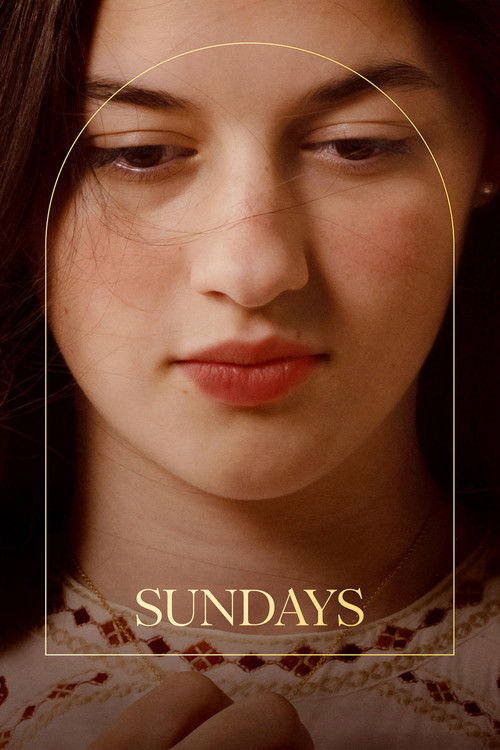
Sundays
2025 · Alauda Ruiz de Azúa
For when you want a thoughtful, grown-up drama that respects your intelligence and gives you a real question to wrestle with — not comfort viewing, but deeply rewarding if you're in a reflective frame of mind.
What it's about
A brilliant seventeen-year-old at a Catholic school in Spain, about to choose her university path, stuns her family by announcing she wants to enter a convent and test a call to cloistered religious life. Her widowed father is drawn toward her faith; her atheist aunt sees grief and manipulation at work — and the girl's decision becomes a pressure test that exposes everything unresolved in the family around her.
The experience
Quiet, patient, and morally serious — it refuses to tell you what to think, holding faith and skepticism in genuine balance while the family tension tightens. It's the kind of film that keeps rearranging itself in your head afterward.
The craft
Alauda Ruiz de Azúa directs with remarkable restraint, building drama from family meals, conversations, and silences rather than confrontation set-pieces. The film's evenhandedness is itself the craft: every scene is calibrated so belief and doubt stay equally plausible.
Why it matters
Winner of the Golden Shell for Best Film at the 2025 San Sebastián festival, it confirmed Ruiz de Azúa as one of Spain's essential new dramatists of family life.
Snapshot
Sundays (Spanish: Los domingos) is the second feature by the Basque director Alauda Ruiz de Azúa, a quiet, morally serious family drama built around a provocation that is entirely internal: a seventeen-year-old girl announces she wants to become a cloistered nun. Where a lesser film would treat vocation as pathology or as inspirational uplift, Sundays holds the question open, using Ainara's decision as a pressure test applied to the adults around her — a widowed father drawn toward his daughter's faith, and an atheist aunt who reads the same impulse as a symptom of grief and control. The film premiered in competition at the 73rd San Sebastián International Film Festival on 22 September 2025 and won the Golden Shell for Best Film, alongside the FIPRESCI critics' prize and several other awards; it opened in Spanish cinemas that October and went on to a major presence at the 40th Goya Awards. It confirmed Ruiz de Azúa, after the breakout of Cinco lobitos (Lullaby, 2022), as one of the central figures in the contemporary wave of Spanish women filmmakers working in an intimate, observational register.
Industry & production
Sundays is a Spanish production assembled from the kind of multi-company, broadcaster-backed structure that now underwrites most mid-budget Spanish auteur cinema. Production companies credited include Buenapinta Media, Colosé Producciones, Sayaka Producciones, Encanta Films and Think Studio, with the pay-television and streaming platform Movistar Plus+ attached — a decisive institutional partner, since Movistar Plus+ has become one of the most important patrons of prestige Spanish film and series work in the last decade. The producers include Marisa Fernández Armenteros, Sandra Hermida, Nahikari Ipiña and Manu Calvo; Sandra Hermida in particular brings experience on large, logistically demanding Spanish-language productions. Trade reporting around the San Sebastián premiere indicated the French company Le Pacte handling international sales, with early territory deals — the customary path for a festival title with awards momentum. The film runs 116 minutes and, on the strength of its festival wins and Goya campaign, performed strongly in Spanish cinemas; a domestic gross in the region of €5 million has been reported, though I flag that precise box-office figures for a film this recent should be treated as provisional. The wider production context matters: the film's Basque setting and personnel connect it to a well-funded regional ecosystem (Basque institutional support, and the Irizar Basque Film Award it won at San Sebastián), which has been an engine of Spanish cinema's recent international profile.
Technology
There is little in the public record to suggest Sundays is a technically experimental film, and it would be false to invent claims about its capture format or post-production pipeline. It belongs, on the evidence of its style and its lineage, to the mainstream of contemporary digital European art-house production: shot digitally, finished with restrained color grading in service of a naturalistic palette, and reliant on available and motivated light rather than conspicuous technological display. The one domain where craft technology is genuinely load-bearing is sound — the film's convent and domestic interiors depend on precise, unshowy location and post sound to register hush, footsteps, liturgy and the ambient life of a family restaurant. Beyond that, the specifics of lenses, cameras and workflow are not established in the material available to me, and I will not speculate.
Technique
Cinematography
Cinematography is by Bet Rourich, a director of photography associated with the naturalist, closely observed strand of recent Spanish and Catalan filmmaking. On the evidence of the film's reception and Ruiz de Azúa's established method, the images favor patient framing, natural light, and a camera that stays near its performers without crowding them — the visual grammar of contemporary European realism rather than of expressive stylization. The dramatic architecture of the film, which sets the enclosed, ordered world of the convent against the cluttered warmth of a family home and restaurant, invites a photographic contrast between the two spaces; how far Rourich presses that contrast into a deliberate visual scheme is something I can gesture at from the premise but cannot document in fine detail from the current record.
Editing
Andrés Gil is credited as editor. Ruiz de Azúa's cinema is one of duration and accumulation rather than montage effect, so the editorial task here is chiefly one of rhythm and restraint: letting scenes breathe long enough for ambivalence to register, and managing the film's central structural device — the slow shift of sympathy among father, aunt and daughter — without tipping the audience's hand toward a verdict. The cut, in this kind of work, is where the film's refusal to editorialize is actually enforced.
Mise-en-scène / staging
The staging is the film's real engine. Sundays is a chamber drama about a family that cannot agree on what one of its members is doing, and Ruiz de Azúa's characteristic strength — visible already in Cinco lobitos — is the choreography of ordinary domestic space: kitchens, cars, thresholds, meals. The two governing environments, the Catholic secondary school and convent on one side and the household on the other, function as opposed moral atmospheres, and much of the drama is carried by where people are placed within them, who is included in a conversation and who is left at the doorway. The title itself — Sundays — folds the sacred and the domestic together: the day of Mass and the day of the family lunch.
Sound
Sound design is central to the film's texture even in the absence of a prominent orchestral score. The record does not foreground a named composer, and Ruiz de Azúa's prior work leans toward sparse, near-scoreless soundtracks in which the acoustic world of the story does the emotional work; it is reasonable to read Sundays similarly, though I note that a definitive account of its music is not established here. The contrast between the reverberant quiet of religious interiors and the overlapping noise of family life is a resource the film appears to use deliberately.
Performance
Performance is where Sundays was most conspicuously honored. The film pairs the newcomer Blanca Soroa, as Ainara, with the established Patricia López Arnaiz as her aunt Maite, and surrounds them with Miguel Garcés as the father Iñaki, alongside Juan Minujín, Mabel Rivera and Nagore Aranburu (as the Mother Prioress). López Arnaiz — already one of the most respected actors of her generation in Spain — anchors the film's skepticism, and the interplay between her worldly, protective doubt and Soroa's opaque conviction is the axis on which the drama turns. The casting of a genuine unknown as Ainara is itself a dramatic strategy: the character's interiority stays unreadable partly because the face is unfamiliar. The performances drew the film's strongest awards recognition, including major acting honors at the Goyas.
Narrative & dramatic mode
The film's mode is realist melodrama stripped of melodrama's heat — a domestic drama conducted almost entirely through conversation, silence and withheld judgment. Its narrative engine is a single decision that never resolves into a clean cause: Ainara wants to enter religious life, and the film declines to tell us definitively whether this is authentic vocation, adolescent rebellion, a displacement of grief for her dead mother, or some irreducible mixture. Crucially, the protagonist function is split. Ainara is the object of the drama, but the aunt Maite is arguably its subject — the consciousness through which the audience is invited to worry — and the film's TMDB framing (the aunt reading the vocation as "the manifestation of a deeper problem") signals this doubling. The result is a structure of interpretation: the drama is less about what Ainara will do than about what the people who love her will make of it, and what their readings reveal about them.
Genre & cycle
Sundays sits at the intersection of two well-worn genres and refreshes both. It is a coming-of-age film — the final year of secondary school, exams, the choice of a future — inverted so that the "future" the girl chooses is renunciation rather than expansion. And it is a faith-and-family drama, a lineage that runs from Bresson and Dreyer through to contemporary treatments of belief and doubt. Within Spanish cinema specifically, it belongs to a recent cycle of intimate, female-authored family portraits that treat ordinary domestic crisis with novelistic seriousness — the cycle that includes Carla Simón, Pilar Palomero, Elena Martín Gimeno and Ruiz de Azúa herself. What distinguishes Sundays within that cycle is its subject: religious vocation is a strikingly unfashionable theme for contemporary art cinema, and the film's willingness to take faith seriously as a live human possibility, rather than an object of critique, is part of what critics responded to.
Authorship & method
Alauda Ruiz de Azúa (b. 1978, Barakaldo, Basque Country) trained at Madrid's ECAM film school and built a career in advertising and short form before her fiction debut. That debut, Cinco lobitos (Lullaby / Five Little Wolves, 2022), a raw study of new motherhood and the return to the family home, won awards at Málaga and San Sebastián and earned her the Goya for Best New Director; she subsequently directed for the acclaimed television series Querer (2024). Her authorial signature is consistent across these works: closely observed family systems, moral ambivalence held without resolution, performances given room to breathe, and a refusal of tidy catharsis. She wrote Sundays as well as directing it, which underlines how much its non-judgmental structure is a deliberate authorial stance rather than an accident of production.
Her key collaborators on Sundays extend that method. Cinematographer Bet Rourich works in the naturalist idiom the film requires; editor Andrés Gil shapes its patient rhythm; and the ensemble is led by Patricia López Arnaiz, whose casting brings a ready-made gravity and skeptical intelligence to the aunt. The producing team, anchored by figures including Sandra Hermida and backed by Movistar Plus+, situates the film within the professionalized upper tier of Spanish auteur production. On the film's music the record is thin, and I decline to attribute a score I cannot verify.
Movement / national cinema
Sundays is a Basque-inflected work within contemporary Spanish national cinema, and both identities are meaningful. The Basque dimension is institutional and cultural: the setting, personnel, the Irizar Basque Film Award, and the region's robust film-funding culture, which has helped make Basque cinema disproportionately visible in Spain's recent international successes. The broader Spanish frame is the more critically significant one. Over the past decade Spanish cinema has been defined internationally less by genre spectacle than by a cohort of directors — many of them women — making intimate, realist, domestically scaled films of high formal control. Ruiz de Azúa is now firmly among the leading names of that movement, and Sundays, by winning San Sebastián's top prize on home ground, functions as a kind of institutional coronation of both the director and the tendency she represents.
Era / period
The film is a product of the mid-2020s, and it reflects that moment in two ways. Industrially, it embodies the current settlement in which streaming platforms (here Movistar Plus+) co-finance theatrically released prestige cinema, and in which national festivals like San Sebastián serve as launchpads for awards campaigns. Thematically, it is quietly of its time: a serious, non-polemical film about religious belief made in an overwhelmingly secular European cultural context, in which a teenager's turn toward the cloister reads to the adults around her — and to much of the presumed audience — as almost unthinkable. The film's dramatic tension depends on that contemporary secular default; a version made in an earlier, more devout era would not generate the same shock from the same premise.
Themes
The film's governing themes are faith and doubt; grief and its displacements; and the limits of a family's, and a society's, ability to accept a choice it cannot comprehend. Vocation is treated less as a theological question than as a relational one: Ainara's decision becomes a mirror in which each family member sees their own convictions and fears — the father his consolation, the aunt her protectiveness and her secular certainty. Adolescence and autonomy are in play too, and pointedly gendered: the film asks whether a young woman's radical self-determination can be honored when the direction she chooses is one the surrounding culture reads as self-erasure. Underneath runs the theme of interpretation itself — the impossibility of finally knowing another person's interior life, and the moral hazard of insisting that we do.
Reception, canon & influence
Critically, Sundays was among the most warmly received Spanish films of its year. Its Golden Shell at San Sebastián — awarded by an international jury on the festival's home turf — was accompanied by the FIPRESCI Prize and further honors (including the Feroz Zinemaldia, SIGNIS and Irizar Basque Film awards), and reviewers singled out its restraint, its refusal to caricature belief, and its performances; the film subsequently featured prominently at the 40th Goya Awards, with recognition for the film, its direction and its acting. Reported critical language was notably admiring, though I avoid attributing specific quotations I cannot source precisely.
The influences on the film are legible in its form: the spiritual-crisis cinema of Bresson and Dreyer stands behind any serious modern film about a young woman and vocation, and the immediate Spanish precedents — the naturalist family dramas of Simón, Palomero and Martín Gimeno, and Ruiz de Azúa's own Cinco lobitos — supply its idiom of patient domestic observation. Its forward influence is, necessarily, still forming: as a 2025 film only recently released, Sundays has not yet had time to shape a body of subsequent work, and any claim about its legacy would be premature. What can be said is that its major-festival triumph consolidates the critical prestige of the contemporary Spanish women's realist current and strengthens Ruiz de Azúa's position as a director whose next films will be widely anticipated. On the longer arc — whether Sundays enters a durable canon — the honest answer is that it is too soon to know, and the record will have to be written by time rather than asserted now.
Sources: Deadline — San Sebastián winners; Cineuropa; Variety — Le Pacte sales; Wikipedia — Sundays (film)); Wikipedia — 73rd San Sebastián International Film Festival; Premios Goya — Los domingos.
Reception
It went from San Sebastián favorite to Golden Shell winner (plus the FIPRESCI prize) in September 2025, then swept into the Goyas with 13 nominations and took Best Film — a festival darling that became Spain's consensus movie of the year within months.
How Sundays was received, from release to now →
Influences: the films it descends from and the films it influenced
- The Passion of Joan of Arc (1928) — Establishes the template of the young woman tested by vocation rendered through faces held longer than comfort allows, so that belief becomes a matter of physiognomy and duration rather than dialogue — the interrogative attention Sundays trains on its adolescent's silences.
- Ordet (1955) — Its patient, drifting long takes inside a single farmhouse dramatize faith versus doubt as a pressure distributed across a whole family gathered in one room — the domestic-space choreography and refusal to resolve belief that Sundays inherits directly.
- Diary of a Country Priest (1951) — The Bressonian model of vocation as ascetic ordeal, stripped of underscore and emotive acting, where grace is withheld from the viewer as it is from the protagonist — the near-scoreless austerity Sundays adopts around its religious calling.
- Mouchette (1967) — Bresson's use of a blank, non-professional adolescent 'model' whose interior life is deliberately unreadable is the direct precedent for Sundays' unknown-lead casting and its theme of the unknowability of others.
- The Spirit of the Beehive (1973) — The founding Spanish work of natural-light, near-silent observation filtered through a child's uncomprehending gaze, letting meaning accrete in domestic stillness — the ambient-realist grammar Sundays writes within.
- Cinco lobitos (2022) — Ruiz de Azúa's own debut fixes her method — closely observed family systems, moral ambivalence held without catharsis, performances given room to breathe in the returned-to family home — which Sundays extends into the register of faith.
- Summer 1993 (2017) — Carla Simón's naturalist child's-eye realism — available light, elided plot, grief absorbed into the texture of ordinary domestic days — is the immediate Spanish current Sundays belongs to and shares its withheld-resolution structure with.
- Alcarràs (2022) — Its non-professional ensemble cast filmed in overlapping, semi-improvised family interplay across shared rooms and outdoor labor models the ensemble-interplay and staging choreography Sundays uses to make a household feel lived-in.
- Schoolgirls (2020) — Palomero's Catholic-schooling coming-of-age, built on an unknown adolescent lead and restrained observation of a girl negotiating faith, class and the body, is the closest thematic-formal sibling in the Spanish women's-realist wave.
- Creatura (2023) — Its split-timeframe, fragmented-protagonist construction and unhurried domestic staging of a woman's interior life exemplify the same authorial current of women directors dismantling a single self across a family's rooms.
- Ida (2013) — A young novice confronting vocation against a worldly aunt (the two-hander of innocent and skeptic) shot in still, austere frames with a near-absent score — the split-protagonist faith-and-doubt architecture Sundays mirrors in its niece-and-aunt pairing.
- Silent Light (2007) — An explicit Dreyer descendant that films a religious community with non-actors, natural light and durational long takes to make faith and grace materially present — the same transcendental-realist inheritance Sundays draws on, updated for a secular audience.
- First Reformed (2017) — Schrader's programmatic revival of Bresson's transcendental style — withheld affect, static framing, spiritual crisis dramatized through austerity rather than incident — is the contemporary anglophone parallel to Sundays' Bresson-Dreyer lineage.
- Of Gods and Men (2010) — Its near-scoreless immersion in the daily rhythms and communal deliberations of a religious life, refusing to resolve the ethics of faith for the viewer, shares Sundays' ambient sound design and non-judgmental structure.
- Rosetta (1999) — The Dardennes' handheld long takes trailing an unknown young lead through repetitive domestic and social action, granting secular grace without commentary, is the working model for observing an adolescent's moral struggle without authorial verdict.
- Loreak (2014) — A landmark Basque-language ensemble drama built on quiet domestic observation and a diffuse, multi-strand structure with no tidy closure — the Basque-cinema context and withheld-resolution ethos Sundays extends.
Similar films
- Ida (2013) — influence & lineage
- Summer 1993 (2017) — influence & lineage
- The Little Sister (2025) — same viewing thread
- 20,000 Species of Bees (2023) — same viewing thread
- Sound of Falling (2025) — same viewing thread
- The Mysterious Gaze of the Flamingo (2025) — same viewing thread
- Romería (2025) — shared sensibility
- Young Mothers (2025) — shared sensibility
All the films related to Sundays →
Watch it with: curated runs of related films
- What the Mothers Left — A run of daughters and young women — grieving lost mothers, wary of surrogate ones, unearthing the family's secrets — where a house or a legacy keeps shaping who a girl becomes.