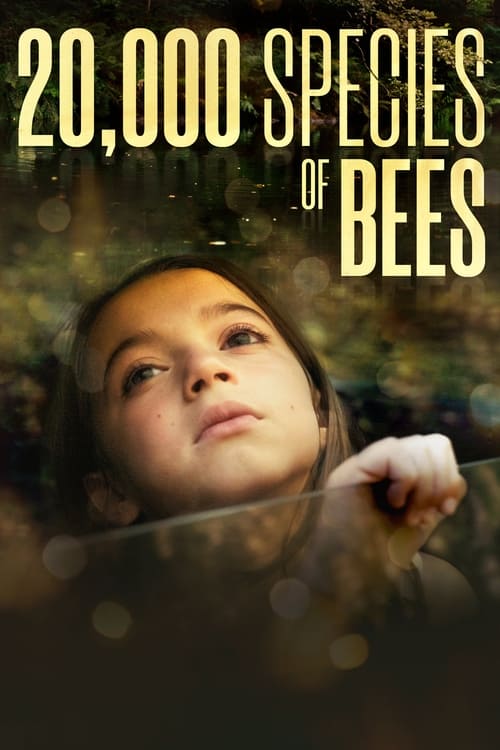
20,000 Species of Bees
2023 · Estibaliz Urresola Solaguren
For when you want a quiet, humane film to chew on for days — one that earns its feelings honestly. A gentle challenge rather than comfort food, and worth the attention it asks.
What it's about
Over one summer in the Basque Country, an eight-year-old child the family calls Cocó — and who is coming to know herself as Lucía — moves among three generations of women: a mother at a crossroads, a grandmother, a great-aunt who keeps bees. While the adults wrestle with their own choices and identities, Lucía is simply, stubbornly working out how to be seen as who she is.
The experience
Patient, intimate, and observational — it stays at a child's eye level and lets scenes breathe, so the emotion accumulates rather than strikes. Tender without being soft; by the end it lands hard.
Performances
Sofía Otero, eight years old at the time, won the Silver Bear at Berlin for the lead role — the youngest winner in the festival's history — and the award is deserved: her performance is unforced, wounded, and completely transparent, never once reading as a kid performing.
The craft
Estibaliz Urresola Solaguren's debut is built on close observation — handheld intimacy, natural light, and a screenplay that trusts silences and family friction over speeches. The beekeeping world gives the film its texture and its central metaphor without ever underlining it, and the movement across Basque, Spanish, and French makes the family feel documentary-real.
Why it matters
A Berlinale competition breakout that swept Spain's Goya Awards, announcing a major new voice in Basque-language cinema and setting a benchmark for how to portray a trans childhood with care.
Snapshot
20,000 Species of Bees (20.000 especies de abejas) is the feature debut of Basque filmmaker Estibaliz Urresola Solaguren, an intimate, observational drama that follows an eight-year-old child — called Aitor and nicknamed Cocó by the family, but coming to recognize herself as Lucía — across a single summer among three generations of women in the Basque Country. It premiered in competition at the 73rd Berlin International Film Festival in February 2023, where its young lead, Sofía Otero, won the Silver Bear for Best Leading Performance, becoming the youngest recipient of that award in the festival's history. The film went on to lead the field at Spain's 38th Goya Awards. Spoken across Basque, Spanish, and French, it belongs at once to a resurgent Basque-language cinema, to a wave of autobiographical realism by young Spanish women directors, and to a growing international body of films about trans childhood — while distinguishing itself by centering the child's own perception and agency rather than the trauma-spectacle that had marked some earlier entries in that cycle.
Industry & production
The film is a modestly budgeted Spanish independent production, produced by Gariza Films and Inicia Films, and developed within the ecosystem of Basque and Spanish public support that has underwritten much of the region's recent output. International sales were handled by the French agency Luxbox, which boarded the project ahead of its Berlin premiere — a typical arthouse route in which a Continental sales house shepherds a debut through the festival circuit toward distribution. As a first feature by a woman director working substantially in Euskara (Basque), the project reflects the funding priorities and co-production habits of the 2020s Spanish industry: regional cultural investment, festival-facing ambition, and a reliance on the Berlinale/San Sebastián axis to convert critical attention into theatrical and streaming sales. Precise budget figures and box-office returns are not well documented in the public record, and I will not invent them; the film's commercial profile is best understood through its unusually strong awards run rather than through reported grosses.
Technology
The technical particulars of the production — camera system, capture format, lenses, aspect ratio — are not well established in the accessible public record, and I will not assert specifics I cannot ground. What can be said with confidence is that the film pursues a naturalistic aesthetic consistent with contemporary European realist practice: available and motivated light, a mobile handheld camera, shallow focus that isolates the child's face against soft summer backgrounds, and long, patient takes. Whether this was achieved on digital or photochemical stock is not reliably documented, so any claim to "16mm grain" or a particular sensor would be speculation. The relevant technological point is aesthetic rather than instrumental: the film deploys whatever tools it used in service of proximity and duration, effacing technique so that the apparatus disappears behind the child's point of view.
Technique
Cinematography
Gina Ferrer García's photography is the film's central expressive instrument. The camera stays low and close, frequently at the child's eye level, and lingers on faces — above all on Sofía Otero's — long enough for micro-expressions to register as events. Depth of field is kept shallow, dissolving the adult world into a sympathetic blur while holding the child in tender focus. Light is naturalistic and summery, and the framing repeatedly places Lucía at thresholds — doorways, mirrors, the surface of water — visual figures for a self caught between states. The handheld mobility is restrained rather than nervous, following the child's attention rather than dramatizing it.
Editing
Raúl Barreras's cutting favors an unhurried, observational rhythm keyed to the elastic time of a childhood summer. The film advances through accumulation and ellipsis rather than through the ratchet of conventional plot; scenes are allowed to breathe past their informational function, and transitions often elide the "important" beats in favor of their quiet aftermath. This patience is a dramaturgical choice as much as a rhythmic one: by refusing to hurry toward crisis, the edit keeps the emphasis on perception and small daily negotiation rather than on melodramatic turning points.
Mise-en-scène / staging
The film is organized around a handful of charged spaces: the family's summer house, the maternal grandmother's domain; the mother's sculpture studio, freighted with the legacy of a late artist father; and, above all, the great-aunt's apiary. Bees and their keeping supply the governing visual and thematic system — the hives, the smoke, the netted veils, the swarm — and the title's literal referent (the sheer diversity of bee species) is staged as a natural argument for the diversity of ways of being. Water recurs as a staging motif, with bathing and the river functioning as sites of exposure, self-inspection, and something like baptism. The domestic interiors are dense with the ordinary business of a multi-generational household, so that the child's self-discovery unfolds not in isolation but amid the competing femininities of the women around her.
Sound
Sound direction and design, credited to Eva Valiño (with Koldo Corella), foregrounds ambient and natural textures — the drone of bees, water, the murmur of a full house — over a conventional score. The film largely eschews wall-to-wall music, letting sound carry emotional weight through presence and absence rather than through underscoring; sources conflate Valiño's sound work with "music," but the film's sonic signature is clearly that of naturalistic design rather than a symphonic accompaniment. The restraint matters thematically: without a score cueing how to feel, the spectator is left, like the child, to read the world attentively.
Performance
The film's engine is Sofía Otero's astonishingly unaffected performance — a non-professional child directed toward naturalism rather than "acting," and rewarded with an unprecedented Silver Bear. Around her, an ensemble of women anchors the film: Patricia López Arnaiz as the mother, Ane, a sculptor navigating her own artistic and marital uncertainty; Ane Gabarain as the beekeeping great-aunt Lourdes, the family's most instinctively accepting figure; and Itziar Lazkano as the grandmother. The performances are pitched at the register of lived behavior, and the film's refusal to assign a villain — no single adult is made the antagonist of the child's becoming — depends on that ensemble naturalism.
Narrative & dramatic mode
The film works in a realist, observational mode built on the child's point of view. Its dramatic question — will Lucía be recognized, by others and by herself — is answered not through a plotted climax but through a gradual, cumulative movement toward self-naming. Conflict is diffuse and interpersonal rather than melodramatic: the frictions of a family that loves the child but stumbles over pronouns, names, and expectations. This is a coming-of-age story compressed into one summer and braided together with the parallel self-reckonings of the adult women, so that the child's search for identity rhymes with the mother's and the aunts' reflections on their own femininity. The mode is closer to the patient European art film than to issue-driven social drama; it trusts observation over exposition.
Genre & cycle
Formally, the film sits at the intersection of the child-centered arthouse realist tradition and the emerging cinema of trans childhood. Within that latter cycle it is best read against Céline Sciamma's Tomboy (2011) and Lukas Dhont's Girl (2018): it shares their subject but pointedly avoids the bodily anguish and dysphoric spectacle for which Girl was criticized, keeping the emphasis on a young child's untroubled self-knowledge and the world's lag in catching up. Its deeper generic kinship is with the recent Spanish and Catalan wave of autobiographical, child's-eye summer films — most obviously Carla Simón's Summer 1993 (Estiu 1993, 2017) and, in its rural-family texture, her Alcarràs (2022) — and with the sensitivity to a self-contained child's world found in Sciamma's Petite Maman (2021). Presiding over all of it is the tutelary Spanish precedent of the beehive as metaphor and the child as the film's perceiving center.
Authorship & method
Urresola Solaguren, a Basque director who came to the feature through documentary and short-form work, wrote the screenplay alone, and the film bears the marks of a strongly authored first feature: a controlling central metaphor, a patient rhythm, and a refusal of easy dramatic payoffs. Her method is grounded in research and care — the film is informed by consultation with trans children and their families, and it is built around a non-professional child performer directed toward behavior rather than performance. Her immediately preceding short, Cuerdas (2022), screened at Cannes Critics' Week and won its Rail d'Or, establishing her festival credibility just ahead of the debut. Her key collaborators form a coherent authorial unit: cinematographer Gina Ferrer García, whose close, shallow-focus imagery defines the film's look; editor Raúl Barreras, whose elliptical patience sets its tempo; and sound designer Eva Valiño, whose naturalistic soundscape substitutes for a score. The absence of a conventional composer is itself an authorial signature.
Movement / national cinema
The film is a significant entry in contemporary Basque cinema, the Euskara-language filmmaking that has gained international traction through the work of directors such as Jon Garaño and Jose Mari Goenaga (Loreak, Handia) and their Moriarti collective, backed by Basque regional cultural investment and public broadcasting. Simultaneously it belongs to the broader renewal of Spanish cinema led by young women directors — Carla Simón, Pilar Palomero, Clara Roquet, Elena López Riera — whose intimate, often autobiographical realism reshaped the national art film in the late 2010s and early 2020s. That its acting recognition came via the Berlinale's gender-neutral Silver Bear for Best Leading Performance (introduced in 2021) is quietly apposite to the film's own subject.
Era / period
The film is a product of the early-2020s, post-pandemic surge in Spanish cinema's international standing, and of a streaming-era festival economy in which a Basque-language debut could travel worldwide on the strength of a Berlin prize. Its release was also politically timed: its February 2023 Berlin premiere coincided with the period in which Spain's "Ley Trans" — legislation easing legal gender self-determination — was moving through and being approved by the Spanish parliament, making the film part of a charged national conversation about trans rights. The film wears none of this as message; but its moment gave its gentle, particular story an unmistakable public resonance.
Themes
At its center is the recognition of gender identity in early childhood — the gap between a child's settled sense of self and a family's and society's readiness to see it — dramatized above all through the act of naming. Around that core the film gathers a set of intertwined concerns: femininity as something inherited, negotiated, and questioned across generations of women; motherhood and its uncertainties; artistic inheritance and the weight of a father's legacy in the mother's studio; and nature as moral analogy, with the twenty thousand species of bees standing as a patient argument that difference is the rule of the living world, not its exception. Water and bathing supply a recurrent motif of exposure and renewal, and beneath it all runs the texture of Basque family life and language as a marker of rootedness and identity.
Reception, canon & influence
Critically, the film was warmly received from its Berlin premiere onward, praised for Otero's performance, its tenderness, and its refusal of sensationalism. Its awards run was exceptional for a debut: beyond the historic Silver Bear, it took the Sebastiane Award at San Sebastián, the Golden Biznaga for Best Spanish Film at Málaga, and a Forqué Award, and it led the 38th Goya Awards with a field-topping fifteen nominations, converting them into wins for Best New Director and Best Original Screenplay (both Urresola) and Best Supporting Actress (Ane Gabarain) — a notable outcome in which the film's screenwriting and direction, rather than its celebrated lead turns, carried the top honors.
Looking backward, the film's influences are legible. The Spanish beehive-and-child lineage of Víctor Erice's The Spirit of the Beehive (El espíritu de la colmena, 1973) hovers over its central metaphor and its perceiving child; Carla Simón's Summer 1993 offers the nearest formal model for its child's-eye summer realism; and Sciamma's Tomboy stands as the reference point it both joins and revises within the cinema of gender-nonconforming childhood. Looking forward, it is genuinely too early to fix the film's legacy, and I will not overstate it. What can be said is that it consolidated Urresola as a major new voice in Spanish and Basque cinema, extended the international momentum of Spain's women-led realist wave, gave the depiction of trans childhood a widely praised, non-traumatizing template, and — through Otero's unprecedented Berlin win — marked a small landmark in the recognition of child performance. Its downstream influence on subsequent films remains to be written.
Reception
No reappraisal needed — it landed fully formed: a Berlinale 2023 competition debut that stunned the festival, then went home and topped the Goya nominations with 15 nods, winning Best Original Screenplay, Best New Director and Best Supporting Actress (Ane Gabarain). It's held its festival-darling glow ever since.
How 20,000 Species of Bees was received, from release to now →
Influences: the films it descends from and the films it influenced
- The Spirit of the Beehive (1973) — The direct source of the apiary-as-hidden-interior metaphor observed through a solemn perceiving child, including the impulse to read a household of women's emotional order through the glass hive and bee behavior.
- Cría Cuervos (1976) — Establishes the Spanish model of a child's unblinking gaze (Ana Torrent) as the organizing consciousness of the film, filtering a house of grieving women through generational femininity and a child's POV.
- The 400 Blows (1959) — Founds the observational coming-of-age built on a non-professional child directed toward behavior rather than performance, refusing tidy dramatic payoff in favor of watched, accreting incident.
- Ponette (1996) — Model for sustained shallow-focus proximity to a very young non-professional's face, eliciting genuine behavior through immersion and improvisation rather than scripted line-readings.
- Tomboy (2011) — The explicit reference point for gender-nonconforming childhood: child-eye-level framing of gendered play, a non-professional child directed naturalistically across a summer, which the seed both joins and revises.
- Water Lilies (2007) — Uses water as the physical medium of emerging identity and desire, the staging debt behind the seed's recurring water-motif and its coding of the body in transition.
- Summer 1993 (2017) — The nearest formal model: child's-eye summer realism built from shallow-focus handheld intimacy, a non-professional child, and an elliptical accretion of small scenes carried by diegetic sound rather than score.
- Petite Maman (2021) — Shares the elliptical, near-scoreless child's-POV construction and the use of thresholds and doorways as framing devices to move between states of being with minimal exposition.
- Girl (2018) — The trans-childhood-cycle entry the seed pointedly revises, trading Dhont's shallow-focus fixation on the suffering, dysphoric body for a non-traumatizing register of recognition.
- Close (2022) — Shares shallow-focus intimacy held on children's faces and an editing pattern that withholds the decisive emotional beat, working from directed non-professional child ensembles.
- Aftersun (2022) — Uses the same elliptical-observational editing and threshold framing to assemble a child's fragmentary perception into memory, near-scoreless and carried by diegetic ambient sound.
- Playground (Un monde) (2021) — Locks the camera rigorously at a child's physical eye-level with shallow focus, restricting the visible world to exactly what the child can see and understand.
- The Florida Project (2017) — Shares the child-eye-level camera and non-professional child lead, keeping adult crisis and jeopardy at the blurred edges of the child's absorbed, observational frame.
- Alcarràs (2022) — Extends the same women-led Spanish realist wave through ensemble naturalism performed by a non-professional regional family cast, prioritizing lived texture over plot mechanics.
- Loreak (2014) — A Basque-cinema companion organizing its quiet realism around a recurring natural metaphor (flowers) and generational femininity, with naturalistic diegetic sound in place of score.
Similar films
- Summer 1993 (2017) — influence & lineage
- The Spirit of the Beehive (1973) — influence & lineage
- Tomboy (2011) — influence & lineage
- Petite Maman (2021) — influence & lineage
- Cria! (1976) — influence & lineage
- The Mysterious Gaze of the Flamingo (2025) — same viewing thread
- Sundays (2025) — same viewing thread
- The Little Sister (2025) — same viewing thread
All the films related to 20,000 Species of Bees →
Watch it with: curated runs of related films
- What the Mothers Left — A run of daughters and young women — grieving lost mothers, wary of surrogate ones, unearthing the family's secrets — where a house or a legacy keeps shaping who a girl becomes.