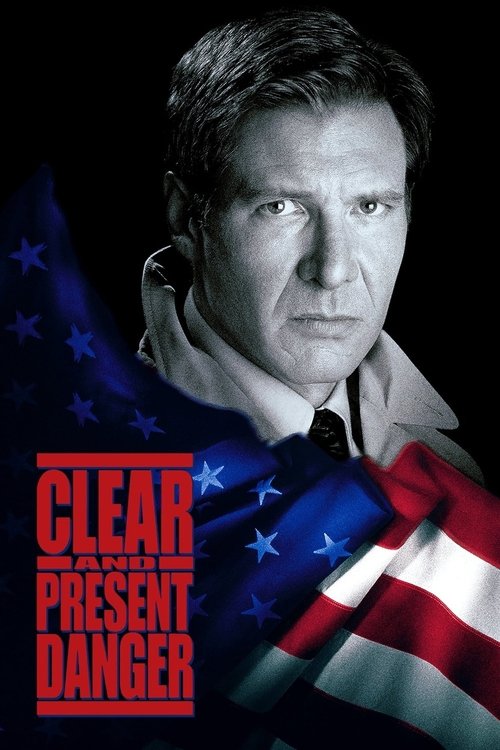
Clear and Present Danger
1994 · Phillip Noyce
For when you want a meaty, old-school thriller — smart enough to respect you, exciting enough for a Friday night. Comfort viewing for anyone who loves competence, procedure, and a hero who fights with a briefcase as often as a gun.
What it's about
When his mentor falls ill, CIA analyst Jack Ryan is promoted into the agency's inner circle — just as a friend of the President is murdered by a Colombian drug cartel. While Ryan follows the money through official channels, someone above him has already launched a secret, illegal war in Colombia, and the soldiers sent to fight it are about to be hung out to dry. Ryan finds himself battling the cartel and his own government at once.
The experience
A steady, absorbing slow burn punctuated by expertly staged bursts of violence — including an ambush sequence that still ranks with the best action set pieces of the '90s. The real tension is watching a decent man realize how deep the rot goes.
Performances
Harrison Ford is at his mid-'90s best, radiating stubborn integrity as Ryan, and Willem Dafoe brings quiet, coiled professionalism to field operative John Clark — their uneasy alliance gives the film its pulse.
The craft
Phillip Noyce directs with unfussy classical confidence, grounding Tom Clancy's dense plotting in real locations and practical action — helicopters, convoys, and one meticulously constructed street ambush that filmmakers still study. The sound design and scale reward good speakers.
Why it matters
The commercial peak of the Jack Ryan series and a model for how the political thriller adapted after the Cold War, turning from foreign enemies to corruption inside the government itself.
Snapshot
Clear and Present Danger is the third feature adapted from Tom Clancy's Jack Ryan novels and the second to star Harrison Ford as the analyst-turned-administrator, following Phillip Noyce's Patriot Games (1992). Where The Hunt for Red October (1990) was a Cold War submarine procedural, this film arrives after the Soviet collapse and retools the franchise for a new set of anxieties: the war on drugs, executive overreach, and the unaccountable machinery of covert action. Ryan, elevated to acting Deputy Director of Intelligence when his mentor Admiral Greer falls ill, uncovers an illegal paramilitary war being waged against a Colombian cartel — sanctioned off the books by the President's inner circle. The film's distinctive achievement is to graft a conspiracy-thriller of institutional betrayal onto the chassis of a large-scale action picture, and to make bureaucratic discovery — the reading of files, the tracing of money, the confrontation in a corridor — as suspenseful as its gunfire. It was a major commercial success on release and is widely regarded as the strongest of the Ford-era Ryan films.
Industry & production
The film was produced and released by Paramount Pictures, which held the Clancy property and had built the Ryan films into a dependable franchise. Mace Neufeld, the producer who shepherded the series from Red October, returned, with Robert Rehme. The decisive franchise move had already occurred on Patriot Games, when Alec Baldwin (Ryan in Red October) was replaced by Harrison Ford — a substitution that aged the character upward, traded boyishness for gravitas, and aligned the series with Ford's standing as the era's preeminent embattled-everyman star. By 1994 the formula was proven, and the production was mounted on a substantial studio budget commensurate with its international locations and large-scale action set-pieces.
Clancy's source novel (1989) is dense with procedure and politics, and the adaptation passed through multiple hands — a sign of the difficulty of compressing his institutional sprawl into a three-act movie. The studio assembled an unusually heavyweight writing roster (detailed below). Production filming took the company to Mexico standing in for Colombia, alongside Washington-area work for the government interiors that anchor the film's other half. The result is a film consciously balanced between two registers — the marble corridors of Washington and the jungle roads of Latin America — a structural division that the production design and locations reinforce.
Technology
Clear and Present Danger is a film of its moment technologically: a 1994 studio production made on photochemical film, before digital intermediates and large-scale CGI reshaped the action picture. Its spectacle is overwhelmingly practical — vehicles, squibs, pyrotechnics, and stunt work staged for the camera. The most celebrated sequence, a daylight ambush of an American motorcade in a Bogotá street, is built from practical destruction: rocket fire, exploding cars, collapsing storefronts, and choreographed crossfire, captured with multiple cameras rather than fabricated in post.
Within the story, the film is also a period document of intelligence technology on the cusp of the digital age. Its plot turns on data: surveillance imagery, encrypted communications, and — memorably — Ryan's race to decrypt and download incriminating financial files before a remote operator can erase them, a sequence that dramatizes computing and networked records as instruments of both crime and accountability. The depiction is heightened for suspense, but it reflects a genuine early-1990s shift in which the thriller's evidence increasingly lived in machines rather than documents.
Technique
Cinematography
The film was photographed by Donald McAlpine, the Australian cinematographer who had shot Patriot Games and was a natural continuation of Noyce's visual approach. McAlpine builds a deliberate contrast between the film's two worlds. Washington is rendered in cool, controlled, often low-key light — wood-paneled offices, the blue dark of situation rooms, faces half in shadow — a visual language of concealment appropriate to a story about what is hidden inside government. The Latin American material is hotter and more saturated, with hard sun, dust, and the chromatic intensity of the cartel's compounds. The ambush sequence is the photographic showpiece: staged in bright daylight, it derives much of its terror from clarity and exposure — there is nowhere to hide on an open street — which is precisely the opposite of the genre's usual reliance on darkness.
Editing
Neil Travis edited the film, as he had Patriot Games; he was an Academy Award winner for Dances with Wolves (1990). His cutting is central to the film's signature effect: the intercutting of physical action with informational action. Travis sustains parallel tension between Ryan at a keyboard and operatives under fire, between a Washington meeting and a jungle firefight, so that revelation and violence escalate together. The motorcade ambush is a model of action editing of its era — rhythmic, legible, escalating — privileging spatial coherence so the audience always understands the geometry of the kill zone, in contrast to the fragmentary style that would later dominate the genre.
Mise-en-scène / staging
The film's staging dramatizes power as architecture. Washington scenes are blocked around thresholds, desks, and corridors — who sits, who stands, who is admitted to the room — so that bureaucratic hierarchy becomes visible spatial information. The Oval Office and its antechambers are staged as spaces of euphemism and deniability. Against this, the Colombian material is staged for exposure and vulnerability: the open road, the indefensible jungle clearing, the soldiers abandoned in the field. The recurring compositional idea is the trap — characters placed within spaces that look secure and prove not to be.
Sound
James Horner composed the score, continuing his work on Patriot Games. His music here blends a brass-driven orchestral idiom for the Washington intrigue with Latin American instrumental color and percussion for the Colombian operations, and synthesizer textures characteristic of his early-90s thriller scoring. The score is restrained in the procedural passages and surges for action, supporting suspense without overwhelming dialogue. Sound design is at its most aggressive in the ambush, where the layered impacts of rocket fire and automatic weapons in an enclosed street generate much of the sequence's visceral force.
Performance
Harrison Ford anchors the film with a performance built on moral exhaustion and stubborn rectitude rather than physical heroics; Ryan is most often shown thinking, reading, and refusing, and the film's emotional climax is a verbal confrontation, not a fight. Ford's gift here is to make institutional courage — saying no to power — feel as dramatic as combat. Willem Dafoe brings flinty professionalism to John Clark, the operative who carries out the dirty work and ultimately recognizes his own betrayal. The supporting cast is unusually strong: James Earl Jones lends weight and pathos to the dying Greer; Henry Czerny is memorably cold as the careerist Robert Ritter; Harris Yulin and Donald Moffat embody the smooth corruption of the executive branch; and Joaquim de Almeida gives the cartel's intelligence chief Félix Cortez a seductive, intelligent menace that makes him the film's most dangerous figure.
Narrative & dramatic mode
The film operates in two interlocking modes: the political-conspiracy thriller and the large-scale action picture. Its dramatic engine is discovery — Ryan, the analyst, gradually assembling a truth that powerful men have buried — which structurally resembles a detective story conducted through documents, briefings, and electronic records. This is braided with the operational thread of Clark's deniable war on the ground, so that the audience knows the crime before the investigator does, generating dramatic irony and dread. The two strands converge on a moral rather than a martial climax: Ryan's refusal to be complicit, and his confrontation of the President. The film's distinctive dramatic claim is that integrity within an institution is a form of heroism, and that the most consequential act in the story is a man declining to keep a secret.
Genre & cycle
Clear and Present Danger belongs to the post-Cold War techno-thriller cycle that Clancy's novels did much to define, and specifically to the franchise strand of the Jack Ryan films. It sits at a hinge in the cycle: with the Soviet enemy gone, the series migrates toward non-state threats — narco-cartels, terrorism, internal corruption — that would dominate 1990s and post-9/11 thrillers. It also draws on the heritage of the 1970s paranoid conspiracy film (the corrupt government, the lone figure who knows too much) and fuses it with the muscular action spectacle of the late-80s/early-90s studio blockbuster. That hybridization — the conscience-of-Washington thriller wedded to the action tentpole — is the cycle position that defines the film.
Authorship & method
Phillip Noyce, the Australian director who had broken through internationally with Dead Calm (1989) before taking over the Ryan franchise with Patriot Games, directs with an emphasis on clarity, escalation, and tonal control. His method here is to treat the procedural and the spectacular with equal seriousness, trusting that audiences will find institutional confrontation gripping if it is staged with the same precision as combat — a discipline that distinguishes the film from more purely kinetic action fare.
The screenplay is credited to Donald Stewart, Steven Zaillian, and John Milius, a trio whose combined sensibilities are legible in the result. Stewart had co-written The Hunt for Red October and brought continuity with the franchise's procedural texture. Zaillian — a major screenwriter of the period, soon an Oscar winner for Schindler's List (1993) and writer-director of Searching for Bobby Fischer — lends the conscience and moral architecture of the Washington material. John Milius, the writer-director associated with martial, masculine American cinema (co-writer of Apocalypse Now, director of Conan the Barbarian and Red Dawn), is a plausible source of the film's hard-edged operational and combat sensibility. The collaboration of cinematographer Donald McAlpine, editor Neil Travis, and composer James Horner — all carried over from Patriot Games — gave the production a stable, experienced craft team and accounts for the strong stylistic continuity between the two Noyce-Ford entries.
Movement / national cinema
The film is mainstream American studio cinema and belongs to no art-cinema movement, but it is worth noting the conspicuous role of Australian filmmakers — director Noyce and cinematographer McAlpine — within this most American of franchises, part of the broader migration of Australian talent into Hollywood during the late 1980s and 1990s. The film also reflects Hollywood's globalized production economy of the era, with Latin American locations and an international supporting cast (notably the Portuguese actor Joaquim de Almeida) serving a story explicitly about the United States projecting force across its hemisphere.
Era / period
Clear and Present Danger is a quintessential product of the early-to-mid 1990s. Made in the immediate aftermath of the Cold War, it registers the period's search for a new antagonist and finds one in the drug trade, the defining domestic-policy obsession of the Reagan-Bush years. Its plot of an illegal, unauthorized covert war run from the White House and hidden from Congress unmistakably echoes the Iran-Contra scandal of the 1980s, channeling a real and recent crisis of executive accountability into popular entertainment. The film thus belongs to a moment when American action cinema was negotiating the loss of a clear external enemy by turning inward, toward institutional corruption and the costs of clandestine power.
Themes
The film's central theme is accountability — the conflict between duty to law and constitution and loyalty to persons and power. Ryan embodies institutional conscience: his arc is the discovery that the gravest threat ("a clear and present danger," the legal phrase the title repurposes) may come not from a foreign cartel but from his own government's lawlessness. Around this turn a cluster of related concerns: the moral cost of deniable operations and the soldiers abandoned to protect officials' careers; the seductions and corruptions of proximity to power; the gap between public rectitude and private rot in high office. The film is finally about integrity as resistance — the dramatization, in its climactic confrontation, of a man who will not be made complicit, captured in Ryan's blunt refusal to absorb the President's guilt.
Reception, canon & influence
Clear and Present Danger was both a critical and commercial success, generally regarded as the best-reviewed and most fully realized of the Harrison Ford Jack Ryan films, with particular praise for Ford's grounded performance, the strength of the supporting cast, and the bravura motorcade ambush. (Precise box-office figures should be verified against authoritative sources, but the film was unambiguously one of the major studio hits of 1994 and performed strongly worldwide.)
Looking backward, the film's influences are clear: Clancy's source novel and the established conventions of the techno-thriller; the 1970s paranoid conspiracy film (Three Days of the Condor, All the President's Men) in its vision of corrupt institutions and a lone truth-teller; and the real political memory of Iran-Contra. Within its own franchise it inherited the craft template of Patriot Games — the same director, cinematographer, editor, composer, and star — and refined it.
Looking forward, the film helped cement the template of the intelligent, institutionally embedded action-thriller in which paperwork, politics, and accountability carry as much weight as combat — a model visible across later Clancy adaptations and the broader genre, including the Ryan franchise's own subsequent reboots (The Sum of All Fears, Jack Ryan: Shadow Recruit, and the Amazon television series). Its motorcade ambush became a frequently cited reference point for staging urban convoy attacks. Above all, it stands as a high-water mark for the 1990s conspiracy-action hybrid and for Harrison Ford's run as Hollywood's definitive man of conscience under institutional pressure.
A Deleuzian reading
Start with the image the whole film is secretly built around: Jack Ryan at a keyboard, a progress bar crawling, copying a file while somewhere across the hemisphere another man's cursor is deleting the same file out from under him.
The full Deleuzian reading of Clear and Present Danger →
Reception
A #1 box-office hit in summer 1994, it was received as solid grown-up entertainment; now it's routinely held up as the gold standard of the extinct mid-budget adult thriller — the 'they don't make these anymore' movie.
How Clear and Present Danger was received, from release to now →
Influences: the films it descends from and the films it influenced
- The Sum of All Fears (2002) — Descendant Ryan-franchise entry that inherits the institutionally embedded analyst-hero whose memos and briefings drive the plot, preserving CAPD's bet that bureaucratic confrontation can carry a thriller.
- Patriot Games (1992) — Direct craft template — same director, cinematographer (McAlpine), editor (Travis), composer (Horner), and star — establishing the cross-cut surveillance/combat set piece where Ryan watches remote violence on a monitor, refined here in the satellite-feed ambush.
- The Hunt for Red October (1990) — Sibling franchise entry that set the procedural texture (co-writer Donald Stewart carried over) of treating naval/intelligence paperwork and chain-of-command verbal sparring as suspense, which CAPD extends to Washington bureaucracy.
- Three Days of the Condor (1975) — Ancestor of the lone insider discovering an off-the-books operation run by his own agency, using methodical document/file detective work rather than gunplay to expose institutional rot.
- All the President's Men (1976) — Ancestor in dramatizing accountability through clerical procedure — the camera finding tension in databases, ledgers, and modem records, modeling CAPD's climactic forensic accounting of misdirected funds.
- The Parallax View (1974) — Ancestor of paranoid framing where power is rendered as architecture — figures dwarfed by monumental interiors and conference-room geometry — a staging grammar CAPD reuses for the Oval Office and White House corridors.
- Apocalypse Now (1979) — Ancestor via co-writer John Milius, whose hard-edged operational/combat sensibility — sanctioned-then-disavowed black ops and morally abandoned soldiers in the field — surfaces in CAPD's betrayed Colombian incursion.
- Dead Calm (1989) — Ancestor in Noyce's own method of sustained spatial-coherence suspense — clean geographic logic and escalating threat within a confined arena — later scaled up to the urban motorcade kill-box.
- The Day of the Jackal (1973) — Ancestor of the procedural cross-cut thriller that grants equal screen weight to hunter and hunted assembling their operations step by step, the parallel-action rhythm CAPD applies to Ryan versus the cartel and Cutter.
- The French Connection (1971) — Ancestor of daylight, ground-level urban action staged for spatial coherence — real streets, practical vehicles, geographically legible pursuit — the lineage behind CAPD's motorcade ambush.
- Schindler's List (1993) — Sibling through screenwriter Steven Zaillian, whose conscience-driven moral architecture — a competent man forced to choose integrity against institutional complicity — shapes Ryan's arc.
- The Fugitive (1993) — Sibling in the Harrison-Ford 'man of conscience under institutional pressure' mode, pairing his grounded everyman doggedness with a clean discovery-plot structure of evidence assembled against a powerful cover-up.
- Spy Game (2001) — Descendant that extends the agency-procedural — a real-time briefing-room race against the clock where paperwork, deniability, and a sanctioned-then-abandoned operative are the engine of suspense.
Similar films
- The Sum of All Fears (2002) — influence & lineage
- The Hunt for Red October (1990) — influence & lineage
- Apocalypse Now (1979) — influence & lineage
- Spy Game (2001) — influence & lineage
- The Fugitive (1993) — influence & lineage
- Syriana (2005) — influence & lineage
- Body of Lies (2008) — often watched together
- The Report (2019) — often watched together