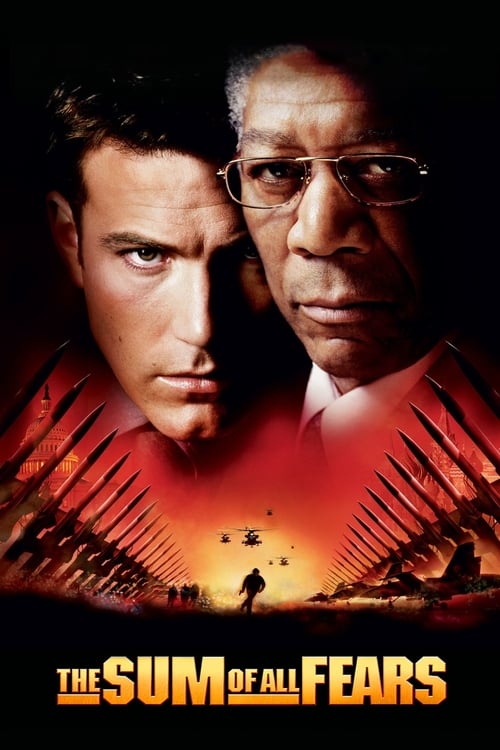
The Sum of All Fears
2002 · Phil Alden Robinson
For a gripping, grown-up thriller night — when you want stakes that feel plausible rather than cartoonish, and a story that leaves you a little rattled about how the world actually works.
What it's about
When Russia's president suddenly dies and an unknown succeeds him, the CIA scrambles to read the new man — and its director pulls a junior analyst, Jack Ryan, off his desk because he literally wrote the file. Then a nuclear bomb goes off in an American city, Washington blames Moscow, and Ryan races to prove the truth before two superpowers talk themselves into the end of the world.
The experience
A slow-tightening geopolitical thriller that trades punch-ups for dread — the tension comes from watching powerful men misread each other in real time. Its centerpiece sequence is genuinely shocking, and the last act plays like a countdown you can't look away from.
The craft
Robinson stages the crisis with procedural patience — situation rooms, intercepts, chains of command — so the one moment of spectacle hits with real weight rather than action-movie gloss. The sound design and scale of that sequence reward good speakers.
Why it matters
A deliberate reboot of the Jack Ryan franchise with Ben Affleck as a younger Ryan, and — arriving in the first summer after 9/11 — an eerily timely film about nuclear terror that caught the anxieties of its moment.
Snapshot
The Sum of All Fears is the fourth feature adapted from Tom Clancy's Jack Ryan novels and the first to break continuity with its predecessors, recasting the CIA analyst as a young man at the start of his career. Directed by Phil Alden Robinson and released by Paramount in the early summer of 2002, it arrives as a deliberate franchise reboot: where The Hunt for Red October (1990), Patriot Games (1992), and Clear and Present Danger (1994) had carried Ryan from Alec Baldwin to Harrison Ford across a roughly continuous biography, this film resets the clock, installing Ben Affleck as a junior analyst plucked from his desk into a fast-moving nuclear crisis. The plot turns on the death of a Russian president, the rise of an unknown successor, and the detonation of a nuclear device on American soil—engineered not by either superpower but by a third party intent on provoking war between them. Its defining and most discussed sequence is the destruction of Baltimore during a Super Bowl, an image whose release roughly nine months after the September 11 attacks gave the production an uneasy topical charge it had not sought. The film is a competent, somewhat sober entry in the post–Cold War geopolitical thriller, more interested in accidental escalation than in heroics.
Industry & production
The film was produced by Mace Neufeld, the producer who had shepherded the entire Paramount Ryan cycle, which lends the reboot an institutional continuity even as it severs narrative continuity. By the late 1990s the franchise had stalled: Harrison Ford and Paramount were unable to agree on a further installment, and the studio chose to relaunch the property with a younger lead rather than retire it. Casting Ben Affleck—then near the peak of his early-2000s stardom—signaled the strategy plainly: rebuild the brand around a new generation rather than continue an aging timeline. The decision to make The Sum of All Fears, a 1991 novel set late in the literary Ryan's life, into an origin-adjacent story required substantial reconception, since the book presumes a Ryan already seasoned in Clancy's earlier plots.
The production's most consequential adaptation choice concerned the antagonists. In Clancy's novel the nuclear conspiracy involves Middle Eastern terrorists; the film reassigns the plot to a cabal of European neo-fascists who seek to reignite superpower hostility for their own ideological ends. This change was made before the September 11 attacks and was reportedly the subject of advocacy from groups concerned about Arab stereotyping in Hollywood; the precise internal deliberations are not fully documented in the public record, and accounts of who urged what should be treated with some caution. Whatever its origins, the choice gave the film an antagonist structure—villains who weaponize the two nations' mutual suspicion—well suited to its theme of catastrophe by misattribution.
Release timing dominated the film's public framing. Distributed by Paramount in 2002, less than a year after 9/11, a thriller whose centerpiece is a nuclear strike on a U.S. city inevitably drew commentary about appropriateness and resonance. The film had been substantially completed before the attacks, so the convergence was circumstantial rather than opportunistic, but it shaped reception unavoidably.
Technology
The Sum of All Fears is a conventionally produced studio thriller of its moment, shot on 35mm film and assembled with the standard tools of early-2000s mainstream production. Its principal technological showpiece is the depiction of the nuclear detonation and its aftermath, which combines practical staging with digital visual effects to render the blast, the shockwave, and the irradiated cityscape. The sequence is built to convey scale and consequence rather than spectacle for its own sake; the film lingers on the disorientation and physical aftermath—damaged aircraft, casualties, a stricken motorcade—more than on the explosion as a money shot. This was an era in which digital compositing had matured enough to integrate large-scale destruction convincingly into live-action plates, and the film uses that capacity in service of a grim, almost documentary register rather than a triumphal one. Beyond the set piece, the film's technological profile is unremarkable in the best sense: the apparatus is invisible, subordinated to plot mechanics and procedural texture.
Technique
Cinematography
John Lindley, who had photographed Robinson's Field of Dreams and Sneakers, shoots the film in a clean, controlled, institutional idiom appropriate to a story of war rooms, situation rooms, and intelligence corridors. The visual scheme favors legibility and weight over flourish: cool palettes for the chambers of power, a measured handling of the many scenes built around screens, briefings, and reaction. Lindley's camera does its most expressive work around the catastrophe, where the established orderliness of the geopolitical scenes gives way to chaos and gray ruin, the contrast itself carrying meaning. Elsewhere the photography is disciplined and somewhat anonymous, a deliberate stylistic neutrality that lets the escalation plot carry the tension.
Editing
The film was cut by Neil Travis, an Academy Award winner for Dances with Wolves, whose work here is organized around cross-cutting between parallel centers of decision—Washington, Moscow, and the conspirators—as a misunderstanding compounds toward war. The editorial logic is one of mounting parallel pressure: the audience holds knowledge the characters lack, and the cutting exploits that dramatic irony, intercutting between officials drawing the wrong conclusions and the viewer's awareness of the truth. The detonation and its immediate aftermath represent the film's most demanding editorial passage, shifting abruptly from the procedural rhythm of the first two acts to a register of shock and confusion.
Mise-en-scène / staging
The film's staging is dominated by the iconography of institutional power: the Situation Room, the interiors of Air Force One, Kremlin chambers, CIA offices. Robinson and his collaborators stage these scenes for a sense of process and hierarchy—who sits where, who briefs whom, how information moves and degrades as it travels up a chain of command. The production design renders these spaces with a plausible, lived-in officialdom. Against this controlled environment, the Baltimore sequence functions as a deliberate rupture of the established order, the staging of ruin set against the staging of bureaucracy.
Sound
Sound design carries significant weight in the detonation sequence, where the handling of the blast, the silence and ringing that follow, and the muffled aftermath are central to the scene's impact. The film generally uses sound in the service of procedural realism—the texture of communications, the ambient hum of command centers—punctuated by the overwhelming sonic event at its center. Detailed technical documentation of the sound team's specific approach is not extensively recorded in readily available sources, and claims beyond the evident on-screen effect should be made cautiously.
Performance
Ben Affleck plays Jack Ryan as a capable but green analyst, an everyman thrust above his station; the performance is earnest and unshowy, calibrated to a younger, less authoritative Ryan than Ford's. The film's gravitational center is Morgan Freeman as CIA Director Bill Cabot, whose authority and warmth anchor Ryan's arc and whose mentorship structures the analyst's initiation. Ciarán Hinds brings ambiguity to the new Russian president Nemerov, a man whose intentions the Americans cannot read—the human embodiment of the film's theme of misjudged adversaries. Liev Schreiber appears as the field operative John Clark, providing a harder, more kinetic counterpoint to Ryan's deskbound analysis. James Cromwell plays the U.S. president and Bridget Moynahan plays Ryan's romantic interest Cathy Muller. The ensemble's veteran character actors lend the geopolitical machinery a credible human texture.
Narrative & dramatic mode
The film's dramatic mode is the escalation thriller, in which the engine of suspense is not a villain's master plan executed but a misunderstanding spiraling toward catastrophe. Its governing device is dramatic irony: the audience knows the bomb was the work of a third party, while the principals on both sides read it as an act of the other superpower. The narrative is structured around parallel chains of command misinterpreting the same events, with Ryan as the lone figure positioned to see the truth and racing to communicate it before retaliation becomes irreversible. This is a story about information and its failures—about how intelligence, filtered through fear and institutional momentum, produces the wrong conclusion. The hero's task is less to defeat an enemy than to interrupt a feedback loop of mutual suspicion before it consummates itself in nuclear exchange.
Genre & cycle
The Sum of All Fears belongs to the geopolitical techno-thriller, the genre Clancy did much to define on the page and which Paramount's Ryan films translated to the screen. It sits at the tail of the post–Cold War cycle of such films, in which the old bipolar certainties have dissolved and the threat migrates to rogue actors, loose nuclear materials, and the instability of succession in a post-Soviet Russia. Within the Ryan franchise specifically, it is the reboot installment, distinguished from its predecessors by its recast, de-aged hero and its abandonment of the earlier films' continuity. Thematically it shares DNA with the broader 1990s–2000s cycle of nuclear-terror thrillers, films preoccupied with the loose-nuke scenario and the prospect of catastrophe detached from state authorship.
Authorship & method
Phil Alden Robinson is an unusual choice for a Clancy adaptation: his best-known films, Field of Dreams (1989) and Sneakers (1992), are respectively a lyrical fantasy and an ensemble caper, neither a hard-edged action picture. His sensibility here tends toward the humane and the deliberate rather than the bombastic; the film is more interested in dread and consequence than in set-piece propulsion, a temperament that aligns with the story's emphasis on accidental escalation. Robinson reunited with cinematographer John Lindley, his collaborator on Field of Dreams and Sneakers, a continuity that supports the film's controlled visual manner.
The screenplay is credited to Paul Attanasio and Daniel Pyne, both experienced screenwriters tasked with the considerable problem of reverse-engineering a late-period novel into a franchise restart. The score is by Jerry Goldsmith, one of the most distinguished composers in American film and near the end of his career; The Sum of All Fears stands among his later works before his death in 2004. Editor Neil Travis brings the cross-cutting discipline noted above. Producer Mace Neufeld provides the throughline of authorship across the franchise, the figure most responsible for the property's screen identity. The result is a film whose method is collaborative and institutional in the studio sense, with Robinson's relatively gentle directorial temperament shaping material that could easily have been louder.
Movement / national cinema
The film is a mainstream American studio production with no affiliation to any art-cinema movement; its lineage is the Hollywood geopolitical thriller rather than any national or stylistic school. What is worth noting is its engagement with the representation of Russia in American cinema at a specific historical juncture—the post-Soviet period in which the screen Russia is no longer the monolithic Cold War adversary but an unstable, opaque state whose intentions cannot be read with confidence. The film's portrait of a new Russian leadership defined by ambiguity reflects an American cinematic and political imagination still recalibrating after the Soviet collapse.
Era / period
Produced and released in 2002, the film is doubly marked by its era. As a text it is a product of the post–Cold War decade's anxieties about nuclear materials adrift in a fragmented former Soviet sphere. As an artifact it is inseparable from its release context less than a year after September 11, 2001: a film conceived and largely made in a pre-9/11 world, depicting the nuclear destruction of an American city, that reached audiences in a transformed climate of national fear. This accident of timing is the most historically salient fact about the film's reception, lending a literal scenario unexpected and uncomfortable contemporary weight.
Themes
The film's central theme is catastrophe by misattribution—the danger that a deniable provocation, read through the lens of existing enmity, can trigger a war neither principal intended. It is a meditation on the fragility of nuclear deterrence, which depends on accurate attribution and rational command, and on how fear corrodes both. Secondary themes include the limits and failures of intelligence, the gulf between analysis and the decisions made atop it, and the burden borne by the lone figure who perceives the truth amid institutional momentum toward disaster. Through Nemerov, the film dramatizes the unknowability of the adversary—the way leaders project intentions onto opponents they cannot read. The conspirators' aim—to make two great powers destroy each other through misunderstanding—renders the theme explicit: the true threat is not the enemy but the machinery of suspicion between rivals.
Reception, canon & influence
Critical reception was mixed-to-moderate. Reviewers generally found the film a serviceable, intelligent thriller, praising its sober treatment of nuclear danger and its strong supporting cast—Morgan Freeman in particular—while some found it less propulsive than its franchise predecessors and noted the awkwardness of recasting Ryan as a younger man. The detonation sequence drew the most comment, both for its craft and for the discomfort of its timing. Precise box-office figures and aggregate scores are not restated here to avoid error, but the film was a substantial commercial release that performed solidly without becoming a defining hit of its year.
The influences on the film run backward through Tom Clancy's source novel and the established Paramount Ryan pictures, whose institutional, procedural template it inherits, and more broadly through the post–Cold War nuclear-thriller tradition. Robinson's own Sneakers shares its interest in intelligence and technological intrigue. Looking forward, the film's most concrete legacy is franchise-mechanical: it was the last Ryan film of this Paramount cycle, and the property would later be relaunched again, recast once more, in Jack Ryan: Shadow Recruit (2014) and subsequently as a television series—evidence of Hollywood's persistent willingness to reboot the character rather than retire him. The Sum of All Fears itself did not generate direct sequels with Affleck. Its more diffuse influence lies in its place within the early-2000s conversation about nuclear terrorism on screen, a subject the post-9/11 years would return to repeatedly. The film endures less as a canonical landmark than as a representative document: a competent, thoughtful studio thriller whose accident of timing made its imagined catastrophe resonate far beyond its makers' intentions.
A Deleuzian reading
The image that stays is a man on his hands and knees in gray light, ears ringing, the sound of the world gone to a flat whine.
The full Deleuzian reading of The Sum of All Fears →
Reception
A solid hit in summer 2002 but received nervously — a nuclear-terrorism thriller landing just months after 9/11 — and today it's mostly remembered as the odd-one-out Jack Ryan film, the Affleck reboot that never got a sequel.
How The Sum of All Fears was received, from release to now →
Influences: the films it descends from and the films it influenced
- Fail Safe (1964) — Establishes the accidental-nuclear-catastrophe-by-system-error template, structured as cross-cut dramatic irony between sealed command rooms where the audience knows the misattribution that the principals cannot — the exact escalation machine Robinson inherits.
- Dr. Strangelove (1964) — Codifies the War Room as institutional-power iconography and the runaway-mechanism plot in which procedure itself drives the bombs forward, the visual and structural grammar the seed renders straight rather than satirically.
- Seven Days in May (1964) — Models the sober, institutionally-neutral rendering of Washington corridors of power — desk-level procedural staging of a national-security crisis — that John Lindley's controlled, non-expressive camerawork descends from.
- The Day After (1983) — Pioneers the detonation-and-aftermath as the moral center of a nuclear drama, with blast-flash and concussive sound design as rupture; the seed's Baltimore sequence and its disorienting blast-aftermath audio follow this method.
- Three Days of the Condor (1975) — Defines the intelligence-analyst everyman pitted against an unknowable institutional adversary, shot with deglamorized institutional neutrality — the analyst-protagonist DNA carried into Ryan.
- The Hunt for Red October (1990) — Sets the Paramount Ryan house style the seed restarts: parallel cross-cutting across rival navies and agencies, procedural decoding of ambiguous signals, and institutional-thriller restraint over set-piece spectacle.
- Patriot Games (1992) — Continues the franchise's everyman-inside-the-machine staging, embedding Ryan in CIA/Pentagon bureaucracy and using surveillance-feed iconography the seed reuses for its war-room scenes.
- Clear and Present Danger (1994) — Refines the bureaucratic-procedural mode — institutional betrayal traced through paperwork, briefings, and chain-of-command staging — that defines the cycle the seed concludes.
- Sneakers (1992) — Robinson's own prior film and his John Lindley collaboration: an intelligence-and-technology procedural whose humane, deliberate temperament and ensemble-of-experts staging directly shape the seed's controlled, dread-over-bombast manner.
- Munich (2005) — Extends the cross-cut, dramatic-irony rendering of retaliation cycles into a post-9/11 meditation on catastrophe-by-retaliation, inheriting the seed's interest in consequence and escalation over heroics.
- Syriana (2005) — Develops the multi-strand geopolitical-institutional thriller — agencies, governments, and operatives cross-cut toward a detonation — pushing the seed's institutional-neutrality further into mosaic structure.
- Zero Dark Thirty (2012) — Carries the institutional-procedural rendering of intelligence work against an unknowable adversary to its rigorous extreme, the analyst-driven, deglamorized agency thriller the seed anticipates.
- Jack Ryan: Shadow Recruit (2014) — The direct franchise descendant, recasting Ryan once more as analyst-everyman and reapplying the institutional-procedural-escalation formula the seed's cycle established.
- Crimson Tide (1995) — Builds an entire thriller on nuclear escalation triggered by an ambiguous, possibly-misread launch order — the catastrophe-by-misattribution premise as submarine chamber drama.
- The Peacemaker (1997) — Shares the loose-nuke-terrorism, race-against-detonation procedural with cross-cut intelligence and field strands, the immediate post-Cold-War sibling treatment of the same threat.
- The Bourne Identity (2002) — Same-year sibling reinventing the post-Cold-War espionage everyman with institutional-neutral, documentary-leaning realism — the competing 2002 template for the intelligence thriller.
Similar films
- The Hunt for Red October (1990) — influence & lineage
- Clear and Present Danger (1994) — influence & lineage
- The Bourne Identity (2002) — influence & lineage
- Fail Safe (1964) — influence & lineage
- Zero Dark Thirty (2012) — influence & lineage
- Argo (2012) — shared sensibility
- The Bourne Supremacy (2004) — shared sensibility
- Thirteen Days (2000) — shared sensibility