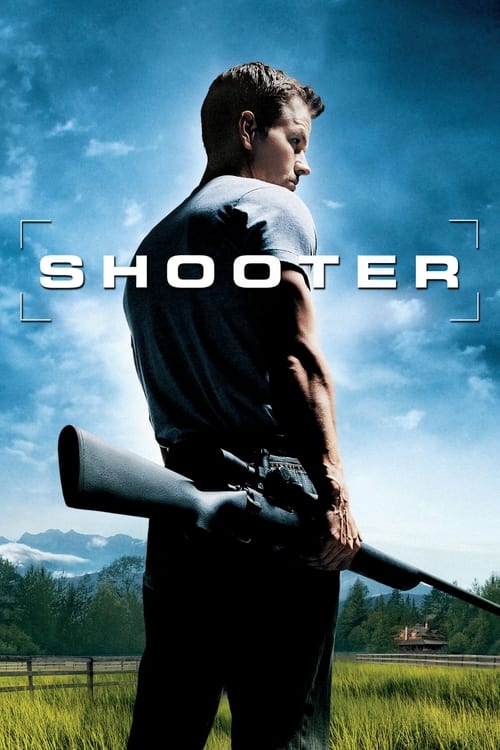
Shooter
2007 · Antoine Fuqua
For when you want a satisfying revenge-against-the-system thriller — the kind where one capable, wronged man methodically outsmarts powerful people who deserve it. Comfort food for the paranoid.
What it's about
A retired Marine sniper living alone in the mountains gets talked into one last job: helping the government stop an assassination plot against the President. When the plot unfolds anyway and the frame lands squarely on him, he becomes the most wanted man in America — wounded, hunted, and forced to use every trick of his trade to unravel who set him up and why.
The experience
Lean, angry, and propulsive — a manhunt movie that keeps moving while stoking a slow burn of righteous fury. It's pulpy fun on the surface, but there's a bitter, distrustful edge underneath that gives the action real teeth.
The craft
Antoine Fuqua stages the sniper craft with procedural relish — wind reads, distances, improvised field medicine — so the action feels earned rather than magical. Wide winter landscapes and big, concussive set pieces make it a strong pick for a large screen and loud speakers.
Why it matters
One of the sharpest of the post-Iraq-era action thrillers to aim its anger directly at government officials and private contractors, it found a long second life on cable and streaming and later spawned a TV series.
Snapshot
Antoine Fuqua's Shooter is a post-Iraq War conspiracy thriller that uses the idiom of the betrayed-veteran action film to mount an unusually explicit critique of American imperial power. Adapted from Stephen Hunter's 1993 novel Point of Impact, the film follows master sniper Bob Lee Swagger (Mark Wahlberg), coaxed out of self-imposed exile, framed for a presidential assassination attempt, and driven across a winter landscape of institutional rot and corporate violence. The film sits at the intersection of the classical Hollywood wronged-man thriller, the cynical 1970s conspiracy film, and the post-9/11 disillusionment cycle; its willingness to name the enemy — government officials, mercenary contractors, Senate power brokers — gives it a more corrosive political charge than most studio action pictures of its era. Competently made and grounded in tactical verisimilitude, Shooter is less a prestige work than an efficient genre machine whose political content aged into renewed relevance.
Industry & production
Paramount Pictures produced Shooter through Lorenzo di Bonaventura's production company, a collaboration that reflected Paramount's mid-2000s appetite for star-driven, mid-budget action thrillers. Di Bonaventura, who had built his career at Warner Bros. shepherding franchises including The Matrix and the Harry Potter series, brought Fuqua in as the director whose Training Day (2001) credential gave him authority over morally complex, street-level crime material. The screenplay was credited to Jonathan Lemkin, whose prior work included The Devil's Advocate (1997); the adaptation compressed and partially updated Hunter's novel, sharpening its political subplot and relocating some of its more dated Cold War texture toward a contemporary framework of African mercenary operations and oil-company malfeasance.
Stephen Hunter, on whose novel the film is based, is a Pulitzer Prize-winning film critic and novelist whose Bob Lee Swagger character had accumulated a devoted readership across multiple novels. Hunter's work in the Swagger cycle draws heavily on a Southern working-class gun-culture ethos and on the mythology of the American long-rifleman, traditions that reach back to James Fenimore Cooper. Lemkin's adaptation preserves the novel's core conspiracy architecture — a framing operation engineered to cover up a massacre conducted for corporate resource interests — while streamlining its procedural texture for theatrical pacing.
The film was shot in part in Alberta, Canada, standing in for Swagger's isolationist retreat in the Montana wilderness, and in the Philadelphia area, among other locations. The production's budget was substantial for a mid-tier action picture, reflecting both the logistical demands of its extended wilderness sequences and the cost of assembling a cast that included Wahlberg, Danny Glover, Michael Peña, Kate Mara, Elias Koteas, and the formidable character actor Ned Beatty. The film earned a modest theatrical return — box-office records place it in the range of profitable but not spectacular performance — sufficient to confirm Wahlberg's continued viability in leading-man action roles but insufficient to establish a theatrical franchise. A cable television continuation, Shooter (2016–2018), produced for the USA Network with Ryan Phillippe in the Swagger role, extended the property's cultural life.
Technology
Shooter is a mid-2000s studio picture that deploys digital intermediate color grading to achieve its characteristic desaturated, cold-toned visual palette — a technique that by 2007 had become a default grammar of the gritty American action film, tracing a lineage from Training Day through the first Bourne films. The sniper-range sequences are organized around the optical and mechanical properties of precision long-range rifles, with production apparent in its consultation of ballistic tradecraft: the film stages Swagger's calculations of bullet drop, wind correction, and atmospheric compensation with enough specificity to signal authenticity to firearms-literate audiences. This emphasis on procedural verisimilitude — the hours of patient setup before a single shot — distinguishes the film's action logic from the hyperkinetic aesthetic of contemporaneous comic-book blockbusters, aligning it instead with the quieter rhythms of the professional-craftsman thriller.
Visual effects work is limited and largely invisible; Shooter is not an effects-driven film. The production's technological investment is concentrated in camera work, weapons acquisition, and location capture rather than in digital augmentation.
Technique
Cinematography
Peter Menzies Jr., who served as director of photography, gives the film a visual scheme built on environmental contrast: the open, clean-aired Montana landscape — rock, snow, ponderosa pine — is rendered with a broad horizon and natural light that reads as Edenic before corruption intrudes. As the film moves into the institutional world of government safehouses, FBI offices, and Senate corridors, the palette closes down, becoming more artificially lit, more constricted. Fuqua and Menzies use wide-angle views of terrain for the sniper sequences, emphasizing the enormous distances involved, while the action set pieces shift to tighter focal lengths and handheld movement. The film does not aspire to the expressive visual lyricism of Fuqua's collaborations with Mauro Fiore (Training Day, Brooklyn's Finest), and Menzies's cinematography is functional rather than distinctive; nonetheless, the opening Eritrea sequence — establishing Swagger's extraordinary skill in a fire-support engagement — is composed with clarity and force.
Editing
Conrad Buff IV edited Shooter, and his cutting follows the conventions of the contemporary action thriller: scene-level pacing is deliberate when exposition requires it, accelerating into overlapping cuts during action sequences without descending into the incoherence that plagued contemporaneous shaky-cam productions. The film's middle section, in which Swagger is hunted while simultaneously building his counter-investigation, is cut with the procedural rhythm of the paranoid thriller rather than the headlong velocity of the pure action genre — a structural choice that permits the political argument to accumulate weight. The film's finale, which Fuqua and Buff execute as a methodical reversal rather than a climactic spectacle, is somewhat atypical for the genre.
Mise-en-scène / staging
Fuqua stages the film's physical environments with professional competence but reserves his directorial authority for scenes of moral confrontation. The most durable moment of staging in Shooter is Ned Beatty's late monologue as Senator Charles Meachum, delivered in the spare geometry of a winter landscape: Meachum's casual, even collegial articulation of unlimited elite impunity — his argument that powerful men simply do as they wish, that nations and rules are instruments of their convenience — is staged as a conversation rather than a confrontation, which sharpens its menace. The physical staging gives Beatty room to work without interference. Elsewhere, the film's action geography is functional, emphasizing spatial legibility over kinetic spectacle.
Sound
Mark Mancina composed the score, a propulsive, percussion-forward work that operates within genre conventions without particularly distinguishing itself. Sound design in the sniper sequences is attentive to the physics of long-range ballistics — the gap between the visible impact of a round and the arrival of the report, the suppressed quality of particular weapons — which contributes to the film's procedural register. The sonic landscape of the Montana wilderness sequences uses ambient environmental texture to establish the pastoral baseline before its disruption.
Performance
Wahlberg's performance as Swagger is built on physical discipline and calibrated reticence: he plays a man who has withdrawn from the world, whose emotional interiority has been compressed by betrayal into a dense, hard-edged competence. The characterization does not have great psychological range, but it does not require it; Swagger is a figure in a political parable, and Wahlberg's stoic, economical presence serves that function well. Michael Peña as FBI agent Nick Memphis provides the film's most humanizing performance — warmer, more comedically inflected, and ultimately more morally legible than any other character. Danny Glover is persuasive as the villainous Colonel Isaac Johnson, playing corruption as the quiet confidence of a man who has never been held accountable. Ned Beatty's Senator Meachum, despite limited screen time, is the film's defining performance: Beatty locates the character's evil in its utter ordinariness, in the absence of any felt need for justification.
Narrative & dramatic mode
Shooter operates in the mode of the wronged-man conspiracy thriller, a form with deep roots in American popular narrative. Its dramatic logic is straightforward: an extraordinary individual is targeted by a corrupt institutional apparatus, stripped of his identity and freedom, and forced to use the very skills that made him valuable to his betrayers in order to dismantle them. The film does not complicate this structure or introduce the moral ambiguity that Fuqua had pursued in Training Day. What it does instead is populate the conspiracy with specific political referents — African oil fields, mercenary contractors, Senate immunity — that give the formula an unusually concrete ideological texture. The film's explicit argument, delivered most baldly in Meachum's monologue, is that American power operates through a permanent class of unaccountable actors for whom democratic institutions are instruments rather than constraints. For a studio action film made under major-label distribution, this is a notably forthright political statement.
Genre & cycle
Shooter belongs to a discernible mid-2000s cycle of American action films processing the disillusionment of the post-9/11 and Iraq War years through the idiom of the conspiracy thriller and the betrayed-soldier narrative. Films across this period — including Syriana (2005), Lions for Lambs (2007), Rendition (2007), and In the Valley of Elah (2007) — reflect a broad cultural reckoning with the costs and corruptions of American military adventurism; Shooter is the most genre-committed of these, making its argument through action-film mechanics rather than prestige drama. The betrayed-veteran narrative has older roots in the American action film — First Blood (1982) is the genre's defining statement of the form — and Shooter draws consciously on that lineage, though it updates it from the Vietnam-era wound to the specific injuries of mercenary contracting and executive-level cover-up.
The film also participates in the professional-assassin cycle that the Bourne series (2002–) had revitalized: its emphasis on tactical competence, on the knowledge-systems of the trained killer turned against institutional power, reflects the influence of that franchise on the post-2002 action mainstream.
Authorship & method
Antoine Fuqua came to Shooter as a director whose commercial profile had been established by the Academy-validated success of Training Day but whose subsequent films — Tears of the Sun (2003), King Arthur (2004), Shooter — positioned him as a maker of serious-minded but commercially oriented genre work rather than as an auteur in the critical sense. Fuqua's consistent thematic preoccupations are visible across his filmography: institutional corruption, masculine codes of loyalty and betrayal, the violence of systems upon individuals. He is not a stylistic innovator, and his visual method is shaped more by competent professional craft than by distinctive aesthetic vision. His strength is in working with actors and in organizing moral argument through action-film structure, a capacity that Shooter uses well enough.
Lemkin's screenplay is the film's intellectual motor; the translation of Hunter's novel into a more explicitly contemporary political register was a choice that gave Shooter its lasting political resonance. Mancina's score and Menzies's cinematography serve the project without asserting themselves against it.
Movement / national cinema
Shooter is a product of the Hollywood studio system and has no significant relation to any national cinema movement outside that tradition. Its Montana and Alberta locations situate it within the American frontier-mythology visual vocabulary, and its political argument is entirely internal to American politics. The film's investment in the iconography of the American rifleman — its treatment of the long gun as both tool and moral instrument — marks it as firmly within a domestic cultural conversation.
Era / period
The film was released in March 2007, at the lowest point of American public support for the Iraq War and in the early months of the "surge" policy debate. The political argument embedded in its conspiracy — that elite American actors murder civilians in resource-rich African countries and face no accountability — landed in a culture already saturated with revelations about contractor misconduct, intelligence failures, and executive overreach. The film's timing made its argument feel less like genre convention and more like commentary. Whether that was the filmmakers' explicit intention or the product of convergence is difficult to establish; the political material is present in Hunter's 1993 novel, but Lemkin's adaptation amplified and updated it.
Themes
The film's central themes are institutional corruption and the impossible position of the soldier who serves an institution that has sacrificed its honor. Swagger's crisis is not personal trauma in the therapeutic sense but structural: he was a perfect instrument for a system that proves unworthy of his skill and loyalty. The film is interested in the gap between the rhetoric of national service and the reality of corporate interest — the massacre in Africa that generates the conspiracy is explicitly framed as having been executed to protect oil access, a detail that carried considerable resonance in 2007. The film also engages, less centrally, with themes of expertise and accountability: Swagger's ability to operate outside institutional surveillance, to bring evidence and judgment to bear without bureaucratic authorization, figures the film's fantasy of a justice that the system cannot provide for itself.
Senator Meachum's monologue is Shooter's most philosophically charged passage: its argument — that there are no sides, only those who have power and those who do not, and that power's first project is its own perpetuation — articulates a political cynicism that the film both endorses and attempts to refute through Swagger's final action.
Reception, canon & influence
Shooter received mixed-to-moderately-positive critical notices on release. Critics who engaged with the film as a genre piece generally found it a competent and occasionally pointed thriller; critics who measured it against more formally ambitious political cinema found its argument blunt and its action-film mechanics limiting. Roger Ebert's review was broadly favorable, praising the film's efficiency and Wahlberg's performance without overstating its ambitions. The more common critical response acknowledged the political material as unusual for the genre without claiming that the film fully exploited it.
The film's influences backward are legible: the 1970s American conspiracy film cycle — The Parallax View (Alan J. Pakula, 1974), Three Days of the Condor (Sydney Pollack, 1975) — provides the structural and atmospheric template. First Blood (Ted Kotcheff, 1982) informs the wronged-veteran narrative. The Bourne films reshaped the action-thriller vocabulary that Shooter employs. Hunter's source novel draws on an older literary tradition of the American rifleman as moral instrument, traceable through Western fiction and the armed-citizen mythology of the republic.
Shooter's forward influence is modest as a formal or aesthetic model. Its more significant legacy is cultural: the USA Network television series ran three seasons (2016–2018), extending the Swagger property and indicating the character's durability, though the series achieved neither critical distinction nor the cultural footprint of comparable television adaptations of action novels. As a marker within the post-Iraq War action cycle, Shooter documents the degree to which studio genre filmmaking was capable, in 2007, of absorbing genuine political critique into commercial form — and the limits of that absorption. It is not a canonical work, but it is a historically specific and occasionally corrosive one.
A Deleuzian reading
Watch the first kill in the Eritrea prologue and notice the small physical fact the film is proudest of: the bullet lands before you hear the shot.
The full Deleuzian reading of Shooter →
Reception
Shrugged off in 2007 as a mid-tier conspiracy potboiler (critics were lukewarm, box office modest), it's since been reappraised as prime 'they don't make these anymore' comfort food — a mid-budget star-driven action thriller that plays better every year it airs on cable.
How Shooter was received, from release to now →
Influences: the films it descends from and the films it influenced
- First Blood (1982) — Establishes the wronged-veteran-as-survivalist staging logic: the protagonist's superior fieldcraft and wilderness-terrain mastery deployed against institutional military force, with the open landscape functioning simultaneously as refuge and tactical advantage — the exact spatial grammar Shooter inherits for Swagger's Montana sequences.
- The Day of the Jackal (1973) — Pioneered the procedural-sniper-craft sequence as legitimate dramatic material: weapon modification, range calculation, and patient waiting before a single decisive shot rendered in methodical real-time detail — the procedural rhythm and ballistic specificity that Shooter's long-range staging directly inherits.
- The Parallax View (1974) — The institutional-impunity ending as formal device: a conspiracy so embedded in governmental and corporate power that exposure changes nothing, with the investigator left powerless before a committee that closes ranks — Shooter's cynical Senate-hearing resolution is a direct formal descendant of this move.
- Three Days of the Condor (1975) — The wronged intelligence operative framed by his own agency: improvised survival using professional skills, the unlikely civilian ally, and going public as the only route to exoneration — Shooter's entire wronged-man-conspiracy architecture maps onto this structure beat for beat.
- Heat (1995) — Established the benchmark for stoic-craftsman performance and procedural weapons authenticity: the protagonist whose identity is expressed entirely through professional competence, with a character-actor supporting ensemble providing layered antagonist menace — a direct formal antecedent to Shooter's Glover/Beatty/Koteas configuration.
- Ronin (1998) — The professional-gunman ensemble thriller built on authentic weapons handling and tactical procedure rather than character interiority, with character-actor casting (De Niro, Reno, Skarsgård) supplying menace depth — a template Shooter adopts for its own ensemble of morally compromised professionals.
- Enemy of the State (1998) — Updates the surveillance-state government-framing conspiracy for the digital era: a protagonist targeted by his own government's institutional machinery using real-time intelligence tools, establishing the post-Cold War paranoid thriller visual and narrative grammar that Shooter directly continues.
- Training Day (2001) — Fuqua's own prior grammar: the digital intermediate palette as moral-descent tool, Mauro Fiore's desaturated urban color scheme, and the character-actor-as-systemic-menace mode (Washington's Alonzo) that Ned Beatty's Senate patriarch in Shooter directly extends into a different institutional register.
- The Bourne Identity (2002) — The rogue operative framed by his own handlers, with Doug Liman's desaturated digital intermediate palette and the conspiracy-thriller architecture of a skilled professional dismantling the institutional apparatus that betrayed him — Shooter adopts both the visual grammar and the wronged-operative narrative logic wholesale.
- The Equalizer (2014) — Fuqua's direct continuation of the stoic-professional-craftsman formula: McCall is Swagger reconstituted as urban operative, with the same procedural-rhythm editing of methodical violence, the same character-actor menace ensemble, and the same institutional corruption as antagonist engine — now scaled into a franchise.
- American Sniper (2014) — Brings the Iraq War sniper figure to prestige treatment using Shooter's procedural vocabulary: ballistic calculation under pressure, stoic veteran performance register, and wide-angle compositions of open terrain that use the sniper's sovereign distance to convey both mastery and moral isolation.
- Sicario (2015) — Roger Deakins's wide-angle compositions of borderland terrain inherit Shooter's environmental-contrast cinematography — vast open desert replacing Montana — while the procedural staging of elite tactical operations and the theme of government complicity in extrajudicial violence extend Shooter's post-Iraq political critique into bleaker, more formally rigorous territory.
- Wind River (2017) — The stoic frontiersman-hunter in extreme snowy wilderness: wide compositions of snow-and-conifer terrain as both setting and moral landscape, the professional tracker's patient craft as primary visual grammar, and the same performance register of stoic reticence that Wahlberg's Swagger established for the competent man alone against institutional failure.
- Michael Clayton (2007) — The post-Iraq War corporate-conspiracy revelation thriller: institutional machinery covering up mass harm, complicit power brokers who remain untouchable, and the same cynical acknowledgment that corporate and governmental interests are structurally inseparable — a parallel track through the same political moment using legal rather than ballistic genre mechanics.
- No Country for Old Men (2007) — Shares the procedural-restraint mode for depicting a professional killer: Chigurh's weapon rendered with the same obsessive technical specificity Shooter applies to long-range ballistics — violence as precision craft rather than spectacle, with stoic reticence as the performance register for lethal competence.
Similar films
- The Equalizer (2014) — influence & lineage
- American Sniper (2014) — influence & lineage
- No Country for Old Men (2007) — influence & lineage
- Jack Reacher (2012) — same viewing thread
- Warfare (2025) — same viewing thread
- Lone Survivor (2013) — shared sensibility
- Dirty Harry (1971) — shared sensibility
- Rebel Ridge (2024) — shared sensibility
All the films related to Shooter →
Watch it with: curated runs of related films
- The Set-Piece Machine — A run of hard-charging, forward-driving action cinema — watch these back-to-back when you want mission-structured, physical-stakes spectacle built by people who know exactly how to escalate.