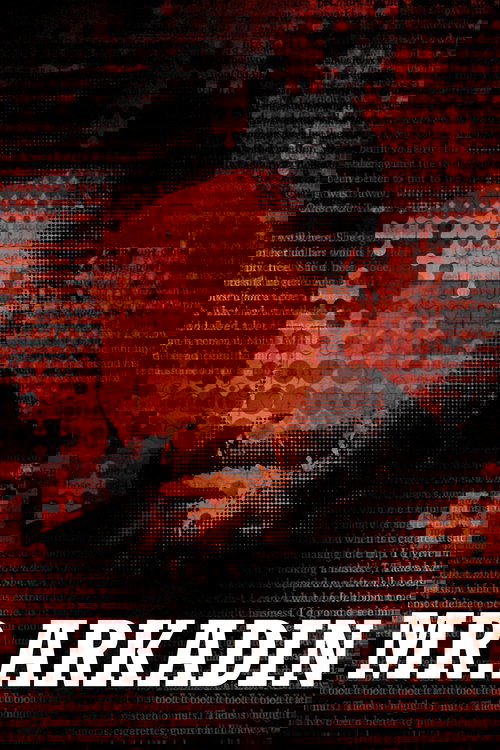
Mr. Arkadin
1955 · Orson Welles
For a late night when you want something strange and shadowy — a puzzle-box thriller you watch as much for atmosphere and audacity as for answers. Definitely a challenge pick, not a comfort one.
What it's about
Gregory Arkadin is one of the richest men in Europe, and he claims he can't remember anything about his own life before the late 1920s. He hires Guy Van Stratten, a small-time American hustler, to dig up his forgotten past — and the deeper Guy digs, the stranger the story gets, as the people he tracks down start turning up dead. It's a detective story where the mystery is the man paying the bills.
The experience
Fast, jagged, and deliriously off-kilter — a whirl of grotesque faces, strange locations, and low-angle shots that make every room feel like a trap. It plays less like a tidy thriller than a fever dream of one, and part of the fascination is feeling the film itself teeter on the edge of chaos.
Performances
Orson Welles plays Arkadin himself, buried under a beard and an accent, as a self-made myth of a man — a larger-than-life monster you can't look away from.
The craft
Shot on the run across Spain, France, Germany, and Italy on scraped-together money, it turns poverty into style: expressionist angles, baroque compositions, and editing that lurches like a nightmare. Welles lost control of the cut, and the film survives in several different versions — which has become part of its legend. Even at its roughest, almost every frame is more visually alive than most thrillers' best shot.
Why it matters
A key work of Welles's European exile and a famous case study in a masterpiece mangled by its producers — its competing cuts have kept critics and restorers arguing for decades.
Snapshot
Mr. Arkadin — released in a differently edited European cut under the title Confidential Report — is Orson Welles's Continental "mystery of the mogul," a labyrinthine thriller about a fabulously wealthy financier who hires a small-time American adventurer to reconstruct a past the financier claims to have forgotten. The premise is a trap: the investigation is really a hit list, and each witness Guy Van Stratten locates dies shortly after. Made cheaply and quickly across Spain, France, Germany, and Italy during Welles's long European exile, the film is famous almost as much for its production catastrophe as for its content — Welles lost control of the edit, and the picture survives in several substantially different versions with no single director-sanctioned cut. It is at once a self-conscious reworking of the Citizen Kane investigative structure, a baroque expressionist thriller, and one of the most contested texts in the Welles canon.
Industry & production
Mr. Arkadin was a low-budget European co-production, principally financed and produced by Louis Dolivet — a political operator and Welles associate — through companies including Filmorsa and Cervantes Films, with Welles's Mercury name attached. It belongs to the phase of Welles's career (roughly 1948–1958) when, effectively locked out of Hollywood's studio system, he financed and shot films piecemeal in Europe, often self-funding through acting jobs. Shooting took place on location and in modest studios across the Costa Brava, Madrid, Segovia, Munich, Paris, and Rome, a peripatetic method dictated by money and by Welles's habit of chasing available locations and actors.
The production is one of the notorious debacles of Welles's career. He fell badly behind on the editing schedule, and Dolivet — losing patience and needing to deliver a releasable film — ultimately took the picture out of Welles's hands and had it assembled without him. Welles disowned the result, saying in later interviews that the released film was not his; he considered the loss of Arkadin one of the great wounds of his working life, comparable in his own telling to the mutilation of The Magnificent Ambersons. Because Welles never completed a definitive cut, the film exists in multiple forms: an English-language "Confidential Report" version that circulated in Europe; a shorter American "Corinth" version; at least one Spanish-language version shot partly with different actors; and a 2006 reconstruction (associated with the Criterion Collection and the scholars Stefan Drössler and others) that attempts to approximate Welles's likely intentions by drawing on all surviving material. No version can claim final authority, and this textual instability is now inseparable from the film's identity.
A related tangle surrounds the novel Mr. Arkadin, published under Welles's name around the same period. Welles repeatedly denied having written it, and scholarship has generally attributed it to the French writer Maurice Bessy, working from the screenplay or story materials; the precise authorship remains genuinely uncertain, and the honest position is that the book is best treated as a novelization of disputed provenance rather than a Welles original.
Technology
The film was shot on 35mm black-and-white stock using the standard Academy ratio of its moment, with the wide-angle lenses and deep-focus compositions that had been Welles's signature since Kane. Its most consequential technical fact is its sound: like many European co-productions of the era, Arkadin was largely post-synchronized, with dialogue dubbed in after shooting to accommodate a multinational cast speaking varied languages and accents. Welles himself reportedly looped a number of the supporting voices. This reliance on dubbing — partly economic, partly a function of the scattered locations — gives the soundtrack a slightly detached, non-naturalistic quality and is one reason performances can feel unmoored from the image. The many-versions problem is itself partly a technological artifact of an era when a film's "text" was a set of physical prints assembled by different hands for different markets.
Technique
Cinematography
Photographed by Jean Bourgoin, Mr. Arkadin is aggressively expressionist. Welles builds the film out of extreme wide-angle lenses, low camera placements that make figures loom, canted "Dutch" angles, and stark, high-contrast chiaroscuro. Arkadin is repeatedly shot from below to monstrous, statuesque effect, his bearded head filling the frame like a carving. Deep-focus staging keeps foreground and background in simultaneous play, and Welles exploits real architecture — Spanish castles, a Munich cathedral, cavernous halls — to dwarf his characters. The visual grammar is continuous with Kane and The Lady from Shanghai but pushed toward the grotesque; the imagery is often more expressive than the sometimes ragged narrative that carries it.
Editing
Editing is the film's wound and, paradoxically, part of its fascination. Renzo Lucidi is credited among the editors on the released material, but the decisive fact is that the final assembly was completed without Welles after Dolivet removed him. The surviving cuts differ in scene order, in the handling of the framing flashback, and in emphasis. Even so, the film's editing sensibility — rapid, elliptical, fond of hard transitions and jarring juxtapositions — is recognizably Wellesian in ambition, and the fragmentary construction (a montage of interviews, each a discrete vignette) suits a story literally assembled from testimony. Whether the jaggedness of the released versions reflects design or damage is impossible to fully separate, which is precisely the interpretive problem the film poses.
Mise-en-scène / staging
Welles orchestrates dense, theatrical set-pieces: a masked ball at a Spanish castle, a Goya-esque penitentes procession, cramped garrets, and grand staircases. Objects and décor carry weight — the trappings of Arkadin's wealth become a visual argument about a self-invented man surrounding himself with borrowed grandeur. The staging favors deep planes and strong diagonals, with actors arranged in depth so that power relations are legible in the blocking. The recurring motif of Arkadin's grotesque false beard and heavy make-up (Welles was in his late thirties playing a older titan) turns the protagonist's face into a mask, literalizing the theme of a constructed identity.
Sound
Paul Misraki's score drives the film's nervous momentum, and the soundtrack's post-dubbed texture — voices slightly disembodied, ambient sound stylized rather than naturalistic — reinforces the film's dreamlike, unstable quality. Welles, a radio master, structures much of the story as a chain of spoken testimonies; the film is talky in the manner of an audio drama, which is unsurprising given its origins (see below). The interplay of narration, interrogation, and confession makes voice a central expressive instrument.
Performance
Welles dominates as Arkadin, a deliberately theatrical, larger-than-life turn: booming, imperious, buried under beard and prosthetics. Around him the ensemble is uneven, a consequence of the multinational casting and dubbing. Robert Arden, as Van Stratten, gives a brash, hard-boiled American performance that many critics have found grating — a limitation the film partly survives on and partly suffers from. The supporting gallery is studded with vivid character cameos: Akim Tamiroff as the doomed, flea-bitten Jakob Zouk; Katina Paxinou as the aging gang matriarch Sophie; Michael Redgrave, Mischa Auer, Suzanne Flon, Patricia Medina, Peter van Eyck, and Grégoire Aslan each contributing a sharply drawn vignette. Paola Mori plays Arkadin's cloistered daughter Raina; she would soon become Welles's wife, and the paternal obsession that drives the plot gains an uncomfortable charge from the casting.
Narrative & dramatic mode
The film's dramatic mode is the investigative flashback thriller, framed by a portentous device — an unmanned aircraft over the Mediterranean and Van Stratten's retrospective narration — that signals doom from the outset. The story unfolds as a picaresque quest: Van Stratten, hired to compile a "confidential report" on Arkadin's origins, travels Europe interviewing figures from the financier's buried past, each encounter a self-contained set-piece. The great structural irony, revealed by degrees, is that the amnesia is a fiction and the investigation a mechanism of murder: Arkadin uses his hired investigator as a bloodhound to locate the surviving witnesses to his criminal beginnings, then eliminates them, all to keep his adored daughter from learning what he was. The mode is thus both detective story and tragedy of a self-made man destroyed by the past he cannot outrun — Van Stratten's naïve legwork becomes the instrument of the very exposure Arkadin sought to prevent.
Genre & cycle
Mr. Arkadin sits at the intersection of film noir, the European art thriller, and the "great man" mystery. It carries noir's fatalism, criminal underworld, and doomed narrator, but transplants them into a jet-set Continental milieu of castles, yachts, and international finance. It belongs, too, to a small Wellesian cycle of investigations into powerful, enigmatic men — most obviously Citizen Kane, whose structure of a reporter reconstructing a mogul's life through interviews it openly echoes and inverts (here the investigation is engineered by its subject to lethal ends). Contemporary and later critics have sometimes described it, not always kindly, as a "poor man's Kane," a phrase that captures both the lineage and the reduced means.
Authorship & method
This is a total-authorship Welles film in conception — he wrote the screenplay, directed, and stars — even though he was denied authorship of the final cut. The material grew directly out of Welles's radio work: the seed is generally traced to his early-1950s radio series The Lives of Harry Lime (a spinoff of The Third Man), and specifically to an episode of that series built around a man of mystery investigating himself. That radio provenance explains the film's reliance on voice, testimony, and serial vignette. Key collaborators include cinematographer Jean Bourgoin, whose expressionist lighting realizes Welles's compositional ideas; composer Paul Misraki, supplying a propulsive, anxious score; the credited editorial team led by Renzo Lucidi, working ultimately under producer Louis Dolivet rather than Welles; and Dolivet himself, whose intervention makes him an unwilling co-author of the released text. Welles's working method here — improvisational, location-driven, chronically underfunded, dependent on favors and on his own acting income — is emblematic of his European period and directly produced both the film's freedoms and its incoherences.
Movement / national cinema
The film resists tidy national placement: it is a stateless European production, shot in several countries with a polyglot cast, financed through French and Spanish channels, and directed by an American exile. This rootlessness is thematically apt for a story about a man without a verifiable origin. It stands outside any organized movement, yet it prefigures aspects of the international art cinema that would flourish later in the decade and shares the era's noir sensibility. Its warmest early champions were the young French critics of Cahiers du cinéma, so in reception terms it belongs partly to the pre-history of the French New Wave's Welles cult.
Era / period
Made in the mid-1950s, Arkadin is a product of the Cold War's shadow and of Welles's specific predicament as a blacklist-era Hollywood outcast working abroad. Its world of stateless capital, buried wartime and pre-war criminal histories, refugees, and men reinvented under new names is saturated with the anxieties of a Europe still processing displacement and complicity. The financier who cannot afford to have his origins examined is a recognizably postwar figure. Technologically and industrially it belongs to the moment just before widescreen and color became near-universal, and it embodies the fragile economics of independent European production in that transitional period.
Themes
The governing theme is the impossibility of escaping the past — Arkadin's whole enterprise is an attempt to murder his own history, and it destroys him. Around this cluster the film's other preoccupations: self-invention and the constructed identity (the mogul as a mask, literalized in Welles's prosthetics); the corrupting logic of power and wealth; paternal love turned tyrannical, as Arkadin's devotion to his daughter curdles into serial murder to preserve her innocence; and the nature of evil as intrinsic rather than chosen. This last idea is crystallized in the film's most celebrated set-piece, Arkadin's telling of the fable of the scorpion and the frog — the scorpion stings its ferryman mid-river and drowns with him, explaining only that stinging is its character. It is the film's moral thesis in miniature, and one of the most quoted passages in all of Welles.
Reception, canon & influence
On release, Mr. Arkadin was widely judged a confusing, uneven failure, and its garbled distribution history — multiple cuts, retitling, no premiere of a director's version — blunted its impact and reputation for decades. Yet it was defended early and passionately in France; the Cahiers du cinéma circle prized it, and it became a touchstone for critics who read Welles as a great baroque poet of cinema whose ruined films were more valuable than other directors' finished ones. Over time the critical consensus settled into a productive ambivalence: Arkadin is regarded as a flawed, damaged, frequently incoherent film that is nonetheless indispensable — visually dazzling, thematically rich, and revealing about its maker.
Its influences run backward most directly to Citizen Kane, whose interview-driven reconstruction of a powerful man it reworks, and to the noir and continental-intrigue world of The Third Man and the Harry Lime radio series from which it sprang. Looking forward, it anticipates Welles's own Touch of Evil and The Trial in its grotesque expressionism and moral murk, and its structure — an outsider hired to investigate a secret that the powerful will kill to protect — has echoed through the paranoid conspiracy thrillers of later decades. The film's very unfinishedness has also made it a central case study in the scholarship of authorship, restoration, and the "multiple-version" film; the 2006 reconstruction turned Arkadin into a laboratory for questions about what a director's intention means when no authorized cut exists. Its afterlife, in short, is as much about the ethics and practice of film preservation as about the story on screen — a fitting legacy for a picture whose subject is the impossibility of ever fixing the truth of a life.
A Deleuzian reading
A plane crosses the Mediterranean with nobody flying it.
The full Deleuzian reading of Mr. Arkadin →
Reception
Taken away from Welles in the edit and released in mangled form as 'Confidential Report', it was widely dismissed as an incoherent mess — yet Cahiers du cinéma's critics famously voted it one of the twelve greatest films ever made in 1958, and it's since become a beloved cult puzzle.
How Mr. Arkadin was received, from release to now →
Influences: the films it descends from and the films it influenced
- Citizen Kane (1941) — Arkadin directly reworks Kane's engine: an investigator reconstructs a powerful, secretive man's life from serial witness testimonies delivered as overlapping investigative flashbacks.
- The Third Man (1949) — Arkadin sprang from the Harry Lime figure Welles played here and inherits Reed's canted dutch-angle framing and wet-cobblestone chiaroscuro of postwar continental intrigue.
- The Magnificent Ambersons (1942) — The founding precedent for Arkadin's fate — a Welles film seized and re-cut by producers into multiple contested versions with no authorized director's cut.
- The Lady from Shanghai (1947) — Supplies the baroque elliptical montage and spatially disorienting compositions (the hall-of-mirrors climax) that Arkadin extends into vignette structure.
- The Cabinet of Dr. Caligari (1920) — German Expressionist source for Arkadin's distorted angular compositions, stylized shadow, and grotesque masklike faces.
- M (1931) — Lang's manhunt models the low-angle looming framing and the structure of pursuing a monstrous, self-concealing man through an underworld of testimony.
- Stagecoach (1939) — Ford's low-angle ceilinged interiors taught Welles and Toland the looming vertical framing that Arkadin's expressionist low angles carry forward.
- Greed (1924) — The archetype of the mutilated masterpiece — a sprawling authored vision butchered in the cutting room — that Arkadin's multiple-version scholarship descends from.
- Touch of Evil (1958) — Extends Arkadin's grotesque expressionism, masklike bloated faces and moral murk, plus the deep-focus blocking staged in long mobile takes.
- The Trial (1962) — Carries forward the labyrinthine expressionist architecture and low-angle distortion in service of an individual crushed by an unknowable power.
- F for Fake (1973) — Turns Arkadin's theme of the unfixable, self-fabricating life into an essay film on authorship, forgery, and the impossibility of verifying a man's truth.
- Point Blank (1967) — Deploys fractured elliptical montage across a picaresque revenge quest through a criminal 'Organization,' extending Arkadin's vignette-and-flashback grammar.
- The Parallax View (1974) — Inherits Arkadin's template of a lone outsider drawn into a secret the powerful will murder to protect, hardened into full paranoid-conspiracy architecture.
- Chinatown (1974) — A detective's picaresque inquiry uncovers a magnate's buried past he will kill to keep hidden — Arkadin's investigative structure and theme of the inescapable past.
- The Limey (1999) — Builds an entire revenge narrative from time-scrambled elliptical editing around an aging man reassembling a hidden past, extending Arkadin's associative montage.
- The Crying Game (1992) — Puts the scorpion-and-frog fable on film as a monologue in which a man diagnoses his own unalterable nature; Jordan lifts it intact and converts it into bookend structure, moving it from Arkadin's banquet toast into Jody's mouth and finally Fergus's.
- The Phoenician Scheme (2025) — The tycoon fable built as a serial itinerary: a shadowy magnate's dossier investigated through discrete European encounters, each a self-contained set-piece handing a grotesque character actor one scene and one exit — the structural chassis for the film's chaptered investor visits.
- Chimes at Midnight (1966) — Product of the same European method — improvisational, underfunded, location-driven, post-synchronized dubbing patched over asynchronous production.
Similar films
- Touch of Evil (1958) — influence & lineage · same viewing thread
- The Third Man (1949) — influence & lineage · same viewing thread
- The Trial (1962) — influence & lineage
- Citizen Kane (1941) — influence & lineage
- The Magnificent Ambersons (1942) — influence & lineage
- The Lady from Shanghai (1947) — influence & lineage
- The Cabinet of Dr. Caligari (1920) — influence & lineage
- F for Fake (1973) — influence & lineage
All the films related to Mr. Arkadin →
Watch it with: curated runs of related films
- The Long Shadow of M — A run from Lang's Weimar crime films through their noir and neo-noir children — killers, con men, masterminds, and manhunts — where you can watch expressionist menace mutate step by step into the modern thriller.