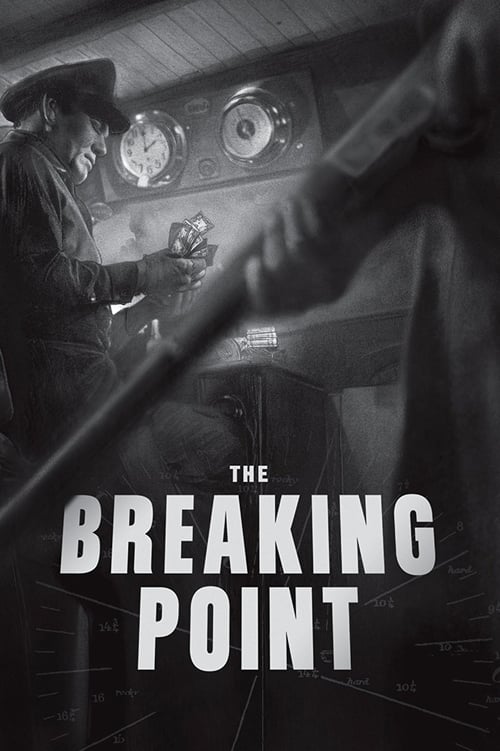
The Breaking Point
1950 · Michael Curtiz
For a serious noir night — when you want crime drama about ordinary desperation rather than glamorous doom. It rewards close attention and leaves you with something to sit with.
What it's about
Harry Morgan is a charter-boat fisherman in California with a wife, two daughters, and not enough money coming in. When a client stiffs him and leaves him stranded, he starts hiring out his boat for cargo no honest man should carry — first desperate people, then worse — while a sardonic drifter named Leona complicates his marriage and a shady lawyer keeps offering one more job.
The experience
Tense and grounded — a noir where the pressure is economic before it's criminal, and you feel every dollar Harry doesn't have. It tightens patiently, punctuated by hard bursts of violence, and it lands with real moral weight.
Performances
John Garfield, in one of his final roles, gives the film its soul — a proud, cornered decency eroding under pressure, with none of the usual tough-guy varnish. Phyllis Thaxter and Patricia Neal pull him in opposite directions with equal conviction.
The craft
Michael Curtiz directs with unshowy authority, keeping the Hemingway novel's spine — a working man squeezed between shrinking honest income and dirty money — that the more famous 1944 version threw away. The boat sequences have a documentary saltiness, and the film's handling of Harry's Black partner and his family is quietly ahead of its era.
Why it matters
Long overshadowed by the Bogart-Bacall version of the same novel, it has been rediscovered as the truer adaptation and one of the great working-class noirs — and a poignant capstone to Garfield's blacklist-shortened career.
Snapshot
The Breaking Point is the second of three Warner Bros. adaptations of Ernest Hemingway's 1937 novel To Have and Have Not, and by broad critical consensus the one that actually adapts it. Where Howard Hawks's 1944 film famously discarded nearly everything but the title and a Caribbean setting — Hemingway reportedly having told Hawks he could make a picture out of "the worst book I ever wrote" — Michael Curtiz and screenwriter Ranald MacDougall returned to the novel's spine: a working boatman with a wife and children, squeezed between a shrinking legitimate income and the money offered by men who want his boat for illegal cargo. Harry Morgan is played by John Garfield, in what proved to be one of his last performances; Phyllis Thaxter plays his wife Lucy, and Patricia Neal the drifting, sardonic Leona Charles, a figure invented for the film. The action is relocated from Key West and Cuba to Newport Beach, California, and Mexico, and the cargo is shifted from rum and Chinese laborers to human smuggling and, later, a gang of racetrack robbers.
The result is a film that sits uneasily between the crime melodrama Warners knew how to sell and something closer to a Depression-inflected domestic tragedy about earning a living. It failed to make much impression in 1950 and then effectively vanished for decades, tangled in rights issues that kept it off television and out of revival circulation. Its rehabilitation has been one of the more decisive critical reversals in postwar American film: since its restoration and re-release in the 2000s and 2010s, it has been widely described as among the best American films of its year and as the most faithful Hemingway adaptation Hollywood produced. Its interest for an atlas of influence is twofold — as a late, unusually domestic mutation of film noir, and as a text whose reception history demonstrates how thoroughly distribution accident can determine canon.
Industry & production
The film was made at Warner Bros. under a studio system already visibly changing. The 1948 Paramount consent decrees had begun forcing the majors to divest their theater chains, removing the guaranteed exhibition that had underwritten mid-budget programmers; television was drawing away the audience for exactly the kind of modestly scaled adult drama The Breaking Point represents. Warners in 1950 was still producing at volume but with a narrower tolerance for pictures that did not announce their genre clearly.
The property was a studio asset. Warner Bros. had bought the rights to To Have and Have Not and used them once already in 1944; the 1950 production is a re-adaptation of material the studio already owned, a common economy of the period. (The studio would return to it a third time in 1958 with Don Siegel's The Gun Runners, starring Audie Murphy, relocating it again to the Cuban revolution.) Ranald MacDougall wrote the screenplay; he had scripted Mildred Pierce (1945) for Curtiz and knew how to build a Warners melodrama around a protagonist's economic humiliation. Jerry Wald, the producer most associated with that strain of Warners filmmaking, produced.
The most consequential production context is political rather than industrial. John Garfield was, by 1950, under intense pressure from the House Un-American Activities Committee's second wave of hearings into Hollywood. He had co-founded the Enterprise Productions venture in the late 1940s in part to work outside major-studio control, and his standing with the studios was deteriorating as the blacklist tightened. He would testify before HUAC in 1951, declining to name others, and died of a heart attack in May 1952 at thirty-nine. The Breaking Point and He Ran All the Way (1951) are therefore his last substantial screen work, and both are films about men cornered. The temptation to read the blacklist directly into the performance should be handled carefully — the film was written and shot before his testimony — but the biographical circumstance is part of why the film has been received the way it has.
Contemporary commercial performance is not well documented in accessible sources; the film is consistently described as a commercial disappointment, and Warners is generally understood to have promoted it as a conventional crime picture rather than as a Hemingway adaptation. What is documented, and matters more, is what happened afterward: rights complications surrounding the Hemingway material kept the film out of television syndication and largely out of circulation for decades, so that it was effectively unavailable to the generation of critics who built the noir canon in the 1970s and 1980s.
Technology
The film was shot in black-and-white 35mm, standard Academy ratio (1.37:1), on the cusp of the industry's turn toward widescreen — CinemaScope was still three years away. Its release therefore belongs to the last phase of the classical format, and its compositions assume the boxier frame: figures stacked in depth, ceilings and boat cabins pressing down on the top of the image.
Sound is optical monaural. The most technologically inflected choices are location-related: substantial shooting in and around Newport Beach and on the water, which by 1950 was practicable with the lighter postwar equipment and faster stocks that had already enabled the semi-documentary crime cycle (The Naked City, 1948; Call Northside 777, 1948). The film does not push technique into ostentation — no deep-focus set pieces of the Citizen Kane kind, no experimental sound design — but it uses the era's improved location capability to give the harbor, the boat, and the small-town economy a physical specificity that studio-bound noir generally lacks.
Technique
Cinematography
Ted McCord photographed the film. McCord's work here is notable for how much of it is not expressionist. The received image of 1950 noir is chiaroscuro, wet streets, venetian-blind shadow; McCord supplies that idiom where the material calls for it — the night sequences on the water, the interiors where Harry negotiates with men he shouldn't be talking to — but the daylight material is bright, hard, and flatly exposed, closer to a rural drama than to The Big Sleep. The domestic scenes with Lucy and the daughters are lit plainly and staged in open, uncramped space; the criminal scenes darken and compress. The film's visual argument is carried in that alternation rather than in a single dominant style.
McCord is a useful figure for tracing lines of influence: he had shot Johnny Belinda (1948), would shoot Treasure of the Sierra Madre (1948) — a Warners production of comparable moral bleakness — and later East of Eden (1955) and The Sound of Music (1965). His range across naturalism and stylization is exactly what The Breaking Point requires.
Editing
Alan Crosland Jr. cut the film. The editing is classical continuity work, unshowy, but with two characteristic pressures. First, the film cross-cuts between Harry's working life and his home with a regularity that keeps the domestic stakes in front of the audience — the crime plot is never allowed to become self-sufficient. Second, the violence, when it arrives, is cut short and hard: the film's climactic shootout aboard the boat is compressed rather than extended, denying the audience the pleasure of a set piece. The famous final shot — held after the action has ended, on a figure the plot has forgotten — depends entirely on the decision not to cut away, and is the film's single most discussed formal gesture.
Mise-en-scène / staging
Curtiz stages the film around confinement of two kinds. The boat is the obvious one: cabins, cockpits, and decks that force characters into physical proximity and make every negotiation a matter of bodies too close together. The second is the domestic interior, where Harry's failure is measured in small rooms, in a wife's attempts to make herself attractive to a distracted husband, and in the presence of children who register the household's tension without understanding it.
Curtiz's blocking favors depth: a foreground figure in a doorway, a conversation continuing behind. The result is a film in which the pressures on Harry are usually visible in the same frame as Harry — the family in the background of the money problem, the money problem in the background of the family. The staging also handles race with unusual attention for 1950: Harry's partner Wesley Park, played by Juano Hernández, is given a full domestic and moral existence, and the film's compositions repeatedly place him as an equal within the frame rather than at its margin.
Sound
Max Steiner composed the score. Steiner — Warners' house composer, responsible for Casablanca (1942), Now, Voyager (1942), and The Treasure of the Sierra Madre — was by 1950 the most established practitioner of the leitmotif-driven Hollywood symphonic idiom, and his approach here is broadly in that tradition. The score is, however, comparatively restrained by his standards, leaving considerable stretches of the boat material to engine noise, water, and voices. That relative sparseness matters: the film's most effective passages of tension play with minimal musical support.
Dialogue delivery is a component of the sound design in its own right. MacDougall's script gives Harry a clipped, evasive way of talking to his wife and a differently clipped way of talking to men who want something from him, and the film relies on the audience hearing the difference.
Performance
Garfield's Harry Morgan is the reason the film survives as more than a curiosity. He plays a man whose competence is real and whose competence is not enough — a boatman good at his work in an economy that no longer needs quite so many boatmen. The performance is built on withholding: Harry does not explain himself, and his decisions arrive as faits accomplis that the people around him have to absorb. Garfield's Group Theatre background is legible in the physical specificity — the way he handles rope and gear, the exhaustion that accumulates across the film — and the performance is frequently cited as among the finest of the pre-Method postwar American screen.
Phyllis Thaxter's Lucy is the film's structural innovation relative to Hawks. Hawks had no wife; the 1950 film makes the marriage the load-bearing relationship, and Thaxter plays Lucy as neither saint nor scold but as a woman conducting her own campaign to hold a marriage together, including a much-noted scene in which she attempts to remake herself into the kind of woman she thinks her husband wants. Patricia Neal's Leona is the film's other significant invention — a drifter with no illusions, funny and unsentimental, who declines to become the femme fatale the genre expects. Juano Hernández's Wesley Park is played with a quiet gravity that makes the film's final movement land; Hernández, one of the few Black actors of the period given roles of this weight (he had broken through in Intruder in the Dust, 1949), is essential to the film's moral architecture.
Narrative & dramatic mode
The film's dramatic mode is tragedy of circumstance rather than of character flaw. Harry is not greedy, not vicious, and not stupid; he is short of money, and each decision he makes to solve that problem creates a worse problem. The narrative proceeds by escalating compromise: a charter that goes wrong, a smuggling job to recoup the loss, a robbery-getaway job to escape the consequences of the smuggling. This is the structure of the crime film, but the film consistently reframes it as an economic structure — the question is never "will he get away with it" but "what will it cost to keep his family fed."
MacDougall's screenplay preserves Hemingway's fatalism while abandoning the novel's episodic construction and its political framing (the novel's "have-nots" versus the yachting class is largely absent). What replaces it is domestic: the film keeps returning to the house, the wife, the daughters. The tension between the noir plot and the family drama is the film's real subject, and its ending — in which the cost of Harry's choices is paid, most terribly, by someone else's child — is one of the bleakest closing images in studio-era American cinema precisely because the film has spent ninety minutes teaching the audience to think about children.
Genre & cycle
The Breaking Point belongs to film noir, but to a specific and less-mapped branch of it: the daylight, working-class, family-encumbered noir. It shares the cycle's fatalism, its criminal spiral, and its sense of an economy that has no place for its protagonist, but it discards the urban night, the private detective, the femme fatale, and the voice-over. Its closest generic relatives are the noirs about labor and debt — Thieves' Highway (1949), Try and Get Me! (1950), and, later, The Prowler (1951) — rather than the metropolitan mysteries.
It is also a node in the Hemingway adaptation cycle, which in this period ran from For Whom the Bell Tolls (1943) through The Killers (1946) — another film that took a Hemingway text seriously — to The Snows of Kilimanjaro (1952) and The Old Man and the Sea (1958). Within that cycle, and within the three Warners versions of To Have and Have Not, it occupies the position of the faithful adaptation that nobody saw.
Authorship & method
Curtiz is the standing test case for auteurist criticism's limits: a director of enormous range and volume — Angels with Dirty Faces (1938), The Adventures of Robin Hood (1938, with William Keighley), Casablanca, Mildred Pierce, White Christmas (1954) — whose films are hard to unify under a single thematic signature. His method was craft-first: fluent camera movement, efficient coverage, an instinct for where to put the emotional weight of a scene, and a willingness to let the material dictate the style rather than the reverse. The Breaking Point is often advanced as evidence that Curtiz's supposed anonymity was in fact a discipline: the film's refusal of stylistic display is what allows its ending to register.
The key collaborators form a recognizable Warners cluster. Ranald MacDougall (screenplay) brought the Mildred Pierce facility for melodrama grounded in money. Ted McCord (cinematography) supplied the naturalist-to-expressionist range described above. Max Steiner (score) supplied the studio's symphonic house voice, used sparingly. Alan Crosland Jr. (editing) cut for clarity and for withheld release. Jerry Wald produced. Above them all sits Garfield, whose participation shaped the project's seriousness — he had spent the late 1940s deliberately seeking material about working men under pressure, and The Breaking Point is continuous with Body and Soul (1947) and Force of Evil (1948) in that regard.
Movement / national cinema
The film is American studio cinema, but it belongs to a postwar current that ran alongside and partly against Hollywood's dominant modes: the socially conscious, location-inflected realism that emerged after 1945 under the double influence of wartime documentary practice and Italian neorealism. The stream is visible in Jules Dassin, Abraham Polonsky, Robert Rossen, Nicholas Ray, and the Enterprise Productions circle — a group that overlaps almost exactly with the group HUAC destroyed. The Breaking Point is a Warners picture, not an independent one, but its concerns are those of that current: work, wages, family, and the moral cost of getting by.
That connection is not incidental to its obscurity. The blacklist scattered the people who made films like this, and the cycle they represented largely ended by the early 1950s.
Era / period
1950 is a hinge year. The studio system was being dismantled by the consent decrees; television penetration was accelerating; the second HUAC wave was underway; and the Production Code, though still binding, was under increasing strain. Film noir was at its peak year for output and about to begin its long decline into the color and widescreen era.
The Breaking Point carries all of this. Its economics are late-Depression in feeling but postwar in fact — a veteran (Harry served in the war) unable to convert his skills into a living. Its politics are legible without being stated, which is what a film made under blacklist conditions could do. Its formal conservatism is that of a studio in its last confident years. And its treatment of Wesley Park anticipates, cautiously, the racial reckonings that American cinema would take up more directly across the following decade.
Reception, canon & influence
Contemporary reception. The film was not a success. It was released with limited promotional emphasis and reviewed respectfully but without excitement; Garfield's performance drew the most consistent praise. It won no major awards and generated no cycle of imitators. Within a few years it had disappeared from circulation, and rights entanglements around the Hemingway property kept it from television syndication and from the revival houses — the two channels through which most 1950s American films were kept alive and reappraised. For roughly half a century it was, in practical terms, a film that could not be seen.
Influences on the film (backward). The primary source is Hemingway's novel, whose fatalism, terse dialogue, and central figure the film retains where Hawks did not. Behind that lies the Warners social-problem tradition of the 1930s — I Am a Fugitive from a Chain Gang (1932), the Cagney and Garfield vehicles — with its conviction that crime is a function of economics. The film also draws on the postwar semi-documentary manner in its use of harbor locations, and on the noir cycle for its criminal-spiral structure. Garfield's own filmography, particularly Body and Soul and Force of Evil, sets the template for the compromised working man he plays here.
Legacy (forward). The film's influence is unusual in that it was largely deferred. Because it was unavailable, it could not shape the 1950s and 1960s the way a comparable film in circulation might have. Its reputation was rebuilt from the 2000s onward through restoration, festival screenings, and home-video release, and the reappraisal has been strikingly uniform: critics have repeatedly named it the finest Hemingway adaptation and one of the strongest American films of 1950, with particular attention to Garfield's performance and to the final shot. It now functions as a standard example in two arguments — the case for Curtiz as a genuine, if impersonal, artist, and the case that the noir canon as constructed in the 1970s was shaped as much by which prints happened to be available as by critical judgment.
Its most direct textual descendant is Don Siegel's The Gun Runners (1958), the third Warners pass at the material. More diffusely, the film stands upstream of a persistent American strain — the crime film in which the crime is a symptom of the household's balance sheet — that runs through The Friends of Eddie Coyle (1973), A Simple Plan (1998), and a good deal of subsequent television. Direct lines of transmission there are unprovable and should not be asserted; the kinship is one of form and conviction rather than documented influence. What can be said flatly is that The Breaking Point got there first, in 1950, and that almost nobody was watching.
A Deleuzian reading
A woman stands in a small room fixing her hair, trying to look like someone worth coming home to.
The full Deleuzian reading of The Breaking Point →
Reception
Buried on release in 1950 — Warner Bros. barely promoted it as John Garfield's blacklist troubles deepened — it spent decades as a footnote to the Hawks–Bogart version before critics and a 2017 Criterion release recrowned it as one of Curtiz's best films and maybe the finest Hemingway adaptation ever made.
How The Breaking Point was received, from release to now →
How to watch The Breaking Point: what to notice on a first viewing
- Watch for a family visible behind a money conversation. Curtiz stages in depth, a foreground figure in a doorway with life continuing behind him, so the pressures on Harry sit in the same frame as Harry himself. Nothing has to be said aloud when the whole problem is already visible in one shot.
- Notice the domestic scenes look flatter and brighter than the boat scenes. McCord lights the home in open, hard daylight and darkens and compresses the night water and the criminal interiors, alternating between the two looks rather than settling on one. The film argues its case through that back and forth between open light and closed shadow, not through either alone.
- Watch Garfield handle rope and gear on the boat. Garfield plays Harry through physical competence and withholding, never explaining a decision, letting exhaustion accumulate in his body rather than in speeches. You read Harry through what his hands and shoulders do, not through anything he says about himself.
- Track how often the film cuts from the boat to home. Editor Alan Crosland Jr. cross-cuts Harry's earning scenes against scenes of Lucy and the daughters, so the crime plot never gets to run on its own for long. The editing keeps reminding you who actually pays for every job Harry takes.
- Notice how small and crowded the boat's cabin looks. The boat's cabins, cockpits and decks force characters into close physical proximity, so every negotiation happens with bodies pressed too near each other. Confinement on the water makes every deal feel physically unavoidable, not just morally hard to refuse.
The whole guide to watching The Breaking Point, with the keys for a rewatch →
Influences: the films it descends from and the films it influenced
- To Have and Have Not (1944) — The direct textual predecessor at the same studio: Hawks, Furthman and Faulkner kept only the title and a boat, so MacDougall's script is built as a corrective — it restores Hemingway's charter-boat economics, the fee-per-charter arithmetic and the wife and daughters, making the 1950 film a structural argument against the 1944 one.
- The Killers (1946) — Established the studio method for adapting Hemingway that Curtiz follows — preserve the source's flat declarative dialogue and refuse to explain motive, then build the missing architecture around it rather than softening the fatalism into romance.
- I Am a Fugitive from a Chain Gang (1932) — The Warners social-problem template Curtiz inherits: crime staged as an accounting problem rather than a moral choice, and an ending that withholds resolution by holding on a figure receding into darkness instead of cutting to consequence.
- Angels with Dirty Faces (1938) — Curtiz's own school for depth blocking — foreground figure, mid-ground witness, deep-background street — which he reuses in *The Breaking Point*'s cockpit and dockside scenes so that Harry's decisions are always framed with the people who will pay for them physically present in the shot.
- Mildred Pierce (1945) — Ranald MacDougall's screenwriting method carried over intact: melodrama scored to a ledger, with domestic scenes crosscut against the earning scenes so that every kitchen-table exchange is legible as a line item in the household's balance sheet.
- The Postman Always Rings Twice (1946) — Set Garfield's daylight-noir register — the doomed drifter played in flat California sun rather than expressionist shadow, with the actor's clipped, defensive underplaying supplying the fatalism the lighting refuses to.
- Body and Soul (1947) — Built the Garfield persona Curtiz casts against: the working man who sells himself in installments to men with money, with the performance keyed to small physical withdrawals — shoulders, hands, a refusal to meet the eye — rather than declamation.
- Force of Evil (1948) — Supplies the specific Garfield structure of crime as a business whose collateral is family — the compromised man who tells himself each transaction is the last one, dramatized through a relative he cannot protect and a final walk toward a body he is responsible for.
- The Treasure of the Sierra Madre (1948) — Ted McCord's naturalist-to-expressionist gradient, developed here — location work shot flat and documentary until greed enters, at which point faces are lit from below and hard-edged — is the exact scheme he applies to the harbor and cockpit interiors of *The Breaking Point*.
- Key Largo (1948) — The immediate model for shipboard-confinement staging: gunmen commandeer a working boat and its captain, and the climax is blocked entirely within the few feet of cockpit and cabin, using sightlines around the wheel and hatch rather than cutting to open water for relief.
- Thieves' Highway (1949) — The postwar semi-documentary manner applied to a small operator whose vehicle is his only capital — location shooting at the working site (market, harbor), with the machine's mechanical condition tracked as a running index of the protagonist's solvency.
- Intruder in the Dust (1949) — Juano Hernandez's performance and its framing directly precede Wesley Park: a Black character granted full compositional weight — held in single close-up, allowed to refuse and to judge white characters within the frame — rather than being staged in the servant position at the edge of shots.
- The Gun Runners (1958) — The third Warners pass at the same Hemingway property and the film's only documented textual descendant: Siegel keeps the charter-boat-for-hire structure and the escalating-compromise ladder but reverts the ending to genre resolution, which is precisely what makes Curtiz's withheld final shot legible as a choice.
- Odds Against Tomorrow (1959) — Extends the racial-equality-in-frame device into structure — the Black partner is not a supporting witness but a load-bearing half of the crime's mechanics, and the film's economics (alimony, debt, a rent notice) are the stated motive, with Polonsky writing from behind a front, linking it back to the Garfield cycle.
- The Friends of Eddie Coyle (1973) — The purest later statement of the form: gun-running staged as wage labor in flat New England daylight, with the score withheld almost entirely and the criminal transactions filmed in parking lots and bar booths as workplace procedure, so the crime reads as an entry in a household budget.
- Night Moves (1975) — Reprises the charter-boat trap and the held final shot — the climactic violence confined to the deck and water around a hired boat, then an ending that refuses release by holding on the vessel circling with no one able to steer it.
- A Simple Plan (1998) — The escalating-compromise engine reproduced step for step: an ordinary man makes one recoverable decision for money, and each subsequent scene is crosscut with the domestic interior so the audience sees the household cost accrue before the protagonist does.
- East of Eden (1955) — Ted McCord carrying the same lighting argument into color and scope — naturalistic exteriors that tilt into canted, hard-shadowed expressionism precisely at the moments of family rupture, confirming that the *Breaking Point* scheme was the cinematographer's method and not a studio default.
Similar films
- The Treasure of the Sierra Madre (1948) — influence & lineage
- Mildred Pierce (1945) — influence & lineage
- The Postman Always Rings Twice (1946) — influence & lineage
- Body and Soul (1947) — influence & lineage
- To Have and Have Not (1945) — shared sensibility
- The Grapes of Wrath (1940) — shared sensibility
- The Long Voyage Home (1940) — shared sensibility
- On the Waterfront (1954) — shared sensibility