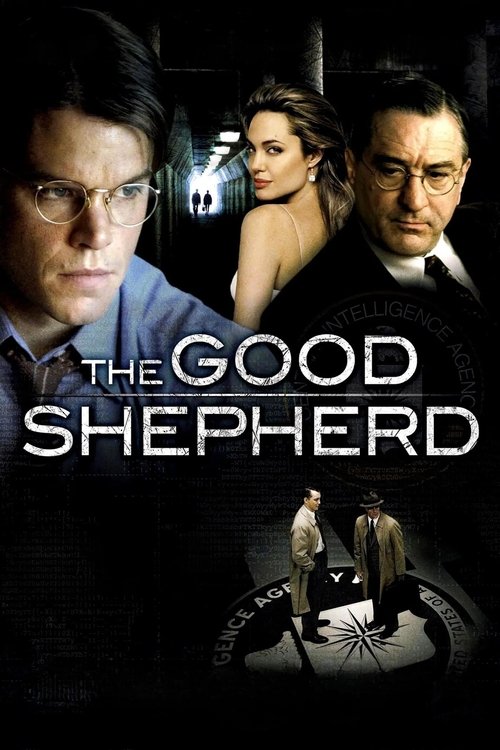
The Good Shepherd
2006 · Robert De Niro
For a long, serious evening when you want to sink into a dense Cold War puzzle and don't mind gloom — a film to chew on, not comfort food. Reach for it when you're in the mood for patient, grown-up intrigue over thrills.
What it's about
A fictional history of the CIA's founding, told through one man's career in secrets. Edward Wilson is recruited out of Yale's Skull and Bones society into the wartime OSS, then rises through the new agency as a counterintelligence officer in London, Berlin and Washington. The story opens in the wreckage of the failed Bay of Pigs invasion, as Wilson hunts the leak behind the disaster, and loops back through two decades of Cold War spycraft — and through the marriage and family he keeps sacrificing to the work.
The experience
Slow, hushed and deliberately chilly — a nearly three-hour epic of whispered conversations, coded favors and quiet betrayals rather than chases or gunfights. It asks patience and close attention, and what it leaves you with is less excitement than a creeping melancholy about what secrecy does to a person.
Performances
Matt Damon carries the film almost entirely through restraint — a man so buttoned-down that a flicker of feeling registers like a shout — and Angelina Jolie gives real ache to the wife left outside his locked inner life.
The craft
Eric Roth's screenplay builds an intricate flashback structure spanning 1939 to 1961, trusting you to assemble the timeline yourself, and De Niro directs it with funereal control — muted colors, smoky rooms, immaculate period detail. The sound of the film is murmurs and silences; it rewards a quiet room and full attention more than a big screen.
Why it matters
De Niro's long-gestating second feature as director became the rare Hollywood attempt at a serious, unglamorous origin story of American intelligence, and it remains a touchstone for anyone curious how the CIA sees — or hides — itself.
Snapshot
The Good Shepherd is Robert De Niro's second feature as director, after A Bronx Tale (1993). It is a long, deliberately paced fictional history of the early Central Intelligence Agency, told through the career of Edward Wilson (Matt Damon). Wilson is a Yale-educated counterintelligence officer whose temperament, a mix of discretion, loyalty and emotional suppression, makes him both well suited to secret work and unable to live outside it. Eric Roth's screenplay sets a framing story in the days after the failed Bay of Pigs invasion of April 1961, when Wilson tries to find the leak behind the disaster. Flashbacks run from his student years in 1939 through wartime service in the OSS in London and Berlin and the founding of the CIA in 1947. Wilson is fictional but plainly built from real figures, above all James Jesus Angleton, the poetry-loving Yale man who ran CIA counterintelligence for two decades, with elements of Richard Bissell and others. The film is close to three hours long, quiet and withholding. It works less as a thriller than as a study of how an institution is made and what it costs the people who make it. In its year it was received respectfully but without enthusiasm. Since then its reputation has grown as one of the more serious American films about the national-security state.
Industry & production
The project spent a long time in development. Eric Roth wrote the screenplay in the 1990s after Forrest Gump (1994), and it went through Hollywood for years with various directors linked to it. Francis Ford Coppola was attached at one stage and remains on the finished film as an executive producer. De Niro took it on as director in the early 2000s. It was produced through Tribeca Productions, his company with Jane Rosenthal, with James G. Robinson's Morgan Creek. Universal distributed it in the United States, opening it in late December 2006 in the awards-season corridor.
For a prestige drama the production was large: a big speaking cast, period re-creations across three decades and several countries, and a running time of about 167 minutes, which the filmmakers kept despite its obvious commercial drawbacks. De Niro's stature drew an unusual ensemble around Damon. Angelina Jolie plays Wilson's wife Margaret "Clover" Russell. Alec Baldwin plays an FBI agent, William Hurt a patrician agency director, Billy Crudup a British intelligence officer modelled on Kim Philby, Michael Gambon a Yale poetry professor, and John Turturro Wilson's enforcer-deputy. Timothy Hutton, Joe Pesci, Lee Pace, Martina Gedeck, Tammy Blanchard, Keir Dullea and the young Eddie Redmayne, as Wilson's son, round it out. De Niro himself plays General Bill Sullivan, a thin version of OSS founder William "Wild Bill" Donovan. Most shooting took place in and around New York in 2005, with period exteriors standing in for Washington, New Haven and Europe. The commercial result was moderate rather than a failure or a breakout, and it didn't change the market for adult political drama in the way the producers might have hoped.
Technology
The film was shot photochemically on 35mm, as most studio dramas still were in the mid-2000s. It was finished with a digital intermediate grade, which by then was standard and which lets the film control its subdued, period-coded palette across many locations. It isn't a technologically innovative film. Its craft lies in period production design and photography, not in new tools. Visual effects are used mostly invisibly: to extend period streets, to rebuild wartime and postwar Berlin and London, and to supply the closing image of the newly built CIA headquarters at Langley. The film's real interest in technology is thematic. One key strand follows the forensic analysis of a covert audio recording, with technicians isolating background sounds to place the room where it was made. It is a procedural celebration of analogue intelligence craft, and it ties the film to the tape-obsessed paranoia of The Conversation (1974).
Technique
Cinematography
Robert Richardson, best known for his work with Oliver Stone, Martin Scorsese and Quentin Tarantino, shot the film. He works here in an unusually restrained register. His familiar signature, strong hard top-light and hot backlight that make faces glow at the edges, is still present, but it's turned toward dimness and enclosure rather than spectacle. The palette is muted: browns, greys and institutional greens, with interiors that feel airless and offices lit as if daylight were rationed. The camera is mostly composed and still. It favours medium shots and frames that put Wilson in doorways, behind glass, or at the edge of rooms where others talk. Lenses and blocking often hold him at a distance in his own home. The visual grammar makes his isolation spatial before the script makes it explicit.
Editing
Tariq Anwar, editor of American Beauty (1999) and other British and American dramas, cut the film. He had the hardest structural job in it: moving between the 1961 investigation and a flashback chain that runs, roughly in order, from 1939 onward. The cutting is unhurried and often elliptical, with years passing between scenes and little on screen to signal them. Viewers have to follow ageing make-up, costume and political context. That deliberate pace is the main reason the film was called slow on release, and also the reason it sustains an atmosphere of procedural patience. The structure puts the two timelines on a collision course. The tape investigation slowly turns from a professional puzzle into a personal one, and the flashbacks lead toward the moment the two stories join.
Mise-en-scène / staging
Jeannine Oppewall's production design was nominated for the Academy Award for Best Art Direction, shared with set decorators Gretchen Rau and Leslie E. Rollins. The nomination recognises the film's most widely praised element: a precise world of Yale clubrooms, wood-panelled offices, wartime London flats, ruined Berlin and the bland government spaces of Washington in the 1950s. Ann Roth's costumes trace a class and an era through hats, overcoats and wool suits that all look alike. The staging is formal and ritual-minded. The Skull and Bones initiation, with its humiliations and confessions, is shown as the first of the film's many rites of admission, and later scenes of recruitment, interrogation and debriefing echo its theatre of secrecy. Recurring props carry meaning. Wilson builds ships in bottles, an image of patient, enclosed, hidden craft. A wartime photograph and the recording that drive the 1961 plot become objects the film examines almost like relics.
Sound
The score, credited to Marcelo Zarvos and Bruce Fowler, is subdued and mostly stays in the background. It supports mood rather than signalling suspense. Much of the film plays in near silence or in low murmurs, which suits a story about men who say little. The most notable sound design belongs to the audio-analysis thread, where the soundtrack itself becomes evidence. Ambient noise, voices and incidental sounds are pulled apart and examined, and the audience is asked to listen the way Wilson's technicians do. That attention to the texture of recorded sound is the film's clearest formal comment on surveillance.
Performance
Matt Damon's performance is built on suppression. Wilson speaks quietly, rarely raises his voice and almost never shows feeling openly. It was a deliberate counterweight to Damon's athletic Jason Bourne, the other intelligence figure he was playing in the same years. Some critics found the result opaque, even inert. Others read the blankness as the point: a man whose self has been consumed by his role. Damon ages across more than twenty years mostly through stillness, not make-up. Angelina Jolie, cast against her action-star image, plays a wife slowly hollowed out by neglect. Among the supporting cast, Billy Crudup's charming British officer, Michael Gambon's tragic professor and John Turturro's menacing deputy are often singled out. At the 2007 Berlin International Film Festival the ensemble received a Silver Bear for Outstanding Artistic Contribution, a rare award to a cast as a whole.
Narrative & dramatic mode
The film is a dual-timeline character study in the form of an espionage procedural. The 1961 plot is a hunt for a mole. A photograph and an audio recording reach Wilson anonymously, and identifying the people and the place in them drives the present-day story. The flashbacks form a Bildungsroman in reverse, showing how a young man of conscience becomes the agency's ideal servant by giving up his conscience piece by piece. The dramatic mode is tragic and anti-climactic. Revelations come quietly, violence is mostly off-screen or abrupt, and the climax is a decision Wilson makes in private, one that sacrifices his son's happiness to preserve institutional security. The film borrows the shape of family dynastic tragedy and fuses it with institutional history. It ends not on resolution but on Wilson walking into the new Langley headquarters, absorbed into the building he helped bring into being.
Genre & cycle
The Good Shepherd belongs to the "literary" or "realist" espionage tradition associated with John le Carré. That tradition values bureaucracy, betrayal and moral exhaustion over gadgets and action, and stands opposite the Bond line. It also belongs to the mid-2000s cycle of American films about intelligence, surveillance and covert power made in the shadow of 9/11 and the Iraq War. That cycle includes the Bourne films, Syriana (2005), Munich (2005, co-written by Roth), Breach (2007) and Rendition (2007). It overlaps as well with the historical CIA drama: the TNT miniseries The Company (2007), adapted from Robert Littell's novel and broadcast the following year, covers much of the same ground, including the Angleton figure and the mole hunt. The film's mix of thriller, period drama and family epic also places it near the American dynastic saga.
Authorship & method
As a director, De Niro is unshowy and devoted to actors. A Bronx Tale was a warm, neighbourhood-scaled coming-of-age film. The Good Shepherd is colder and much larger, but it shares that film's interest in fathers, sons and the codes that bind men to institutions. De Niro has said little publicly about a single guiding visual idea. The film's authorship is best seen as a collaboration in which the director's main contribution is tone, patience and the trust of an ensemble.
Eric Roth is arguably the film's primary author. His screenplays (Forrest Gump, The Insider, Munich, later The Curious Case of Benjamin Button) often follow a single figure through decades of American history and treat individual lives as channels for national change. The Good Shepherd is the darkest version of that habit. Its research draws on the documented history of the OSS and the early CIA. Roth and De Niro were reported to have considered further instalments carrying Wilson's story into later decades, but none was made.
Among the other collaborators, Robert Richardson brings a major cinematographer's control to deliberately austere material, and Tariq Anwar manages the time structure. Jeannine Oppewall, whose earlier work includes L.A. Confidential (1997) and Pleasantville (1998), supplies the film's most celebrated texture. Composers Marcelo Zarvos and Bruce Fowler score it with restraint. Francis Ford Coppola's role as executive producer is formal, but his influence is felt in the film's Godfather-like structure.
Movement / national cinema
The film is an American studio-distributed prestige production. It doesn't belong to a movement in the strict sense. It sits in the line of the American political cinema of the 1970s, especially Alan J. Pakula's paranoia trilogy and Sydney Pollack's Three Days of the Condor (1975), which treated the intelligence state as a moral problem rather than an adventure setting. The 1970s films reacted to the Church Committee era and Watergate. The Good Shepherd returns to that suspicion from a retrospective, origin-story angle: it asks how the institutions those films feared were founded, and by what kind of people. Its strong debt to British spy fiction, and Crudup's Philby-like figure, also tie it to the transatlantic history of Anglo-American intelligence, a link the film makes explicit through the OSS's training in London.
Era / period
The story covers 1939 to 1961, from the eve of American entry into the Second World War to the Bay of Pigs. It shows the shift from the amateur, Ivy League–staffed OSS to a permanent, professional Cold War bureaucracy. The film stresses the class and social basis of that early establishment: Yale, Skull and Bones, family connections, and the assumption that a WASP elite could be trusted to act in secret on the nation's behalf. It touches on the betrayal of Allied intelligence by the Cambridge spies. It also treats the defector problem of the 1950s and 1960s in a fictionalised, compressed version of the disputes over rival Soviet defectors that consumed Angleton's counterintelligence staff. The film's own moment, 2006, matters as well. It was released amid public argument over intelligence failures, interrogation and covert action, and its scenes of coercive questioning, including drug-assisted interrogation, were read against those debates.
Themes
- Loyalty and its corruption. Wilson's virtues of discretion, honour and reliability are what the agency wants and what destroys him. The film presents institutional loyalty as a slow emptying of the self.
- Fathers and sons. It opens with the father's suicide, which the boy witnesses and whose note he hides, and ends with Wilson choosing between his son and the agency. The inherited burden of secrecy is the film's emotional spine. The title's pastoral and biblical sense of the shepherd who protects his flock turns ironic: Wilson protects the nation by sacrificing his own.
- Class and the American establishment. Secret societies, old-money networks and religious and ethnic hierarchies run through the film. A much-quoted exchange with Joe Pesci's Italian-American character suggests that, for Wilson's class, America itself is their inheritance and everyone else is "just visiting."
- Trust and epistemology. Counterintelligence becomes a problem of knowledge. Nothing can be verified, and every source may be a plant. The film stages a world where suspicion is a professional virtue and a personal disaster.
- Marriage and domestic absence. Clover's story shows the domestic cost of the secret state, a home turned into another site of silence.
- The institution as protagonist. The closing image of Langley suggests the real subject is not a man but a structure that outlives and absorbs him.
Reception, canon & influence
Critical reception. On release, reviews were mixed to positive. Critics widely praised the ambition, production design, ensemble and seriousness of purpose. The most common complaints were the length, the slow pace and the emotional opacity of Damon's lead, which some found too cold to anchor a three-hour film. Several reviewers compared it, favourably or not, to The Godfather, calling it an attempt at a dynastic epic of the CIA. Its formal honours were the Berlinale ensemble Silver Bear and the Oscar nomination for art direction. Box-office returns were respectable rather than strong.
Influences on the film (backward). The clearest models are John le Carré's fiction and its screen adaptations, especially Tinker Tailor Soldier Spy (the 1979 BBC serial), for the mole hunt and the melancholy of institutional betrayal. The Godfather films shape the structure: a son's induction into a closed "family," a growing moral void, and a final isolation that recalls Michael Corleone's. The 1970s American paranoid thriller (The Conversation, The Parallax View, Three Days of the Condor) supplies the tone and the fixation on recordings. The historical record is a source too: published biographies and histories of Angleton, the OSS and the CIA's early years, as well as public knowledge of the Cambridge spies and the Bay of Pigs.
Legacy (forward). The film didn't found a cycle, but it holds a lasting place in the run of serious screen treatments of Cold War intelligence that followed. Tomas Alfredson's Tinker Tailor Soldier Spy (2011) extended the same patient, melancholy register into British cinema. The television series The Americans (2013–2018) took up its pairing of espionage with domestic and marital erosion. Steven Spielberg's Bridge of Spies (2015) offered a more humane counterpoint set in the same era. Matt Damon's performance is now often cited as the deliberate opposite of his Bourne persona, which makes the two films a revealing pair about the decade's ideas of the intelligence agent. The film's reputation has steadily improved, aided by later public interest in Angleton and the history of the CIA. It is increasingly treated as an underrated, if imperfect, American epic about the cost of secrecy. The claim that it directly shaped specific later works is mostly a matter of critical affinity rather than documented influence, and should be read that way.
A Deleuzian reading
Edward Wilson builds ships in bottles.
The full Deleuzian reading of The Good Shepherd →
Reception
Pitched as 'The Godfather of spy movies,' it landed in 2006 to shrugs — critics called it cold, slow, and nearly three hours of whisper. Since then it's picked up a steady reappraisal among spy-fiction devotees, who now cite it as one of the most serious films ever made about the CIA's founding.
How The Good Shepherd was received, from release to now →
How to watch The Good Shepherd: what to notice on a first viewing
- Notice how often Richardson frames Damon in doorways or behind glass. Wilson stands in doorways, behind panes of glass, at the edge of rooms where other men talk. At home the camera keeps its distance from him at his own family's table. You see how alone Wilson is in the shape of the shot, long before anyone says it out loud.
- Watch Wilson's hands at his workbench building ships in bottles. The film keeps returning him to the bench. Masts fold flat, the hull slides through the narrow neck, and the rigging rises inside on thread. Nobody looking at the finished model can see how it got there. The hobby is Wilson's working method in miniature: patient, enclosed, hidden craft.
- Listen to how quietly Damon speaks, and how rarely his face moves. Damon builds Wilson out of suppression. He almost never raises his voice or shows feeling, and he ages more than twenty years mostly through stillness while Crudup charms and Turturro threatens around him. The stillness shows what years of discretion leave on a body that has learned its role too well.
- Listen as the technicians strip background noise from the tape. The recording that reaches Wilson gets replayed again and again. Voices are pulled away from incidental sounds, and each pass isolates another noise until a room starts to emerge from the hiss. You end up listening the way the agency listens, and that procedural patience becomes the suspense.
- Track the hats, suits and aging makeup to date each scene. Anwar cuts between the 1961 investigation and flashbacks that start at Yale in 1939, often with nothing on screen to mark the jump. Years pass between scenes. Costume, faces and politics are your only clock. Holding both timelines lets you watch the young Wilson still deciding while you already know the older man he becomes.
The whole guide to watching The Good Shepherd, with the keys for a rewatch →
Influences: the films it descends from and the films it influenced
- The Godfather (1972) — Gives Roth's script its basic shape: a reluctant son is drawn into a closed 'family', its rituals bind him, and the film ends on his isolation in a darkened interior. Coppola's executive-producer credit makes the debt explicit.
- The Godfather Part II (1974) — Its cross-cut double timeline, set decades apart, lets each era comment ironically on the other. Tariq Anwar adapts this for the jumps between 1961 and Wilson's Yale and OSS years.
- The Conversation (1974) — Harry Caul replays a degraded tape until its meaning shifts. That is the model for the CIA technicians isolating ambient sound on the Léopoldville recording, where audio forensics becomes the film's method of detection.
- The Parallax View (1974) — Gordon Willis frames people as small figures dwarfed by corporate and government architecture. This is the source of the film's habit of trapping Wilson in doorways, behind glass and inside institutional geometry.
- All the President's Men (1976) — Pakula and Willis made procedural tedium and bureaucratic interiors visually tense. De Niro uses the same approach for the CIA's archives, labs and corridors.
- Three Days of the Condor (1975) — The first American thriller to show the CIA as a rotten-from-within bureaucracy rather than a heroic agency. Its analyst-desk realism anticipates Wilson's world of paperwork.
- The Spy Who Came in from the Cold (1965) — Oswald Morris's drab, deglamorised monochrome and Burton's exhausted, inward performance set the le Carré screen register, the anti-Bond realism that Damon's withheld performance continues.
- Tinker Tailor Soldier Spy (BBC serial) (1979) — A mole hunt told through quiet interrogations, files and Guinness's near-silent, watchful Smiley. It is the template for Wilson's passive, recessive presence and the slow uncovering of betrayal inside the service.
- The Conformist (1970) — A reverse bildungsroman: a man trades intimacy and conscience for belonging to a state apparatus, and flashbacks track his hollowing out. Storaro's framing through glass and partitions presents it as entrapment.
- JFK (1991) — Robert Richardson's hard white toplight and his archival treatment of Cold War intelligence history first appear here. He pares this vocabulary down into the austere, top-lit chiaroscuro of The Good Shepherd.
- The Insider (1999) — Eric Roth's screenplay studies a man inside an institution that demands silence. The story is told through deposition, recording and procedure, a precursor to Wilson's world of tapes and testimony.
- Absolute Power (1997) — De Niro's procedural thriller of CIA institutional corruption adopts the Goldman-Pakula architecture—unhurried crosscutting between operational tradecraft and personal cost, naturalistic cinematography (Robert Richardson) without atmospheric embellishment, and a performance-economy ensemble whose behavioral restraint carries the moral accounting.
- Breach (2007) — An American mole-hunt drama about Robert Hanssen. It keeps the Good Shepherd register: grey institutional interiors, a buttoned-up and devout traitor, and anti-climactic procedure instead of action.
- Tinker Tailor Soldier Spy (2011) — Hoyte van Hoytema shoots it through glass, partitions and long lenses. A nearly mute lead and elliptical cross-cutting between past and present carry the patient, melancholy mole-hunt mode into British cinema.
- Zero Dark Thirty (2012) — A post-9/11 intelligence procedural following one analyst who becomes more and more consumed. Its last image is a hollow, solitary victory, much like Wilson's empty triumph inside the agency.
- Bridge of Spies (2015) — Janusz Kamiński's top-lit, period-exact Cold War offices and an exchange-of-agents plot revisit the same era and design idiom. It answers Wilson's coldness with a humane lead.
- The Irishman (2019) — De Niro plays another loyal functionary of a closed institution whose decades are told in elliptical jumps. It ends, as The Good Shepherd does, with the man alone and his family estranged.
- Munich (2005) — Co-written by Roth in the same period, it is the companion piece. An intelligence operative's loyalty to the state erodes his family and his sense of self, and the final scene asks what the secret work was for.
- The Lives of Others (2006) — Released the same season, it builds its drama around a listener wearing headphones and recording equipment. Like De Niro's film, it treats audio surveillance as both an investigative technique and a moral trap.
Similar films
- Bridge of Spies (2015) — influence & lineage · same viewing thread
- Three Days of the Condor (1975) — influence & lineage · same viewing thread
- The Godfather (1972) — influence & lineage
- The Conversation (1974) — influence & lineage
- The Godfather Part II (1974) — influence & lineage
- The Spy Who Came In from the Cold (1965) — influence & lineage
- Zero Dark Thirty (2012) — influence & lineage · same viewing thread
- The Brutalist (2024) — same viewing thread
All the films related to The Good Shepherd →
Watch it with: curated runs of related films
- Great Men, Grand Reckonings — A run of prestige true stories about singular, obsessive men chasing an epochal achievement — the bomb, the moon, the checkered flag, a nation — and reckoning with what it cost them and everyone around them.
- Inside the Security State — A run of modern espionage and national-security thrillers — globe-trotting spycraft, submarine brinkmanship, and the paper trail behind the black sites — where operatives and investigators race secretive institutions and catastrophic clocks.