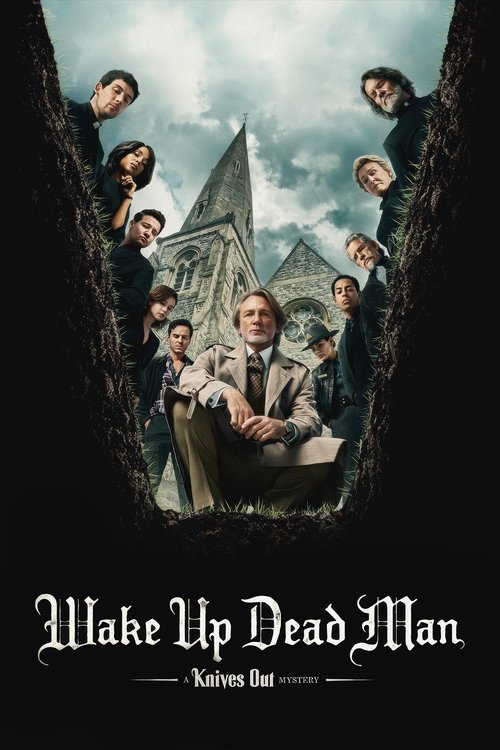
Wake Up Dead Man: A Knives Out Mystery
2025 · Rian Johnson
For a proper puzzle night — when you want to play armchair detective and be beaten fair and square. Cozy in form, wicked in content; great with company who like to whisper theories.
What it's about
The third Benoit Blanc mystery sends the gentleman detective to a small upstate New York parish, where a young priest has been posted to assist a charismatic, combustible monsignor — and where a murder occurs that seems flatly impossible. Blanc teams with the local police chief to pick apart a congregation full of secrets, hidden motives, and a crime that appears to defy logic itself.
The experience
A twisty, talky pleasure machine — playful and quotable on the surface, with a darker, more serious undertow than the earlier Blanc films. It keeps you guessing in the honest way: the clues are on screen if you're sharp enough to catch them.
Performances
Daniel Craig's Blanc remains one of the great modern comic-detective creations, the drawl and courtliness masking a mind like a trap; Josh O'Connor gives the young priest a bruised sincerity that anchors the film's more soulful register.
The craft
Rian Johnson writes whodunits the old-fashioned way — fair-play clues, misdirection hidden in plain sight, structure as showmanship — and here bends the form toward questions of faith and forgiveness without losing the fun. The church setting gives the production a gothic richness the series hadn't tried before.
Why it matters
It cemented the Knives Out films as the rare modern franchise built on original mysteries rather than existing IP, proving the classic detective story still draws a mass audience.
Snapshot
Wake Up Dead Man is the third feature in Rian Johnson's Benoit Blanc series, following Knives Out (2019) and Glass Onion: A Knives Out Mystery (2022). Daniel Craig returns as the Southern-inflected "gentleman detective" Blanc, here drawn into an ostensibly impossible killing set within the orbit of a parish church and its charismatic, combustible pastor. Where the first film staged a New England inheritance farce and the second a tech-billionaire island satire, this installment turns toward the overtly theological register the series had only flirted with: a priest, a congregation, a crime that "defies all logic," and a title that frames death itself as something to be awoken from. The film continues Johnson's project of writing free-standing whodunits under one recurring sleuth — an anthology structure modeled on Agatha Christie's Poirot and Marple novels rather than on serialized franchise continuity. It reached audiences through Netflix, which financed and distributed the two sequels under a landmark rights deal.
Industry & production
The defining industrial fact of Wake Up Dead Man is its ownership. After Lionsgate released the original Knives Out theatrically to outsized returns on a modest budget, Netflix acquired the rights to two sequels in 2021 in a deal that was widely reported at roughly $450 million — one of the largest such acquisitions on record at the time. That arrangement realigned the series' economics around subscriber value rather than ticket sales, and it explains a recurring tension in the franchise's rollout: Johnson has publicly favored theatrical exhibition for these ensemble mysteries, and Netflix granted Glass Onion and this film limited theatrical windows before streaming, though not the wide, sustained runs a traditional studio would mount.
The film was produced through T-Street, the company Johnson runs with longtime producing partner Ram Bergman, who has shepherded Johnson's work since Brick (2005). The production reassembles Johnson's core creative team (see Authorship) and, per series practice, a fresh marquee ensemble around Craig's constant. Confirmed principals include Josh O'Connor as the young priest Jud Duplenticy, Josh Brolin as Monsignor Jefferson Wicks, and Mila Kunis as police chief Geraldine Scott, alongside an ensemble reported to include Glenn Close, Jeremy Renner, Kerry Washington, Andrew Scott, Cailee Spaeny, Daryl McCormack, and Thomas Haden Church. As with the prior two films, casting operates on the Christie principle that every recognizable face is a potential suspect and a potential red herring. Precise production budget figures for this specific entry have not been authoritatively disclosed, and I will not estimate them; the meaningful economic frame remains the two-picture Netflix acquisition rather than a standalone line item.
Technology
The Knives Out films have been, quietly, some of the more technically considered studio productions of their era because of cinematographer Steve Yedlin, an unusually research-driven imaging technologist. Yedlin is known within the industry for his work on digital color science and for building custom software pipelines — his public "display-prep demo" argued that the perceived "film look" is a product of controlled image processing rather than of any single capture format. The first two films were shot digitally in large format (ARRI's Alexa 65 system figured prominently in the series' look), and Wake Up Dead Man continues within that large-sensor, controlled-pipeline lineage. I will not assert the exact camera package for this installment absent confirmation, but the relevant point is methodological: Yedlin treats the capture-to-display chain as a single engineered system, which is why the series sustains a consistent painterly density across films despite changing locations. On the delivery side, the film is a Netflix production and thus mastered for the platform's streaming specifications (high-dynamic-range and immersive-audio deliverables are standard for Netflix originals of this scale), even as it plays theatrically in select venues.
Technique
Cinematography
Yedlin's camerawork across the series favors deliberate, legible framing over restless coverage — a whodunit demands that the audience be able to read a room, and Yedlin builds compositions that hold multiple suspects in depth and let the eye do detective work. Expect the house style: warm, saturated interiors; strong practical-motivated lighting; and a willingness to let faces sit in pooled shadow, which suits an ecclesiastical setting of candlelight, stained glass, and dark wood. Given the film's religious milieu, the series' recurring interest in architecture-as-suspect — the Thrombey mansion in Knives Out, the glass dome in Glass Onion — likely finds its analog in church interiors, which historically lend cinematographers vertical scale and directional, "sacred" light. I flag as unconfirmed any specific set-piece staging; what is grounded is the collaborators' established grammar.
Editing
Bob Ducsay, Johnson's editor since Looper (2012), cuts these films around information control. The signature Knives Out device is the flashback that revises what we thought we saw — the same event replayed with a new fact inserted — and the editorial rhythm is built to manage the audience's knowledge, doling out and retracting certainty. Ducsay's task on a mystery is fundamentally architectural: the reveal must feel both surprising and, in hindsight, inevitable, which is an editing problem as much as a writing one. The series' comic timing is likewise cut sharp, with reaction beats and deadpan holds calibrated to Craig's performance.
Mise-en-scène / staging
Production design in this franchise is a load-bearing element: interiors are dressed as psychological portraits and as puzzle boards, thick with props that may or may not be clues. A parish setting invites a dense iconographic vocabulary — liturgical objects, religious statuary, the theater of the pulpit — and Johnson's method is to overload the frame with potential meaning so that misdirection can hide in plain sight. The "impossible murder" premise foregrounded in the synopsis points toward the locked-room tradition, in which physical space itself is the enigma; staging in such stories must establish geography rigorously so the eventual solution reads as fair play.
Sound
Nathan Johnson's scores for the series blend orchestral mischief with genre pastiche, signaling the films' double register as both sincere mysteries and knowing comedies. A church setting offers obvious sonic affordances — organ, choral texture, bells — that a composer can deploy straight or ironically. I will not describe specific cues that have not been documented, but the established approach is a lush, motif-driven score that treats the whodunit as a form with its own musical rhetoric.
Performance
Craig's Blanc anchors the series through stylized excess: an operatic drawl, courtly manners, and bursts of theatrical deduction. The design of each film hands the surrounding ensemble a spectrum of registers, from broad caricature to genuine pathos, and the pleasure lies in not knowing which performances are masks. O'Connor and Brolin here occupy the emotionally central axis — the uncertain young priest and the domineering monsignor — a dynamic of faith, authority, and doubt that gives the film a moral spine beneath the puzzle. Kunis's police chief provides the local, grounded counterweight to Blanc's flamboyant outsider, echoing the series' habit of pairing Blanc with a sincere partner (Ana de Armas's Marta, Janelle Monáe's Helen) against whom his artifice reads.
Narrative & dramatic mode
Structurally, the film belongs to the classical detective form: a closed community, a death, a gathering of suspects, an outside investigator, and a climactic reconstruction. Johnson's innovation across the series has been to fuse that Golden Age skeleton with contemporary social satire and with a bifurcated structure that often shows the audience more than a pure whodunit would — Knives Out famously reveals its apparent "solution" at the midpoint before pulling it apart. The dramatic mode is tonally hybrid: comedy of manners, thriller, and, increasingly, moral drama. The "impossible" framing signals a specific sub-mode — the miracle problem, in which a crime appears to violate physical or rational law and the detective's job is to restore causality. That the setting is a church sharpens the theme: the film stages a contest between apparent miracle and rational explanation, between faith and detection, which are historically two ways of reading the same inexplicable event.
Genre & cycle
Wake Up Dead Man sits at the center of the 21st-century whodunit revival that Knives Out itself largely catalyzed. The 2019 film's success helped reopen commercial space for the ensemble murder mystery — a cycle visible in the renewed appetite for Christie adaptations (Kenneth Branagh's Poirot films), in comedic mysteries (See How They Run, Glass Onion's own imitators), and in television (Only Murders in the Building, The Afterparty). Within that cycle, this installment's turn toward the locked-room "impossible crime" points past Christie to a distinct lineage: John Dickson Carr and the miracle-problem specialists, and above all G.K. Chesterton, whose Father Brown stories made a Catholic priest the paradoxical instrument of rational detection. Johnson has cited Chesterton among his touchstones, and a Knives Out mystery built around clergy reads as a deliberate engagement with that priest-detective tradition — even as Blanc, not the priest, holds the magnifying glass.
Authorship & method
The series is a sustained auteur project. Rian Johnson writes and directs each entry alone, and the films extend preoccupations visible across his career: genre as a formal playground (the high-school noir of Brick, the con-artist mechanics of The Brothers Bloom, the time-travel logic of Looper, the mythology deconstruction of The Last Jedi). Johnson's method is architectural and fair-play — he has described plotting mysteries so that clues are visible on rewatch — and thematically he has used the genre as a vehicle for social commentary (class and immigration in Knives Out, wealth and fraudulent genius in Glass Onion).
His collaborators form an unusually stable authorial unit. Cinematographer Steve Yedlin has shot nearly all of Johnson's features since Brick, making the pair one of the most durable director–DP partnerships working. Composer Nathan Johnson, the director's cousin, has scored his films throughout. Editor Bob Ducsay has cut Johnson's work since Looper. Producer Ram Bergman has produced it from the start. This continuity is the reason the series maintains a coherent voice across shifting genres-within-the-genre; the "Rian Johnson film" is as much the product of this repertory crew as of the director alone.
Movement / national cinema
The film is an American production in the tradition of the Hollywood star-ensemble mystery, but its DNA is transatlantic. The Knives Out films are consciously Anglophile in their genre allegiance — the country-house murder, the eccentric detective, the drawing-room reconstruction are inheritances from British Golden Age fiction (Christie, Sayers, Chesterton) filtered through American setting and satire. There is no "movement" in a school-of-filmmaking sense; rather, the relevant context is the streaming-era realignment of prestige mid-budget filmmaking, in which a director-driven, adult-skewing genre film that once would have been a theatrical studio release is instead a platform tentpole. In that sense Wake Up Dead Man is a document of how Hollywood's commercial middle migrated onto Netflix.
Era / period
Made and released in 2025, the film is a product of the post-pandemic, streaming-dominant moment, and of an industry still negotiating the value of theatrical exhibition after the 2023 labor disputes and the contraction of mid-budget studio production. Its contemporary setting (rather than period) lets Johnson continue using the mystery as a mirror for present anxieties; the series has consistently read the "closed community" of the whodunit as a microcosm of a stratified America. A church-centered story arrives at a moment of pronounced cultural argument over religion, authority, and belief, and the film's premise — faith versus the demand for rational explanation — is legible as an engagement with that climate, though I will not attribute specific topical intentions that Johnson has not stated on record.
Themes
The organizing theme is the collision of faith and reason. Detection is, by its nature, a rationalist enterprise — the insistence that every effect has a discoverable cause — and setting a detective story inside a church, around an "impossible" death, stages a direct confrontation between the miracle and the material explanation. Chesterton's Father Brown resolved that tension by making the priest the supreme rationalist, one who understands evil precisely because he understands the soul; Johnson's configuration, placing a secular showman-detective amid clergy, sets up a related but distinct dialectic. Secondary themes recur from the series: institutional authority and its abuses (here located in a charismatic religious leader), the gap between public performance and private truth, and the moral clarity of an outsider who sees a corrupt system plainly. The title's resurrection imagery — waking a dead man — points toward themes of guilt, confession, and the possibility (or impossibility) of restoration.
Reception, canon & influence
On influences flowing into the film (backward): the deepest debt is to Agatha Christie's serial-detective model, which supplies the anthology structure and the recurring-sleuth conceit; to the locked-room and "miracle problem" tradition of John Dickson Carr; and, most specifically for this entry, to G.K. Chesterton's Father Brown, the foundational text of the clerical mystery. More broadly the series draws on the all-star ensemble mysteries of the 1970s and after — the Christie adaptations of that decade (Murder on the Orient Express, Death on the Nile) and comic entries like Murder by Death and Clue — which established the tone of affectionate, self-aware pastiche that Johnson refined.
On its own reception and legacy (forward): the franchise as a whole has been the single most influential force in reviving the commercial whodunit, and each entry is received as a cultural event. As of this writing I do not have a settled critical consensus or verified box-office/viewership data for Wake Up Dead Man that I can responsibly summarize, and the record here is genuinely thin — I will not manufacture aggregate scores, ratings, or viewing figures. What can be said is structural: the film extends a series that has already reshaped studio and streaming appetites for the form, confirmed the recurring-detective anthology as a viable modern model, and made Craig's Benoit Blanc one of the few genuinely new franchise characters of the era to be built around a screenwriter's original creation rather than existing IP. Its lasting significance will hinge on whether the series continues, and on whether this more overtly moral, religious register marks a durable deepening of Johnson's whodunit project or a single tonal excursion — a question the historical record cannot yet answer.
A Deleuzian reading
A man in a pulpit, working a room he owns.
The full Deleuzian reading of Wake Up Dead Man: A Knives Out Mystery →
Reception
Too young for a reappraisal arc — it premiered at TIFF in September 2025 and hit Netflix that December to strong reviews as the trilogy's gothic, most serious entry, with 'this might be the best one' takes forming almost immediately.
How Wake Up Dead Man: A Knives Out Mystery was received, from release to now →
How to watch Wake Up Dead Man: A Knives Out Mystery: what to notice on a first viewing
- Notice every object placed deliberately somewhere in a room. Johnson overloads interiors with liturgical objects, props, and details that may or may not be clues, so the frame becomes a puzzle board as much as a setting. Nothing on screen is neutral decoration; every object is a promise the story intends to keep.
- Watch for shots that hold several people in one frame. Cinematographer Steve Yedlin composes in depth so multiple suspects stay legible at once, letting your eye do detective work instead of the cutting doing it for you. You are meant to scan the frame yourself, the way a detective would scan a room.
- Notice how candlelight and stained glass shape the light. The church setting is lit warm and saturated, with faces allowed to sit in pooled shadow, giving the investigation a candlelit, sacred atmosphere rather than a bright procedural look. The lighting borrows the church's own vocabulary of shadow and reverence for a murder investigation.
- Watch Blanc's flamboyance against the police chief's plain manner. Craig plays Blanc with an operatic drawl and courtly excess, while Kunis's local chief supplies a grounded, sincere counterweight the series always pairs him against. His artifice only reads as artifice because someone sincere is standing next to it.
- Notice how self-contained this mystery feels from the start. Johnson writes each Benoit Blanc film as a free-standing whodunit, an anthology model closer to Agatha Christie's Poirot novels than to serialized franchise continuity. You don't need the earlier films. Every clue you need starts and ends inside this case.
The whole guide to watching Wake Up Dead Man: A Knives Out Mystery, with the keys for a rewatch →
Influences: the films it descends from and the films it influenced
- Father Brown (1954) — Alec Guinness's genial, morally-driven clerical sleuth who cracks cases through spiritual and psychological intuition rather than forensic ratiocination is the direct screen precedent for a Chesterton-derived detective working the faith-versus-reason 'miracle problem.'
- Knives Out (2019) — Establishes the series' revising-flashback architecture — a plausible narrated account shown early, then corrected on replay — plus Blanc's stylized drawling detective and the Yedlin/Ducsay/Nathan Johnson repertory craft this entry inherits wholesale.
- Brick (2005) — Origin of the Johnson–Yedlin partnership and of Johnson's 'genre-as-formal-playground' method: transplanting a rigidly codified detective idiom into an incongruous register while keeping its deductive machinery intact.
- The Last of Sheila (1973) — Sondheim and Perkins's meticulously fair-play game-mystery, in which clues are literally planted for the players to find, is the purest forebear of Johnson's 'clues visible on rewatch' ethos and his detective-as-gamesmaster framing.
- Sleuth (1972) — A theatrical two-hander of dueling gamesmanship staged inside an elaborate mechanical house — the 'frame as puzzle-board' and detective-as-performer lineage Johnson makes literal.
- Murder on the Orient Express (1974) — The template of the all-star Christie ensemble built around a single flamboyant star detective (Finney's Poirot), fixing the affectionate period-pastiche tone and the touring set-piece interrogation rhythm.
- Death on the Nile (1978) — Extends the Ustinov/Christie ensemble model of a glamorous closed society of suspects picked off within a sealed touring milieu — the recurring-sleuth anthology conceit Blanc revives.
- Murder by Death (1976) — The self-aware parody of the gathered-suspects whodunit that establishes the knowing, meta-comic pastiche register Johnson refines into affectionate genre commentary.
- Clue (1985) — The single-mansion farcical ensemble with multiple-solution playfulness — a direct forebear of the comic puzzle-box whodunit staged as one continuous spatial game.
- Gosford Park (2001) — The anglophile country-house ensemble whose deep-staged, layered blocking lets several suspects perform simultaneously within one frame — a direct model for Johnson and Yedlin's deep staging.
- The Name of the Rose (1986) — The ecclesiastical whodunit that pits rational deduction against religious faith inside a cloistered setting — the faith-versus-reason clerical mystery this entry foregrounds.
- Rashomon (1950) — The foundational contradicting-flashback structure — the same event re-shown as differing narrated versions — from which the series' revising-flashback editing descends.
- See How They Run (2022) — A meta, fourth-wall-aware period whodunit greenlit in the Knives Out revival, extending the affectionate self-aware pastiche mode into overt commentary on the genre's own conventions.
- Glass Onion (2022) — Its bifurcated 'rewind' structure — replaying the first half with concealed information restored — is the identical editorial device Ducsay and Johnson deploy to make clues fair-play visible on rewatch.
- A Haunting in Venice (2023) — A contemporaneous star-detective revival that stages the 'miracle problem' directly, setting a rationalist sleuth against apparent supernatural phenomena on the same faith-versus-reason terrain.
- Murder on the Orient Express (2017) — The modern large-format (65mm) star-vehicle Christie revival that, like the Blanc films, rebuilds the ensemble whodunit as a prestige theatrical event driven by a single showcased detective.
Similar films
- Knives Out (2019) — influence & lineage · same viewing thread
- Murder on the Orient Express (2017) — influence & lineage
- Glass Onion: A Knives Out Mystery (2022) — same viewing thread
- Conclave (2024) — same viewing thread
- Twinless (2025) — shared sensibility
- Misericordia (2024) — shared sensibility
- The Mastermind (2025) — shared sensibility
- Oddity (2024) — shared sensibility
All the films related to Wake Up Dead Man: A Knives Out Mystery →
Watch it with: curated runs of related films
- Locked In With the Powerful — A run of elegant, twisty chamber pieces where the rich and the powerful gather in one sealed world — an island restaurant, a Greek estate, a gothic mansion, the sealed Vatican — and the social order gets carved up in front of you.