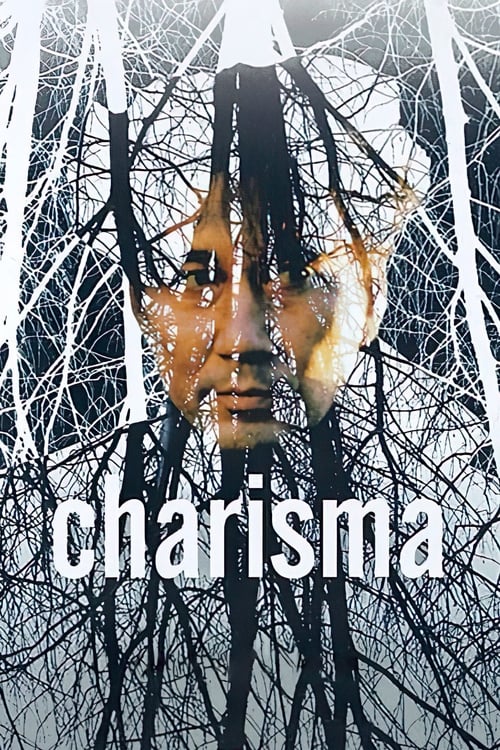
Charisma
1999 · Kiyoshi Kurosawa
When you want a film to chew on for days and argue about after — not a scare, not a comfort watch, but a genuine puzzle for a curious, patient evening.
What it's about
A police negotiator freezes at the decisive moment of a hostage standoff and loses both the hostage and his footing in the world. He drifts out of the city into a mountain forest, where he finds a strange withered tree called Charisma — and a scattering of people at war over it. Some say the tree is poisoning the forest; others guard it with their lives. He's asked, in effect, to restore the rules of the world, and no one can agree what they are.
The experience
Strange, dry, quietly funny and genuinely unresolvable — it plays like a thriller that has wandered into a philosophy problem and decided to stay. You come out arguing with yourself, which is the point.
Performances
Kōji Yakusho is the ideal guide through the absurdity — baffled, stubborn, and deadpan, he keeps an allegory about a tree feeling like a story about a man.
The craft
Kurosawa shoots the forest as a world with its own broken logic — wide, watchful compositions, sudden bursts of violence, a tone that slides between deadpan comedy and menace without warning. The sound of the woods does half the storytelling.
Why it matters
Landing between Cure and Pulse, it became one of the most argued-over films of Kurosawa's great late-90s run — a cult object that shows his unease was never only about ghosts.
Snapshot
Charisma (Karisuma) is a parable about a police negotiator who loses his place in the world. It became one of the most argued-over films of Kiyoshi Kurosawa's late-1990s run. It came out between Cure (1997), which brought him international attention, and Pulse (Kairo, 2001), which secured his reputation. Kōji Yakusho, Kurosawa's regular lead in this period, plays detective Goro Yabuike. He tries to save both a hostage (a politician) and the hostage-taker, and fails both. The note the gunman leaves behind, usually translated as "restore the rules of the world", follows Yabuike out of the city and into a mountain forest. There he finds a strange, withered tree called "Charisma", and a group of people with competing claims on it. Some believe the tree is poisoning the forest around it. Others guard it. Others want to sell it. Yabuike drifts from faction to faction. He refuses each side's logic and keeps returning to the idea that both things — the one tree and the whole forest — might be allowed to live, even if that destroys the system.
The film adapts the ecological allegory into something stranger: a philosophical thriller that is cold and deliberately hard to pin down, part black comedy and part apocalyptic fable. It screened at Cannes in the Directors' Fortnight in 1999 and opened in Japan in early 2000. It is often called Kurosawa's most openly allegorical film, and the most divisive one.
Industry & production
Charisma was made during the most productive stretch of Kurosawa's career. In the late 1990s he moved between direct-to-video genre work (the V-Cinema yakuza films of the mid-decade), low-budget features, and festival projects, sometimes finishing several films a year. License to Live (1998) and Barren Illusion (1999) came from the same period. Kurosawa has said in interviews that the Charisma script went back years, to well before Cure. It was a project he could only get made once Cure's success at home and abroad gave him leverage. Accounts of its exact development history differ, and the details of its financing and production companies are poorly documented in English-language sources.
The film's resources look modest. Most of it was shot on location in forest, in a few rural buildings and in a sanatorium-like ruin, with a small cast. This fits the economics of independent Japanese production at the end of the 1990s, when the studio system had largely collapsed. Directors like Kurosawa worked on tight budgets and schedules, often through partnerships between production houses, video distributors and broadcasters. The film's Cannes slot (Directors' Fortnight rather than the official competition) reflects his position at the time: newly visible to programmers, not yet a competition regular.
Technology
Charisma is a 35mm film made with conventional tools. It makes no use of the digital effects or video formats Kurosawa would experiment with elsewhere. Its strangeness comes from location, light and framing, not technology. The tree itself is a physical prop. Its unremarkable, gnarled ordinariness is part of the joke: everyone fights over something that barely looks like anything. The few violent or fantastical moments are handled with practical, unglamorous means, often off-screen or in long shot. This matches Kurosawa's general preference for hiding horror in plain, undramatised images.
Technique
Cinematography
The film was shot by Junichiro Hayashi, the cinematographer behind Cure and later Pulse. Kurosawa and Hayashi built the visual style these films share. The camera sits back. Takes run long and the camera often doesn't move. Figures are placed in the middle distance of wide frames, so the setting weighs as much as the people in it. In Charisma the forest isn't shot as lush or romantic. It looks grey-green, overcast, uniform and slightly sick. The light is flat and natural, with frequent mist. Interiors are dim and full of clutter. The tree is rarely given a heroic close-up. It tends to be seen from a distance, as a shape among other shapes, which suits the film's question of whether it is special at all.
Editing
The editing (by Kurosawa's regular collaborators of the period; credits in English sources are inconsistent) follows the director's usual approach: long takes, few cuts, and scenes that end abruptly instead of building to a peak. Violence often comes without a cut to prepare for it. The camera keeps running and an act of brutality simply happens inside the frame, which makes it more shocking. The film's ellipses are large. Time passes without clear markers, characters vanish and return, and Yabuike's motives are never fully explained. The story moves in blocks: an alliance with one faction, then another, then betrayal. It feels more like a series of philosophical positions being tested than a plot moving forward.
Mise-en-scène / staging
Kurosawa's staging puts characters at odd, uncomfortable distances. Conversations happen across rooms, through doorways and in the open. A sense of the absurd runs through the film: people argue earnestly about a tree's metaphysical status in muddy clearings, and fatal decisions are made in the middle of mundane chores. Recurring locations include a ruined institutional building used as a base, a botanist's house in the woods, and the clearing where the tree stands. Each is marked by decay, abandonment or makeshift occupation. The world looks like it has already been left behind. That fits the closing images, which open onto a wider collapse.
Sound
Sound is sparse and subtle. Natural forest sound (wind, insects, distant machinery) dominates, and silence is used for pressure. The music, credited in most sources to Gary Ashiya, who also scored Cure, is used sparingly and tends towards unsettling, unresolved textures instead of melody. As in other Kurosawa films, the soundtrack often hints at a threat the image doesn't show. Background hums and low drones make the forest feel watchful, even hostile.
Performance
Kōji Yakusho's performance anchors the film. His Yabuike is calm, drained and almost blank. He is not a classic hero, and in his passivity he becomes a vessel for the competing ideologies around him. Yakusho had played a detective facing a troubling mirror figure in Cure. Here he plays a man who has stopped being a detective. The role asks him to withhold: to stay flat when other actors would show anguish, and to make Yabuike's few decisions feel at once arbitrary and inevitable. The supporting cast is led by Hiroyuki Ikeuchi as Kiriyama, the tree's young, fanatical guardian, with Jun Fubuki as Jinbo, a botanist, and Ren Osugi, a familiar face in Japanese genre and art cinema, as the leader of a forestry crew. Their acting is pitched in a heightened, slightly deadpan register. The characters speak like mouthpieces for positions as much as like people, and this gives the film its dry comedy.
Narrative & dramatic mode
Charisma works as a fable, or a philosophical puzzle, more than as a psychological drama. The hostage prologue sets up a dilemma — one life against another, the individual against the order — and the rest of the film repeats it on a larger, more abstract scale. The tree stands for the individual. The forest stands for the collective. One faction wants to kill the tree to save the forest. Another wants to protect the tree at all costs. Speculators see it as a commodity. Yabuike's eventual position, that both can live, sounds humane at first. The film then follows it to conclusions that are anything but comforting.
Its tone is famously ambiguous: deadpan, menacing and absurd at once. Kurosawa doesn't tell the audience which faction is right, whether the tree really poisons anything, or what the "rules of the world" are. The ending widens the frame from the forest to a city apparently in crisis or burning. It reads as apocalypse, liberation, or both, and the film refuses to settle which.
Genre & cycle
The film sits on the edge of several genres. Its premise — a disgraced detective, a hostage crisis, an investigation — draws on crime-thriller conventions. Its atmosphere and occasional eruptions of violence connect it to the J-horror cycle that Kurosawa (with Hideo Nakata, Takashi Shimizu and others) was helping to define at the time. Its structure is closer to the art-cinema parable. It belongs most naturally to the group of late-1990s and early-2000s Kurosawa films that use genre as a vehicle for social and metaphysical unease: Cure, License to Live, Barren Illusion, Séance (2000), Pulse and Bright Future (2003). Critics have often called Charisma the most explicitly "philosophical" of these, and the one least interested in genre payoffs.
Authorship & method
Kurosawa wrote and directed the film. It shows his signature concerns clearly: the dissolution of social bonds, an indifferent or hostile universe, characters who act on impulses they can't explain, and horror lodged in ordinary spaces. Kurosawa trained in the film culture of Rikkyō University, where the critic Shigehiko Hasumi taught. Hasumi's emphasis on cinema as a material and visual art, and his teaching of American genre filmmakers, shaped a generation of Japanese directors. Kurosawa started in 8mm independent film and worked as an assistant (including to Shinji Sōmai) before making pink films and V-Cinema. That route through low-budget genre production shaped his economy and his trust in suggestion over exposition.
Key collaborators in this period include cinematographer Junichiro Hayashi, central to the restrained, distanced look of Kurosawa's late-1990s work, and composer Gary Ashiya. Kōji Yakusho, who became Kurosawa's most frequent lead across Cure, Charisma, Séance, Pulse (a cameo), Doppelganger (2003), Retribution (2006) and Tokyo Sonata (2008), is in a sense a collaborator too: his combination of ordinariness and deep reserve suits the director's protagonists.
Movement / national cinema
Charisma belongs to the late-1990s revival of Japanese cinema's international profile, a wave that included Takeshi Kitano's festival success, Shōhei Imamura's second Palme d'Or (The Eel, 1997), Hirokazu Kore-eda's early features, and the export of J-horror. Kurosawa is often grouped with a generation of independent filmmakers whose work showed the economic and psychological after-effects of the burst bubble economy. It is also sometimes read in the shadow of the 1995 shocks — the Great Hanshin earthquake and the Aum Shinrikyo sarin attack on the Tokyo subway — which unsettled Japanese assumptions about social order and safety. Critics have read Charisma's competing factions, its charismatic fanatic and its seemingly purposeless violence through that lens. Kurosawa himself has generally resisted one-to-one allegorical readings.
Era / period
The film comes from the tail end of the "Lost Decade", a period of economic stagnation, rising unemployment and widespread anxiety about the failure of postwar institutions. The question that drives Charisma — whether the individual should be sacrificed to keep the system running, or whether the system should be allowed to fall — had obvious resonance in a society facing corporate collapse, failing banks and a sense that the old rules no longer applied. Its millennial date also matters. A film released on the cusp of 2000 that ends with a city apparently in flames fits the broader fin-de-siècle mood, though Kurosawa's apocalypse is quieter and more ambiguous than most.
Themes
- The individual and the whole. The core dilemma, set up in the hostage scene and replayed through the tree, is whether one life can or should be sacrificed for the many. The film tests a utilitarian answer, a protective answer and a market answer, and finds them all wanting.
- The rules of the world. The hostage-taker's note asks for these "rules" to be restored. The film suggests that what society calls rules may be arbitrary conventions, and that seeing them clearly may mean breaking them.
- Charisma itself. The title points both to the tree and to the human quality of drawing others in. The tree has no visible power; its "charisma" comes entirely from what people project onto it. The film is a dry study of how objects and leaders become magnetic.
- Ecology and contagion. The idea that one organism might be poisoning its surroundings offers an ecological reading. Kurosawa leaves it open whether the poisoning is real or an excuse for destruction.
- Withdrawal and drift. Yabuike's departure from his job and family, without explanation, links to a recurring Kurosawa figure: the person who quietly steps outside society and finds no place on the other side.
- Apocalypse as release. The ending shows collapse as a catastrophe and, possibly, as a strange freedom. Pulse and Bright Future would push this ambivalence further.
Reception, canon & influence
Critical reception. At Cannes and on release, Charisma puzzled many critics. Some praised its formal control and boldness. Others found it opaque or frustrating, especially next to the more accessible genre structure of Cure. In the English-speaking world it was seen mainly at festivals and later on home video, and its standing has grown. Critics writing on Kurosawa's career often treat it as a key film for understanding his philosophy, even if it is not one of his most-loved. It is usually ranked below Cure and Pulse but cited as central to his thematic project. Box-office figures are not reliably documented, and it does not seem to have been a commercial success.
Influences on the film (backward). Kurosawa has openly acknowledged his debt to American genre cinema, especially directors like Tobe Hooper, Richard Fleischer and Don Siegel, and to Hasumi's teaching of film as a visual medium. Critics have often compared Charisma to Andrei Tarkovsky's Stalker (1979). Both have a mysterious zone, competing claims on a strange object, and a philosophical treatment of desire and belief. Some also see in it the deadpan, institutional absurdism of European modernism. These comparisons come from critics. Kurosawa's own statements on specific sources for Charisma are scarce in English.
Legacy (forward). Inside Kurosawa's own body of work, Charisma leads straight to the apocalyptic endings of Pulse, where a society empties out, and to Bright Future, with its poisonous jellyfish spreading through Tokyo's waterways. That image recalls the contagious tree. Later films such as Before We Vanish (2017) return to the idea of fixed social concepts being stripped away. More broadly, the film helped establish Kurosawa as a director who uses genre frameworks for philosophical inquiry, a reputation that brought later festival recognition, including the Un Certain Regard Jury Prize for Tokyo Sonata and the Silver Lion at Venice for Wife of a Spy (2020). Its direct influence on other filmmakers is harder to document than Cure's or Pulse's. It survives less as a model to imitate than as a reference point for the "philosophical thriller", and as a demonstration of how much menace and argument a filmmaker can put into a single, ordinary-looking tree.
Influences: the films it descends from and the films it influenced
- Stalker (1979) — A forbidden zone around a mysterious object that rival seekers project their desires onto, filmed in slow long takes through damp, decaying, overgrown locations. Charisma moves this structure into a Japanese forest and its tree.
- The Texas Chain Saw Massacre (1974) — Sudden, unprepared violence in a flat, wide, daylight frame with no warning in the cutting, as with the sledgehammer blow. Kurosawa, who admires Hooper, uses the same method for Charisma's abrupt killings.
- Invasion of the Body Snatchers (1956) — Siegel's plain, unemphatic genre economy, where a spreading organic contagion turns a community against itself in ordinary locations. Charisma's tree, which poisons the forest around it, works the same way.
- Typhoon Club (1985) — Sōmai's one-scene, one-shot long takes, which hold groups of people in wide frames and let behaviour play out without cutting in. Kurosawa worked as Sōmai's assistant and took this staging method into his static wide long takes.
- Weekend (1967) — A deadpan, distanced society falling apart, with characters speaking ideological positions straight out. Charisma's ensemble of mouthpieces and its absurdist apocalypse come from this modernist mode.
- Angel Dust (1994) — Extends the 'landscape/city as sick organism' cinematography and long, drone-scored takes of environmental dread that Angel Dust pioneered in its Tokyo exteriors.
- August in the Water (1995) — Kurosawa extends Ishii's ambient apocalyptic mode — a quiet ecological/cosmic catastrophe carried by drone and desaturated stillness rather than spectacle.
- Serpent's Path (1998) — Carries the warehouse-chamber grammar outdoors: the same frontal wide staging, the same significant figures parked at the frame's periphery, the same withheld motive, now at theatrical budget and festival scale.
- Pulse (2001) — Junichiro Hayashi again shoots in flat, overcast natural light with static wide frames and drone-heavy ambient sound. Charisma's ambiguous apocalypse grows into a whole society quietly emptying out.
- Bright Future (2003) — Swaps Charisma's toxic tree for poisonous jellyfish spreading through Tokyo's waterways. It keeps the same device: one strange organism, filmed with no explanation, carries a fable about collective malaise.
- Before We Vanish (2017) — Picks up Charisma's philosophical fable inside a genre frame. Deadpan characters strip fixed social concepts out of people, building to an apocalyptic ending, all played with absurdist reserve.
- Cloud (2024) — Brings back Charisma's long build-up to a sudden burst of flat, wide-shot violence in empty rural buildings. Characters kill and die with the same blank lack of affect.
- Evil Does Not Exist (2023) — Hamaguchi studied under Kurosawa. His forest parable about a community's balance moves through slow, distanced long takes and droning ambient music, then ends in sudden, unexplained violence that leaves the meaning open, a direct echo of Charisma's ending.
- Dogtooth (2009) — Lanthimos's Greek Weird Wave extends the same deadpan grammar: actors who speak ideas as flat statements, absurdist blocking in static frames, and violence cut in without any build-up.
- Time of the Wolf (2003) — An unexplained social collapse filmed in static wide long takes in grey natural light, with violence that arrives offhand and an ending that stays open. Like Charisma, it pits the individual against a group as it forms in the ruins.
- Cure (1997) — Builds the template Charisma pushes further: Kōji Yakusho's withheld, blank detective, violence placed matter-of-factly in a fixed wide shot, and long ellipses that leave cause and motive out of the story.
- License to Live (1998) — Made just before Charisma. It uses the same deadpan, distanced blocking of characters in run-down semi-rural spaces and the same parable structure about a man who has to build a self from nothing.
- Barren Illusion (1999) — Made the same year in the same low-budget independent mode. It holds disaffected figures in static wide frames in empty, decaying parts of the city, with dialogue kept to the bare minimum.
- Eureka (2000) — Aoyama was a fellow student of Hasumi at Rikkyō and part of the same late-90s revival. Eureka works in patient, fixed long takes that record sudden violence and its aftermath from a cool distance, as Charisma does.
Similar films
- Cure (1997) — influence & lineage
- Dersu Uzala (1975) — shared sensibility
- Rashomon (1950) — shared sensibility
- Chime (2024) — shared sensibility
- Serpent's Path (1998) — shared sensibility
- Creepy (2016) — shared sensibility
- After Life (1999) — shared sensibility
- Séance (2004) — shared sensibility