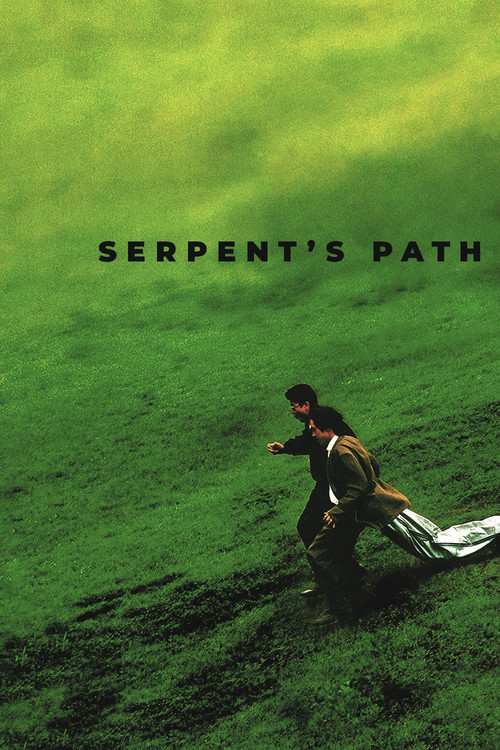
Serpent's Path
1998 · Kiyoshi Kurosawa
The J-horror master's prolific late run (Cloud at Venice, the Serpent's Path self-remake) fuels a "finally getting his flowers in the West" appreciation cycle among genre cinephiles.
For when you want a hard, disquieting thriller rather than a crowd-pleaser — something that unsettles you and gives you plenty to argue about afterward. Challenge, not comfort.
What it's about
A father whose young daughter was kidnapped and murdered sets out for revenge, helped by a mysterious acquaintance — an eerily calm math tutor — as they abduct the man they believe is responsible and chain him up in an abandoned warehouse. But every answer they extract points to someone else, and the hunt keeps widening into something larger and stranger than one killer.
The experience
Cold, controlled, and increasingly unnerving — a revenge thriller that withholds the catharsis the genre promises and replaces it with creeping dread. At under ninety minutes it's lean and fast, but it lingers like a bruise.
Performances
Shō Aikawa, a fixture of Japan's direct-to-video crime cinema, is the film's chilling center as the unreadable tutor Niijima, playing everything at a flat calm that becomes scarier than any outburst; Teruyuki Kagawa gives the grieving father a raw, unstable desperation that grounds the film emotionally.
The craft
Kiyoshi Kurosawa shot this fast and cheap for Japan's video market — back-to-back with a companion film — and turns those limits into style: long static takes, empty industrial spaces, violence kept matter-of-fact. The direction methodically drains a pulpy premise of its genre pleasures, which is exactly what makes it so disturbing.
Why it matters
Made at the moment Kurosawa was breaking through as an international auteur, it's a key example of how Japan's 1990s direct-to-video boom became a laboratory for some of the era's most distinctive filmmaking.
Snapshot
Serpent's Path (Hebi no michi, 蛇の道) is a lean, under-ninety-minute revenge thriller made for Japan's direct-to-video market at the exact moment Kiyoshi Kurosawa was becoming an international auteur. Shot back-to-back with its companion piece Eyes of the Spider (Kumo no hitomi), both starring the V-cinema fixture Shō Aikawa, it takes the most legible of genre premises — a father hunting his daughter's killers — and methodically empties it of catharsis. Aikawa plays Niijima, a cram-school mathematics tutor of unnerving calm; Teruyuki Kagawa plays Miyashita, the ex-yakuza whose child was murdered. Together they chain a succession of men to the floor of an abandoned warehouse and demand names. Each name yields another. The conspiracy widens from a single killer to something closer to an industry, and the film's final reversal turns the two avengers' positions inside out.
What distinguishes the film is not its plot mechanics but its refusal of affect. Kurosawa films torture and confession in long, cool, frontal wide shots, at a distance that denies the spectator both identification and relief. The result is one of the strongest things he made in his V-cinema years — a work that sits directly downstream of Cure (1997) and directly upstream of the 2000s films that made his name, and that he thought worth returning to a quarter-century later, remaking it in French in 2024.
Industry & production
The film belongs to a specific and now largely vanished production ecology: Japanese V-Cinema, the straight-to-video feature market that Toei formalized in 1989 and that rival companies quickly imitated under the general heading of Original Video (OV). The economics were dictated by the VHS rental chains that had saturated Japan through the 1980s: modest budgets, shooting schedules measured in days rather than weeks, running times trimmed to fit a rental cassette, and reliable genre content — yakuza pictures above all — sold on the recognizable face on the sleeve. Shō Aikawa was one of the market's defining faces, a star whose name on a box guaranteed a certain volume of rentals.
Kurosawa had been working inside this system for most of a decade. After a pink film for Nikkatsu, the studio-disowned The Excitement of the Do-Re-Mi-Fa Girl (1985), and a bruising experience on Sweet Home (1989) that ended in litigation with producer Jūzō Itami over the final cut, he had spent the early and mid-1990s making genre assignments that he treated as laboratories. The six-film Suit Yourself or Shoot Yourself series (1995–96), starring Aikawa, established the working relationship that Serpent's Path extends. The crucial context is that Cure had opened theatrically in 1997 and had made Kurosawa a name to watch on the festival circuit; Serpent's Path and Eyes of the Spider were made immediately afterward, in the V-cinema mode, by a director who now had both a reputation and no obligation to protect it.
The paired-production arrangement — two features with the same lead actor, the same revenge premise and overlapping crew, shot in close succession — is a standard low-budget efficiency, and reports of very compressed schedules are widely repeated, though precise figures differ between sources and should be treated as approximate. Because the film went to video rather than to cinemas, there is no meaningful box-office record for it, and English-language documentation of its below-the-line credits is thinner than for Kurosawa's theatrical features of the same years.
Technology
Three technological facts shape the film. The first is the delivery format. A VHS-destined feature in 1998 was designed for a small, low-contrast, 4:3-cropped domestic screen, and Serpent's Path is unusually disciplined about what survives that reduction: strong silhouettes, high-contrast pools of light in dark industrial volumes, and blocking legible at a glance. Paradoxically, the same choices read as severe formal rigor when the film is projected large — which is how it has mostly been seen since restorations and festival retrospectives brought it out of degraded rental-tape transfers and into repertory and disc circulation in the 2000s and after.
The second is video as subject. The film's chain of complicity runs through recorded images — the atrocity exists as footage, watched on a monitor, and the act of watching is itself part of what implicates the characters. This is not incidental to 1998. The screenwriter, Hiroshi Takahashi, wrote Ring (Ringu) the same year, and the two films share a conviction that the videotape is a contaminating object: something that transmits harm by being viewed. Japan's late-1980s and 1990s moral panics about video — crystallized in the coverage of the Miyazaki child murders and the discourse about tape collections and otaku interiority — are the ambient pressure behind that idea.
The third is the computer, which appears in the film as a machine for calculation and pattern rather than for communication, in keeping with Kurosawa's later, more explicit treatment of networked isolation in Pulse (2001). The mathematical material running alongside the revenge plot is not decoration; it is the film's counter-technology, a system of clean deduction placed beside a system of dirty, recursive blame.
Technique
Cinematography
The camera is characteristically Kurosawan: static or very slowly mobile, placed at a middle distance, frequently frontal, and committed to the long take. Scenes of interrogation and violence are held in wide shot with the full geometry of the warehouse visible — captor, captive, the depth of the space behind them — rather than broken into the close-ups that conventional thriller grammar would demand. Shot/reverse-shot is used sparingly, which has the effect of denying the audience the usual purchase on interiority. We watch bodies in rooms.
The palette is drained: concrete grey, rust, sodium light, the dull green of industrial paint. Kurosawa's fondness for the semi-transparent barrier — hanging plastic sheeting, dirty glass, billowing fabric — recurs here as it does across Cure and Pulse, dividing the frame into planes and letting figures blur or dissolve as they cross them. Exteriors favor the emptied margins of the city: vacant lots, riverbanks, reclaimed land, the undeveloped edges of post-bubble Tokyo where construction stopped and never resumed.
Precise cinematography credits for Kurosawa's V-cinema titles are not well documented in English-language sources, and it would be irresponsible to assign this film's images to the collaborator most associated with his theatrical work of the period. What can be said securely is that the visual system here is continuous with the one Kurosawa was developing with Jun'ichirō Hayashi on Cure, Charisma and Pulse: the same distrust of the close-up, the same use of dark industrial volume, the same preference for letting an event happen somewhere in a large frame rather than being delivered to the lens.
Editing
The cutting is patient and structurally repetitive. The film's spine is a series of near-identical situations — a new man, the same floor, the same chain, the same questions — and the editing declines to vary its rhythm to signal escalation. What changes is content, not tempo, which is precisely the point: the procedure grinds on, indifferent. Cuts tend to arrive late, holding after an action has concluded so that the aftermath is included in the shot. Transitions are often abrupt and elliptical, dropping the viewer into a new location without establishing coverage, so that the widening conspiracy is experienced as disorientation rather than as a satisfying unfolding.
Mise-en-scène / staging
The warehouse is the film's governing idea. It is a stage — bare, high, sourced by a few practicals — and Kurosawa stages within it as a theater director would, in depth and in relation to fixed architecture: the pillar, the chain, the doorway, the chair. Characters are frequently positioned with their backs to us or turned three-quarters away. Violence often happens at the periphery of the frame or in a corner of the composition, unemphasized, while something ordinary occupies the center.
This flatness of presentation is an ethical stance as much as a stylistic one. Kurosawa refuses to aestheticize the atrocity or to grant it the operatic scale that would let a viewer enjoy it. Confession and cruelty are filmed with the same evenness as a man eating lunch, and the effect over eighty-odd minutes is a slow, unplaceable dread.
Sound
The soundtrack is dominated by room tone: the acoustic of a large empty building, distant traffic, wind, the small mechanical noises of chain and metal. Scoring is sparse and used strategically rather than continuously, and the film derives much of its unease from sound that arrives without visible source — footsteps, hums, something moving off-screen. Silence is treated as an active element; long stretches proceed with no music at all, so that the absence of reassurance becomes part of the film's texture. Documentation of the music credit for this title is thin in English-language sources, and I will not guess at it.
Performance
The central contrast is the film's engine. Aikawa, a star built on V-cinema swagger, is stripped of every gesture that made him bankable: Niijima speaks quietly, moves economically, smiles at the wrong moments and registers almost nothing. The blankness is not absence but withholding, and it reads retrospectively as the film's largest clue. Kagawa, by contrast — an actor from a kabuki lineage, the son of Ichikawa Ennosuke III, who would later take the name Ichikawa Chūsha IX and who would go on to anchor Kurosawa's Tokyo Sonata (2008) — plays Miyashita in registers of raw, escalating distress, sweating and pleading and shouting. The pairing of a trained stage performer's expressive maximum against a genre star's deliberate zero is what makes the final reversal land.
Narrative & dramatic mode
The film operates as a chamber piece with a serial structure: capture, interrogate, receive a name, release or dispose, repeat. Each iteration promises resolution and delivers deferral. What looks at first like a detective's chain of inference turns out to be a regress — every guilty man is subordinate to another guilty man, and the organization behind the child's death expands until "who did it" ceases to be an answerable question and becomes an indictment of a structure.
Against this runs the mathematics track: Niijima teaching, reasoning, working problems. Kurosawa uses it as a formal counter-voice — a domain in which reasoning terminates in a correct answer — set beside a moral domain in which it never does. The film's closing move reverses the two men's roles and retroactively rewrites everything preceding it, exposing the entire investigation as an instrument that one character has been operating on the other. It is a twist, but delivered without triumph: no crescendo, no explanatory monologue of any length, just a reassignment of who is chained to the floor.
Genre & cycle
Nominally this is a yakuza revenge picture, the staple V-cinema product. Structurally it belongs to a small cluster of films about the interrogation room as a moral trap, and it anticipates the international "confinement thriller" that flourished in the following decade. Its more immediate cycle is the late-1990s Japanese turn toward calm, clinical depictions of extremity — the same years that produced Takahashi's Ring, Takashi Miike's escalating genre experiments, and Kurosawa's own Cure. Where Miike's work of the period is baroque and accelerative, Kurosawa's is decelerative; the two represent opposite solutions to the same low-budget genre constraints.
Retrospective viewers often note the resemblance between Serpent's Path and the Korean revenge films of the early 2000s, Oldboy (2003) above all. The resemblance is real — the captivity chamber, the vengeance that curdles into complicity, the revelation that the avenger has been managed — but resemblance is not lineage, and I am not aware of documented statements establishing direct influence. It is safer and more accurate to say that these films are convergent responses to a shared regional and generic moment.
Authorship & method
Kurosawa (b. 1955) came out of the film-studies seminars of Shigehiko Hasumi at Rikkyo University, the formative milieu for a cohort that included Shinji Aoyama, Akihiko Shiota and Makoto Shinozaki. Hasumi's criticism — attentive to surface, framing and gesture, hostile to psychological and literary explanation — is directly legible in Kurosawa's practice, which consistently declines to explain its characters. He also apprenticed in the industry, working as an assistant to Shinji Sōmai, whose commitment to the long take is visible in Kurosawa's shot durations. Alongside that, Kurosawa has long and openly professed his debts to American genre craftsmen — the line running through Don Siegel, Robert Aldrich, Samuel Fuller and, in horror, Tobe Hooper — and his method is best understood as the application of an essentially critical intelligence to disreputable genre material.
The decisive collaborator here is the screenwriter Hiroshi Takahashi, who in the same year wrote Ring for Hideo Nakata. Takahashi's scripts characteristically build dread from withheld information and treat images and recordings as vectors of harm, and both tendencies are structural in Serpent's Path. Shō Aikawa functions as a collaborator as much as a star: Kurosawa had already spent six films in the Suit Yourself or Shoot Yourself series learning what to subtract from him. Teruyuki Kagawa would become a recurring Kurosawa lead a decade later. On the technical crew, Kurosawa's late-1990s working group — cinematographer Jun'ichirō Hayashi and editor Jun'ichi Kikuchi among them — defined the look and cutting of the adjacent theatrical features; the specific crew assignments on this V-cinema title are not reliably documented in accessible English sources, and I flag that gap rather than fill it.
Movement / national cinema
Serpent's Path sits inside the 1990s Japanese revival that followed, rather than emerged from, the collapse of the old studio system. With the majors weakened, production migrated to independents, television money and the video market, and a generation of directors used those cheap, unsupervised channels as a training ground. Internationally the decade was defined by Takeshi Kitano's Golden Lion for Hana-bi (1997), Hirokazu Kore-eda's festival emergence with Maborosi (1995) and After Life (1998), and the horror breakout of Ring; Kurosawa's own international recognition arrived through Cure, then Cannes selections for Charisma (1999) and Bright Future (2003), and later the Un Certain Regard jury prize for Tokyo Sonata (2008).
The film is also a document of a specific national landscape. Its vacant lots, disused industrial buildings and unfinished edge-of-city spaces are the physical residue of the asset bubble's collapse, and Kurosawa treats them not as production-value shortcuts but as the film's true setting: a country full of rooms that no longer have a use.
Era / period
1998 falls in the middle of Japan's "lost decade." The bubble had burst in 1991; 1995 delivered the Kobe earthquake and the Aum Shinrikyō sarin attack within ten weeks of each other, an ordering shock that criticism has repeatedly read into Cure's account of contagious, motiveless violence. The Asian financial crisis of 1997 brought down major Japanese financial institutions, and in 1998 the country's annual suicide total crossed thirty thousand for the first time. The 1997 Kobe child murders had, months before this film's production, put the killing of children at the center of national attention.
Serpent's Path does not reference any of this directly. It absorbs it as mood: institutions that cannot be appealed to, guilt that distributes itself across an organization until no individual can be held, a father who cannot protect a child and an avenger who cannot locate an enemy.
Themes
The film's central proposition is that revenge is an epistemological failure before it is a moral one. Miyashita wants a culprit; the world offers him a system. Each confession is true and each is insufficient, and the pursuit of a final responsible party becomes indistinguishable from the perpetuation of the cruelty being avenged.
Around that sit several persistent Kurosawa concerns. Complicity as infrastructure: evil here is organized, salaried and procedural rather than monstrous. The contaminating image: what has been recorded can be watched, and watching implicates. Fatherhood as failure, the wound the film keeps pressing and the ground of its final reversal. Reason against the irrational: mathematics as the one discourse that terminates, offered as a bitter joke beside a moral problem that does not. And, most characteristically, flat affect as form — Kurosawa's conviction that horror is best rendered at room temperature, in wide shot, in available light.
Reception, canon & influence
Contemporary reception. Honesty requires saying that the immediate critical record is thin. A 1998 direct-to-video release in Japan was not routinely reviewed, and there is no box-office figure to cite because there was no theatrical run. The film's reputation was built afterward, through Kurosawa retrospectives, festival programming and home-video release once Cure, Charisma and Pulse had made him a director whose back catalogue was worth excavating. Restorations subsequently replaced the poor tape transfers on which the film had circulated for years.
Influences on the film (backward). The yakuza genre supplies the premise and the star, but the film's method is closer to a systematic inversion of Kinji Fukasaku's kinetic jitsuroku cycle: the same criminal milieu, the handheld violence replaced by a locked-off camera. Hasumi's anti-psychological criticism supplies the refusal to explain; Sōmai's example supplies the duration; the American B-picture tradition Kurosawa has repeatedly named supplies the economy. Takahashi's script brings the Ring-adjacent logic of transmissible harm. And the surrounding Japanese discourse of the 1990s — video panic, child murder, institutional collapse — supplies the subject matter, absorbed as atmosphere rather than cited as reference.
Legacy (forward). Within Kurosawa's own body of work the film is a hinge: it consolidates, at V-cinema scale and speed, the grammar that Charisma, Pulse and Bright Future would carry to Cannes. It is now widely regarded as the strongest of his video-market titles and is routinely programmed alongside Cure as evidence that the 1997–2001 stretch is his major period. Its paired relationship with Eyes of the Spider has become a case study in how a director can run two treatments of one premise as controlled variations.
The clearest measure of its durability is that Kurosawa returned to it himself. His French-language Serpent's Path (2024), a Japanese–French co-production starring Kō Shibasaki and Damien Bonnard and premiered on the festival circuit, transposes the story to Europe and reassigns the Niijima role to a woman — an unusual act of authorial self-remaking that brought the 1998 film renewed attention and confirmed that Kurosawa considers its central idea unfinished business. Beyond his own filmography, the film's captivity-and-confession structure prefigures a global thriller mode of the 2000s; the honest formulation is that Serpent's Path got there early, in the cheapest available format, and that later films arriving at similar shapes did so convergently rather than in documented descent from it.
A Deleuzian reading
A man is chained to the floor of an abandoned warehouse.
The full Deleuzian reading of Serpent's Path →
Reception
Made fast and cheap as straight-to-video V-cinema, it was barely seen outside Japan for years while Cure made Kurosawa an international name; it has since been reappraised as one of his leanest, meanest works, with restorations and retrospective screenings finally putting it in front of Western audiences.
How Serpent's Path was received, from release to now →
Influences: the films it descends from and the films it influenced
- Kiss Me Deadly (1955) — Aldrich, whom Kurosawa names among his American genre masters, builds an investigation that hollows out as it advances and stages its beatings at the frame's edge or behind obstructions — coercion inferred from a dangling leg and a held reaction rather than shown, the same displacement Kurosawa makes systematic.
- The Killers (1964) — Siegel's professionals seize and interrogate civilians to reconstruct a death, shot in flat functional wide setups with no psychological rhetoric and no music under the threat — the exact procedural skeleton and economy that Serpent's Path stretches into duration.
- Pale Flower (1964) — Shinoda builds his gambling sequences out of repetitive rhythm — card-slap, chant, room tone laid over the score — and lets his hitman's blank, frequently turned-away face withhold all interiority, the sound-as-metronome and blankness-as-withholding model for the warehouse scenes.
- Shock Corridor (1963) — Fuller, another of Kurosawa's declared debts, proves a single institutional chamber can carry an entire film and shoots tabloid material — madness, murder — in blunt frontal compositions that refuse to editorialize, the license behind Kurosawa's one-room construction of 1990s child-murder panic.
- The Texas Chain Saw Massacre (1974) — Kurosawa's most-cited horror source: dread manufactured from generator hum, room tone and offscreen noise inside a derelict industrial interior, with the camera declining the close-up on the act and holding instead on the space where it is happening.
- Battles Without Honor and Humanity (1973) — Fukasaku's jitsuroku cycle supplies the criminal milieu, the organizational plotting and the star economy, and Serpent's Path proceeds by inverting its grammar point for point — handheld, canted, shrapnel-cut violence replaced by a locked-off frontal wide that will not move or cut in.
- L'Argent (1983) — Bresson's cut that arrives after the violence, his performers emptied of expression, and his displacement of the axe blow into offscreen space are the disciplined precedent for Kurosawa's late cuts, refused close-ups and drained affect.
- Typhoon Club (1985) — Kurosawa apprenticed to Sōmai (Sailor Suit and Machine Gun, 1981), and Sōmai's practice of holding an entire scene in one long, distant take — letting entrances, exits and blocking carry the event instead of cutting — is directly legible in Serpent's Path's shot durations.
- Suit Yourself or Shoot Yourself!! The Heist (1995) — Six V-cinema features with Shō Aikawa taught Kurosawa to treat a star's genre persona as a flat surface and to shoot at video-market speed; Serpent's Path casts that persona against type, draining the swagger to a blankness the camera refuses to explain.
- The Guard from Underground (1992) — Kurosawa's own prototype for the enclosed killing ground: a corporate warehouse interior in which the assailant is held in wide shot at the periphery of the frame or behind glass, and the violence occurs where the camera declines to follow.
- Cure (1997) — The immediately preceding consolidation — interrogation played in frontal wides at conversational distance, drained institutional greys, an unmoved camera through the confession, and characters whose motives the film structurally refuses to supply.
- Charisma (1999) — Carries the warehouse-chamber grammar outdoors: the same frontal wide staging, the same significant figures parked at the frame's periphery, the same withheld motive, now at theatrical budget and festival scale.
- Pulse (2001) — Scales the earlier film's toolkit to apocalypse — acousmatic offscreen sound, figures seen through semi-transparent barriers (taped doors, plastic sheeting, screens), the drained post-bubble industrial palette, and cuts that arrive after the event.
- Serpent's Path (2024) — Kurosawa's own French-language remaking keeps the frontal wide, the improvised captivity chamber and the interrogation-as-structure while reassigning the Niijima role to a woman and swapping post-bubble Tokyo margins for European institutional interiors.
- Eyes of the Spider (1998) — Shot back-to-back with the same star and the same revenge premise as a controlled variation: where Serpent's Path locks the camera off and empties the frame, its twin loosens into drift and deadpan absurdity, isolating the grammar itself as the variable.
- Ring (1998) — Written the same year by Hiroshi Takahashi, and built on the same two devices — dread generated by information withheld from the viewer rather than revealed, and a recording treated as a physical vector of harm (the tape there, the played-back footage in the warehouse here).
- Funny Games (1997) — Arrives independently at the same method: captors in a domestic chamber, the killings pushed into offscreen space while a static frontal wide holds on the room and its aftermath, with room tone and unbroken duration substituted for score and cutting.
- Eureka (2000) — From the same Hasumi seminar cohort: a trauma narrative that declines psychological explanation entirely and holds its figures in drained, distant wide compositions across extreme duration — the cohort's shared anti-psychological framing applied to genre wreckage.
Similar films
- Cure (1997) — influence & lineage
- Pulse (2001) — influence & lineage
- Ring (1998) — influence & lineage
- Creepy (2016) — shared sensibility
- I Saw the Devil (2010) — shared sensibility
- Confessions (2010) — shared sensibility
- Kuroneko (1968) — shared sensibility
- Tokyo Sonata (2008) — shared sensibility