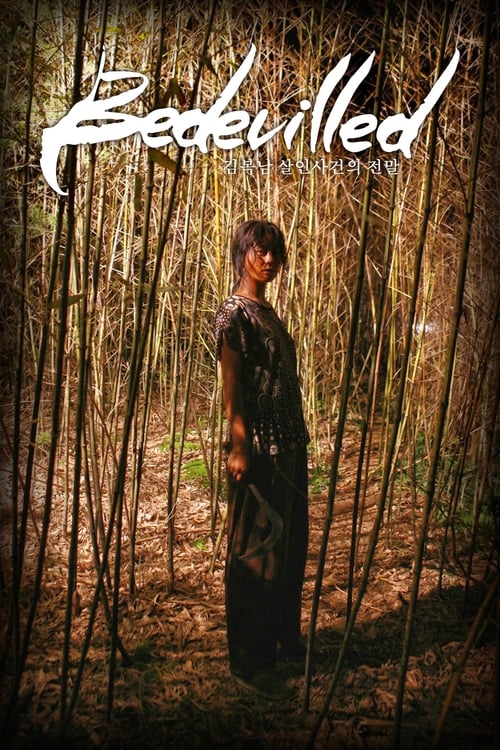
Bedevilled
2010 · Jang Cheol-soo
For when you want to be put through the wringer — a film that earns its violence and makes you feel it. Absolutely a challenge, not comfort viewing; reach for it when you're ready for something harrowing that pays off in fury.
What it's about
A guarded Seoul bank worker, pushed into taking leave after trouble at the office, retreats to the tiny island where she spent childhood summers. There she finds her old friend Bok-nam living as the island's workhorse — beaten by her husband, preyed on by his brother, and surrounded by elders who look the other way. Bok-nam's one dream is to escape to Seoul with her young daughter, and the visit forces both women toward a reckoning neither is ready for.
The experience
A slow, suffocating burn: for a long stretch it plays as grim rural drama, the cruelty mounting until the air feels unbreathable — and then it detonates. The final act is ferocious and cathartic and hard to watch, and it leaves you shaken about complicity, about everyone who stood by and did nothing.
Performances
Seo Young-hee is devastating as Bok-nam, moving from battered servility to something volcanic without ever losing the character's humanity; Ji Sung-won's chilly, self-protective Hae-won is the quiet mirror that makes it sting.
The craft
Jang Cheol-soo's debut controls its escalation with real patience: the sun-baked island looks almost pastoral, which makes the brutality land harder. The structure is the trick — an hour of accumulating dread that recodes everything when the sickle comes out — and the open-air island setting gives the violence a stark, exposed daylight quality rare in revenge cinema.
Why it matters
It became one of the defining Korean revenge films of its era, a festival breakout that announced Jang Cheol-soo and pushed the genre's conversation toward misogyny and bystander complicity rather than simple payback.
Snapshot
Bedevilled (Korean title Kim Bok-nam salinsageonui jeonmal, roughly "The Whole Story of the Kim Bok-nam Murder Case") is Jang Cheol-soo's first feature. It is a slow-burning rural drama that turns, in its final third, into a brutal revenge thriller. Hae-won (Ji Sung-won) is a brittle, self-protective bank employee in Seoul. After an unpleasant incident at work she is pushed into taking leave, and she goes to Moodo, the small island where she spent childhood summers. There she meets Kim Bok-nam (Seo Young-hee) again, her childhood friend. Bok-nam is now the drudge of the island. Her husband beats her, her brother-in-law rapes her, and the handful of elderly women who run the place do nothing to stop it. Bok-nam's one hope is to get her young daughter to Seoul. When that hope is destroyed, she takes up a sickle.
The film premiered in the Critics' Week (Semaine de la Critique) at Cannes in 2010. It then travelled widely on the international genre-festival circuit, and Seo Young-hee's performance in particular drew strong praise. Today it is regarded as one of the defining Korean revenge films after Oldboy. It also stands as an early, unusually angry indictment of the bystander, and the film treats Hae-won's urban detachment as being as guilty as the island's open cruelty.
Industry & production
Bedevilled was a low-budget independent production, made outside the large studio-distributor system (CJ, Showbox, Lotte) that dominated Korean commercial cinema at the time. The script is credited to Choi Kwang-young. Jang came from the Kim Ki-duk school. He worked as an assistant director on Kim's films of the early-to-mid 2000s, and he made Bedevilled the way Kim made his films: small crew, tight schedule, remote location, and a story built around a confined community.
Moodo is fictional. The film was shot on a real island off Korea's south-west coast, and its geography (a few houses, potato fields, a rocky shoreline, a single ferry connection) is central to the drama. English-language sources record few production specifics, such as the budget, the shooting schedule or the financing structure, and those details are not given here. Its route to prominence is better documented. The Cannes Critics' Week selection gave it international visibility before its domestic release in September 2010, and it then played genre festivals in North America and Europe, which built its reputation abroad.
Technology
Nothing about Bedevilled is technologically unusual, and the sources do not reliably confirm whether it was shot on film or digitally. Its look follows from its means: mostly natural or naturalistic light, practical locations, and a handheld-friendly setup suited to a small crew in exposed outdoor terrain. The violent climax uses practical makeup and blood effects instead of digital spectacle. This keeps the violence physical and close-up, in line with the film's insistence on the body as the place where harm happens.
Technique
Cinematography
The island is photographed with a deliberate contrast between beauty and menace. Wide shots show sunlit fields, blue sea and green hills, a landscape that could have come from a tourism brochure. Against these are cramped interiors and close shots of labour: Bok-nam bent double in the potato field, hauling, scrubbing, carrying. The most important visual motif is the sun. Bok-nam looks straight into it, and the film repeatedly frames it as a glaring, almost oracular presence. Before her rampage she says that the sun spoke to her. The bright daylight of the final act is a pointed choice. The horror happens in full glare, with nothing hidden in shadow, which fits a film about violence that everyone can see and no one names.
Editing
The structure is patient and back-loaded. Roughly the first two-thirds build up the island's daily routine of humiliation in accumulating episodes, with small cruelties normalised by repetition. The editing withholds release on purpose, so the audience shares Bok-nam's endurance and Hae-won's evasions. Once the turn comes, the rhythm tightens sharply into pursuit and confrontation. A brief Seoul prologue and a return to the city at the end frame the island story, and a closing flashback to the two girls as children recasts everything that came before as a story of betrayed friendship.
Mise-en-scène / staging
The island's social order is shown through staging. The old women sit together and watch, comment and enforce. The men loll, drink and give orders. Bok-nam is always working, usually at the edge of the frame or below the others. The few houses and the shared outdoor spaces mean nothing is private, and in the film that is a sign of complicity, not of community. Props carry thematic weight. The sickle is a farm tool that becomes a weapon. Doenjang (fermented soybean paste) is rubbed onto wounds as a folk remedy, a detail that ties care, food and injury together. Hae-won's sunglasses and city clothes mark her as a spectator who keeps her distance.
Sound
The soundtrack keeps to ambient sound for long stretches: wind, sea, insects, the scrape of tools. The score is used sparingly and holds back until the drama turns. The island's quiet makes the outbursts of shouting and violence land harder. Specific credits and documentation for the score are thin in English-language sources and are not given here.
Performance
Seo Young-hee's performance as Bok-nam is the film's centre and the main reason for its reputation. She plays a woman who has survived by appearing simple and compliant: smiling, deferential, eager, almost childlike. The performance slowly shows a mind fully aware of its situation underneath. The change in the final act is not presented as madness breaking in from outside. It comes across as rage that has been held back for a long time and is finally released, and Seo makes it plausible. Domestically the role brought her acting prizes and wide critical recognition. Precise lists of awards vary between sources and are not itemised here.
Ji Sung-won's Hae-won is the harder and less flattering role: cold, passive and self-absorbed. She is the audience's way into the island and, by the end, the object of its judgement. The supporting cast plays the island's men and the elderly women. The women are the film's most disturbing figures, because they enforce patriarchal rule while being subject to it themselves, and the cast plays them with a grotesque, sometimes blackly comic matter-of-factness.
Narrative & dramatic mode
The film works as a drama of displaced viewpoint. It opens with Hae-won and seems to promise her story. In Seoul she sees a young woman being assaulted and refuses to identify the attackers to the police, because she doesn't want to get involved. On the island, the film gradually shifts its sympathy and attention to Bok-nam, who has written to Hae-won over the years asking for help and been ignored. The Korean title, with its forensic flavour of "the whole story" behind a murder case, signals the structure. This is the backstory the official account of the killings would leave out.
The dramatic mode is a tragedy of endurance followed by catharsis. Bok-nam's attempt to escape with her daughter, Yeon-hee, ends in the girl's death, and the islanders immediately close ranks to cover it up. This is the hinge of the plot. After it, the film moves from social realism into the revenge mode. The killings are horrifying, but the narrative has built up their moral logic so carefully that the audience's response is divided: appalled, and yet in agreement. The final confrontation sets the two women against each other, and Hae-won's return to Seoul offers a small, compromised act of moral repair.
Genre & cycle
Bedevilled sits where several modes meet:
- Rape-revenge. It belongs to the tradition Carol Clover analysed in Men, Women, and Chain Saws, in which prolonged suffering is followed by retaliation. It departs from the template by spending far more time on the social machinery of abuse than on any single assault.
- The Korean revenge cycle. It follows the international success of Park Chan-wook's Vengeance trilogy (2002–2005), especially Lady Vengeance. It is rougher and more rural, less stylised than Park's films, and more rooted in class.
- Insular-community horror. Its isolated, closed society that hides atrocity places it near what is now called folk horror, with The Wicker Man and Straw Dogs as distant reference points.
- Slasher. The final act borrows the slasher's grammar of stalking and dispatch, with the sickle as signature weapon, but reverses the usual moral arrangement. The killer is the victim, and the audience is placed with her.
Its festival life on the genre circuit put it alongside other films of the period that used extreme violence for social critique. Its basic register, though, is closer to Korean art-cinema realism than to exploitation.
Authorship & method
Jang Cheol-soo's training under Kim Ki-duk is the clearest guide to his method. Kim's films, The Isle (2000) in particular, use isolated, often watery settings, female characters subjected to brutal treatment, sparse dialogue and sudden eruptions of violence. Bedevilled takes over this toolkit but changes its emphasis. Kim's films were often criticised for their ambivalent handling of women's suffering. Jang's film is unambiguous about who is wronged and puts the suffering woman at the centre as the agent of the story.
Choi Kwang-young's screenplay gives the film its moral architecture. The framing through Hae-won, the parallel between her Seoul cowardice and her island cowardice, and the forensic irony of the title are all part of it. English-language sources say little about the other key crew (the cinematographer, composer and editor), and their individual contributions are not attributed here.
Jang's later features never matched Bedevilled's critical standing. Secretly, Greatly (2013) was a commercially successful adaptation of a webtoon about North Korean spies. Bedevilled remains the film he is known for.
Movement / national cinema
Bedevilled belongs to the later phase of the "Korean New Wave" or Hallyu cinema boom. By 2010 the international success of directors such as Park Chan-wook, Bong Joon-ho, Kim Jee-woon and Kim Ki-duk had made Korean genre cinema a recognised festival brand. That brand stood for formal command, generic hybridity, extreme violence and pointed social critique. Bedevilled is a lower-budget, independent variant of this tradition.
Within Korean cinema it also belongs to a strand of films about the gap between the hyper-modern capital and a rural periphery imagined as backward, patriarchal and lawless. Bong's Memories of Murder (2003) and Mother (2009) also explore this territory. Its insistence that communal silence and institutional indifference are forms of violence connects it to later Korean films about abuse and cover-up, most prominently Silenced (Dogani, 2011).
Era / period
The film appeared at a moment of sustained Korean anxiety about modernisation, urbanisation and the hollowing-out of rural communities, issues that were acute in a society that had industrialised within a single generation. Moodo's population is ageing, its young people have left, and it survives on subsistence farming. It is a caricature, but a recognisable one. Bok-nam's dream of Seoul is the dream of rural-to-urban migration, and the film is bleakly aware that Seoul has its own forms of indifference.
Later events gave the film an uncomfortable relevance. In 2014 Korean media exposed forced labour on salt farms in the Sinan island chain off the south-west coast, where disabled and vulnerable men had been held for years with the alleged knowledge of local communities and officials. Commentators often brought up Bedevilled in connection with the scandal, because the parallel to the film's premise was so direct. The film also came before, and in retrospect looks ahead to, the wider public reckoning with gender-based violence in Korea in the later 2010s. This included the 2016 Gangnam Station murder, the feminist mobilisation that followed, and the Korean #MeToo movement.
Themes
- Complicity and the bystander. This is the film's central theme. Its sharpest accusation is aimed less at the men who abuse Bok-nam than at those who watch. The island women enforce the order that oppresses them, and Hae-won ignores Bok-nam's letters, looks away from her bruises and refuses to testify. The opening Seoul assault and the island story mirror each other, so the city's anonymous indifference and the village's intimate complicity are presented as two forms of the same failure.
- Women as enforcers of patriarchy. The elderly women are among the film's most unsettling creations. They have absorbed and reproduce the order that once crushed them, and the film shows how oppression keeps itself going through the people it oppresses.
- Labour and the body. Bok-nam is defined by work. The film keeps showing her body being used: for farm labour, for sex, for punishment. Her revenge reclaims that body and its tools as her own instruments.
- Friendship and betrayal. Underneath the genre mechanics is a story of two girls who were once close and of the woman who left. The closing return to childhood makes Hae-won's failure personal, not just civic.
- City and country. Seoul and Moodo are not opposites. Each is a place where suffering can go unseen.
- The unseeing eye and the blinding sun. The film's visual motifs of sunglasses, looking away and staring into the sun turn the theme of witness into imagery.
Reception, canon & influence
Critical reception. Bedevilled was well received at Cannes Critics' Week and on the festival circuit afterwards. Reviewers singled out Seo Young-hee's performance and the film's control of tone across its long build-up. At genre festivals in North America it found an enthusiastic audience and was often described as one of the strongest Korean genre films of its year. Some critics found the final act's violence excessive or the island's villains too broad. Others argued that this exaggeration was the point, a fable-like heightening of real social mechanisms. Domestically it won recognition for its lead actress and its first-time director. Award lists vary between sources and are not itemised here.
Influences on the film (backward). Kim Ki-duk's island and water films, especially The Isle, and his general dramaturgy of silence and sudden violence. Park Chan-wook's Vengeance trilogy, especially Lady Vengeance, with its woman avenger. The rape-revenge tradition running from I Spit on Your Grave (1978) onward. Insular-community thrillers such as Straw Dogs (1971) and The Wicker Man (1973), as broad generic relatives, not documented direct sources. Further back is the Korean tradition of melodrama about women's suffering (han), which the film both draws on and turns violently around. No interviews documented in English cite these specific films as direct influences, so they are offered here as critical context.
Legacy (forward). Bedevilled became a cult film internationally and a reference point in discussions of Korean women's revenge narratives and of the cinema of complicity. It is regularly cited alongside Silenced (2011) and Han Gong-ju (2013) as one of the Korean films of the early 2010s that turned genre and melodrama toward the institutional and communal structures that enable abuse. Its isolated rural setting with a hidden atrocity looks ahead to later Korean village-horror and folk-horror films such as The Wailing (2016), although direct lines of influence are not documented. Seo Young-hee's performance is still the film's most durable legacy and is often named among the great Korean screen performances of its decade.
Influences: the films it descends from and the films it influenced
- The Isle (2000) — Jang carries over his mentor's grammar for an isolated waterbound setting: long wordless stretches, a nearly mute woman on the margins of a closed male economy, and sudden graphic violence breaking a still surface.
- The Housemaid (1960) — It is the Korean model for melodrama that turns into horror: a woman confined inside a household turns its domestic tools and rituals against the family. Bedevilled moves that pressure-cooker staging out to an island run like a single household.
- Onibaba (1964) — Shindo shoots a sealed-off rural landscape (the wind-blown susuki grass) in harsh natural light as both beautiful and a trap, with peasant women using farm-level violence to survive. This is the template for Bedevilled's idyllic-but-menacing island and its sickle killings.
- Straw Dogs (1971) — Its structure holds back violence: a slow, humiliating build-up inside a closed rural community, then a last-act burst in which ordinary household and farm tools become weapons.
- The Wicker Man (1973) — It is the founding daylight folk-horror plot in which an outsider arrives on an island whose whole population shares a hidden custom. Bedevilled flips it by making the islanders' shared silence the atrocity itself.
- Thriller – A Cruel Picture (1973) — It established the rape-revenge arc in which a mute, endlessly abused woman is pushed past breaking point. The genre's shift from passive suffering to methodical killing rests on a near-silent performance.
- I Spit on Your Grave (1978) — It set rape-revenge's two-part structure: an extended, unflinching first half of abuse in a remote rural place, then a second half of retribution in which the victim takes the abusers apart one by one.
- Ms. 45 (1981) — Ferrara built the avenger's rage around a mute heroine whose blank compliance cracks into killing. It anticipates Seo Young-hee's masked, smiling submission giving way to violence.
- Lady Vengeance (2005) — Park makes the female avenger the centre of the Korean revenge cycle and builds his climax around collective guilt. Bedevilled tightens both by implicating a whole community of watchers.
- Silenced (2011) — It takes Bedevilled's anatomy of communal complicity into institutional melodrama: a provincial community closes ranks around abusers, and the film stages that silence as the central horror.
- Han Gong-ju (2013) — Its fractured flashback structure slowly reveals a gang rape covered up by parents and neighbours. It shifts Bedevilled's bystander-complicity theme, and the women who enforce the cover-up, into a quiet aftermath drama.
- The Wailing (2016) — Na expands the sunlit, idyllic Korean rural space hiding communal rot into large-scale village folk horror, with suspicion and collective violence spreading through a closed community.
- Revenge (2017) — It restates rape-revenge as daylight horror: blinding sun on an empty landscape, and a heroine whose transformation is told through bodily endurance rather than night-time shadow.
- Midsommar (2019) — It refines daylight folk horror: a displaced outsider in a sunlit, pastoral, closed community, where the sun is a ritual presence and the locals' smiling hospitality hides shared violence.
- Memories of Murder (2003) — Bong shoots rural Korea in flat, open daylight (the golden rice fields) as a place where violence hides in plain sight. Bedevilled uses the same daylight-horror palette for its sunlit island.
- Mother (2009) — Kim Hye-ja's mother hides her violence behind a mask of meek, servile compliance before a farm-tool killing in a remote shack. It is the closest contemporary match to Seo Young-hee's role, a downtrodden woman who becomes a killer.
- Pietà (2012) — Kim's own later return to slow-burn cruelty and late retribution, with a woman driving the revenge plot. It shows the mentor's toolkit running in parallel with his former assistant's reworking of it.
- The Chaser (2008) — Korean New Wave thriller sharing the theme of women's disposability and institutional indifference, with the same handheld, location-anchored violence.
Similar films
- Memories of Murder (2003) — influence & lineage · same viewing thread
- Lady Vengeance (2005) — influence & lineage · same viewing thread
- The Wailing (2016) — influence & lineage
- I Saw the Devil (2010) — same viewing thread
- A Tale of Two Sisters (2003) — same viewing thread
- Oldboy (2003) — same viewing thread
- The Handmaiden (2016) — same viewing thread
- Sympathy for Mr. Vengeance (2002) — same viewing thread
All the films related to Bedevilled →
Watch it with: curated runs of related films
- New Korean Cinema — Watch these in a run and you feel one national cinema flip between monster movie, revenge thriller, gothic horror, and slow-burn procedural without ever loosening its grip on class, history, and family.
- Elegant Savagery — A run of sleek, merciless thrillers where vengeance arrives in tailored suits and is paid in broken bone — watch these when you want beauty and brutality in the same frame.