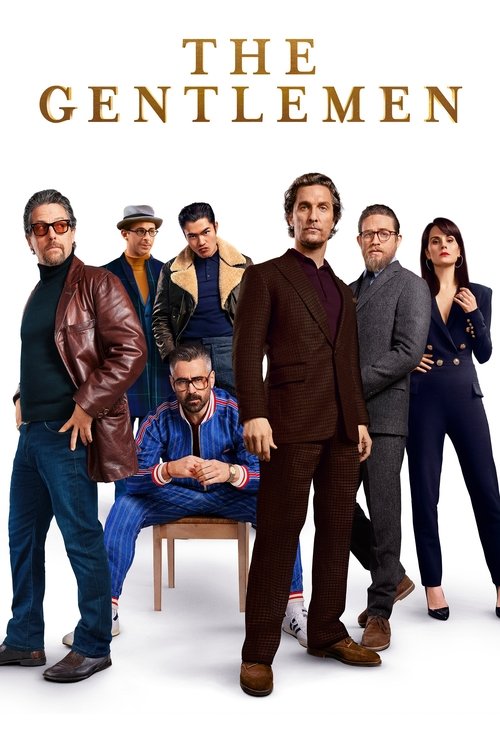
The Gentlemen
2020 · Guy Ritchie
For a Friday night when you want banter, style, and plot twists without emotional heavy lifting — pour a drink and enjoy the show. Fair warning: the humor is deliberately crude.
What it's about
An American expat has spent decades building a massive marijuana empire hidden beneath the estates of England's cash-strapped aristocracy. When word spreads that he wants to sell up and retire, every schemer in London — rival gangsters, tabloid muckrakers, ambitious upstarts — starts circling, and the whole tangled plot is recounted to us by a blackmailing private investigator pitching it as a movie script, so you're never quite sure whose version you're getting.
The experience
Fast, filthy, and very funny — a swaggering crime comedy that runs on verbal jousting, double-crosses, and sudden violence, told through a storytelling gimmick that keeps you pleasantly off balance. It's more cheeky than tense; the pleasure is watching clever people out-talk each other.
Performances
Hugh Grant, playing gloriously against thirty years of charm, steals the film as the oily tabloid fixer narrating the whole affair; Matthew McConaughey brings laconic menace as the kingpin, and Colin Farrell is a deadpan delight as a tracksuited boxing coach dragged into the mess.
The craft
Guy Ritchie's signature machinery — nested narration, flash-forwards, chapter-skipping structure — is deployed here with a clever twist: the story is literally being pitched to us, so every embellishment is part of the joke. The dialogue is the star attraction, dense with insult and innuendo.
Why it matters
It marked Ritchie's return to the London crime comedy he defined in the late nineties, proved the formula still had juice, and later spun off a hit television series.
Snapshot
The Gentlemen is Guy Ritchie's return, after eleven years of studio franchise work, to the London crime comedy he helped define in 1998. It is also something stranger: a gangster film narrated as a screenplay pitch by a blackmailing tabloid fixer, so that every scene arrives pre-framed as speculation, salesmanship, and possible lie. Matthew McConaughey's Mickey Pearson runs a cannabis empire grown in bunkers beneath the estates of cash-poor English aristocrats; his attempt to sell the operation and retire sets off a farce of colliding schemers. Hugh Grant, playing filthily against a thirty-year screen persona, does the actual work of the film — he is its narrator, its unreliable author, and its best joke. Released at the turn of 2020, weeks before the pandemic closed cinemas, it was among the last mid-budget adult originals to complete an ordinary theatrical life, and it profitably re-established Ritchie as a brand rather than a franchise employee. Its most consequential legacy is not cinematic but televisual: the 2024 Netflix series that expanded its world.
Industry & production
The film was produced by Miramax under Bill Block, in the company's post-Weinstein reconstruction — a detail the film itself turns into its punchline, since Fletcher's closing act is to walk into Miramax's offices to sell his script. Ritchie produced alongside Block and Ivan Atkinson, his regular producing and story collaborator. STXfilms handled United States distribution; Entertainment Film Distributors released it in the United Kingdom. It opened commercially at the very start of 2020 in Britain and in late January in the US.
The economics matter more here than usual. This was a picture made for a reported budget in the low-twenty-million range — an order of magnitude below Ritchie's King Arthur: Legend of the Sword (2017), which had failed expensively, and far below Aladdin (2019), which had succeeded enormously without doing much for Ritchie's authorial standing. The Gentlemen was a deliberate de-scaling: a cast assembled on favours and interest rather than quotes, English locations, a short schedule, no visual-effects tentpole apparatus. It grossed well over its cost worldwide. I would rather characterize than cite precise figures, since studio-reported budgets are marketing artifacts and the theatrical tail was truncated by the March 2020 shutdown in ways the standard totals don't register.
Strategically, the film functioned as a proof of concept for two parties at once. For Miramax it demonstrated that a revived label could originate commercial adult genre material. For Ritchie it re-established creative control, and it launched the most productive stretch of his career: Wrath of Man (2021), Operation Fortune: Ruse de Guerre (2023), The Covenant (2023), The Ministry of Ungentlemanly Warfare (2024), and the Netflix series. The Atkinson–Marn Davies–Ritchie writing unit formed here carried through most of that run.
Technology
The Gentlemen was shot digitally and finished with a heavily authored digital grade — the film's tobacco-and-loden palette, its autumnal English browns and greens and the warm interior amber of clubs and studies, is a color-timing achievement as much as a lighting one. Detailed camera and lens documentation for the production is thinner in the public record than for Ritchie's larger films, and I would not want to assert a specific body or glass on recollection.
More interesting than the capture chain is the film's diegetic technology. Its inciting catastrophe is a viral video: Coach's "Toddlers" raid one of Mickey's farms and post the footage online as a music promo, and the clip's circulation — not any police action — is what destabilises the empire. Ritchie stages this in the vernacular of the platform, with the compression, phone-shot angles, and posted-content framing of a YouTube upload. It is the film's one genuinely 2020 gesture: crime as content, exposure as the real threat, virality as a plot engine that neither the gangsters nor the aristocrats understand. Fletcher's blackmail runs on the same logic — he trades not in evidence but in a narrative asset, delivered on a memory stick and in a bound screenplay.
The film's own distribution history is also a technological fact. Cut off from cinemas by the pandemic, it acquired a very long second life on streaming, where a steady catalog audience accumulated over four years and made a series adaptation commercially legible.
Technique
Cinematography
Alan Stewart, Ritchie's cinematographer since King Arthur and through Aladdin, shoots in a mode notably more composed than the fisheye-and-fast-stock delirium of Snatch (2000). The film is widescreen, symmetrical, and often static — Mickey in a pub booth, Fletcher and Raymond in facing chairs — with the flamboyance reserved for punctuation rather than baseline grammar. Interiors are lit for the surfaces of privilege: leather, wood, brass, single-malt. Exteriors favour the low, raking light of an English autumn over the great houses, shot from the air to insist on the land as the film's real subject. When Ritchie does reach for the old toolkit — a whip pan, a speed ramp, a freeze — it now reads as quotation of himself, licensed by the fact that Fletcher is telling the story and Fletcher fancies himself a stylist.
Editing
Cut by James Herbert, Ritchie's editor since Sherlock Holmes (2009), with Paul Machliss — the editor most associated with Edgar Wright's Scott Pilgrim vs. the World and Baby Driver, and a telling hire for a film whose comedy is largely a matter of timing against music and against speech. The dominant figure is the interruption: Fletcher stops a scene, revises it, restages it, or admits he is guessing, and the cut obeys him. The film's opening — Mickey ordering a pint and a pickled egg, a gunshot, blood — is later exposed as Fletcher's invention, an ending he has written speculatively. That single device converts the entire film from a thriller into a demonstration of narrative construction, and the editing has to hold two registers at once: the events, and the pitch that is manufacturing them.
Mise-en-scène / staging
Gemma Jackson's production design and Michael Wilkinson's costumes carry the film's central argument. Every criminal is dressed as a species of Englishman: Mickey in bespoke tailoring that is one shade too rich, Raymond in fastidious tweed and horn-rims, Coach's Toddlers in matching plaid tracksuits that rhyme with the gentry's checks. Underground grow-rooms sit beneath stately homes; a boxing gym under a railway arch is staged with the same care as a Mayfair club. The joke is structural rather than decorative — the aristocracy is asset-rich and cash-poor, the criminals are cash-rich and status-poor, and the film's furniture stages that exchange in every frame.
Sound
Christopher Benstead — who would go on to score Ritchie's subsequent run — supplies a score that alternates orchestral swagger with a low electronic pulse, generally deferring to dialogue. This is a talk picture, mixed for it: Grant's Fletcher is the film's principal instrument, a wheedling, glottal-stopped London voice that the mix keeps close and intimate against the wider spaces of the images he is describing. The needle-drop strategy sets American roots and blues textures against London criminality, and grime and UK rap against the Toddlers, though I would not reconstruct a cue list from memory.
Performance
The casting is a system of jokes about persona. Grant, coming off Florence Foster Jenkins, Paddington 2, and A Very English Scandal, completes his late-career reinvention as a connoisseur of sleaze; the performance is the film's engine and its best reviewed element. McConaughey plays almost entirely in stillness — a deliberate vacancy at the center, a man whose menace is that he never raises his voice. Charlie Hunnam's Raymond is a superb piece of comic underplaying, a consigliere who worries about carpets. Colin Farrell's Coach, in tracksuit and moral certainty, walks off with the film's warmest scenes. Michelle Dockery, indelibly the aristocrat from Downton Abbey, is cast as a hard East London garage owner — the reversal is the point, though the part is written thinner than the idea deserves. Eddie Marsan and Jeremy Strong supply the film's two grotesques.
Narrative & dramatic mode
The structure is a nested pitch. Fletcher, hired by a tabloid editor to dig up ruin on Mickey Pearson, has instead written a screenplay — titled Bush — and arrives at Raymond's house to sell it back to its subjects for twenty million pounds. Everything we see is his account, and he tells us repeatedly that parts of it are inference, embellishment, or wishful thinking. Ritchie thus gets to have his old bravura and disown it: the flourishes belong to Fletcher's taste, not the film's.
Beneath the frame, the plot is farce, not thriller. Nobody's scheme succeeds on its merits; the mechanism is collision. A viral robbery video, a Russian oligarch's dead son, a tabloid editor's compromising encounter, an heiress's overdose, and an ambitious triad lieutenant's overreach all intersect by accident, and the resolution comes less from cunning than from the fact that the least visible operators — Raymond and Coach — clean up after everyone else. The dramatic stakes are deliberately low-temperature: nobody we care about is likely to die, and the pleasure is watching competence tidy chaos.
Its clearest structural ancestors are Get Shorty (1995) for the crime-meets-screenplay-pitch conceit, The Usual Suspects (1995) for narration that reveals itself as construction, and Ritchie's own Lock, Stock and Two Smoking Barrels (1998) for the interlocking-idiots architecture.
Genre & cycle
The film belongs to the British crime cycle that ran from Lock, Stock through Face, Gangster No. 1, Sexy Beast (2000), and Layer Cake (2004) — a late-Nineties, post-Cool-Britannia formation that took the hard tradition of Get Carter (1971) and The Long Good Friday (1980) and set it to comedy, pop music, and chapter cards. The Gentlemen is in especially direct dialogue with Layer Cake, directed by Matthew Vaughn, who had produced Ritchie's first two features: both concern an upmarket, self-consciously professional drug dealer trying to retire, and both treat aspiration to gentility as the criminal's real appetite.
Behind that sits the Ealing caper tradition — The Lavender Hill Mob, The Ladykillers — which is where the film's fondness for eccentric English types and non-lethal comic violence actually comes from, and Elmore Leonard, whose conception of criminals as tradesmen with opinions is the template for nearly every conversation here. Twenty years after Snatch, Ritchie is at once reviving a cycle and eulogising it; the film's nostalgia for its own genre is a large part of what critics found both pleasurable and complacent.
Authorship & method
Ritchie writes fast, shoots fast, and revises on set; the story credit is shared with Ivan Atkinson and Marn Davies, a working unit that has since become his standing writers' room. His method here — small budget, deep bench of character actors, English locations, dialogue given room — is a self-conscious correction after a decade in which his authorship was subordinate to intellectual property.
The film is also unusually close to autobiography-as-fantasy. Ritchie is a man who left school early, made money outside established channels, and then acquired a Wiltshire estate, a brewing concern, and a country-gentleman's public identity. The Gentlemen is a film about precisely that transaction — the outsider who buys his way into the English landscape and discovers the landscape is for sale. Whether this is self-knowledge or self-flattery is the interpretive question the film keeps open.
Key collaborators: Alan Stewart (cinematography), James Herbert and Paul Machliss (editing), Christopher Benstead (score), Gemma Jackson (production design), Michael Wilkinson (costume).
Movement / national cinema
This is a British film financed and released through American channels, which has been the condition of the British commercial cinema since the 1960s and is thematically internalized here: the empire is British soil, the owner is American, and the buyer is American too. Released the same month the United Kingdom formally left the European Union, it is legible — as a reading rather than a claim about intent — as a Brexit-adjacent fable about who owns England, who is asked to leave, and what the aristocracy will sell to stay solvent.
It also participates in the long argument about "mockney" — the charge, made against Ritchie since 1998, that his working-class London is a public-schoolboy's costume. The Gentlemen answers by making the costume explicit: everyone in it is performing a class they were not born into.
Era / period
Late-2010s conditions shape the film at every level. Cannabis legalisation across Canada and much of the United States is the plot's economic premise — Mickey wants to sell before legality collapses the black-market premium, a genuinely contemporary piece of criminal logic. The squeeze on mid-budget adult cinema explains its production model. The gravitational pull of prestige television explains its afterlife. And its release date placed it on the last edge of the pre-pandemic theatrical world.
Themes
Land and class. The film's real subject is the English aristocracy as a rentier class with more acreage than income, renting its cellars to a drug lord because the roof needs doing. The criminal is figured as the era's authentic entrepreneur; the gentry are landlords in every sense.
Englishness as costume. Tweed is camouflage. "Gentleman" is a job description performed by Americans, Cockneys, and triads alike.
Narrative as property. Fletcher's screenplay is the film's central commodity — a story is worth twenty million pounds, blackmail is a pitch, and reputation is the only asset nobody can grow underground.
Exit and succession. The retirement plot, inherited from The Godfather by way of Layer Cake: the wish to leave the game is what makes you vulnerable in it.
Codes of masculinity. Coach's paternal discipline over his Toddlers is the film's moral center, and its most conservative gesture — a nostalgia for hierarchy, apprenticeship, and knowing your place.
Reception, canon & influence
Critical reception was broadly positive but heavily qualified. Reviewers largely agreed on the pleasures — Grant's performance above all, Farrell's warmth, the dialogue's snap, the relief of Ritchie working at his own scale — and largely agreed on the objections. The Chinese characters, and the racial epithets deployed around them as banter, drew sustained criticism; so did the caricature of Jeremy Strong's American buyer, and the film's general strategy of pre-emptively naming its own regressiveness as though naming it were the same as interrogating it. A recurring critical formulation held that the unreliable-narrator frame functions as an alibi: the offensive material is Fletcher's, not the film's, except that the film wrote Fletcher. Others read the return to the 1998 template as a retreat rather than a maturation. It was not an awards film and did not attempt to be.
Backward. Get Carter, The Long Good Friday, and Performance for the British gangster's furniture; the Ealing comedies for its tone; Elmore Leonard and Get Shorty for the professional-criminal register and the Hollywood-pitch frame; Tarantino for the chaptered, pop-referential structure; Sexy Beast and Layer Cake for the retirement plot; and Ritchie's own Lock, Stock, Snatch, and RocknRolla (2008), the last of which had already attempted this return once, less successfully.
Forward. The clearest legacy is The Gentlemen (Netflix, 2024), a Ritchie-created series set in the same world — a young aristocrat inherits an estate and discovers a cannabis operation beneath it — which took the film's premise, its most durable idea, and gave it the serial form the material had always suited. Within Ritchie's own filmography, the picture reset his authorship and enabled the Wrath of Man / Operation Fortune / Ungentlemanly Warfare run, with much of the same creative unit. More diffusely, it consolidated a "tweed gangster" register — the crime story staged in country houses and Savile Row, criminality as an aspiration to landed respectability — that has become a recognizable strand in British screen crime. Its influence on cinema proper is modest; its influence on what streaming commissioners think a British crime property looks like has been considerable.
A Deleuzian reading
A man walks into a pub, orders a pint and a pickled egg, and a gun goes off.
The full Deleuzian reading of The Gentlemen →
Reception
Greeted in 2020 as Ritchie's homecoming — the 'back to doing what he does best' film after a decade of Hollywood detours like Aladdin — and it's only grown since, spawning a hit 2024 Netflix spin-off series that sent people back to the original.
How The Gentlemen was received, from release to now →
How to watch The Gentlemen: what to notice on a first viewing
- Watch Fletcher stop a scene and tell it another way. Grant's tabloid fixer is pitching a screenplay to Raymond across two chairs. He interrupts, revises, restages, and admits when he is guessing. The cut obeys him every time. You are not watching what happened. You are watching what a man is selling, and the film shoots his version as if it were fact.
- Notice where the grow rooms sit under the great houses. Gemma Jackson puts cannabis bunkers beneath the estates of gentry who have acres and no cash. The lords are upstairs with the roof problem. The tenants downstairs have the money. The set design carries the whole argument. Land-rich and broke sits directly on top of cash-rich and unwelcome.
- Count the whip pans and notice who is talking when they land. Alan Stewart's baseline is widescreen, symmetrical, and often still. Men sit in facing chairs and pub booths. The speed ramps and freezes Ritchie made his name on arrive only inside Fletcher's telling. Ritchie gave his old style to a character. The flourishes are Fletcher's taste, which lets the film use them and disown them.
- Watch how rarely McConaughey raises his voice. Mickey Pearson is played almost entirely in stillness, a quiet space at the center of a loud film. Everyone around him gestures and talks. He sits and waits. The menace is the vacancy. You keep leaning in to read a man who gives you almost nothing to read.
- Listen to how close Grant's voice sits in the mix. This is a talk picture. Fletcher's wheedling glottal London voice is recorded intimate and kept near your ear, while the pictures he narrates open onto lawns and aerial estates. The mix puts you in the room with the salesman, not in the world he describes. You are being pitched, closely.
The whole guide to watching The Gentlemen, with the keys for a rewatch →
Influences: the films it descends from and the films it influenced
- Kind Hearts and Coronets (1949) — Ealing's model for a film structured entirely as a self-flattering first-person account — Louis writes his memoir as the framing device that licenses the flashbacks and their tone — the same contract Fletcher's narration signs, down to the outsider narrating his own purchase of an aristocratic identity.
- Get Carter (1971) — Established the English criminal conducting business inside gentry architecture — Kinnear's country-house card game staged in composed, unhurried wide shots — the compositional grammar Alan Stewart reuses for Michael's deals in paneled rooms and on lawns.
- The Long Good Friday (1980) — The plot engine: a gangster attempting to sell his empire to a foreign buyer across one deal-week, with the boardroom pitch (Shand's speech on the boat) replacing the heist as the film's set piece — Mickey's courtship of Matthew is the same scene reshot in tweed.
- The Player (1992) — Made the studio pitch a narrative unit in itself, with characters speaking in loglines and slug lines while the film visualizes what they describe — the exact device Fletcher deploys, delivering blackmail in the register of a spec script he keeps calling 'my film'.
- Pulp Fiction (1994) — The chaptered, out-of-sequence crime ensemble in which digressive banter between professionals is given more screen time than the violence it surrounds, and pop-cultural reference is used as characterization rather than decoration.
- Get Shorty (1995) — Elmore Leonard's professional-criminal register — negotiation, etiquette and understatement doing the work of threat — plus the crime-story-as-movie-business conceit that lets a hood talk in development jargon; Ray's unflappable politeness is Chili Palmer's.
- The Usual Suspects (1995) — The template for dramatizing an interrogation as fully realized flashback, then retroactively voiding it: the visualized scenes belong to the teller, not the film, so the reveal invalidates images the audience has been shown as fact.
- Lock, Stock and Two Smoking Barrels (1998) — The source template Ritchie deliberately returns to: interlocking criminal factions colliding over one commodity, caption-and-freeze-frame character introductions, and a dialogue-forward mix that pushes accent and idiom above the score.
- Snatch (2000) — Perfected the character-actor turn as structural device — each faction handed one scene-length aria of comic idiolect (Brick Top, Bullet-Tooth Tony) — reprised here as Coach's monologues and Big Dave's tabloid bluster.
- Sexy Beast (2000) — The retirement plot as British crime's late form: a criminal who has bought his idyll and is besieged by someone who won't let him leave, with menace delivered as conversational imposition rather than action.
- Layer Cake (2004) — Reframed the drug trade as a supply-chain business seeking a clean exit, and swapped Ritchie's handheld scrappiness for cool, symmetrical widescreen composure — the visual and tonal register Alan Stewart adopts wholesale for Mickey's operation.
- RocknRolla (2008) — The first attempt at this exact maneuver — land and property as the criminal currency, an in-world narrator (Archy) explaining the deal, a foreign buyer at the center — making it the failed rough draft whose structure The Gentlemen rebuilds.
- Wrath of Man (2021) — Takes the interruption-and-restaging device further: the same armoured-car robbery is chaptered and replayed from successive vantages, with Alan Stewart, Christopher Benstead and the Atkinson/Davies writing unit carried over intact from The Gentlemen.
- The Gentlemen (2024) — Extends the film's single most durable production-design idea — industrial grow rooms excavated beneath aristocratic estates, the landed gentry monetizing their own floorboards — into serial form, keeping the class-camouflage costuming and the deal-week structure.
- The Ministry of Ungentlemanly Warfare (2024) — Runs the same standing unit (Atkinson/Davies script, Benstead score, Cavill as tweeded dandy) and the same joke: violent professionals coded as English gentlemen, with clothing and manners staged as the operational cover story.
- Peaky Blinders (2013) — Codified tailoring and land purchase as the visual grammar of criminal ascent — the gangster costumed as country gentleman, the estate acquired as proof of arrival — the same costume-as-class-camouflage logic Michael Wilkinson dresses the Pearson operation in.
- Kingsman: The Secret Service (2014) — Built an entire film's costume design around Savile Row bespoke as functional armor and class disguise, with the fitting room staged as a threshold scene — the identical use of the suit as passport that The Gentlemen makes into its thesis.
- Baby Driver (2017) — Paul Machliss's method — cutting live on set to a locked rhythmic track so performance and camera are edited during the take — carries directly into The Gentlemen's beat-precise interruption-and-restaging cuts inside Fletcher's pitch.
Similar films
- Snatch (2000) — influence & lineage
- Lock, Stock and Two Smoking Barrels (1998) — influence & lineage
- Pulp Fiction (1994) — influence & lineage
- Get Shorty (1995) — influence & lineage
- Kingsman: The Secret Service (2015) — shared sensibility
- The Rip (2026) — shared sensibility
- The Man from U.N.C.L.E. (2015) — shared sensibility
- GoodFellas (1990) — shared sensibility