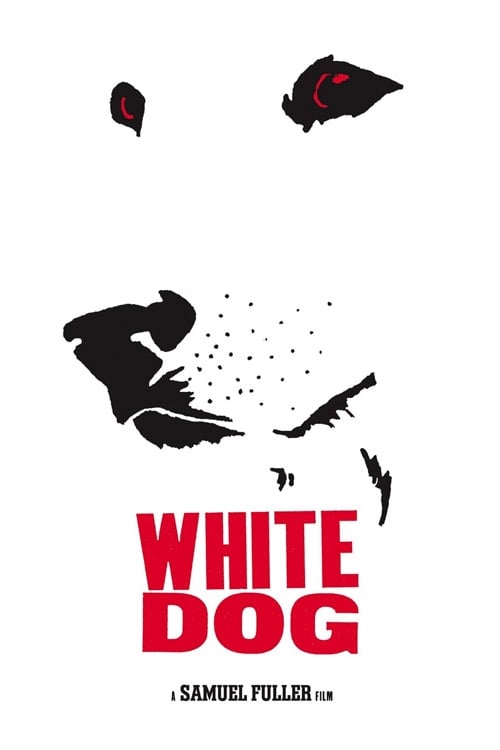
White Dog
1982 · Samuel Fuller
For when you want a film with real moral weight and no easy answers — a short, hard watch that doubles as a conversation piece. Challenge, not comfort.
What it's about
A young Hollywood actress hits a white German shepherd with her car, nurses it back to health, and keeps it — a loyal, affectionate, seemingly perfect companion. Then she discovers the dog has been deliberately trained by a previous owner to attack Black people on sight. She brings it to an animal ranch where a Black trainer takes on the seemingly impossible job of un-teaching the hatred that was bred into it.
The experience
Blunt, gripping, and genuinely upsetting — a lean thriller that grabs you by the collar and doesn't let go. It works as pulp suspense scene by scene while the metaphor underneath keeps tightening, and it leaves you shaken rather than comforted.
Performances
Paul Winfield gives the film its soul as the trainer whose obsession with curing the dog becomes a kind of faith; Kristy McNichol grounds it with an open, unglamorous sincerity.
The craft
Samuel Fuller shoots with tabloid directness — big close-ups, hard cuts, no cushioning — and turns a killer-animal premise into a laboratory for a question about whether learned hatred can be unlearned. Ennio Morricone's mournful score works against the genre, grieving where a lesser film would thrill.
Why it matters
Shelved by its studio amid controversy on release and barely seen for years, it was later rediscovered and championed as one of the most daring American films about racism — a case study in a fearless film misread in its own moment.
Snapshot
White Dog is a seventy-odd-minute parable about racism delivered in the form of a killer-animal picture, and the friction between those two descriptions is the entire film. Samuel Fuller, working from Romain Gary's 1970 novel — itself derived from Gary's account of a dog he and his then-wife Jean Seberg took in — turns a lurid premise into a laboratory. A young actress, Julie Sawyer (Kristy McNichol), hits a white German shepherd with her car on a canyon road, nurses it, and keeps it. The dog is affectionate, protective, apparently ideal. Then it begins killing Black people. It has been conditioned — "trained" is Fuller's word, and the film insists on the passive construction — by a previous owner to attack on sight of dark skin. Julie takes the animal to a Hollywood animal ranch, where a Black trainer, Keys (Paul Winfield), refuses to euthanize it and instead attempts to decondition it, working alone in a caged enclosure, wearing a padded suit, absorbing the attacks himself.
The film was made at Paramount and then effectively buried by it. Anticipating protest — reportedly following pre-release concerns raised by civil-rights organizations who had not seen the finished picture — the studio declined to give it a proper American theatrical release in 1982. It played abroad, surfaced on cable and in repertory, and acquired a reputation as a suppressed film long before most American viewers could evaluate it. Its rehabilitation came slowly through festival screenings and critical advocacy, then decisively through a 2008 Criterion release. What audiences found was not the inflammatory object the studio feared but something harder to metabolize: a film that treats racism as a learned behavior, refuses to locate it in a villain, and declines to promise that it can be unlearned.
Industry & production
The project had a long, unhappy development history at Paramount before Fuller. Gary's novel had been circulating as a property since the early 1970s, attached at various points to different filmmakers and writers; Roman Polanski was among the names associated with it in that period. By the time the studio arrived at Fuller, the material had been through multiple attempts to make it commercially legible — including, per accounts of the development, drafts that pushed the story toward a more conventional revenge or thriller shape.
Fuller came to it in the wake of The Big Red One (1980), the World War II film he had wanted to make for decades and which had been released in a form he considered mutilated by cutting. He was in his late sixties, and White Dog would prove to be his last American studio feature. He co-wrote the screenplay with Curtis Hanson, then a young writer-director well before L.A. Confidential; the collaboration is one of the more interesting mismatches in the film's history, pairing a tabloid modernist with a craftsman who would later become one of the most careful classicists in American studio filmmaking. Their key structural decision was to make the deconditioning attempt — not the killings — the film's actual subject, and to give that attempt to a Black character whose motives are intellectual and obsessive rather than sentimental.
Jon Davison produced, with Edgar J. Scherick and Nick Vanoff among the producing credits. Davison had come from Roger Corman's New World and would produce RoboCop; his presence signals the film's genuine B-picture DNA, which was never a disguise. The picture was budgeted and shot as a modest studio genre film, largely in and around Los Angeles, using the animal-ranch setting as a self-contained arena.
The suppression is the industrial fact that defines the film's afterlife. The studio's decision was pre-emptive: the objection was to what a film about a racist dog might do in the culture, raised before the finished work could be seen. Fuller — who had spent a career making films explicitly about American racism, from The Steel Helmet (1951) through Shock Corridor (1963) — regarded it as a profound misreading, and the experience contributed to his effective relocation to France for the remainder of his career. Television broadcast and later home video kept the film semi-available; the NBC-era and cable screenings, however, were not a substitute for release. The 2008 Criterion DVD, with its accompanying critical apparatus, functioned as the film's actual American premiere twenty-six years late.
Technology
White Dog is technologically unremarkable by design and remarkable in one specific domain: animal work. It was shot on 35mm color negative, finished in a standard 1.85:1 spherical format, with a conventional Dolby-era optical soundtrack. There is no optical trickery of consequence, no process work drawing attention to itself.
The animal performance, however, is a technical achievement of a kind that has essentially no modern equivalent. Multiple white German shepherds were used, trained by Karl Lewis Miller, one of the leading animal trainers in American film (his credits include Cujo and Beethoven). The attacks are staged with real dogs and stunt performers in protective gear; the film's most sustained sequences — Keys in the enclosure, taking charge after charge — depend on the physical reality of an animal actually lunging at a man. Fuller shoots these long enough and close enough that the viewer cannot retreat into the assumption of a cut or a trick. A contemporary production would build much of this digitally, and the loss would be total: the film's argument requires that the dog be an animal, unmalicious, doing what it has been made to do, and a synthetic dog is by definition doing what someone wants.
Technique
Cinematography
Bruce Surtees shot the film. Surtees — son of the cinematographer Robert Surtees, and the regular collaborator on Clint Eastwood's directorial work of the period, including Play Misty for Me and Pale Rider — was known as a low-light photographer, willing to let faces fall into shadow and to expose for the practical rather than fill the frame. That instinct serves White Dog well. The film alternates between two visual registers: sunstruck Los Angeles exteriors, hard and bleached, and the caged interior world of the ranch, where light comes through chain-link and casts the trainer and the animal into the same grid of shadow.
The compositional signature is the low angle at dog height. Fuller and Surtees repeatedly put the camera on the ground, so that the dog moves through the frame as a subject with its own point of view rather than as an object of the human gaze. When the dog hunts — the sequence in which it slips away at night and pursues a man into a church is the film's most notorious — the camera stays with the animal's trajectory. The church killing is staged in a way that turns the sanctuary's stained glass into an ironic light source, blood and colored light merging; it is Fuller at his most baroque, and characteristic of a director who never mistook restraint for seriousness.
Editing
Bernard Gribble cut the film. The editing is compact and unfussy, in the American studio idiom, but it does one thing insistently: it withholds the reaction shot that would let the audience off. Attacks are given continuous duration rather than fragmented into impressionistic pieces. Fuller's habit — visible from Pickup on South Street onward — of cutting on a hard beat, punching from a wide to a tight close-up without an intermediate, is present throughout, and lends the film a percussive, tabloid rhythm entirely at odds with the delicacy of its thesis.
The film is short, and its brevity is structural. There is no subplot to speak of, no romance developed at length, no comic relief. The compression means the film reaches its terminal irony almost before the viewer has settled.
Mise-en-scène / staging
The ranch is the film's real set: a compound of cages, runs, and animal enclosures where Keys works. Fuller stages the deconditioning as a series of variations on a single confrontation — man and dog in an enclosed space, separated by nothing. The repetition is the point. Each session is slightly different, and the differences carry the entire dramatic argument. Around the edges, the ranch is populated with other animals, including a rented menagerie that gives the location an air of Hollywood's own instrumentalized nature — creatures kept to perform.
The domestic scenes in Julie's canyon house work by contrast: warm, cluttered, ordinary. Fuller's decision to make the dog's early behavior genuinely charming — a good dog, a protective dog, one that fends off an intruder — is the film's cruelest structural move, since it implicates the audience's affection before it reveals what the affection is attached to.
Sound
Ennio Morricone composed the score, one of several American assignments in his prolific early-eighties period. It is not a conventional horror score. Morricone builds around a plaintive, almost lullaby-like motif that treats the dog as a tragic figure — mournful rather than menacing — and reserves harsher textures for the attack sequences. The effect is to score the film from the animal's side, which no other element of the film quite does, and it supplies much of the picture's grief.
The sound design otherwise favors dry, close animal sound: breathing, claws, the chain-link rattle. In the enclosure scenes the absence of music at key moments leaves only the dog's respiration and Keys's voice, which is where the film locates its tension.
Performance
Kristy McNichol, then a young television star with substantial audience recognition, plays Julie as an ordinary, decent, unremarkable person, which is exactly right. The role's function is to be the well-meaning liberal who wants the problem solved and cannot solve it, and McNichol plays it without irony or self-congratulation.
Paul Winfield's Keys is the film's center of gravity. Winfield — an actor of enormous authority, Oscar-nominated for Sounder — plays a man whose commitment to curing the dog is not compassionate so much as scientific and personal to the point of obsession. He has tried before and failed; he wants to be the first to succeed; he says so. The performance withholds warmth deliberately, which is why the film cannot be read as uplift. Burl Ives plays Carruthers, the ranch's proprietor, whose weary pragmatism ("kill the dog") is the film's opposing argument, and Ives's casting — an American folk icon with his own complicated political history — gives that argument a cultural weight it would not otherwise have. Fuller himself appears in a small role, as he often did.
Narrative & dramatic mode
The film's mode is the parable executed with total literalism. There is no dream logic, no ambiguity about what the dog is or does. The metaphor is stated aloud — the dog is a "white dog," a specific and documented practice of training animals to attack Black people, with a real history in the American South — and then dramatized without further commentary.
Structurally the film is a rescue narrative that curdles into a laboratory procedural. The first movement is domestic and generic: girl finds dog. The second is investigative: what is wrong with this animal, and who made it so. The third is the deconditioning, which occupies the bulk of the running time and abandons plot almost entirely in favor of repeated trial. The film's most disturbing formal choice is that it never dramatizes the original training. The old man who eventually appears to claim the dog — a grandfatherly figure with two young granddaughters — is not a monster, and Fuller gives him no scene of villainy. The evil is offscreen, historical, and diffuse, which means it cannot be defeated by defeating a person.
The ending — which turns on the dog's redirected aggression at the moment of apparent success — is the film's argument compressed into a single action: conditioning is not erased but displaced. Fuller and Hanson refuse the cure. This is the choice that makes White Dog a genuinely pessimistic film about American racism rather than a reassuring one, and it is almost certainly why the studio, reading the synopsis rather than the film, could not imagine defending it.
Genre & cycle
White Dog arrives at the tail of the 1970s killer-animal cycle — Jaws (1975) and its successors, including a substantial run of dog pictures, and it precedes Cujo (1983) by a year, with which it shares a trainer. It uses every mechanic of that cycle: the stalking POV, the attack setpiece, the innocent-victim structure. But it inverts the cycle's premise. In the standard killer-animal film, nature turns on man; here nature has been programd by man, and the animal is the film's most sympathetic figure.
It also belongs, more awkwardly, to the tradition of the American social-problem film — the studio picture that addresses racism directly — and to Fuller's own lifelong genre of the pulp thesis film, in which a lurid narrative delivers a political argument at speed. The mismatch between the two traditions is precisely what made the film unclassifiable to its distributor.
Authorship & method
Fuller's method is legible in every frame: the aggressive close-up, the confrontational staging, the willingness to let a scene tip into vulgarity in service of an idea. He was a former crime reporter and an infantryman, and his films consistently argue that the truth is best delivered as a headline. He had made The Steel Helmet, with its integrated platoon and its direct address of American hypocrisy; Shock Corridor, with its Black student who has internalized white supremacy and preaches it in an asylum; and The Crimson Kimono (1959), a Los Angeles noir built on interracial romance. White Dog is continuous with all of it. Fuller's core proposition is that racism is taught, and can be taught to anything, and that the teaching leaves a permanent mark.
Curtis Hanson's contribution as co-writer is harder to isolate from the outside, and the record on the division of labor is thinner than the film's later prominence would suggest; what can be said is that the screenplay is more structurally disciplined than Fuller's solo work of the period, and that Hanson would go on to make films — L.A. Confidential above all — deeply concerned with institutionalized racism in Los Angeles.
The key collaborators pull the film in productive directions: Surtees's naturalistic, underexposed photography grounds Fuller's expressionist impulses; Morricone's score mourns what the images indict; Gribble's cutting keeps the parable moving faster than objection. Karl Lewis Miller's animal work is, in a real sense, a fourth authorial voice, since the film's credibility rests on the dogs' behavior.
Movement / national cinema
Fuller occupies a peculiar position in American cinema: a studio-system professional adopted by the French as an auteur. Cahiers du cinéma and the New Wave directors — Godard cast him in Pierrot le fou — championed him when American criticism largely did not, and the loop closed with White Dog, which was better received and more visible in Europe than at home. Fuller spent his final years working in France; his subsequent features were European productions.
The film is thus an artifact of a specifically transatlantic authorship: a Hollywood B-picture veteran making a Hollywood B-picture whose primary intellectual audience was elsewhere. It also sits at the end of the New Hollywood's window, when a personal, difficult, politically pointed genre film could still be greenlit at a major studio — and its suppression marks that window closing.
Era / period
1982 is the crux. The film was made in the early Reagan years, in a culture increasingly disinclined to talk about structural racism and increasingly comfortable with the language of individual responsibility. It emerged into a Hollywood pivoting to the blockbuster and to the family audience — 1982 is the year of E.T. — and a studio culture newly nervous about controversy in an era of expanding cable and video markets where a picture's reputation traveled faster than the picture.
The suppression itself is period-specific: an act of anticipatory self-protection by a corporation, in response to concerns raised about a work no one on either side had yet seen in finished form. The film's later canonization — through the Criterion release and sustained critical advocacy — belongs to a different era, one more willing to sit with an unresolved argument about race.
Themes
The governing idea is that racism is conditioned, not innate — a behavior installed by training, reinforced by reward, and carried by a creature that has no concept of what it is doing. The dog cannot be blamed, and the film's refusal to blame it is not sentimentality but rigor: if the racist is not a monster but a product, then the monster is the training apparatus, which is to say the society.
The second theme is the limit of therapy. Keys's project is explicitly assimilationist in structure — take the conditioned creature, expose it repeatedly to the object of its programd hatred, and unmake the association. His failure is the film's most disputed element. It is not a claim that Black Americans should stop trying; it is a claim that white supremacy is more durable than good-faith individual intervention, and that its energy, when blocked in one channel, finds another.
Third: the film is about Hollywood, quietly and persistently. Julie is an actress; the dog is a trained animal performer; the ranch is where the industry stores its nature. The film is set inside the machinery of American image-making, which is one of the institutions that manufactured the racial imagination it depicts.
Finally, there is the theme of inheritance — the old man with his granddaughters, whose presence implies that the training will simply continue in another generation, off-camera, unstopped.
Reception, canon & influence
Contemporary American reception barely existed, because the film barely did. What criticism appeared in 1982 responded to the suppression as much as to the picture. European critics, who could see it, were markedly more favorable. The film accrued its reputation through the eighties and nineties in the classic manner of a suppressed work — via repertory, festivals, cable, and word of mouth — with critics who had seen it arguing steadily that the studio's fear had been a misreading. J. Hoberman and Armond White were among the American critics who took the film seriously in that period; the 2008 Criterion edition, which included an essay by Hoberman, consolidated the case.
Influences on the film run in three directions. Backward into Fuller's own filmography, where the racial thesis had been rehearsed since The Steel Helmet and Shock Corridor. Backward into Romain Gary's source material and the documented American practice of training dogs to attack Black people, which gives the metaphor its historical anchor. And laterally into the killer-animal cycle whose grammar the film borrows wholesale.
Forward, its influence is real but diffuse rather than schematic. It stands as a durable reference point for filmmakers making genre films about American racism — the strategy of using a pulp frame to carry an argument that would be refused in respectable dress, which runs through a great deal of later work in horror. Jordan Peele's Get Out (2017) operates on a structurally comparable premise: a genre machine built to make white liberal benevolence legible as threat. Direct lines of transmission are not documented, and it would be overreach to claim them; what is fair to say is that White Dog is now routinely cited in that lineage as an antecedent, and that its status as a suppressed film has made it a standing case study in how studios manage racial subject matter.
Within Fuller's own canon it has become, alongside The Big Red One, one of the two late films that carry his reputation. It is his final American studio feature, and it ends his American career on the argument he had been making for thirty years — delivered, finally, with no consolation attached.
A Deleuzian reading
Fuller keeps putting the camera in the dirt.
The full Deleuzian reading of White Dog →
Reception
Paramount got so spooked by pre-release controversy that it shelved the film in the US in 1982 — it was barely seen for decades — and Fuller was so burned he decamped to France and never made another American studio picture. Now, especially since Criterion canonized it in 2008, it's widely regarded as one of the most searing anti-racist films Hollywood ever (almost) released.
How White Dog was received, from release to now →
How to watch White Dog: what to notice on a first viewing
- Watch how often the camera drops to the dog's own eye level. Fuller and Surtees keep putting the lens on the ground, so the dog moves through the frame as its own subject rather than an object you look down on. You end up seeing the world from inside the dog's own trajectory, not just watching it from outside.
- Listen for a mournful, lullaby-like motif scoring the dog. Ennio Morricone treats the animal as tragic rather than menacing, saving harsher sound for the attacks themselves and keeping the score gentle everywhere else. The music grieves for the dog when nothing else in the film is allowed to.
- Watch how similar each session in the cage looks and feels. Fuller stages the deconditioning as one confrontation repeated with small variations, Keys and the dog alone in an enclosed space, separated by nothing. The small differences between one trial and the next carry the entire argument.
- Watch Keys's face while he works with the dog in the cage. Paul Winfield plays him as scientific and personal rather than warm, a man who has failed before and wants badly to be first to succeed. The withheld warmth keeps the film from turning his effort into easy uplift.
The whole guide to watching White Dog, with the keys for a rewatch →
Influences: the films it descends from and the films it influenced
- The Steel Helmet (1951) — Fuller's template for the confrontational two-hander in which a character states America's racial contradiction flat into a near-frontal close-up inside a genre chassis — the POW's needling of Sgt. Tanaka is the rhetorical ancestor of Keys's one-sided interrogations of the dog.
- The Crimson Kimono (1959) — Establishes Fuller's method of smuggling a race argument inside a Los Angeles police procedural, shooting real city locations as reportage and releasing the racial charge through an abrupt cut to close-up rather than through dialogue.
- Shock Corridor (1963) — Supplies the institution-as-laboratory procedural and the hard cut to a scalding close-up of a conditioned subject — Trent's internalized white supremacy is the identical thesis, transposed in White Dog onto a subject that cannot be argued with.
- Old Yeller (1957) — Provides the affection-building grammar Fuller inverts: low dog-height blocking and reverse-cutting that bond an audience to an animal before the obligation to destroy it — Fuller retains the coverage and withholds the consolation the earlier ending grants.
- The Birds (1963) — Model for the motive-free animal antagonist assembled from wrangled real-animal footage cut into fragments, with attacks carried by dry, close wing-and-claw sound in place of music.
- Willard (1971) — The trainer-picture blueprint of the killer-animal cycle: menace built from continuous floor-level takes of real trained animals, with the handler's psychology legible only through the animal's behavior.
- Dirty Harry (1971) — Bruce Surtees's underexposed available-light night photography — faces allowed to sink into black, killings staged inside hard architectural geometry and light-grid patterns — is the exact method he carries into White Dog's chain-link and church interiors.
- Jaws (1975) — Codifies the off-screen antagonist economy White Dog borrows wholesale: the attack registered on the victim's body, the low water-level approach shot, and the reveal withheld well past the point of comfort.
- Orca (1977) — Morricone's precedent for scoring a killer-animal picture as elegy — a mournful lyric theme that mourns the animal instead of stinging the shocks — is the identical register he brings to White Dog.
- Baxter (1989) — Takes the dog-height camera to its limit by running the entire film at knee level with the dog as ideological vessel drawn to a fascist-worshipping child — White Dog's premise reduced to sustained animal POV.
- L.A. Confidential (1997) — Hanson carries forward the structural discipline he brought to White Dog's screenplay and applies it to the same subject — institutionalized Los Angeles racism — built as a genre machine whose interrogation-room scenes do the arguing.
- Amores Perros (2000) — Uses a trained attack dog as the instrument of a social thesis, shot handheld at dog height with close unsweetened animal sound, and refuses rehabilitation for either the animal or the man who conditioned it.
- White God (2014) — The direct formal heir: an extended trained-dog performance carries the argument, tracked at street level through the city, with the turn to violence staged explicitly as training and beating rather than as instinct.
- Get Out (2017) — Builds the same machine — a pulp genre frame engineered so white liberal benevolence reads as threat — with conditioning literalized as a repeatable procedure and the 'cure' offered by white experts revealed as the trap itself.
- Nope (2022) — The Gordy's Home sequence is White Dog's thesis in miniature: an animal conditioned for human use turns on its handlers, the reaction shot is withheld and displaced onto an upright object, and spectatorship is charged as complicity.
- The Plague Dogs (1982) — Same-year companion in the laboratory-procedural register: dogs as experimental subjects framed at animal eye level, ending on a refusal of the rescue the procedure had promised.
- Cujo (1983) — Shares Karl Lewis Miller's animal department and its technique of cutting several specialist dogs into a single 'performance,' with dry, close, unsweetened growl-and-scrabble sound carrying the attacks rather than score.
- Monkey Shines (1988) — Extends the conditioning-lab procedural — an animal deliberately made into a weapon by human experiment — staging its menace at animal height while keeping the guilty handler inside the same frame.
Similar films
- The Plague Dogs (1982) — influence & lineage
- The Power of the Dog (2021) — shared sensibility
- Kiss Me Deadly (1955) — shared sensibility
- Basic Instinct (1992) — shared sensibility
- The Thing (1982) — shared sensibility
- The Birth of a Nation (1915) — shared sensibility
- The Searchers (1956) — shared sensibility
- Dogville (2003) — shared sensibility