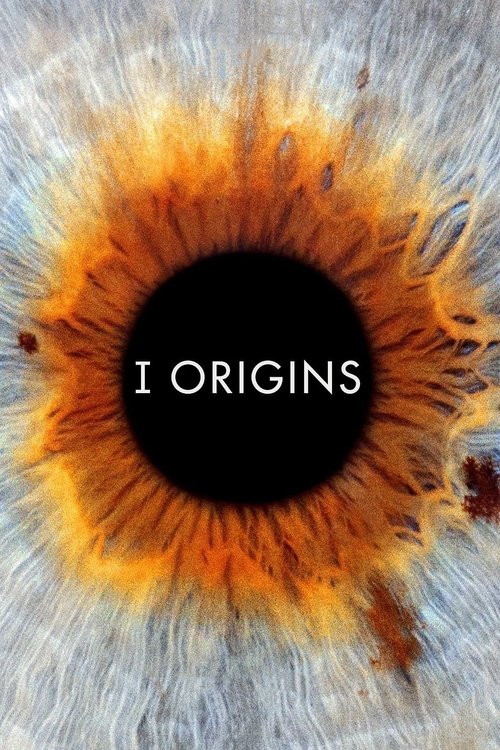
I Origins
2014 · Mike Cahill
For a contemplative night when you want a film to chew on for days — questions over answers, feeling over plot. More challenge than comfort, but a gentle kind of challenge.
What it's about
Ian Gray is a molecular biologist studying the evolution of the eye, out to close the door on intelligent design for good. His orderly life splits between two women — a mystical free spirit and his rigorous lab partner — until, years on, a strange pattern in iris data confronts him with evidence his worldview can't easily absorb, and the search leads to India and a child with impossible eyes.
The experience
Moody and searching, a slow-burn that shifts from romance to lab procedural to something like a spiritual mystery — it wants you arguing with it about science and faith on the walk home. It carries real grief under its big ideas.
Performances
Michael Pitt gives Ian's skepticism a wounded intensity, and Brit Marling brings her signature calm intelligence to the woman who shares his lab and his rigor.
The craft
Cahill shoots science with a romantic's eye — macro photography of irises becomes the film's whole visual language, intimate and eerie at once. The mood is carried by a hushed, melancholy score and a naturalistic indie texture that keeps the metaphysics grounded.
Why it matters
A festival-circuit favorite that consolidated the early-2010s wave of low-budget, idea-driven American science fiction and Cahill's standing as one of its central voices.
Snapshot
I Origins is a metaphysical romance disguised as a laboratory procedural, and a laboratory procedural disguised as a grief film. Mike Cahill's second feature follows Ian Gray (Michael Pitt), a molecular biologist whose research on the evolution of the eye is explicitly framed as an assault on intelligent design — the eye being creationism's favorite exhibit, the organ Darwin himself conceded seemed "absurd in the highest possible degree" to credit to natural selection. Ian photographs irises obsessively, meets and loses a mystic-minded woman named Sofi (Astrid Bergès-Frisbey), marries his lab partner Karen (Brit Marling), and then, years later, stumbles on biometric data suggesting that iris patterns recur across dead and living persons. The film's second half sends him to India to find a child whose eyes match a dead woman's.
The film's real subject is not reincarnation but the epistemological trap of a scientist who has built an identity on falsifiability and is handed evidence he cannot metabolize. It premiered at the 2014 Sundance Film Festival, where it won the Alfred P. Sloan Feature Film Prize — Cahill's second Sloan win in three years — and was released by Fox Searchlight in the summer of 2014 to a small theatrical footprint and a divided press. Its afterlife has been almost entirely on streaming, where it functions as a cult object for viewers who want their science fiction unfashionably sincere.
Industry & production
I Origins belongs to a specific institutional ecology: the American independent film of the early 2010s, financed modestly, built to premiere at Sundance, and acquired there by a studio specialty division. Cahill arrived with the leverage of Another Earth (2011), which he directed, shot, co-wrote with Brit Marling, and cut himself, and which sold to Fox Searchlight out of Sundance after winning both a Special Jury Prize and the Sloan. That relationship carried forward; Searchlight handled I Origins as well.
The Sloan Prize is worth pausing on, because it is not a neutral award. The Alfred P. Sloan Foundation has since the late 1990s funded and prized narrative filmmaking that takes scientists seriously as characters and science seriously as content, underwriting screenwriting fellowships and festival awards. A generation of American indie features — Cahill's two among them — were shaped by the existence of that money and that imprimatur. I Origins is legible as a Sloan film in its bones: a working scientist protagonist, real laboratory procedure, a research question with a genuine literature behind it, and a dramatic structure that treats the design of an experiment as a plot event.
Production was split between New York and India, and the shift in location is also a shift in production register — from controlled interiors and a recognizable Manhattan indie-film geography to a location-heavy final act. The budget was small by studio standards and the theatrical release was limited; the film did not recoup on the strength of ticket sales in any meaningful way, and its economics belong to the specialty-division model of the period, in which theatrical exposure functioned partly as marketing for downstream video-on-demand and streaming revenue. Precise budget and gross figures are not something I'll assert here, as the reliable public record for a release of this size is thinner than it looks.
Technology
The film's speculative engine is biometric identification, and it is unusually well-chosen. Iris recognition became a mature, deployed technology in exactly the years leading up to the film: India's Aadhaar program, launched at the start of the 2010s, enrolled hundreds of millions of residents by capturing fingerprints and iris scans, creating the largest biometric database ever assembled. I Origins takes that infrastructure — a genuine, contemporaneous, state-scale archive of human eyes — and asks what a scientist would do if the archive returned a match it should not be able to return. The film's Indian third act is not exotic set-dressing; it is where the data lives.
There is a sharp irony in the conceit that the film half-acknowledges. Iris patterns are used for identification precisely because they are not heritable in their fine structure. Identical twins have different irises; a single person's two eyes differ from each other. The stromal texture is a product of chaotic developmental processes, not a genetic blueprint. That is the entire basis of its value as a biometric. The film weaponizes this: a recurring iris pattern cannot be explained by inheritance, cannot be explained by chance, and therefore — within the film's logic — demands an explanation of a different order. It is a genuinely elegant piece of science-fictional reasoning, whatever one thinks of where it leads.
The laboratory material is the second technological strand. Ian and Karen work on the evolutionary origin of the eye, pushing back toward photoreceptive precursors and attempting to induce eye development in an organism that has none — territory that gestures at real developmental genetics, particularly the deep conservation of eye-specification genes across phyla, one of the strongest available rebuttals to irreducible-complexity arguments. The film compresses and dramatizes this work aggressively, as narrative films must, but the choice of research problem is not arbitrary: it puts the protagonist's professional life and the film's metaphysical question on the same object.
Technique
Cinematography
Markus Förderer's photography is the film's most widely admired element, and it does specific dramatic work rather than merely looking beautiful. The governing strategy is extreme proximity: macro imagery of irises, filling the frame with a landscape of stroma, crypts, and pigment until the eye stops reading as an organ and starts reading as terrain — a nebula, an aerial photograph, a geological survey. This is the film's central visual argument, that the intimate and the cosmic are the same image at different magnifications, and it is made through lens choice before it is ever made through dialogue.
Around that spine, Förderer works in a warm, soft, available-light idiom typical of the best mid-2010s independent digital photography: shallow focus, practical sources, halation and flare permitted rather than suppressed, an embrace of the grain and bloom that the period's sensors produce at the edge of their latitude. The romance passages are handled with a tactile handheld looseness; the laboratory scenes are cooler and more composed. The Indian sequences open the frame out into daylight and depth after two acts of confinement. Detailed technical documentation of the shoot — specific camera bodies, lens sets — is not something I can state with confidence, and I'd rather flag the gap than invent it.
Editing
The cutting is where the film's structural gamble sits. I Origins is built as two nearly separate movies joined by a decade-long ellipsis: a romance that ends in an abrupt, arbitrary death, and then a detective story that begins years later in a different emotional key. The transition is handled with a bluntness that some viewers experience as a rupture and others as the point — grief does not dissolve, it cuts. Within scenes, Cahill favors elliptical assembly in the romance and a more patient, information-delivering rhythm in the investigative half, where the audience must track evidence. Cahill cut Another Earth himself and remained closely involved in the assembly here; the film's editorial personality is continuous with his first feature's.
Mise-en-scène / staging
The film organizes its world into two visual regimes that never quite reconcile. Sofi's spaces are cluttered, warm, tactile, full of textiles and light and animal life; Ian and Karen's laboratory is white, gridded, instrumented. Staging keeps returning to thresholds — doorways, elevators, screens, masks. The Halloween mask through which Ian first sees Sofi's eyes is the film's founding image: identity reduced to, and located in, the iris alone. The elevator that kills her is the same idea turned lethal — a door, a gap, a mechanism indifferent to meaning.
Recurrence is staged as much as it is written. The film seeds a numerical motif (the repeated appearance of the number eleven) that functions as a visible watermark of coincidence, deliberately pitched at the level where a rational viewer and a mystical viewer will read the same shot differently. That double-readability is the whole design.
Sound
Will Bates's score — Bates having also scored Another Earth as part of Fall On Your Sword — works in processed electronics, sustained tones, and treated strings, a mode by then well established for contemplative independent science fiction. It is used sparingly in the laboratory material and expansively in the romance and the final act, and it carries much of the film's insistence that we are watching something numinous rather than merely improbable. The sound design leans on close, intimate presence in the romance passages and on the ambient density of location recording in India, using the sonic contrast between the two halves to reinforce the editorial one.
Performance
Michael Pitt plays Ian with a brittle, closed-off intensity that reads as a defended man rather than a charismatic one — a deliberate refusal of the affable-scientist type. His best work is in reaction: the face of someone whose framework is failing in real time. Astrid Bergès-Frisbey has the harder assignment, since Sofi is written close to the archetype of the intuitive woman who exists to unsettle a rationalist man; she survives the writing largely through a wary, unsentimental physical presence that keeps the character from dissolving into whimsy. Brit Marling, playing the rigorous colleague rather than the muse, gives the film its most grounded performance and quietly its most sympathetic figure — the scientist who stays a scientist. Steven Yeun, then mid-run on The Walking Dead, provides the laboratory's ballast and comic relief, and Archie Panjabi anchors the Indian sequences.
Narrative & dramatic mode
Structurally the film is a diptych: romance-then-quest, or thesis-then-test. The first movement is a love story governed by coincidence and terminated by accident; the second is an investigation governed by evidence and terminated by ambiguity. The engine throughout is a single dramatic question with two incompatible answers — is this pattern meaningful? — and Cahill is careful to keep both readings live until very late.
The mode is closer to the philosophical fable than to hard science fiction. Characters articulate positions; the dialogue is frankly discursive, staging the science-versus-faith argument in speech as well as in action. This is the film's most-criticized quality and also its most honest one: it does not pretend that its ideas are subtext. The risk of the form is schematism, and I Origins does at moments assign its worldviews to characters a little too tidily — the empiricist man, the mystical woman — a division that carries an old and not very flattering gendered inheritance.
The ending is engineered as an unresolved dare rather than a revelation, and a brief coda after the credits extends the conceit beyond the frame of the story proper, implying that the film's discovery is not a private anomaly but the beginning of something institutional.
Genre & cycle
I Origins sits squarely inside the low-budget metaphysical science fiction cycle that defined American independent cinema in the first half of the 2010s. Its neighbors are Another Earth and Sound of My Voice (both 2011), Upstream Color (2013), Coherence (2013), The One I Love (2014), and Comet (2014), with Shane Carruth's Primer (2004) as the cycle's founding artifact and Jeff Nichols's Midnight Special (2016) as a later, better-funded descendant.
The cycle's shared grammar: a single speculative premise stated plainly and never explained; effects work minimized or eliminated in favor of implication; relationship drama as the actual content; a preference for the elegiac over the propulsive. Economically it was made possible by cheap high-quality digital capture and by the specialty-distribution and VOD apparatus that could monetize a film too small for wide release. Institutionally, the Sloan Foundation's money and prizes bent a portion of it toward scientists as protagonists.
Within that cycle, I Origins is the most openly theological entry. Where Primer and Coherence use their premises to generate paradox and dread, and Upstream Color uses its to generate a poetics of involuntary connection, Cahill uses his to stage an argument about the soul.
Authorship & method
Mike Cahill came to features by way of documentary and post-production — a background including work at National Geographic, and the documentary Boxers and Ballerinas (2004), made with Brit Marling. That craft history matters: Cahill is a filmmaker who has personally shot and cut his own work, and his features have the texture of films made by someone comfortable in an edit suite alone at two in the morning. His method across Another Earth, I Origins, and later Bliss (2021) is consistent: take one metaphysical proposition, refuse to explain its mechanism, and use it as a pressure test on a small number of characters in grief.
I Origins marks a specific authorial transition — it is written by Cahill alone, where Another Earth was co-written with Marling. Marling remains as an actor here, but her voice as a writer had moved to her own projects (Sound of My Voice, The East, and subsequently The OA), and the difference is visible: I Origins argues more explicitly and trusts ambiguity slightly less than its predecessor did.
The key collaborators define the film's surface. Markus Förderer, a German cinematographer whose subsequent career moved into large-scale studio work, supplies the macro-cosmic visual thesis. Will Bates supplies the tonal continuity with Another Earth. The casting of Pitt — an actor associated with Bertolucci, Van Sant, and Haneke's American Funny Games, and thus with a certain art-cinema volatility — is itself an authorial choice, importing a European-inflected unpredictability into an American indie lead.
Movement / national cinema
The film is American independent cinema of the post-Sundance-boom era, but its aesthetic passport is European. The doubling structure, the two women, the chain of coincidences read as design, the metaphysics wrapped in a love story — this is the territory of Krzysztof Kieślowski, particularly The Double Life of Véronique (1991) and the Three Colors trilogy, and the debt is stylistic as well as structural: the warm interior light, the saturated close-ups, the willingness to let a plot turn on a sign. Terrence Malick's lyric romanticism is a second, more diffuse presence in the handheld intimacy and the natural-light rapture.
The film's Indian third act raises a question it does not fully resolve. India functions in the narrative as the site of both the biometric database and the reincarnation belief system — a doubling that is thematically neat but flirts with treating a country as the location where a Western protagonist's spiritual crisis gets externalized. The film mitigates this partly through Panjabi's character, who is a professional operating her own infrastructure rather than a mystical guide, but the structural shape remains a Western scientist traveling east to receive an answer.
Era / period
2014 is a hinge year. The specialty divisions of the major studios were still theatrically releasing acquisitions like this one, but the streaming economy that would absorb such films entirely was already visible. Digital capture had reached the point where a small production could produce studio-grade imagery, and the cost floor for a beautiful-looking film had collapsed. Sundance was the dominant discovery mechanism and its acquisitions market was near its peak.
Culturally, the film sits in the long tail of the New Atheism moment — the mid-2000s wave of popular science writing that made the science-versus-religion debate a mass-market genre — and in the early consumer awareness of biometric surveillance, before that awareness curdled into the darker register of the late 2010s. I Origins treats the world's largest biometric database as a source of wonder rather than dread, which now reads as a genuine period marker.
Themes
The eye is the film's total object, and it is deliberately overdetermined. It is the organ of empirical sight and therefore the instrument of science. It is the creationist's proof of design and therefore the battlefield. It is the biometric signature and therefore the legal instrument of identity. It is the traditional window of the soul and therefore the site of metaphysical claim. It is the thing one loses, in blindness, and the thing the film's laboratory work restores. Cahill stacks all five meanings onto a single image and lets the film's plot slide between them; the title's pun — eye origins, I origins — announces that the question of where eyes come from and the question of where selves come from are the same question.
Beneath that sits a more ordinary and more affecting theme: grief's refusal of finality. Ian's investigation is scientifically motivated and emotionally transparent — a man building an apparatus to prove that the person he lost is not gone. The film's most defensible move is that it never lets him be purely a scientist about it, and its most questionable is that it eventually rewards him.
A third strand concerns the limits of falsifiability as a life philosophy. The film is not anti-science; Karen, the most rigorous character, is also the most decent, and the discovery arrives through method, not revelation. What the film attacks is the confusion of methodological naturalism with completeness — the assumption that what the instruments cannot register does not exist. That is a real and serious argument, and I Origins makes it seriously, if not always subtly.
Reception, canon & influence
Critical reception was genuinely split. The Sundance jury's Sloan Prize signaled institutional approval of the film's engagement with science, and Förderer's cinematography drew near-universal praise. The recurring objections were consistent: that the science-versus-faith debate is conducted too explicitly in dialogue; that Sofi is more device than person; and that the third act's move from ambiguity toward something like confirmation betrays the film's earlier rigor. Sympathetic critics valued exactly the qualities the skeptics faulted — the sincerity, the willingness to ask an embarrassing question directly, the refusal of irony in a period saturated with it. The film has held a reputation as a divisive, ambitious near-miss rather than a consensus success.
Backward. The clearest lineage is Kieślowski, both for The Double Life of Véronique's two-women-one-soul architecture and for the general proposition that coincidence can be filmed as evidence. Hitchcock's Vertigo (1958) is the structural ancestor of the second half — a man who has lost a woman searching for her recurrence in another body, with all the ethical queasiness that entails. Nicolas Roeg's Don't Look Now (1973) supplies the template of grief plus premonition plus a fatal accident. Robert Zemeckis's Contact (1997) is the closest American precedent for the specific dramatic situation of a committed empiricist confronted with an experience she cannot verify and cannot dismiss. Darren Aronofsky's The Fountain (2006) precedes it in treating love-across-death as a legitimate science-fictional structure. And Cahill's own Another Earth is the immediate template: an impossible cosmic premise used as a machine for processing guilt.
Forward. The honest assessment is that I Origins has been influential mostly as a specimen rather than a source. Its clearest direct descendant is Cahill's own Bliss (2021), which reruns the method — one unexplained premise, a couple, an unresolved epistemological standoff — for a streaming platform. Its broader legacy is as a load-bearing example of the 2010s low-fi metaphysical science fiction cycle, frequently cited alongside Another Earth, Upstream Color, and Coherence when that cycle is discussed as a coherent movement. It also anticipated, by a few years, the mainstreaming of biometric infrastructure as a science-fictional resource, though later work has generally used it for dread rather than transcendence.
Its most durable life is with audiences rather than critics. On streaming the film has accumulated the classic cult profile: a small, intense constituency for whom its final scene is a genuine experience, and a larger constituency that finds it overreaching. That gap — between viewers who accept the film's dare and viewers who see the strings — is not a failure of the film. It is, fairly precisely, the film's subject.
Reception
Critics at Sundance 2014 largely shrugged it off as pretty-but-preachy science-vs-faith hokum, but it's since settled into word-of-mouth life as an 'underrated indie sci-fi' pick that audiences keep discovering and defending.
How I Origins was received, from release to now →
How to watch I Origins: what to notice on a first viewing
- Watch the eye extreme close-ups turn into landscapes. Förderer fills the frame with stroma, crypts, and pigment until an iris stops reading as an organ and starts reading as terrain. The film argues, through the lens alone, that the intimate and the cosmic are the same image at a different scale.
- Notice how differently the lab and the romance are lit. Sofi's scenes are warm, soft, and handheld, while Ian and Karen's laboratory stays cooler, more composed, and more controlled. The lighting alone tells you which parts of his life the film treats as feeling and which as method.
- Notice how often you see someone through a doorway or mask. Ian first sees Sofi's eyes through a Halloween mask, and the film keeps returning to doorways and screens as the way people are actually seen. Identity in this film is repeatedly narrowed down to what a small opening lets you glimpse.
- Listen for the score thin out in the lab scenes. Will Bates keeps his electronic score sparing around the science, then lets it expand in the romance and the film's final stretch. The music tells you when the film wants you to feel something numinous rather than just observe an experiment.
- Watch Ian's face react rather than perform emotion. Michael Pitt plays Ian closed off and defended, and his best moments are reactions, a framework visibly failing in real time on his face. You are watching a scientist's certainty come apart in small increments, not in one big speech.
The whole guide to watching I Origins, with the keys for a rewatch →
Influences: the films it descends from and the films it influenced
- Vertigo (1958) — Structural donor to the second half — the mid-film time-jump into a man hunting a dead woman's recurrence in another body, adjudicated by an identifying physical detail (the jewel there, the iris here), with the same ethical queasiness of a lover treating a person as evidence; Bass/Whitney's title spirals emerging from a macro eye is also the seed image of Cahill's iris photography.
- Don't Look Now (1973) — Roeg and Graeme Clifford's associative ellipsis — cutting on color and object rhymes rather than causal continuity, so premonition is produced by the assembly itself; I Origins borrows the grief-plus-omen-plus-fatal-accident armature and the habit of letting a repeated visual token do the work of a plot point.
- Blade Runner (1982) — Establishes the grammar of the eye shot in extreme macro as a film's founding image, and the Voight-Kampff rig as an apparatus that reads identity off the iris — the exact conflation of eye-as-organ and eye-as-document that Cahill's biometric database plot runs on.
- The Double Life of Véronique (1991) — The two-women-one-soul diptych with a hard structural break, plus Sławomir Idziak's method of shooting through refractive objects and filters so that coincidence registers optically as evidence rather than as plot contrivance — Cahill's whole premise that recurrence can be photographed descends from this.
- Gattaca (1997) — Idziak again, applying the same amber-filtered monochromatic light to a genetics fable; more specifically it invents the dramaturgy of biometric gates (retinal and blood scanners) as the machinery that adjudicates who you are — which I Origins simply inverts, using the scanner to certify a soul instead of exposing a fraud.
- Contact (1997) — The empiricist's testimony scene as a set piece: a scientist made to defend an unrepeatable experience under procedural cross-examination with no data to offer — the closest American precedent for the debate Cahill stages, right down to opening on a child's eye in a mirror.
- Minority Report (2002) — Builds a world where iris uniqueness is public infrastructure (the Eyedentiscan) and where identity can be physically carried across bodies by a transplanted eye — the operational precedent for I Origins' database-match plot, used for surveillance dread where Cahill uses it for transcendence.
- Solaris (2002) — The returned beloved in a body that both is and isn't her, examined by a man whose training gives him no way to verify; Soderbergh's memory-fragment ellipsis and Cliff Martinez's tonal-drone electronics are the template for I Origins' processed score and its elliptical assembly of a relationship.
- Primer (2004) — The Sloan-Prize template for the self-shot micro-budget science film: real procedural jargon spoken flatly and unglossed, technical work filmed as labor rather than montage, and the mechanism of the premise deliberately withheld from explanation.
- Eternal Sunshine of the Spotless Mind (2004) — Ellen Kuras shooting an impossible premise in handheld available light with documentary grain, refusing to shift visual register when the science fiction begins — the naturalist-camera-on-a-metaphysical-conceit approach that Markus Förderer executes for Cahill.
- The Fountain (2006) — Peter Parks's macro and microphotography of chemicals in petri dishes standing in for cosmic imagery — practical close-focus optics as metaphysical argument, the same move Cahill makes by shooting irises as galaxies — plus Mansell's processed score and the legitimation of love-across-death as a science-fictional structure rather than a fantasy one.
- Another Earth (2011) — The immediate template Cahill is reworking: one unexplained cosmic premise deployed as a machine for processing guilt, shot and cut by the director himself on prosumer cameras in available light, with Brit Marling's reactive underplaying holding the center.
- Arrival (2016) — Bradford Young's available-light, shallow-focus handheld intimacy applied to a first-contact procedural, Jóhann Jóhannsson's processed electronic drone, and an elliptical assembly of grief fragments that turns out to be a structural revelation rather than flashback — the mainstream vindication of Cahill's method.
- Bliss (2021) — Cahill reruns the identical apparatus for a streaming platform: one unexplained premise, a couple, no mechanism offered, and a final image engineered as an unresolved epistemological standoff the viewer must choose to accept.
- Sound of My Voice (2011) — Marling again as the object of a verification test, in a chaptered structure that makes belief-versus-proof the literal dramatic engine and withholds its single confirming image until the final frame — the same closing dare Cahill makes with the Sofi match.
- Upstream Color (2013) — Carruth shooting, cutting and scoring himself; macro biological photography of orchids and worms used as the film's actual argument, with causality carried by sound design and elliptical assembly instead of exposition — the cycle-mate that does silently what I Origins does in dialogue.
- Coherence (2013) — Available-light handheld shooting of largely improvised performance in one location, with a single premise whose mechanism is never explained — the low-fi metaphysical SF cycle's purest demonstration that the conceit needs no budget, only a rule the film refuses to break.
- Ex Machina (2015) — Conducts its metaphysics as explicit two-hander debate organized around a formal test and chaptered by numbered sessions and door thresholds — the same numerical-motif scaffolding and same willingness (which critics faulted in both films) to let characters argue the thesis aloud.
Similar films
- Ex Machina (2015) — influence & lineage
- Contact (1997) — influence & lineage
- Interstellar (2014) — shared sensibility
- Project Hail Mary (2026) — shared sensibility
- Touch (2024) — shared sensibility
- Origin (2023) — shared sensibility
- Remarkably Bright Creatures (2026) — shared sensibility
- Prometheus (2012) — shared sensibility