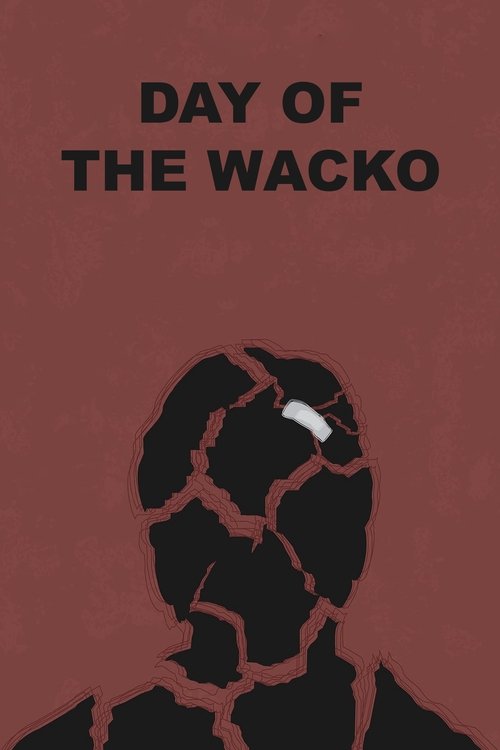
Day of the Wacko
2002 · Marek Koterski
For when you're in a misanthropic mood and want a film that says the unsayable out loud — a challenge, not a comfort, best met when you can handle a mirror held at an unflattering angle. Great for viewers who like their comedy black as tar.
What it's about
One day in the life of Adam Miauczyński, a 49-year-old Warsaw literature teacher at war with everything: his neighbors, his country, his rituals, and above all himself. He reads poetry to bored students, counts his compulsions, seethes on public transport, and narrates his own misery with corrosive eloquence — a portrait of a man, and a Polish generation, stranded between the world they were promised and the one they got.
The experience
Abrasive, profane, and painfully funny — the comedy of recognition at its most uncomfortable, because Adam's pettiest thoughts are the ones we all have and never say. It's exhausting by design; you laugh, wince, and occasionally feel caught.
Performances
Marek Kondrat's Adam is regarded as one of the landmark Polish screen performances of its generation — a full-body portrait of neurosis that stays human, and weirdly sympathetic, at maximum bile.
The craft
Marek Koterski's formal gamble defines the film: nearly all the dialogue is written in metrical, often rhymed verse, so gutter obscenity arrives in the cadence of classical poetry. The collision of high diction and low grievance is the joke and the point, and it makes even the rants strangely musical.
Why it matters
A phenomenon in Poland, endlessly quoted, its hero adopted as the avatar of the frustrated post-communist intelligentsia — the film that turned a director's recurring alter ego into a national type.
Snapshot
Day of the Wacko (Polish: Dzień świra) is a Polish tragicomedy written and directed by Marek Koterski, tracing roughly one day in the life of Adam Miauczyński, a forty-nine-year-old Warsaw literature teacher consumed by neurosis, self-loathing, compulsion, and contempt for nearly everyone around him. It is at once a bilious character study and a portrait of the late-communist and post-communist Polish intelligentsia stranded in the concrete apartment blocks of a gray city. The film is best known for two intertwined choices: Marek Kondrat's central performance, widely regarded as one of the landmark Polish screen roles of its generation, and Koterski's decision to write nearly all of the dialogue in metrical, frequently rhymed verse — a formal gambit that collides elevated poetic diction with obscene, petty, quotidian complaint. Warmly received in Poland and honored at the national film festival in Gdynia, the film has hardened into a cult object at home, endlessly quoted, even as it remains comparatively little known abroad.
Industry & production
Day of the Wacko is a product of Polish national cinema in the years immediately after the country's post-socialist transformation and shortly before its 2004 accession to the European Union — a transitional moment for the domestic film industry, which was still largely dependent on state television and public funding structures rather than a robust commercial market. The film was produced within this ecosystem; detailed, internationally verifiable production records (budget, precise financing partners, shooting schedule) are thin in English-language sources, and I will not invent figures. What is clear is that the project belongs to a continuing, largely author-driven body of work: Koterski had by 2002 built a recognizable brand around the Adam Miauczyński character and around a mode of low-budget, dialogue-heavy, apartment-bound filmmaking that did not require large infrastructure. The picture's commercial and critical fortunes were made primarily inside Poland, where it became a durable reference point rather than an export title.
Technology
The film was made with conventional turn-of-the-millennium production technology and does not foreground technical novelty; its interest lies in language and performance rather than in image-making apparatus. It was shot photochemically in the standard manner of Polish features of the period (I flag that I cannot confirm the specific stock, gauge, or lab from reliable sources, and will not guess). There are no showcase visual effects, no digital spectacle, and no reliance on emergent tools. If anything, the "technology" that matters here is deliberately unglamorous: the gray palette and flat lighting are chosen to render the texture of the wielka płyta — the prefabricated concrete panel housing that dominates the mise-en-scène — rather than to demonstrate any capability of the camera.
Technique
Cinematography
The visual scheme is subordinated to milieu and mood. The film cultivates a drab, desaturated, wintry-urban look: overcast light, concrete surfaces, cramped interiors, the monotonous geometry of a Warsaw housing estate. The camera frequently boxes Adam into tight domestic spaces — the bathroom, the kitchen, the narrow hallway — reinforcing claustrophobia and the sense of a life lived in a cell of one's own making. Reliable attribution of the director of photography is not something I can confirm from memory with confidence, and I will not fabricate a name; readers should treat the below-the-line credits as a gap to be filled from primary Polish sources. What can be stated safely is that the cinematographic strategy is anti-picturesque by design, matching the film's thesis that Adam's inner squalor and his outer environment mirror each other.
Editing
The cutting serves the film's rhythmic, monologic structure. Long stretches are organized around Adam's verbal set-pieces — tirades, prayers, fantasies, complaints delivered to camera or into empty rooms — so the editing tends to give speech room to breathe rather than to accelerate action. Interspersed are sharper comic beats built on repetition and escalation: obsessive rituals shown as sequences of small, exact actions (counting, arranging, checking), where the humor and the pathology both live in the precise accretion of detail. The film's tempo is thus paradoxical — verbally torrential, dramatically becalmed — and the edit holds that tension deliberately.
Mise-en-scène / staging
Mise-en-scène is arguably the film's strongest formal element. The concrete block apartment is not merely a location but the film's central image of Polish life: standardized, worn, communal-yet-isolating. Staging repeatedly emphasizes thin walls and forced proximity — neighbors overheard, resented, cursed — as the material basis of Adam's misanthropy. Props and ritual objects (the morning routine, the food, the domestic clutter) are choreographed to expose compulsion. The staging also exploits a recurring contrast between Adam's grandiose interior life, in which he imagines romance, dignity, and poetry, and the shabby physical reality that surrounds and rebukes those fantasies.
Sound
Sound centers, unusually, on the human voice as an almost musical instrument. Because the screenplay is versified, the soundtrack is dominated by the cadence, rhyme, and rhythm of speech; dialogue functions the way a score might, carrying the film's emotional and comic architecture. Ambient sound reinforces the estate setting — the intrusions of neighbors, plumbing, the muffled life of a block of flats — which is thematically essential, since noise from others is one of Adam's chief torments. I cannot reliably confirm the composer or the extent of an original musical score from memory and will not invent an attribution; the safe claim is that the film's sonic identity is built first and foremost on language.
Performance
Marek Kondrat's turn as Adam Miauczyński is the film's engine and its legacy. He sustains a role that is nearly wall-to-wall speech, modulating between fury, self-pity, tenderness, absurdity, and despair, and he makes a fundamentally unpleasant man watchable and even sympathetic. The performance's achievement is tonal control: Adam must be ridiculous and pitiable at once, a monster of egotism who is also a recognizable everyman. The supporting cast populates Adam's antagonistic world — family, colleagues, romantic prospects, neighbors — largely as foils and irritants seen through his jaundiced perspective. Michał Koterski, the director's son, appears as Adam's son, a casting choice that lends the film's generational and autobiographical undertones an added charge.
Narrative & dramatic mode
The narrative is loosely structured as a day-in-the-life, but its true form is the dramatic monologue expanded to feature length. Plot is minimal and deliberately anticlimactic; the film advances through episodes — rising, teaching, commuting, encountering others, fantasizing, retreating — rather than through conventional cause-and-effect. The dominant mode is confessional and satirical, closer to a versified interior monologue or a stand-up jeremiad than to a plotted comedy. Adam's frequent direct address collapses the distance between character and audience, implicating the viewer in his complaints. The film oscillates between the comic (his pettiness rendered as farce) and the tragic (loneliness, aging, the fear that the next five minutes of living are the worst pain imaginable), refusing to resolve into either register.
Genre & cycle
Formally the film is a comedy-drama, but it is more precisely a tragicomic character study in the tradition of the neurotic, self-lacerating antihero. It belongs to a specific authorial cycle: the series of Koterski films built around Adam Miauczyński, a semi-autobiographical alter ego who recurs across the director's work (including earlier and later pictures in which the character, played by different actors at different ages, embodies the same wounded, intellectual, self-obsessed sensibility). Within that cycle, Day of the Wacko is generally treated as the fullest and most celebrated expression of Koterski's project. It also participates in a broader vein of Central European cinema devoted to the miserabilist comedy of everyday life under and after socialism — the humor of scarcity, bureaucracy, resentment, and the gray apartment block.
Authorship & method
The film is, to an unusual degree, a single-authored work. Marek Koterski wrote and directed it, and the versified screenplay is the clearest signature of his method: he composes dialogue in rhythmic, often rhyming verse, deliberately marrying a "high" Polish literary tradition — the reader will note that his protagonist is a literature teacher who recites poetry — to "low," profane, everyday content. This ironic elevation is the crux of Koterski's authorship: it makes banal grievance sound like an epic lament, and in doing so both mocks and dignifies his hero. The Miauczyński character is widely understood as a persona through which Koterski works out autobiographical anxieties about the artist, the intellectual, masculinity, family, and failure. On the collaborator side, the most securely attributable creative partner is his lead actor, Kondrat, whose interpretation is inseparable from the film's success; the casting of Michał Koterski deepens the autobiographical dimension. For the cinematographer, editor, and composer, I flag honestly that I do not have reliably verified names to offer and decline to invent them — these credits should be sourced from the film's primary documentation.
Movement / national cinema
Day of the Wacko is a quintessential artifact of Polish national cinema. It speaks in and to a specifically Polish idiom: the versified script draws on and parodies national literary tradition; the setting is the emblematic Polish housing estate; the malaise it anatomizes is bound up with the frustrations of the Polish intelligentsia. Rather than belonging to a formal "movement," the film sits within an authorial tradition of Polish cinema that uses the grotesque, the satirical, and the everyday to diagnose national character. Its resonance at home and comparatively limited circulation abroad both flow from this rootedness — much of its power, especially the verse, is difficult to render fully in translation.
Era / period
The film is precisely of its moment: Poland circa 2002, more than a decade past the end of state socialism and on the cusp of EU accession. It captures a transitional, disenchanted mood — the "return to normal life" that turned out to be gray, cramped, and full of unmet expectation. Adam is a man formed under one system and stranded in another, and the film's pessimism registers a broader post-transformation deflation: the sense that political change had not cured private misery, loneliness, or the frictions of communal apartment-block existence. It is thus both a portrait of a psyche and a period document of early-2000s Poland.
Themes
The film's central themes cluster around neurosis and self-hatred: obsessive-compulsive ritual, misanthropy, the impossibility of contentment, and the dread of duration — the recurring notion that the next five minutes of living are unbearable. Around this core radiate loneliness and thwarted desire (Adam dreams of romantic love but is too fearful and self-absorbed to pursue it), aging and masculine crisis, and the failures of family and fatherhood. Sociologically, the film indicts a mode of Polish life: the intelligentsia's impotence, the resentment bred by close-quarters communal living, and the gap between cultural aspiration (poetry, refinement) and squalid reality. Underlying all of it is a bleak, self-aware humor — the recognition, stated in the synthesized record and borne out by the film, that Adam personalizes fears and obsessions the audience shares.
Reception, canon & influence
Critically, Day of the Wacko was received in Poland as a major and characteristic achievement of its author and a career-defining vehicle for Marek Kondrat; it was honored at the national film festival in Gdynia, generally cited as winning that festival's top prize for 2002 (readers should confirm the exact awards from festival records, which I will not embellish). Its longer-term significance at home has been as a cult classic and a reservoir of quotable lines — the film's versified tirades entered popular speech, and it is regularly invoked in Polish discussions of neurosis, the intelligentsia, and the texture of block-of-flats life. Its international footprint, by contrast, is modest, and English-language scholarship on it is comparatively sparse — a gap I note rather than paper over.
Looking backward, the film's influences are literary and authorial more than cinematic: the versified script consciously engages Polish poetic tradition, deploying an elevated national meter against profane content, while the antihero belongs to a long lineage of self-lacerating intellectual protagonists. The strongest "influence on the film" is Koterski's own prior work with the Miauczyński persona, of which this is a continuation and culmination.
Looking forward, its principal legacy is threefold: it cemented the Miauczyński cycle and Koterski's authorial identity; it delivered a defining performance for Kondrat; and it entrenched, in Polish popular and cinematic culture, a template for the versified, apartment-bound tragicomedy of national malaise. Its afterlife lives less in a school of imitators than in its persistence as a quoted, re-watched, argued-over touchstone — the rare art film that became a vernacular reference. Where the documentary record on its production and craft credits is thin, that thinness is itself part of the story: the film's fame rests overwhelmingly on its words and its central face, and it is by those that it continues to be remembered.
Reception
A hit from day one — it took the Golden Lions at Gdynia in 2002 — and it's only grown since: Filmweb users later voted it their favorite Golden Lions winner of the festival's first 50 years.
How Day of the Wacko was received, from release to now →
Influences: the films it descends from and the films it influenced
- House of Fools (1984) — Originates the Adaś Miauczyński alter-ego and the fragmented, episodic autobiographical structure that Day of the Wacko compresses into a single day and brings to its culmination.
- Nothing Funny (1995) — Refines the self-lacerating intellectual-artist persona and the first-person confessional mode, establishing Miauczyński's grievance monologue as the film's organizing voice.
- Ajlawju (1999) — Immediate predecessor that pushes the male-neurotic monologue toward stylized, rhythmic heightened speech, the direct experiment that the fully versified screenplay here perfects.
- 8½ (1963) — Template for persona filmmaking in which a director channels his own artistic, marital and masculine anxieties through a single actor-as-alter-ego (Mastroianni-as-Fellini), the method Koterski adapts with Kondrat-as-Koterski.
- Rejs (1970) — Polish vernacular-absurdist comedy whose lines entered everyday speech, ancestor of the film-as-quotable-touchstone dimension and of satire built from recognizable Polish social types.
- Miś (1980) — Absurdist satire of daily PRL life that became a national reservoir of catchphrases, precedent for a comedy whose afterlife lives in its endlessly re-quoted tirades rather than its plot.
- The Tenant (1976) — Uses a single apartment as a pressure-cooker for a man's psychological disintegration, the claustrophobic-interior staging that Day of the Wacko relocates to a concrete block-of-flats.
- Dekalog (1988) — Stages existential drama inside a gray Warsaw housing estate with desaturated interiors, the blokowisko-realist mise-en-scène and palette Koterski inherits for his hero's environment.
- Annie Hall (1977) — Establishes the neurotic intellectual who turns to the camera to self-analyze, the fourth-wall-breaking direct address deployed here as a confessional-comic device.
- Taxi Driver (1976) — Builds its narrative spine from a lonely urban male's sustained first-person voiceover, the monologue-as-structure that the versified tirades carry throughout Day of the Wacko.
- We're All Christs (2006) — Directly continues the Miauczyński cycle and re-casts Michał Koterski to deepen the autobiographical father-son axis, extending the same persona filmmaking and alcoholic-intelligentsia self-portrait.
- The Wedding (2004) — Extends the grotesque, tightly time-compressed tragicomedy of Polish national vice, carrying forward the bilious, quotable satire of everyday Polish malaise into a new register.
- Naked (1993) — Centers a torrential, self-hating erudite monologist (Thewlis's Johnny) whose verbose misanthropic riffs mirror Miauczyński's logorrheic intellectual bile as pure vocal performance.
- Falling Down (1993) — Compresses a middle-class man's rage-unraveling against modern urban indignities into a single escalating day, the same day-in-the-life descent structure driven by mounting petty grievance.
- High Fidelity (2000) — Arrested intellectual man addresses the camera to catalog his grievances and failures, a near-contemporary parallel of the direct-address confessional list as comic form.
Similar films
- The Big Lebowski (1998) — shared sensibility
- Kanal (1957) — shared sensibility
- Another Round (2020) — shared sensibility
- Groundhog Day (1993) — shared sensibility
- Decalogue V (1989) — shared sensibility
- Perfect Days (2023) — shared sensibility
- Three Colors: White (1994) — shared sensibility
- A Short Film About Killing (1988) — shared sensibility