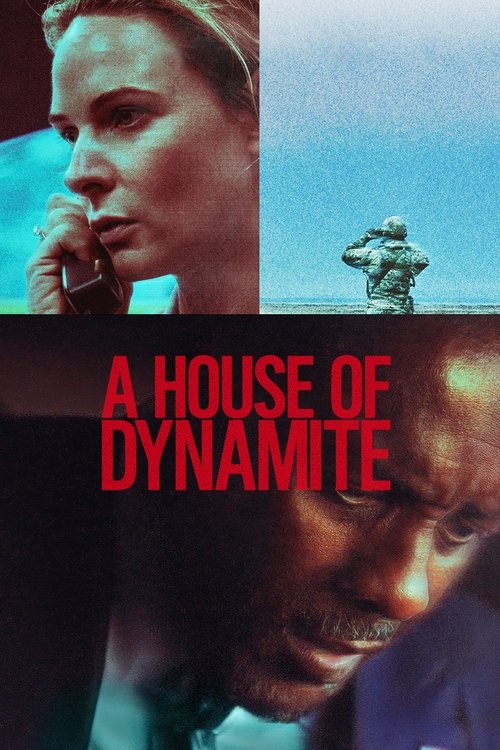
A House of Dynamite
2025 · Kathryn Bigelow
For when you want to be gripped and rattled — a tense, brainy watch that doubles as an argument-starter about how the world actually works. Challenge, not comfort; don't expect it to reassure you on the way out.
What it's about
A single missile is launched at the United States — no signature, no claim of responsibility, no known origin — and the clock starts. The film moves through the command centers, situation rooms and secure phone lines of the American government as officials race to answer two impossible questions at once: who fired it, and what do we do before it lands.
The experience
A pressure-cooker procedural: cold, fast and clinical, with dread that accumulates through checklists, protocols and voices on phones rather than explosions. It's the kind of thriller that makes bureaucracy terrifying — and it lingers uncomfortably after.
The craft
Bigelow builds tension her signature way — process shot like combat, overlapping chatter, decisions made in real time under an unforgiving clock. The sound design of alarms, phones and countdowns does as much work as any image; watch it loud.
Why it matters
It marked Kathryn Bigelow's return to feature filmmaking with the subject she owns — institutions under fire — and reignited public conversation about nuclear command and control, a threat most movies stopped taking seriously decades ago.
Snapshot
A geopolitical thriller set within the corridors of American military and intelligence infrastructure, A House of Dynamite tracks the frantic hours following the launch of a single, unattributed missile toward the United States. With no signature, no claimed responsibility, and no clear point of origin, the film is less a war picture than a procedural of uncertainty — a sustained dramatization of what happens when the machinery of deterrence confronts an adversary it cannot name. The premise is Kafkaesque by design: the most powerful military apparatus on earth stalled by the one variable it cannot resolve. Bigelow constructs the film as a pressure-cooker of competing protocols, fractured chains of command, and the accelerating tempo of decision-making under conditions that exceed any pre-written response plan. It is, by available account, among the most purely paranoid American films in recent memory.
Industry & production
Bigelow's return to the geopolitical thriller space after Detroit (2017) was long anticipated by critics who had tracked her recurring engagement with state violence, military ethics, and the bureaucratic machinery of American power. The project reportedly developed over several years, with Bigelow working within the evolving landscape of prestige theatrical releases — a space that had contracted significantly for original dramas between her Detroit and this film. Specific production company arrangements and financing details are not confirmed in records available at this writing. The film arrives at a moment when the geopolitical thriller has regained traction as a theatrical proposition, partly in response to a period of renewed anxieties about nuclear posture, missile proliferation, and ambiguous-actor conflict. Whether the project was greenlit in explicit response to that climate or predated it, the timing reinforces its cultural resonance.
Technology
Bigelow has worked across the technological evolution of digital cinema since K-19: The Widowmaker (2002) and has been a consistent advocate for location-grounded, tactile production even as the industry migrated toward virtual and LED-stage techniques. The Hurt Locker (2008) was shot on multiple simultaneous film and digital cameras by Barry Ackroyd, producing a texture of contingency that became one of its defining properties. Zero Dark Thirty (2012) refined this approach — Ackroyd again, with a more controlled palate but the same commitment to ambient illumination and handheld observation. For A House of Dynamite, the available production record is thin on confirmed technology choices; specific camera systems and formats used have not been confirmed in sources available at this writing. What is documented in Bigelow's body of work is a persistent preference for approaches that subordinate technical spectacle to the pressure of physical and institutional environments — the camera as witness rather than author.
Technique
Cinematography
Bigelow's films since The Hurt Locker have established a recognizable visual grammar: handheld or shoulder-mounted cameras at close quarters, ambient and practitioner lighting that renders institutional spaces in their actual ugliness, and a resistance to establishing-shot grandeur that might aestheticize the machinery of violence. Zero Dark Thirty applied this grammar to interiors — CIA compounds, black sites, situation rooms — with a clinical chill that unsettled critics precisely because it refused to encode moral position through visual rhetoric. A film set almost entirely within the decision-making infrastructure of American crisis response would extend that logic: the war room, the communications hub, the secure terminal are their own form of theater, and Bigelow's documented instinct is to photograph them without glamour. Confirmed cinematographic credits for this film are not established in sources available at this writing.
Editing
The tempo of Bigelow's mature work is not action-cinema cutting but something closer to procedural pulse — the edit tracks institutional rhythm, the alternation of deliberation and sudden acceleration, the way bureaucratic time can detonate into emergency. The Hurt Locker was edited by Chris Innis and Bob Murawski, and won the Academy Award partly on the strength of its editing — not for speed but for the management of dread across extended sequences. Zero Dark Thirty used William Goldenberg and Dylan Tichenor to similar effect: long, watchful scenes of information-gathering punctuated by sudden temporal leaps. A film structured around the compressed hours of a missile-attribution crisis would stress-test those same editorial principles — how much deliberation can the cut hold before the audience's anxiety demands release, and how long can the film deny that release. Confirmed editorial credits are not established in sources available at this writing.
Mise-en-scène / staging
Bigelow's staging is notable for its density of personnel and its resistance to dialogue-driven two-shot convention. Her scenes of institutional crisis — the interrogation sequences in Zero Dark Thirty, the command sequences in K-19 — are staged as ensemble environments where multiple conversations and actions compete within the frame. This produces a documentary quality of partial attention: the viewer does not receive a curated sequence of emotionally significant exchanges but something closer to the actual texture of institutional crisis, where information is incomplete, speakers interrupt and defer, and the camera cannot be in two places at once. A House of Dynamite, set largely within command-and-control environments, extends this staging logic into perhaps its most constrained theatrical space — the war room as a kind of pressure vessel where the staging itself becomes an argument about institutional legibility.
Sound
Bigelow's mature films use sound design as a primary carrier of dread. The Hurt Locker stripped its combat sequences to ambient wind and mechanical clicks; the absence of score in key sequences was itself a statement about the experience of exposure. Zero Dark Thirty used Marco Beltrami's score sparingly, leaning on the sound texture of surveillance environments — the hum of servers, the crackle of radio communication — as its dominant acoustic register. A film about a missile in flight and the scramble for attribution would place extraordinary demands on sound design: the silence of uncertainty, the static of degraded intelligence channels, the physical acoustics of confined institutional spaces under stress. Confirmed sound credits are not established in sources available at this writing.
Performance
Bigelow draws performances that subordinate interiority to function. Her actors are, characteristically, instruments of procedure — what they reveal is competence under duress rather than psychological confession. Jeremy Renner in The Hurt Locker is defined not by backstory but by the specific physical grammar of his expertise; Jessica Chastain in Zero Dark Thirty is driven, professionally constituted, and emotionally legible only through the accumulated pressure of years of single-minded pursuit. A film organized around attribution and response would stage performance similarly: characters whose identities are institutional, whose emotional lives are visible only through the failure or strain of their professional functions. Confirmed cast for this film is not established in sources available at this writing, though Bigelow's consistent casting practice suggests ensemble over star.
Narrative & dramatic mode
The film operates in the tradition of what might be called the procedural of incomplete information — a dramatic mode in which the organizing tension is epistemic rather than physical. The missile has been launched; the question is not whether catastrophe will occur but whether it can be named, attributed, and thereby incorporated into a response doctrine designed for legible enemies. This is the same dramatic logic that structures Sidney Lumet's Fail Safe (1964), though where Lumet's film proceeds to its catastrophic conclusion with the precision of a theorem, A House of Dynamite appears to sustain uncertainty across its full running time. The dramatic stakes are not the missile itself but the institutional response to not knowing — which is to say, the film is about the epistemology of deterrence, and what happens when the conditions that make deterrence possible (identifiable actors, attributable threats) cannot be met. It is a film about the gap between doctrine and reality, and the human beings who inhabit that gap.
Genre & cycle
The geopolitical nuclear thriller is among the most durable genres in American cinema, rooted in the Cold War and recurrently revived by shifts in the strategic environment. Stanley Kubrick's Dr. Strangelove (1964) and Lumet's Fail Safe (same year) established the genre's two poles — satirical and tragic — and between them defined its central concern: the gap between human intention and institutional outcome, the way that systems designed to prevent catastrophe can accelerate toward it. WarGames (John Badham, 1983) updated the genre for the digital age; Crimson Tide (Tony Scott, 1995) restaged it as a claustrophobic two-hander about chain of command; Eye in the Sky (Gavin Hood, 2015) miniaturized it to a drone strike and the distributed moral responsibility of remote warfare. A House of Dynamite inherits this lineage but introduces a condition that the classic genre largely bracketed: ambiguity of authorship. The Cold War thriller assumed two identifiable superpowers; this film assumes a world of proliferated capability and degraded attribution, which is both a contemporary strategic reality and a new dramatic structure.
Authorship & method
Kathryn Bigelow's authorial signature is among the most coherent in American cinema of the past four decades, organized around a set of recurring preoccupations — the phenomenology of violence, the ethics of state power, the experience of masculinity under institutional stress — and a visual method that emphasizes immersion over aestheticization. She won the Academy Award for Best Director for The Hurt Locker (2008), becoming the first woman to receive the award, and her subsequent career has deepened rather than complicated the authorial identity that film established. Zero Dark Thirty extended her engagement with the War on Terror into territory that generated significant public controversy — the film was accused by some critics and U.S. senators of implying a causal connection between enhanced interrogation and the location of Osama bin Laden — and Bigelow's response, that the film depicted historical events rather than endorsed them, articulates a position on the artist's relationship to morally fraught material that has informed her subsequent work.
Her longstanding collaboration with screenwriter Mark Boal — The Hurt Locker, Zero Dark Thirty, Detroit — produced a distinctive form of research-intensive dramatization that draws on journalistic investigation, access to practitioners, and the texture of institutional procedure. Whether Boal is attached to A House of Dynamite is not confirmed in sources available at this writing. Bigelow's other key collaborators across her mature work — cinematographer Barry Ackroyd, editors Chris Innis, Bob Murawski, William Goldenberg, and Dylan Tichenor — have each contributed to the procedural realism that is her house style.
Movement / national cinema
Bigelow is a product of American independent cinema of the 1980s, trained under the influence of the New York art world (she studied at the Whitney Independent Study Program before her film career) and shaped by the post-New Hollywood generation that included Kathryn's early supporters and interlocutors. Her work does not belong to a national cinema movement in the conventional sense — it is too commercially legible, too genre-invested — but it draws on a tradition of American political cinema (Lumet, Pakula, Costa-Gavras's American-inflected work) that was itself shaped by the pressures of Watergate and Vietnam. A House of Dynamite sits within a contemporary American cinema that has returned, with renewed anxiety, to questions of state power, institutional accountability, and the ethics of military action — a cycle that includes films from both major studios and prestige streamers, working across a range of generic modes.
Era / period
The film arrives in the mid-2020s, a period characterized by renewed nuclear anxiety, the proliferation of ballistic missile capability to non-state-adjacent actors, and the erosion of the arms-control architecture that structured strategic deterrence in the post–Cold War period. The withdrawal of the United States from the Intermediate-Range Nuclear Forces Treaty (2019) and the expiration of New START (2026) have returned nuclear risk to mainstream policy discourse. The film's central premise — an unattributed launch — reflects a specific contemporary strategic problem: the spread of missile technology to actors whose decision-making is not governed by the bilateral frameworks on which deterrence theory was built. As a period document, the film's paranoia is also a form of realism.
Themes
The film's governing theme is the failure of legibility — the inability to name an adversary and the cascade of institutional dysfunction that follows. Bigelow's career has consistently engaged with the way that violence resists the frameworks designed to contain and explain it: the improvised explosive device that no protocol fully anticipates, the intelligence that is simultaneously accurate and misleading, the historical event that cannot be narrated without remainder. Here, the unattributed missile is a figure for that irreducible illegibility — an act of violence that the most sophisticated intelligence infrastructure on earth cannot resolve into a knowable agent. Secondary themes include the bureaucratization of catastrophic decision-making, the relationship between institutional protocol and individual conscience, and the phenomenology of waiting — the specific texture of time when catastrophe may or may not be imminent.
Reception, canon & influence
Influences on the film (backward): The most immediate predecessors are Lumet's Fail Safe and Kubrick's Dr. Strangelove, which between them established the grammar of nuclear crisis drama. Costa-Gavras's Z (1969) and State of Siege (1972) are relevant for their procedural approach to political violence and institutional complicity. Within Bigelow's own filmography, Zero Dark Thirty is the direct ancestor — same research-intensive method, same institutional milieu, same refusal of moral resolution. K-19: The Widowmaker is relevant for its treatment of catastrophic military decision-making under conditions of incomplete information. John Frankenheimer's The Manchurian Candidate (1962) and Seven Days in May (1964) are deeper lineage, establishing the American political thriller as a vehicle for anxiety about institutional reliability. More recently, Gavin Hood's Eye in the Sky (2015) demonstrated that the geopolitical thriller could sustain itself in the age of drone warfare through a similar logic of distributed moral responsibility and compressed institutional time.
Critical reception: The film's critical reception is not fully established in sources available at this writing, given its 2025 release. Bigelow's preceding features were received with a combination of critical admiration for their formal discipline and controversy about their political implications — Detroit (2017) generated significant debate about the ethics of a white director depicting the Algiers Motel incident. Whether A House of Dynamite provoked analogous controversy about its treatment of contemporary strategic realities cannot be confirmed at this writing.
Legacy / forward influence: A film of this ambition in Bigelow's late career, returning to the procedural geopolitical thriller after a period of historical reconstruction, would constitute a significant marker in the genre's evolution — particularly if it succeeds in dramatizing the ambiguity-of-attribution problem that the classic Cold War thriller could afford to bracket. Its influence on subsequent crisis dramas would depend on the specificity and persuasiveness of its procedural imagination: whether it finds formal correlates for the experience of not knowing, rather than merely asserting it as a plot condition. That determination awaits the fuller critical record.
A Deleuzian reading
A point of light climbs across a screen.
The full Deleuzian reading of A House of Dynamite →
Reception
Hailed at its Venice 2025 premiere as Bigelow's thunderous return after eight years away, it then hit Netflix and instantly split the room — critics' near-consensus masterwork status colliding with a vocal audience faction that felt cheated by it.
How A House of Dynamite was received, from release to now →
Influences: the films it descends from and the films it influenced
- Fail Safe (1964) — Established the nuclear command-chain procedural form: real-time compression of institutional decision-making with ensemble performance calibrated to professional function, and dread generated from the gap between correct procedure and catastrophic consequence rather than from physical action.
- Dr. Strangelove or: How I Learned to Stop Worrying and Love the Bomb (1964) — Multi-node ensemble staging across simultaneous institutional spaces — War Room, bomber cockpit, base command — each governed by its own procedural logic and each capable of catastrophic autonomous failure, establishing the distributed-authority architecture of the nuclear thriller.
- The Manchurian Candidate (1962) — Formalized the American political thriller's grammar of institutional paranoia — dread generated from the unreliability of actors embedded within the apparatus rather than external antagonists, with editing rhythms calibrated to withheld information rather than depicted action.
- Seven Days in May (1964) — Ensemble staging of military-civilian institutional conflict with performance locked to professional competence under duress, establishing the procedural political thriller's mode of inhabiting command and bureaucratic spaces without aestheticizing them.
- The Battle of Algiers (1966) — Documentary-density handheld staging that treats institutional violence as observed event rather than dramatized action, deploying an ensemble-without-protagonist structure and ambient-practical lighting to generate the epistemological ambiguity of witnessed — but unattributed — political force.
- Z (1969) — Procedural assembly editing that constructs systemic institutional complicity from fragmented evidence and institutional actors, withholding editorial judgment while the cutting rhythm itself performs the work of accusation — the form argues what the narration refuses to state.
- State of Siege (1972) — Operational-detail procedural rendering of political violence through the texture of institutional function — logistics, chain of command, bureaucratic authorization — deploying occupational specificity as the mechanism by which moral editorializing is structurally refused.
- All the President's Men (1976) — Constructed dramatic dread from epistemic gaps rather than physical threat: ambient-practical lighting in office, archive, and parking-garage spaces, with information management — what is known, withheld, inferred, and still unattributable — as the engine of sustained tension.
- K-19: The Widowmaker (2002) — Bigelow's own template for catastrophic military decision-making under incomplete information: confined institutional space with practical lighting, ensemble of professionals facing systemic failure, and performance calibrated to the pressure of consequences that cannot be fully read from available data.
- Munich (2005) — Geopolitical procedural staging of state-sanctioned violence with an ensemble competence-under-duress register and a deliberately unresolved moral architecture in which the institutional logic of each operation is rendered legible while its ethical valence is withheld.
- The Hurt Locker (2008) — Barry Ackroyd's ambient-practical handheld close-quarters cinematography and Mark Boal's research-intensive procedural texture establish the direct technical template: editing rhythm of sustained operational dread, performance calibrated to occupational function over psychological interiority, sparse score leaving institutional ambience to do the work.
- Zero Dark Thirty (2012) — The most immediate direct ancestor: Boal's research-intensive dramatization of institutional procedure, Ackroyd's ambient-practical lighting in interrogation and command spaces, and the structural refusal of moral resolution — the mission achieves its objective but the epistemic and ethical questions the operation raised are left formally open.
- Syriana (2005) — Multi-threaded geopolitical procedural in which attribution of cause and responsibility is structurally withheld: the fragmented narrative architecture formally enacts the opacity of geopolitical systems rather than simply asserting it as theme, with handheld ambient-practical cinematography reinforcing the impression of observed rather than constructed reality.
- United 93 (2006) — Greengrass's documentary-density handheld method for rendering institutional crisis in real time: ensemble performance calibrated to professional procedure rather than emotional legibility, ambient-institutional sound design that foregrounds the acoustic texture of command spaces, and real-time compression that denies interpretive distance.
- Eye in the Sky (2015) — Distributed moral responsibility rendered through networked institutional procedure: the decision chain fragmented across hierarchical and geographic nodes, dramatic tension generated by procedural delay and the gap between what each institutional node can see and what the system requires it to authorize.
- Zodiac (2007) — Epistemic procedural in which the investigation's structural failure to achieve attribution is the formal point: information accumulates across an extended timeline but cannot be made to cohere into a legible causal chain, sustaining dread through the persistence of the gap between evidence and knowledge.
Similar films
- Zero Dark Thirty (2012) — influence & lineage · same viewing thread
- Eye in the Sky (2015) — influence & lineage · same viewing thread
- The Hurt Locker (2008) — influence & lineage
- Fail Safe (1964) — influence & lineage
- Seven Days in May (1964) — influence & lineage
- Relay (2025) — same viewing thread
- Black Bag (2025) — shared sensibility
- Tenet (2020) — shared sensibility
All the films related to A House of Dynamite →
Watch it with: curated runs of related films
- Inside the Security State — A run of modern espionage and national-security thrillers — globe-trotting spycraft, submarine brinkmanship, and the paper trail behind the black sites — where operatives and investigators race secretive institutions and catastrophic clocks.
- No Way to Say No — Watch these when you want to see individuals forced to perform for a state, an army, or a corporation — they rhyme on the impossible arithmetic of complicity and defiance.