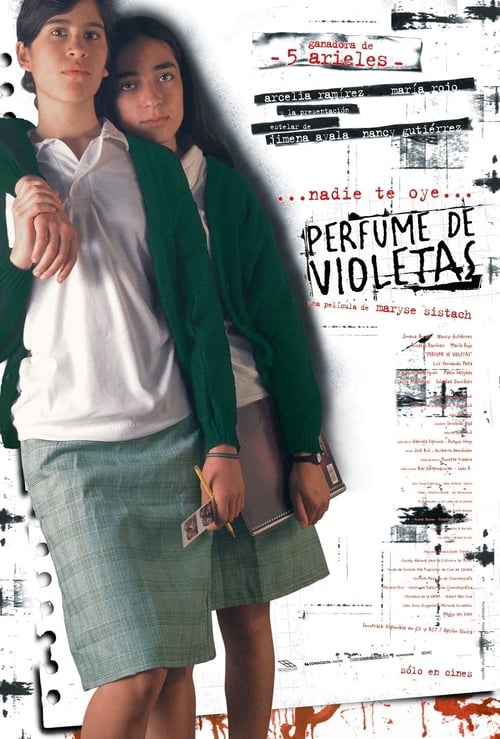
Violet Perfume: Nobody Hears You
2001 · Maryse Sistach
For when you want a film that tells a hard truth without flinching — a challenge, not a comfort, and one you'll need to talk about afterward. Not the pick for a fragile night.
What it's about
On the rough edges of Mexico City, two schoolgirls fall into an intense friendship: Yessica, defiant and starved of affection in a household ruled by a brutal stepfather and a predatory stepbrother, and Miriam, quieter, raised in a small pocket of calm by her loving single mother. Between classes they share perfume, secrets, and a way out of their separate lonelinesses. But the violence circling Yessica's home life keeps pressing closer, and the adults around them — teachers, neighbors, family — keep looking away.
The experience
Tender and dread-soaked at once: the girls' scenes have a loose, sunlit warmth that makes the surrounding menace harder to bear. It builds quietly toward heartbreak, and the title's promise — nobody hears you — hangs over every scene. This one stays with you, and not comfortably.
Performances
Ximena Ayala is ferocious and wounded as Yessica, all bravado over need, and Nancy Gutiérrez matches her with a stillness that makes the friendship feel real rather than scripted.
The craft
Maryse Sistach, working with her longtime co-writer José Buil, shoots in a stripped-down social-realist register — handheld intimacy, real streets and classrooms, no score telling you what to feel. The restraint is the point: the horror lands harder because the film refuses to dramatize it, and the everyday texture makes the adults' blindness feel like an indictment.
Why it matters
One of the key Mexican films of the early 2000s to force sexual violence against girls — and the institutional silence around it — into national conversation, and a landmark for women directing social-issue cinema in Mexico.
Snapshot
Perfume de violetas: Nadie te oye is a Mexican social-realist drama about two adolescent girls whose fragile friendship is destroyed by sexual violence and by the silence that surrounds it. Directed by Maryse Sistach (sometimes credited Marisa Sistach) from a screenplay by her longtime creative partner José Buil, the film follows Yessica (Ximena Ayala), a defiant, unloved girl from a violent home on the edge of Mexico City, and Miriam (Nancy Gutiérrez), a quieter classmate raised by a caring single mother. When Yessica's amoral stepbrother Jorge (Luis Fernando Peña) arranges to have a friend rape her, the assault fractures the girls' bond and sets in motion a tragedy that the surrounding adults — teachers, neighbors, family — fail to see or hear. Running roughly ninety minutes and released in March 2001, the film became one of the most honored Mexican pictures of its year and a landmark of women's filmmaking within the country's turn-of-the-millennium cinematic revival. Its title works as an indictment: the "nobody hears you" is a statement about who, in a class-stratified city, is granted the dignity of being listened to.
Industry & production
The film is a product of the state-supported art-cinema infrastructure that made the Mexican revival of the late 1990s possible. Financing came through IMCINE (the national film institute) and, crucially, FOPROCINE, the fund for quality production established in the late 1990s to underwrite auteur-driven and socially serious work that the commercial market would not support. Additional backing came from Mexican production entities (Producciones Tragaluz and associated companies), the national film schools' apparatus (the CCC — Centro de Capacitación Cinematográfica — and UNAM's film arm), and two prominent international sources: the Hubert Bals Fund of the Rotterdam festival, which specializes in seeding films from the global South, and the John Simon Guggenheim Memorial Foundation. José Buil served as producer as well as writer. This funding mosaic is itself telling: a modest, difficult, uncommercial subject was assembled from precisely the pool of public and festival-linked money designed to keep such films alive. The exact budget is not part of the reliable public record, but the production was plainly a low-to-modest one, shot on real locations rather than sets, which is consistent with its aesthetic.
Technology
The film was made and exhibited in the standard professional format of its moment — 35mm photochemical production for theatrical release — before the digital transition reshaped low-budget filmmaking later in the decade. There is no evidence of unusual technical apparatus; the picture's power comes from method rather than machinery. Its "technology," in a meaningful sense, is the technology of the city itself: the peseros and microbuses of Mexico City's informal transit system, whose cramped, jolting interiors become the film's most charged spaces. The specific technical metadata (film stock, lenses, aspect ratio) is not well documented in accessible sources, and I will not invent it.
Technique
Cinematography
Photographed by Servando Gajá, the film adopts an observational, documentary-inflected realism. The camera stays close to its adolescent protagonists — frequently handheld, mobile, and attentive to faces and small gestures — favoring available-light naturalism over composed prettiness. The visual grammar draws a class geography with restraint: the confined, chaotic interiors of Yessica's home and the punishing public transit contrasted against the more ordered, gentler space Miriam shares with her mother. The microbus sequences, jostling and intimate, place the viewer at the physical level of the girls, making the ordinary journey a site of vulnerability. The cinematography's ethical stance is notable — it neither aestheticizes the violence nor turns away, choosing instead a sober, unglamorous proximity.
Editing
The film was cut by José Buil (who also wrote it) together with Humberto Hernández. The editing serves the realist mode: it builds through accretion of everyday detail rather than through aggressive montage, allowing scenes to breathe and letting the dread accumulate gradually. The dual role of Buil as writer-editor is characteristic of his and Sistach's tightly integrated working method, in which the shaping of the story continued into the cutting room.
Mise-en-scène / staging
The film's authenticity rests heavily on its production design — a point the Mexican Academy recognized by awarding it for both art direction (Guadalupe Sánchez) and costume design (Alejandra Dorantes). The lived-in clutter of a poor household, the uniforms and cheap adornments of schoolgirls, the market stalls and street textures of the urban periphery: these are rendered with specificity rather than as generic "poverty." The violet perfume of the title is the film's key material object — a small, cheap luxury, a token of tenderness and aspiration that carries an unbearable weight as the story darkens. Staging repeatedly emphasizes thresholds and enclosures — the bus, the schoolyard, the apartment — spaces in which the girls are watched, judged, or trapped.
Sound
Sound is central to a film whose title is about the failure of hearing. Rather than a conventional orchestral score, the film uses a curated, eclectic soundtrack drawn from contemporary Mexican music — including the all-female garage-punk band Las Ultrasónicas — alongside contributions associated with figures such as Leonardo Heiblum and the artist Miguel Calderón. (Sources differ on the precise apportioning of "music" versus "composed score" credits, and I flag that the record here is somewhat tangled.) The effect is to root the girls' world in a specific, youthful, urban present rather than to editorialize over it with sentimental scoring. The soundscape of the city — traffic, transit, crowds — is itself a dramatic instrument, ambient noise standing in for the indifferent hum that swallows the girls' cries.
Performance
The performances are the film's foundation, and the awards record reflects it. Ximena Ayala, in a breakthrough role, plays Yessica with a raw, unsentimental force — abrasive, needy, and finally devastating — a performance that won her the Ariel for Best Actress. Nancy Gutiérrez's Miriam is her necessary opposite: contained, watchful, decent. Arcelia Ramírez, as Miriam's loving mother Alicia, earned the Ariel for Best Supporting Actress, and the veteran María Rojo appears as Yessica's mother; Luis Fernando Peña plays the predatory stepbrother Jorge. Sistach's direction of young, relatively unknown leads alongside seasoned character actors produces a texture of unforced naturalism that is the film's signature achievement.
Narrative & dramatic mode
The film operates in a mode of social-realist tragedy. Its dramatic engine is not suspense in the thriller sense but a mounting, almost inevitable dread, generated by the audience's awareness of how little protection its protagonists have. The narrative is patient and observational in its first movement — establishing the girls' friendship, their contrasting homes, the ordinary rhythms of school and city — before the central act of violence ruptures everything. Crucially, the film treats the rape not as spectacle but as catastrophe, and it is at least as interested in the aftermath — the disbelief, blame, and silence that compound the original harm — as in the act itself. The trajectory is downward and unsparing; this is a film built to demonstrate a mechanism of social abandonment rather than to deliver catharsis or redress.
Genre & cycle
As drama, the film belongs to the tradition of socially engaged realism, and more specifically to the international current of "adolescence-in-crisis" cinema that flourished around the turn of the millennium — films that use the vulnerability of young people to anatomize a society's failures. Within Mexican cinema it sits alongside the era's hard-edged urban dramas about marginality and youth, sharing DNA with pictures like De la calle (in which Luis Fernando Peña also figured) and the broader wave of gritty city films that followed Amores perros (2000). Its distinctive contribution to the cycle is its unwavering focus on girlhood and on sexual violence as a class phenomenon.
Authorship & method
The film is inseparable from the decades-long partnership of Maryse Sistach and José Buil, a couple who have functioned as one of Mexican cinema's most durable creative teams — she directing, he writing and producing, both editing. Sistach, born in Mexico City in 1952, is among the most important women directors of modern Mexican cinema, part of a generation (with figures such as María Novaro, Busi Cortés, and Dana Rotberg) that expanded the space for women's stories and women's authorship from the 1980s onward. Her method here is documentary-rooted: the project reportedly grew out of years of interest in the lives of adolescent girls in the poor neighborhoods of Mexico City, and Mexican sources report that its origin lay in a newspaper crime report Sistach preserved and in subsequent field research and gathered testimonies — the fiction built atop observed reality. The key collaborators — cinematographer Servando Gajá, co-editor Humberto Hernández, art director Guadalupe Sánchez, costume designer Alejandra Dorantes — worked in service of that observational fidelity. On the question of a single "composer," the credits are diffuse rather than authored by one hand, which is itself an authorial choice consistent with the film's realist grain.
Movement / national cinema
Perfume de violetas is a defining work of the Mexican cinema renaissance of the late 1990s and early 2000s — the moment when a moribund national industry was revived by a combination of new state funding (FOPROCINE), a generation of ambitious filmmakers, and international festival attention. It is contemporaneous with the breakout titles that carried Mexican cinema to global visibility — Amores perros (2000) and Y tu mamá también (2001) — but represents the movement's quieter, more socially committed wing rather than its internationally marketed face. It also stands as a central document of Mexican women's cinema, extending a lineage of female-directed work concerned with domestic space, gendered violence, and the interior lives of women and girls.
Era / period
The film is precisely of its turn-of-the-millennium moment: a post-1997, FOPROCINE-enabled art cinema, made just before digital tools democratized low-budget production, and set in a contemporary Mexico City marked by deep and visible inequality. Its concerns — impunity, gendered violence, and the invisibility of the poor — would only grow in national urgency across the 2000s, giving the film a grimly prophetic cast. Within Sistach's own career it inaugurates what is often described as a loose trilogy on violence against young women, its "Nadie te oye" ("nobody hears you") subtitle later echoed by companion films built on the same "Nadie te…" construction, extending the motif of unheard, unseen girls across a body of work.
Themes
The film's central theme is the social production of silence: the ways in which class, gender, and family violence combine so that a poor girl's suffering goes literally unheard. Sexual violence is treated not as an aberration but as an outgrowth of everyday machismo and impunity, enabled by adults who look away. Female friendship — its tenderness and its fragility under pressure — is the emotional core, and its destruction is the film's true tragedy. Around these run themes of class stratification (dramatized through two contrasting households and the shared indignity of public transit), the precariousness of adolescent girlhood, and the failure of every institution — family, school, community — meant to protect children. The violet perfume itself distills the thematic paradox: a fragile emblem of love and self-worth in a world that grants neither to girls like Yessica.
Reception, canon & influence
The film was warmly received critically and had a substantial festival life, traveling internationally and being submitted as Mexico's entry for the Best Foreign Language Film category at the 74th Academy Awards, though it was not ultimately nominated. Domestically it was among the most celebrated films of its year at the Ariel Awards, Mexico's national film honors, winning in a cluster of categories that recognized its craft and performances — Best Actress (Ximena Ayala), Best Supporting Actress (Arcelia Ramírez), Best Original Screenplay (José Buil), and its design categories (art direction and costume). (Reporting on the exact tally of wins versus nominations varies across sources, and I flag that some accounts list additional Ariel recognition that I cannot fully confirm.)
Looking backward, the film's influences are the traditions of Latin American social realism and neorealist-descended observational drama, filtered through Sistach's documentary sensibility and her years of field research into adolescent life. Looking forward, its most concrete legacy is within Sistach's own filmography, where it opened a sustained cycle of films about unseen and unheard young women. More broadly, it stands as a touchstone of Mexican women's cinema and of the socially conscious strand of the country's early-2000s revival — a film repeatedly cited when the conversation turns to how Mexican cinema has confronted gendered violence and class. Its afterlife is less a matter of stylistic imitation than of moral example: an unflinching, compassionate model for how to film the violence done to those a society has decided not to hear.
Reception
Barely seen outside Mexico on release despite winning five Ariels and being Mexico's Oscar submission the same year Y tu mamá también was passed over, it has since become a generational memory-object for Mexican viewers — the film everyone half-remembers being shown in school — and now draws steady rediscovery on Letterboxd.
How Violet Perfume: Nobody Hears You was received, from release to now →
How to watch Violet Perfume: Nobody Hears You: what to notice on a first viewing
- Watch the camera stay close and handheld on the girls. Gajá keeps the camera mobile and near Yessica and Miriam's faces, favoring available light over composed prettiness throughout their ordinary days. The proximity makes you feel their world at their own physical scale, not from a safe distance.
- Notice the small bottle of violet perfume the girls share. The cheap perfume passes between Yessica and Miriam as a token of tenderness and a small stolen luxury neither girl's home can really afford. That one object carries more of the friendship's warmth than any line of dialogue does.
- Watch the two households staged so differently from each other. Yessica's cramped, chaotic home and Miriam's calmer one with her mother are shot in contrasting registers, and the crowded microbus puts both girls at the same physical level. The contrast in spaces tells you how much protection each girl has at home.
- Listen for the city's noise standing in for the score. Traffic, transit, and crowd sound run under the scenes instead of orchestral music, an ambient hum that neither comforts nor warns you. The indifferent city noise becomes the very thing the title says nobody hears through.
- Watch Yessica's defiance versus Miriam's watchful quiet. Ximena Ayala plays Yessica as raw and needy, while Nancy Gutiérrez's Miriam stays contained and decent, two very different survival strategies sitting side by side. Their contrasting registers show two ways a girl can try to stay safe in this world.
The whole guide to watching Violet Perfume: Nobody Hears You, with the keys for a rewatch →
Influences: the films it descends from and the films it influenced
- Los Olvidados (1950) — Established the Mexican template of filming Mexico City's slum adolescents with unsentimental, near-documentary observation that refuses redemptive uplift — the tragic-inevitability arc and refusal to console that Sistach inherits directly.
- Bicycle Thieves (1948) — The founding neorealist method — nonprofessional casting, real streets, available light, and plot subordinated to observed daily texture — is the observational grammar Sistach and cinematographer Servando Gajá build on.
- The 400 Blows (1959) — Model for the adolescent-in-crisis portrait carried by a breakthrough nonprofessional lead and closed with an aftermath-focused, unresolved ending rather than narrative catharsis.
- Pixote (1980) — Cast an actual street child as lead and let real slum life bleed into the fiction, letting documented reality dictate a tragic outcome — the Latin American precedent for Sistach's fiction-built-on-testimony approach.
- Salaam Bombay! (1988) — Built drama from months of field research and workshops with real street children — the same documentary-rooted method by which Sistach grew this film out of a preserved crime report and gathered adolescent testimony.
- Lola (1989) — Anchors the 1980s–90s generation of Mexican women's authorship — centering a working-class woman's interior life in Mexico City — the specific national tradition of women's cinema Sistach belongs to and extends.
- La niña en la piedra: Nadie te oye (2006) — Sistach's own continuation of the 'nobody hears you' cycle — same Sistach–Buil partnership, nonprofessional adolescent lead, and theme of the social production of silence around gendered violence.
- Fish Tank (2009) — Handheld, boxed-in observation of a working-class adolescent girl carried by a breakthrough nonprofessional lead, dramatizing gendered-class predation within domestic enclosures — the craft Sistach pioneered a decade earlier.
- Miss Bala (2011) — Immersive handheld camera locked to a young Mexican woman engulfed by violence she cannot escape, extending Sistach's formal device of the powerless female body as the film's fixed perspective.
- La jaula de oro (2013) — Documentary-rooted casting of nonprofessional adolescents and location shooting driving toward tragic inevitability — inherits Sistach's fusion of field-researched reality and observational fiction.
- Las elegidas (2015) — A restrained, observational Mexican portrait of young girls coerced into prostitution, foregrounding the social silence and gendered-class violence that are Sistach's central moral subject.
- Ixcanul (2015) — Nonprofessional cast, available-light naturalism, and a young woman's body as the site of gendered violence a community refuses to hear — the Central American extension of Sistach's theme of socially produced silence.
- Rosetta (1999) — Handheld camera glued to a working-class girl's body, accretive realist cutting, and a breakthrough nonprofessional lead — a near-contemporaneous parallel of the same observational-immersion craft.
- Ratcatcher (1999) — Available-light naturalism and a child's-eye observation of poverty, staged through thresholds and enclosures, developed independently at the same moment as Sistach's own confined domestic framing.
- Amores Perros (2000) — Co-founds the early-2000s Mexican revival with raw handheld cinematography and unvarnished Mexico City street texture — the same movement moment that gave Sistach's social realism its national visibility.
- De la calle (2001) — Released the same year with the same subject — Mexico City's street adolescents rendered through social-realist observation — a direct genre-innovation sibling in the revival's socially conscious strand.
- Y tu mamá también (2001) — Shares the revival's naturalistic handheld shooting and unflinching attention to Mexican class stratification observed through adolescents, though roving where Sistach is confined.
Similar films
- Amores Perros (2000) — influence & lineage
- Y Tu Mamá También (2001) — influence & lineage
- Prayers for the Stolen (2021) — shared sensibility
- All Your Faces (2023) — shared sensibility
- Thesis (1996) — shared sensibility
- Talk to Her (2002) — shared sensibility
- Nobody Knows (2004) — shared sensibility
- Yuni (2021) — shared sensibility