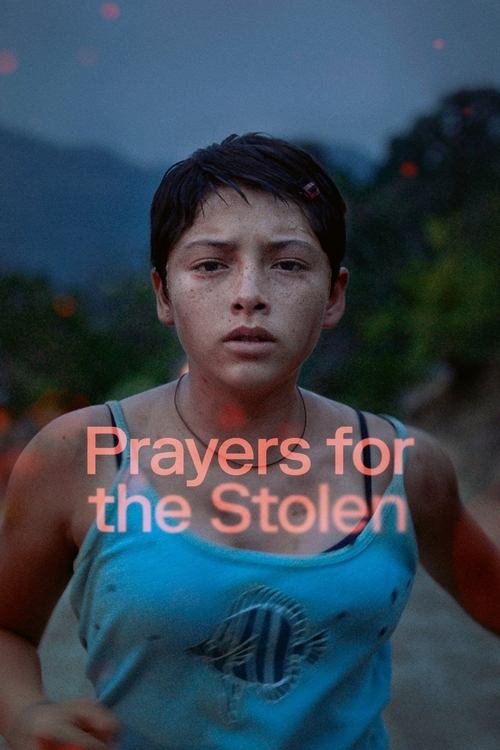
Prayers for the Stolen
2021 · Tatiana Huezo
For when you want a film that's beautiful and devastating in equal measure — one to sit with in silence afterward. This is a challenge, not a comfort watch, but it rewards the attention with real emotional weight.
What it's about
In a poppy-farming village in the mountains of Guerrero, Mexico, three girls — Ana, María, and Paula — grow up under the shadow of the cartel that controls the region. Their families work the opium harvest while young women keep disappearing, so mothers dig hiding holes in the earth and cut their daughters' hair to pass them off as boys. The film follows the friends across two stretches of childhood, first as small kids and then as adolescents, as the games and secrets of girlhood unfold alongside the sound of trucks climbing the mountain road.
The experience
Quiet, tender, and quietly terrifying — the danger stays mostly at the edge of the frame while everyday life goes on, which makes the dread accumulate rather than spike. It's slow-burning and immersive, closer to lived memory than to a thriller, and it leaves a lump in the throat.
Performances
The young non-professional and first-time actors playing the girls across two ages are remarkably natural — the film lives or dies on their unguarded faces and easy intimacy, and it lives.
The craft
Tatiana Huezo came to fiction from documentary, and it shows in the best way: the village feels observed rather than staged, with handheld closeness, natural light, and a soundscape where distant motors and gunfire carry more menace than anything shown. The two-part structure — childhood, then adolescence — lets you feel time and threat growing together.
Why it matters
A major arrival for Huezo as a fiction director after her acclaimed documentary work, and one of the defining recent films about how Mexico's drug war lands on women and children; it became Mexico's Oscar entry conversation piece of its year.
Snapshot
Prayers for the Stolen (original title Noche de fuego, "Night of Fire") is the fiction feature debut of Tatiana Huezo, a Salvadoran-Mexican filmmaker who arrived at narrative cinema by way of an already substantial documentary career. Adapted from Jennifer Clement's 2014 novel of the same name, the film observes three girls — Ana and her friends María and Paula — growing up in a poppy-farming village in the mountains of Guerrero, where the routine terror of the drug economy has made the disappearance of young women an ambient fact of life. Families dig hiding holes in the earth, cut their daughters' hair to disguise them as boys, and listen for the trucks that climb the mountain road. Huezo structures the film across two phases of childhood — the girls first as small children, then as adolescents — so that the film's real subject becomes the narrowing of possibility as a body becomes a target. It premiered in the Un Certain Regard section at the 2021 Cannes Film Festival, where it received a Special Mention, and was subsequently selected as Mexico's official submission for the Academy Award for Best International Feature Film. It stands as one of the most acclaimed Mexican films of its year and a landmark in a lineage of women-directed cinema about the country's drug violence.
Industry & production
The film sits at the intersection of Mexican auteur production and international art-house financing that has defined the country's prestige cinema in the 2010s and 2020s. It was produced by Nicolás Celis through Pimienta Films, the Mexico City company most widely known internationally as a producer of Alfonso Cuarón's Roma (2018); that pedigree situates Prayers for the Stolen within a specific ecosystem of Mexican production houses accustomed to steering festival-oriented work toward global distribution. The project was a multi-country co-production drawing on Mexican, German, and other European partners, a structure typical for Latin American art films of this scale, which assemble financing across national film funds, broadcasters, and co-production markets rather than from a single studio.
The adaptation of Clement's novel gave the production a literary property with existing international visibility — Clement, an American-Mexican writer and former president of PEN International, wrote the book out of research into the disappearance of women in rural Mexico. Netflix acquired the film for streaming distribution, which became its primary means of global exposure after the festival run; this pairing of Cannes prestige with a streamer's reach mirrors the distribution logic that carried Roma and other recent Mexican titles to worldwide audiences. Precise budget and box-office figures are not part of the well-documented public record, and I will not estimate them; as an art-house title whose commercial life ran largely through streaming and festivals, it was not a theatrical earner in the conventional sense.
Technology
Prayers for the Stolen was shot digitally, the default for contemporary independent production of its kind, and there is nothing in the record to suggest the use of exotic or experimental capture technology; its formal distinctiveness comes from craft choices rather than hardware. The film's technological signature, insofar as it has one, lies in the marriage of documentary-trained image-making to fiction: long lenses and available or naturalistic light used to hold real landscapes and non-professional performers, and a sound design built to render the mountain environment with unusual density. The two-phase casting — different actors playing the girls as children and as adolescents — is a production-design solution to the film's time structure rather than a technological one, and it is executed without digital de-aging or synthetic manipulation. Where technique elsewhere in this dossier reads as "technological," it is more accurately a matter of the disciplined analog-to-digital documentary toolkit — patient observation, environmental sound capture — repurposed for staged narrative.
Technique
Cinematography
The photography, by Dariela Ludlow, is the film's most immediately recognizable achievement. The camera keeps close to the children's eye level and scale, favoring a tactile intimacy with faces, hands, hair, and the surrounding vegetation of the poppy fields and forest. Landscape is neither postcard scenery nor abstracted menace; it is a lived terrain whose beauty and danger are inseparable — the same green mountains that shelter the girls also conceal the men who hunt them, and hide the poison sprayed from the sky. The cinematography withholds the genre's usual spectacle of violence, keeping guns, trucks, and armed men at the edges of the frame or just outside it, so that threat is registered as sound, rumor, and the reactions of adults rather than as depicted action. This choice — to photograph fear from the inside of a child's limited vantage — is the film's central visual strategy and the reason its terror feels so total.
Editing
The editing serves the film's two-part temporal architecture, executing the leap from childhood to adolescence as a structural rhyme rather than a titled chapter break: the same spaces, rituals, and relationships return, now inflected by the girls' changed bodies and sharpened awareness. Within scenes the cutting is patient, holding on faces and on the duration of ordinary activity — school, play, chores, hiding drills — so that the intrusions of violence land as ruptures in an otherwise continuous texture of daily life. The specific editorial credits are not something I can attribute with confidence from memory, and I will not guess at names; what is clear from the film itself is an editorial sensibility trained on documentary rhythm, comfortable with observational duration and with letting meaning accrue rather than be cut into shape.
Mise-en-scène / staging
Huezo stages the film around a small repertoire of charged spaces and rituals: the hole dug in the yard where a girl must climb down and lie still; the schoolroom that empties as teachers flee and families disappear; the hillside poppy fields worked by the mothers. Recurrent gestures — the cutting of a daughter's hair, the drill of hiding, the listening for engines — accumulate into a grammar of survival that the children internalize as normal. The staging consistently privileges the girls' collective friendship as the emotional center against which the encroaching apparatus of violence is measured. Adults are often framed as protectors who are themselves powerless, and the men of the cartels are kept largely offscreen or peripheral, a staging decision that refuses to let the perpetrators become the film's protagonists.
Sound
Sound is arguably where Huezo's documentary background asserts itself most powerfully. The film builds an immersive environmental soundscape — insects, wind, water, the mountain's living hum — into which mechanical and human threats intrude: the drone of crop-dusting planes, the approach of vehicles, distant voices. Because the visual field withholds violence, the soundtrack carries much of the film's dread; danger is heard before, and often instead of, being seen. This makes the ambient world both beautiful and unbearable, and it is the film's principal means of placing the spectator inside the children's state of perpetual, uncertain listening. On the question of the musical score, I am not confident of the specific composer credit and will not invent an attribution; the film's affective power rests as much on organized environmental sound as on scoring.
Performance
The performances, largely from non-professional and young actors cast for authenticity, are central to the film's realism. Because the story spans two ages, the three central girls are played by two sets of performers — younger children and older adolescents — a doubling that the film absorbs into its structure so that the passage of time is felt as a physical transformation. Huezo draws unguarded, interior performances from the children, work that depends on trust and on the director's documentary habit of observing rather than directing behavior into shape. The mothers, who labor in the fields and must contemplate sending their daughters away for safety, provide the film's register of adult grief and resignation. The naturalism is not incidental: it is the mechanism by which the film converts a reported social horror into lived, particular experience.
Narrative & dramatic mode
The film's dramatic mode is observational realism organized around a coming-of-age structure that has been hollowed out by threat. It is not plotted as a thriller with escalating incidents toward a climax; instead it proceeds through the accretion of daily life, allowing the shape of the danger to emerge gradually from the texture of the ordinary. The two-part structure — children, then adolescents — functions as the primary dramatic engine, because what changes across the gap is not the external situation but the girls' vulnerability to it: to grow up female here is to become prey. The narration stays disciplined within the children's perspective and knowledge, so that much of the surrounding violence reaches the audience as it reaches them — partially, obliquely, through overheard adult fear. The result is a film about anticipation and endurance rather than event, whose dramatic tension is the tension of waiting.
Genre & cycle
Nominally a drama, Prayers for the Stolen participates in and revises the Mexican narco-cinema and drug-war film. Where much of that cycle centers on cartels, sicarios, and the machinery of the trade — often from within a masculine, action-driven frame — Huezo's film systematically decenters the perpetrators to foreground those the violence acts upon: girls, women, families in the rural communities caught between the state's absence and the cartels' presence. It also belongs to a broader art-house cycle of Latin American films about childhood under conditions of political and social violence, and to a coming-of-age tradition in which growing up is figured as loss rather than liberation. Its refusal to depict violence spectacularly marks it as a deliberate counter-cinema to the genre's dominant mode.
Authorship & method
Tatiana Huezo is the film's decisive author, and Prayers for the Stolen is best understood as the migration of a documentary sensibility into fiction. Born in El Salvador and based in Mexico, Huezo established herself with the documentaries The Tiniest Place (El lugar más pequeño, 2011), about a Salvadoran community rebuilding after the civil war, and Tempestad (2016), which addressed disappearance, wrongful imprisonment, and the machinery of fear in Mexico. Those films established her defining methods: patient observation, attention to landscape and sound, an ethics of proximity to people living through trauma, and a preference for testimony and atmosphere over exposition. All of these carry directly into her first fiction feature, so that Prayers for the Stolen reads less as a break with her documentaries than as their continuation by other means — the same subject of enforced disappearance and the same immersive method, now staged with actors.
Among her collaborators, cinematographer Dariela Ludlow is central to realizing the film's intimate, landscape-attentive image. Producer Nicolás Celis and Pimienta Films provided the production framework. Huezo worked from Jennifer Clement's novel as source material; the adaptation reshapes the book toward Huezo's observational, child-centered method. On the specific credits for editing and music I will not assert names I cannot verify, and the historical record on the exact contours of those collaborations is, in my recollection, thin.
Movement / national cinema
The film is a significant entry in contemporary Mexican cinema and, more specifically, in the recent surge of women-directed Mexican and Latin American films addressing violence and disappearance. It shares terrain with the international-facing Mexican art cinema associated with Pimienta Films and the Roma moment, and with a wider regional current in which festival cinema takes up the human cost of the drug war from perspectives — women's, children's, rural, indigenous, communal — that mainstream narco-media had marginalized. Huezo's own trajectory from El Salvador into Mexican cinema also situates the film within a transnational Central American–Mexican authorship, and its documentary lineage connects it to the strong Mexican nonfiction tradition of the 2010s.
Era / period
Prayers for the Stolen is a film of the early 2020s that speaks to and about the long era of the Mexican drug war — the period, running roughly from the mid-2000s onward, in which cartel violence, forced disappearance, and the disappearance of women in particular became defining national traumas. It arrived in the specific festival moment of 2021, when the pandemic had reshaped release patterns and streaming platforms had become primary conduits for international art cinema; its acquisition by Netflix is characteristic of that juncture. Within Huezo's own career it marks the pivotal transition from documentary to fiction, and within Mexican cinema it belongs to a period of unusual international visibility and of increasing prominence for women directors.
Themes
The film's governing theme is the gendering of danger: to be born a girl in this village is to be born a potential target, and the whole apparatus of daily life — the holes, the haircuts, the hiding drills — is organized around that fact. From this flow its other concerns: childhood and its foreclosure, so that the coming-of-age story becomes an account of innocence surrendered under duress; the resilience and grief of mothers forced to weigh a daughter's safety against her presence; the entanglement of the natural world and violence, with the poppy fields and mountains rendered as both sustenance and threat, and the crop-dusting planes poisoning the very land that feeds the community. Underlying all of it is the theme of enforced disappearance and the absence of the state — the sense of communities left to devise their own inadequate defenses against a predation that the wider society tolerates or ignores. Friendship among the three girls stands as the film's counter-value: the fragile, sustaining bond that the violence works to sever.
Reception, canon & influence
Critically, Prayers for the Stolen was strongly received on the international festival circuit and beyond, praised in particular for its formal control, its restraint in handling violence, and its child's-eye immersion in an unbearable reality. Its Cannes Un Certain Regard Special Mention in 2021 conferred early prestige, and its selection as Mexico's Academy Award submission confirmed its standing as a nationally representative work; I want to be careful not to overstate its awards trajectory beyond these, and will not claim a final Oscar nomination. Within Mexican film culture it was widely honored, and it consolidated Huezo's reputation as one of the country's most important contemporary filmmakers.
The influences on the film run in two directions: backward to Jennifer Clement's novel, which supplied the material and its central premise, and — more formatively — to Huezo's own documentaries and the broader Latin American observational tradition, whose patience, landscape-consciousness, and ethics of proximity the film inherits. Its forward legacy is best measured by what it consolidated: the viability of a de-spectacularized, victim-centered, woman-authored approach to the narco film, and the confirmation that a documentarian's methods could produce fiction of the first rank. It strengthened the visibility of women directors in Mexican cinema and helped set a template for treating the drug war's human cost through intimacy rather than action. Huezo's subsequent standing — and her continued work in both documentary and fiction — is the clearest downstream evidence of the film's importance. Given the film's relative recency, claims about a long-term canonical position remain provisional, but within its own moment it is securely regarded as a major work.
Reception
It premiered in Un Certain Regard at Cannes 2021 (taking a special mention) and became Mexico's Oscar entry, making the Best International Feature shortlist — yet its quiet Netflix drop meant it reached most viewers by word of mouth, and it's since settled in as one of those 'best films of 2021 nobody talks about enough' picks.
How Prayers for the Stolen was received, from release to now →
How to watch Prayers for the Stolen: what to notice on a first viewing
- Notice how low the camera sits, near the girls' eyes. Dariela Ludlow keeps the camera close to the children's height and scale, favoring faces, hands, and hair over any wider view of the danger around them. You experience the threat the way the girls do, close and partial, never from a safe wide view.
- Notice how much of the frame is mountain and field. The poppy fields and green hills fill the image again and again, the same land that feeds and shelters the girls' families and conceals the men who hunt them. The land is never scenery here, it is the same ground that sustains the village and hides what threatens it.
- Listen for engines or plane drone breaking the quiet. Huezo builds a dense environmental track of insects, wind, and water, then lets a distant motor or crop duster cut through it as an intrusion. Danger arrives in this film as a sound before it is ever a sight.
- Notice how long the camera stays on ordinary chores. The editing holds on school, play, and daily work far longer than a plotted thriller would, so the rare intrusion of danger lands as a rupture in that calm. The patience is deliberate, since the film's dread depends on how ordinary the surrounding life actually feels.
- Watch how unguarded and unrehearsed the girls' faces look. Huezo casts non-professional children and observes rather than directs them, so their reactions read as caught rather than performed, especially in the quiet stretches between events. The naturalism is the mechanism, it turns a reported horror into something felt through one particular face.
The whole guide to watching Prayers for the Stolen, with the keys for a rewatch →
Influences: the films it descends from and the films it influenced
- The Tiniest Place (2011) — Huezo's debut documentary established her method of building trauma through testimony, ambient sound, and patient landscape observation rather than exposition — the exact grammar she migrates wholesale into fiction here.
- Tempestad (2016) — Renders enforced disappearance and cartel menace almost entirely as threat heard-not-seen — offscreen perpetrators and dread carried by voice and atmosphere over a moving landscape — the direct template for this film's withheld violence.
- The Spirit of the Beehive (1973) — Pioneers the child-restricted perspective in which adult political violence stays permanently at the blurred edge of a girl's comprehension, the camera pinned to her eye level and the horror kept just outside the frame.
- Come and See (1985) — Sustains a subjective child POV of atrocity where sound design — ringing, muffled, ambient — privileges what is heard over what is shown, making menace an acoustic rather than visual event.
- Los Olvidados (1950) — Foundational Mexican model for casting non-professional children in an unsparing poverty realism, staging violence as an environmental condition the young simply inhabit.
- Nostalgia for the Light (2010) — Treats terrain as the keeper of the disappeared — the desert as an active field holding absence — the Latin American landscape-as-terrain-of-loss consciousness Huezo inherits for her mountain village.
- The Golden Dream (2013) — Moves a non-professional child cast across a lethal Mexican landscape where perpetrators strike from offscreen, coupling documentary-trained naturalism with an observational road structure.
- Birds of Passage (2018) — Extends the de-glamorized-narco project by rendering cartel violence entirely from the rural community's ground-level, sensory perspective — never the traffickers' spectacle — with landscape and off-screen dread doing the work.
- The Amazing Catfish (2013) — Advances the women-directed Mexican wave with tactile, child-perspective naturalism and available-light intimacy, applying Catfish's body-attentive observational image-making to a new subject.
- Tótem (2023) — Extends the woman-directed Mexican child-restricted perspective, holding observational domestic duration so that catastrophe is filtered entirely through a young girl's partial understanding.
- Sujo (2024) — Continues women-authored narco cinema tracing a child raised in the cartel's shadow across a two-part temporal structure, favoring intimacy and aftermath over the violence itself.
- El Eco (2023) — Huezo's return to observational documentary of children within a demanding rural landscape confirms the continuity — the same eye-level proximity, sound, and durational patience now folded back from fiction into nonfiction.
- Roma (2018) — Shares producer Nicolás Celis / Pimienta Films and the same wager on a non-professional female lead within observational, long-duration realism where historical violence intrudes on domestic space from the margins.
- Ixcanul (2015) — Casts non-professional indigenous women against a volcanic landscape-as-terrain, building through rituals of survival and restraint until danger arrives, staged rather than spectacularized.
- Monos (2019) — Uses mountainous terrain as an armed-conflict theater for adolescents, with an immersive environmental soundscape that turns ambient noise into constant, unseen threat.
- Beasts of the Southern Wild (2012) — Locks the camera to a child's eye level and body height so an overwhelming, hostile environment is experienced entirely through a young girl's sensory scale, carried by a non-professional lead.
- Moonlight (2016) — Recasts a single character across ages with different performers to mark time's rupture — the dual-age doubling and two-part temporal rhyme Huezo uses to split her protagonist into child and adolescent selves.
- Identifying Features (2020) — Woman-authored revisionist narco cinema that centers a searching mother and victims, dramatizing disappearance through restraint and offscreen horror rather than cartel action.
- La Civil (2021) — A same-year, mother-centered drug-war drama built on the gendering of danger, keeping cartel perpetrators as an offscreen apparatus of fear that acts on women's bodies and households.
Similar films
- Tótem (2023) — influence & lineage
- Identifying Features (2020) — influence & lineage
- Violet Perfume: Nobody Hears You (2001) — shared sensibility
- The Mysterious Gaze of the Flamingo (2025) — shared sensibility
- 20,000 Species of Bees (2023) — shared sensibility
- The Official Story (1985) — shared sensibility
- Sound of Falling (2025) — shared sensibility
- Our Land (2026) — shared sensibility