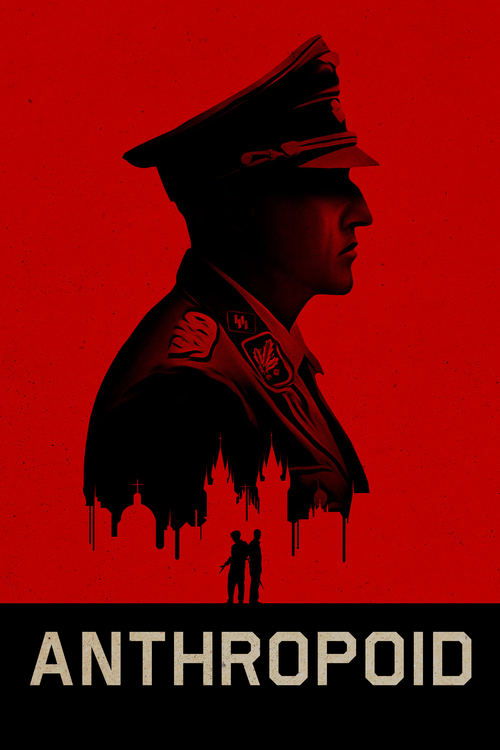
Anthropoid
2016 · Sean Ellis
For when you want a serious, white-knuckle historical thriller and you're prepared for it to cost something — this honors its true story too much to offer easy catharsis. Not a light watch, but a riveting one.
What it's about
December 1941: two Czechoslovak soldiers parachute into their Nazi-occupied homeland with a single mission — assassinate Reinhard Heydrich, the architect of the Reich's terror in Prague and one of the most powerful men in the SS. Working through a resistance network held together by suspicion and rationed trust, they must plan the impossible while knowing what reprisals will follow.
The experience
A slow-coiling spring of a thriller — quiet, methodical tension for the first half, then almost unbearable intensity once the mission is in motion. The final act is one of the most gruelling, gripping siege sequences in recent war cinema; it leaves you drained rather than triumphant.
Performances
Cillian Murphy is all coiled discipline as Gabčík, playing the mission's resolve against its human toll, with Jamie Dornan giving Kubiš a more openly fearful, affecting counterweight.
The craft
Ellis shot the film himself, and it shows in the grainy, handheld, period-soaked texture — Prague plays itself, and the film feels closer to a reconstructed classified file than a glossy war movie. The church siege finale is a masterclass in sustained, geographically clear action; loud speakers make it hit harder.
Why it matters
It brought Operation Anthropoid — one of the war's most consequential acts of resistance and among the least told in English-language film — to a wide audience, and stands as one of the most historically faithful WWII thrillers of its decade.
Snapshot
Sean Ellis's Anthropoid reconstructs Operation Anthropoid — the British-sponsored mission to assassinate SS-Obergruppenführer Reinhard Heydrich, Reich Protector of Bohemia and Moravia — with the patient procedural fidelity of a classified file declassified at last. Two Czechoslovak paratroopers, Jozef Gabčík (Cillian Murphy) and Jan Kubiš (Jamie Dornan), drop into their occupied homeland in December 1941, spend months threading through a resistance network run on suspicion and rationed trust, then carry out the most consequential killing of a senior Nazi official in the war — and pay for it in one of the most gruelling siege sequences committed to screen in the 2010s. Where most Second World War dramas traffic in retrospective vindication, Anthropoid keeps the camera close to the cost: the botched moment, the jammed weapon, the reprisal that obliterates two Czech villages, the final hours in a baroque crypt filling with blood and water. It is austere, procedural, and, in its final forty minutes, almost unbearably sustained.
Industry & production
The film was an Anglo-Czech-French co-production, with Ellis serving simultaneously as director, cinematographer, and co-producer — a consolidation of creative control he had exercised on Metro Manila (2013), which won the BAFTA for Outstanding British Film in 2014. Anthropoid premiered at the Tribeca Film Festival in April 2016 before a theatrical release through Bleecker Street in North America and Entertainment One in the United Kingdom. Precise budget and box-office figures are not reliably documented in the public record, and this dossier declines to speculate. What is on record is that production was centered in Prague and, crucially, that Ellis secured use of the Cathedral of Saints Cyril and Methodius — the actual site of the June 1942 siege in which Gabčík, Kubiš, and five fellow paratroopers died — for principal photography. Filming within the genuine space, whose crypt still bears bullet marks and memorial plaques, carries an ethical and atmospheric charge that no studio reconstruction could replicate. The script was co-written by Ellis and Anthony Pearce, drawing on declassified British Special Operations Executive documents and the substantial body of Czech historiography on the operation, including the accounts that informed Miroslav Ivanov's long-studied chronicle of the events.
The earlier major English-language dramatization of Operation Anthropoid, Lewis Gilbert's Operation Daybreak (1975), starring Timothy Bottoms and Martin Shaw, provided Ellis with a narrative template to measure against and a set of choices to consciously revise: Gilbert's film leaned into the romantic subplot and a more conventionally heroic frame, while Ellis compresses sentiment and foregrounds operational uncertainty.
Technology
Ellis doubled as director of photography, a practice continuous with his career since Cashback (2006). The specific camera platform has not been authoritatively confirmed in detailed technical interviews available to this account; given the production period and Ellis's established working methods, digital acquisition on a large-sensor camera is consistent with the visual evidence, though the precise specifications should be treated as unverified. What is documentable is Ellis's post-production approach: the image was treated with significant color grading to suppress saturation and push the film toward a cool, desilvered palette — period monochrome photographs of occupied Prague clearly serve as a reference point, without the film committing to full desaturation. The grade desaturates warm skin tones and mutes the colors of civilian clothing and Nazi regalia alike, flattening hierarchy, making everyone look equally besieged by the gray world around them.
Technique
Cinematography
Ellis shoots Anthropoid on a tight two-register system: wide, locked-off frames for the planning sequences, where space and its surveillance become the subject; and a destabilised, close, handheld grammar once kinetic threat enters the frame. The assassination sequence itself is shot with a documentary urgency — short focal lengths, bodies crossing the frame and cutting its sightlines — that foregrounds the chaos of the original event: Gabčík's Sten gun jams, Kubiš throws a grenade modified with plastic explosive, Heydrich's Mercedes slows, and everything goes wrong in a cascade that the camera refuses to mythologize with slow motion or grace notes. The crypt siege is lit in a way that registers the progressive failure of the environment: water seeping through stone walls, diminishing torchlight, the geometry of cover and exposure mapped with the clarity of a battle map. Ellis composes with attention to threshold — doorways, crypt entrances, gun slits — as architectural figures for the men's diminishing options.
Editing
The film's binary structure — a slow-building first half of network maintenance and paranoid logistics, a second half of kinetic escalation that does not relent — is held together by editing that initially resists rhythmic excitement and then, when the violence arrives, refuses to cut away from its duration. The cathedral siege runs for an extended stretch with few elisions; it is an editorial decision that functions as moral argument: the audience must remain with the dying for as long as the dying lasts. The editor on the film was Richard Mettler, though detailed documentation of his specific contribution to the cut is sparse in the critical literature.
Mise-en-scène / staging
Production design by Mark Geraghty reconstructs occupied Prague with care for the material texture of a city under administrative terror: the tram network, the apartment interiors, the storefronts with their German signage overlaid on Czech façades. The staging of dialogue scenes favours proximity — two people in a small room, unable to raise their voices, communicating through compression — and the direction of actors within space consistently uses walls and doorways to encode exposure. The cathedral crypt sequences make use of the genuine architecture: the low vaulted ceilings, the stone pillars, the external ventilation shafts through which the Nazis pump tear gas, are not reconstructions. The staging makes spatial literacy a survival skill the audience has to develop alongside the characters.
Sound
The sound design is a significant contributor to the film's effect and receives relatively little critical attention. The jammed Sten gun — its click and the silence where a burst should be — is among the most precisely rendered failure sounds in recent war cinema. The siege deploys overlapping acoustic channels: the German commands from outside, the ricochet patterns inside the crypt, the water, the men's breathing. Robin Foster's score is spare and tonal, using strings and low brass to mark anticipation rather than action; the composer does not attempt to aestheticize the violence but to score its approach. During the assassination and siege sequences, the score largely withdraws, leaving the production sound to carry full weight.
Performance
Murphy's performance as Gabčík is one of controlled interiority — a man whose affect has been scoured down to function. He does not perform heroism; he performs decision. This is calibrated against Dornan's Kubiš, who carries more visible feeling and whose romantic attachment to Marie (Anna Geislerová) is the film's main emotional conduit. The performances from the Czech cast — Geislerová, Marcin Dorocinski as Uncle Hajský, and Toby Jones as the resistance leader Zelenka-Hajský — anchor the film's other register: the civilian population absorbing the consequences of the mission they did not choose. Charlotte Le Bon plays Lenka, Gabčík's love interest, with an appropriate economy given how little the screenplay allows her interiority to register. Dornan, whose casting was met with some skepticism given his then-recent associations with the Fifty Shades franchise, delivered a performance widely acknowledged as a genuine dramatic turn.
Narrative & dramatic mode
Anthropoid operates as historical procedural: the narrative interest is not whether the mission will succeed — that is known — but how, and at what cost, and in what condition of moral clarity the men will carry it out. The film is uninterested in the Führer's-bunker teleology of dramatic irony that allows most WWII cinema to position its audience above events. Instead, it traps the viewer in operational uncertainty alongside the characters, sharing their incomplete information about timing, exposure, and the likely reprisal. The insertion of the Lidice and Ležáky massacres — communicated in a title card at the film's end — retrospectively weights the preceding action with a consequence the characters could only partly anticipate. This ethical structure, deferring the full moral reckoning to the last moments, is one of Ellis's most considered formal decisions.
Genre & cycle
The film belongs to the special-operations war procedural, a subgenre with roots in films like The Guns of Navarone (1961) and its descendants — missions defined by precise targeting, small team dynamics, and a catastrophe encoded in the mechanics of the plan itself. More immediately, Anthropoid participates in the 2010s cycle of sober, desaturated Second World War cinema that included Fury (2014), Dunkirk (2017), and Hacksaw Ridge (2016), films collectively revisiting the war with an emphasis on physical cost and moral ambiguity over triumph narrative. Within this cycle, Anthropoid occupies a specific niche: European resistance rather than Allied military, assassination rather than liberation, defeat-in-victory rather than triumph.
Authorship & method
Ellis is the auteur center of Anthropoid in an unusually concentrated sense: director, cinematographer, and co-writer, he controls the film's visual rhetoric from script to grade. His career trajectory — from still photography and fashion work to short films to features — is consistent with a director for whom image composition is not supplementary to storytelling but constitutive of it. Cashback (2006) established his interest in frozen time and the phenomenology of the ordinary moment; Metro Manila (2013) demonstrated his ability to shape genre material (the Filipine noir thriller) with location-grounded visual authenticity. Anthropoid extends these methods into historical material. Anthony Pearce's contribution to the screenplay is underexplored in the critical literature; the dialogue is spare and functional, suggesting a shared preference for showing over statement. Robin Foster's score is one of strategic restraint. Editor Mettler's specific relationship with Ellis's camera grammar — how assembly and shooting informed each other — is not documented in detail.
Movement / national cinema
Anthropoid is not Czech cinema in any straightforward sense, though it was filmed in Prague, draws on Czech historical memory, and engages with one of the defining events of Czech national consciousness. It is more precisely a British film about Czech history, with an international cast, framed through a British director's aesthetic. This positioning gives it a particular relationship to Czech cinema's own treatment of the occupation. Jiří Menzel's Closely Watched Trains (1966) addressed Czech resistance and collaboration in the occupation period with an ironic realism that won the Academy Award for Foreign Language Film; Jan Němec's Diamonds of the Night (1964) brought a more experimental phenomenology to related historical experience. Ellis's film is adjacent to this tradition without participating in it — it is a film about Czech history that does not deploy Czech cinematic intelligence, and the distance is legible in the film's more conventionally generic architecture. This is neither condemnation nor praise; it is a structural condition of the production.
Era / period
The film's historical period — occupied Czechoslovakia, 1941–42 — is rendered with attention to the administrative geography of Nazi control: the Reich Protectorate, the Gestapo apparatus, the calculation of risk attached to every civilian movement. It does not glamorize the occupation in the manner of some wartime nostalgia cinema but depicts it as a system of total exposure, in which the presence of a stranger in an apartment building is a potentially lethal event.
Themes
The film's central preoccupations are: the mechanics and morality of political killing; the civilian cost of resistance (the reprisals against Lidice and Ležáky render the paratroopers' courage inseparable from catastrophe for innocent others); the compression of loyalty and love under operational conditions; and the question of what constitutes a meaningful death. The film does not answer the last question — it presents the paratroopers' deaths in the crypt with grief and without redemption rhetoric, and lets the final title cards do the work of historical context rather than editorialising.
Reception, canon & influence
Critical reception was broadly positive without achieving the unanimity that attends canonical war films. Reviewers consistently praised the cathedral siege as among the most sustained action sequences of its moment; more mixed responses addressed the film's slow first half and its limited interiority for the female characters. Murphy and Dornan's performances were cited as anchoring the film's credibility. The film has not secured a position in the canonical WWII film conversation dominated by Saving Private Ryan, Dunkirk, and Come and See, but has accumulated a consistent following among viewers interested in the specific history and in procedural war cinema more broadly.
Looking backward, the film's influences are visible in the tradition of the sober European resistance procedural — Jean-Pierre Melville's Army of Shadows (1969) is the inevitable point of comparison, its resistance fighters ground down by operational logic and the impossibility of clean hands, its aesthetic stripped of sentiment. The Day of the Jackal (1973) provides the procedural thriller model for a political killing whose outcome is known. Operation Daybreak (1975) is the direct precursor on identical material. Laurent Binet's novel HHhH (2010), which approaches the same events through a radically meta-fictional lens that foregrounds the impossibility of historical reconstruction, represents the road not taken: Ellis opts for immersive realism where Binet interrogates the very act of representation.
Looking forward, the same historical material received another screen treatment in Cédric Jimenez's The Man with the Iron Heart (2017, also released as HHhH), which approached the story from Heydrich's perspective and generated a different set of critical debates about perpetrator-focalized war narrative. Whether Anthropoid directly shaped subsequent production decisions is difficult to establish with evidence; more plausibly it belongs to a wave rather than initiating one. Its genuine contribution may be the cathedral crypt sequence itself — a model for how to shoot a siege in confined space with dwindling resources and without cutting the duration of dying down to dramatic convenience.
A Deleuzian reading
A man steps off the curb, lifts a submachine gun at a slowing Mercedes, and squeezes.
The full Deleuzian reading of Anthropoid →
Reception
Landed quietly in 2016 with mixed reviews — 'slow first half, devastating finale' was the consensus — but it's picked up a steady afterlife as an 'underrated war film' pick, helped by Cillian Murphy completists working backwards from Oppenheimer.
How Anthropoid was received, from release to now →
Influences: the films it descends from and the films it influenced
- The Battle of Algiers (1966) — Pontecorvo's neorealist handheld documentary grammar for staging historical resistance operations in authentic locations established the device of treating known historical events as procedural sequences shot to resemble recovered footage — the foundational formal model for Ellis's authentic-location commitment and historical-procedural structure.
- Army of Shadows (1969) — Melville's grammar of stripping the resistance procedural of heroic inflation — gray desaturated palette, operational logic foregrounded over drama, moral cost accumulating through acts rather than speeches — is the direct template for Ellis's controlled interiority and refusal of sentiment in depicting the Anthropoid team.
- The Day of the Jackal (1973) — Zinnemann's model of the political assassination procedural with a historically known outcome — building suspense through the grammar of logistics and operational preparation rather than dramatic uncertainty about result — is the structural template Ellis applies to the Heydrich operation.
- Operation Daybreak (1975) — The direct structural and historical template on identical material — the Heydrich assassination and the cathedral crypt siege — that Ellis explicitly revises, retaining the procedural framework while replacing Gilbert's broader heroic register with spatial compression and emotional restraint.
- Das Boot (1981) — Petersen's grammar of durational siege in compressed space — the submarine interior as a formal device making spatial constriction the primary source of dread — anticipates Ellis's cathedral crypt sequence, which generates its power from the same logic of constriction prolonged past dramatic convenience.
- Come and See (1985) — Klimov's immersive WWII sound design — specifically the use of tinnitus, distortion, and ambient battlefield chaos as a subjective register in place of conventional scoring — is the formal precursor to Ellis's failure-sound-design approach and score-withdrawal strategy in the crypt siege.
- Saving Private Ryan (1998) — Spielberg and Janusz Kamiński's bleach-bypass desaturated color grammar for WWII — draining saturation as an authenticity signal rather than a stylistic flourish — is the direct technical ancestor of Ellis's own desaturated grade, and the extended Omaha Beach sequence establishes the durational-siege commitment Ellis develops in the crypt.
- Black Hawk Down (2001) — Scott and Slawomir Idziak's technique of multiple-coverage small-unit staging with desaturated stock — giving a historical special operations engagement the texture of recovered documentary footage — informs Ellis's grammar of procedural authenticity applied to the Anthropoid mission's execution phase.
- Munich (2005) — Spielberg's special-operations procedural on a state-sanctioned targeted killing uses deferred moral reckoning — the operatives' psychological cost accumulating across the operational sequence rather than declared in dramatic confrontation — as its moral grammar, which Ellis directly inherits for the Anthropoid team's controlled interiority.
- The Hurt Locker (2008) — Bigelow and Barry Ackroyd's handheld desaturated small-unit grammar — positioning the camera as near-peer observer within the operational unit rather than omniscient narrator — establishes the visual-stylistic template Ellis inherits for his two-register cinematography and situates Anthropoid within the 2010s desaturated-war-cinema movement.
- Hangmen Also Die! (1943) — A late entry in the Heydrich-assassination canon that Hangmen inaugurated, dramatizing the same operation and the reprisal-guilt structure across a new national cinema.
- Dunkirk (2017) — Nolan's durational-siege grammar — extending the temporal experience of survival without cutting to dramatic relief, refusing the war-film convention of heroic action punctuating waiting — develops the same formal commitment Ellis demonstrates in the cathedral crypt, applying it to a larger canvas with comparable refusal to abbreviate dying to dramatic convenience.
- 1917 (2019) — Mendes and Deakins's choice to stage the WWI mission as a real-time endurance experience — using the restriction of continuous duration to generate physical dread in place of dramatic cutting — extends Ellis's durational-siege principle from the contained crypt to an entire film, and the two-operative procedural structure mirrors Anthropoid's Jozef-and-Jan compression of the war to a pair of bodies.
- Valkyrie (2008) — Singer's historical procedural on a known-failed assassination of a Nazi leader shares Ellis's binary structure of operational preparation followed by execution, and the specific device of building procedural suspense through conspiratorial mechanics whose outcome the audience already knows — the closest Hollywood parallel to Anthropoid's genre position.
- Zero Dark Thirty (2012) — Bigelow and Mark Boal's procedural-accuracy grammar — subordinating dramatic structure to operational sequence, letting the mission's own logic generate tension without conventional plot mechanics — and Greig Fraser's desaturated handheld visual language together constitute the most direct stylistic sibling to Ellis's approach throughout the Anthropoid operation.
- Son of Saul (2015) — Nemes's shallow-focus extreme-proximity WWII grammar — using the protagonist's immediate physical perimeter as the film's entire visual field, compressing space to foreground sensory experience over historical panorama — is the closest formal parallel to Ellis's compression-of-space staging and his systematic refusal of the heroic establishing wide shot.
- Sicario (2015) — Villeneuve and Roger Deakins's score-withdrawal grammar — extended operational sequences where the score is withheld entirely and sound design alone carries dread — directly parallels Ellis's use of Robin Foster's score as a device of strategic restraint rather than continuous emotional underwriting.
- The Man with the Iron Heart (2017) — Jimenez's treatment of the identical Heydrich assassination events from the perpetrator's focalization — staging the same procedural historical material through a reversed moral optic — makes this a direct formal counterpoint testing what the same operational sequence yields when the camera aligns with the target rather than the assassins.
- Number 24 (2024) — Ellis's period-reconstructed urban resistance operation shares Number 24's formation narrative structure, biographical source material, and occupied-city spatial grammar — narrow institutional interiors, civilian normalcy as operational cover — as primary dramatic environment.
- The Resistance Banker (2018) — Matches the desaturated-cold palette and resistance-cell procedural that tightens toward an inexorable tragic-heroic climax under the constant threat of capture.
Similar films
- 1917 (2019) — influence & lineage
- Army of Shadows (1969) — influence & lineage
- Hangmen Also Die! (1943) — shared sensibility
- War for the Planet of the Apes (2017) — shared sensibility
- Enemy at the Gates (2001) — shared sensibility
- The Painted Bird (2019) — shared sensibility
- The Dirty Dozen (1967) — shared sensibility
- Downfall (2004) — shared sensibility