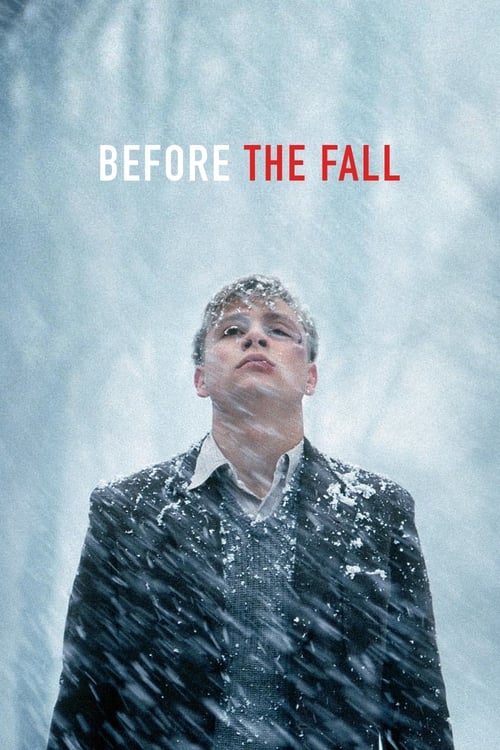
Before the Fall
2004 · Dennis Gansel
For when you want a serious, absorbing drama that earns its heartbreak — a film about conscience and friendship that leaves you with a lump in your throat and plenty to talk about. Emotionally challenging, but accessible and gripping rather than grueling.
What it's about
In 1942 Germany, a working-class Berlin teenager named Friedrich boxes well enough to earn a place at a Napola — one of the elite boarding schools built to breed the Nazi ruling class — and enrolls against his father's wishes. Inside, he finds gleaming facilities, brutal hazing, and an education designed to hollow boys out and refill them with the regime's code. His friendship with Albrecht, the sensitive son of a powerful local governor, becomes the axis of his year, as the two boys respond very differently to what the school demands of them.
The experience
Handsome and seductive on its surface, which is exactly the trap — you feel the pull of the place alongside Friedrich even as dread builds underneath. It plays like a classic boarding-school drama slowly curdling into tragedy, and it lands with real emotional weight.
Performances
Max Riemelt gives Friedrich a physical confidence that makes his gradual awakening believable, and Tom Schilling is quietly devastating as Albrecht — a boy too gentle for the machine his father serves.
The craft
Gansel shoots the academy with a polished, almost romantic beauty — misty grounds, firelit halls, disciplined bodies in motion — precisely so you understand how such a place recruited its victims. The boxing scenes are visceral, and the film's control of tone, letting menace seep into the school-story template, is its sharpest tool.
Why it matters
One of the key films in Germany's 2000s wave of reckoning with the Third Reich on screen, it dramatized an institution cinema had largely ignored and established Dennis Gansel — who returned to the mechanics of indoctrination in his later work — as a director of ideas.
Snapshot
Released in Germany as Napola – Elite für den Führer and abroad as Before the Fall, Dennis Gansel's second theatrical feature takes one of the Third Reich's least-dramatized institutions — the Nationalpolitische Erziehungsanstalten, the boarding schools built to manufacture a Nazi ruling caste — and runs it through the oldest machinery of the school film: a working-class boy admitted on athletic merit, a sensitive aristocrat who befriends him, an academic year that ends in ruin. Friedrich Weimer (Max Riemelt) boxes his way out of a Berlin tenement into Napola Allenstein in East Prussia in 1942. Albrecht Stein (Tom Schilling), the Gauleiter's son, is the boy who cannot survive the place. The film's power lies in the gap between its handsome, seductive surfaces and what those surfaces are recruiting for — a gap it exploits deliberately, and which critics have argued it does not always control. It arrived at the crest of Germany's mid-2000s reckoning with Nazism on screen, alongside Der Untergang and Sophie Scholl, and it functions now chiefly as the prehistory of Gansel's far more widely seen Die Welle (2008).
Industry & production
The picture is a product of the German funding-and-broadcast apparatus as it stood after the collapse of the Neuer Markt film-finance bubble: co-produced by Molly von Fürstenberg's Olga Film with Seven Pictures, the feature arm attached to the ProSiebenSat.1 broadcast group, with Viola Jäger and Harald Kügler among the producing credits. That structure is the story of German mid-budget cinema in this period — a regional soft-money base, a broadcaster attached at development for the eventual television window, and a theatrical release sized for the domestic market with international arthouse sales as upside rather than premise.
The project's origin is unusually personal for a film of this scale. Gansel has consistently described the impulse as familial: his grandfather attended a Napola, and the film began as an attempt to understand what such a school did to a boy who went willingly. This matters to the finished work, because it explains the film's refusal of the easy option — Friedrich is not conscripted or tricked into Allenstein. He forges his father's signature to get in.
Gansel came to the material from an odd angle. His previous feature, Mädchen, Mädchen (2001), was a commercially successful teen sex comedy; before that he had made the television film Das Phantom (2000) about the Red Army Faction. Napola was the film that converted a young genre director into a director of theses, and the production leaned on that youth: a cast of largely unknown performers in their late teens and twenties, subjected to a training regimen — boxing, drill, swimming — that reads on screen as physical competence rather than choreography.
The Germany-set exteriors make heavy use of surviving institutional architecture — the castle-and-cloister building stock that the NPEA system itself appropriated in the 1930s, and that German period production has drawn on ever since. Detailed technical documentation of the shoot is not richly published in the accessible record, and I would rather flag that than fill it.
Technology
Napola is a 35mm film made at the moment when European mid-budget production was crossing over to digital finishing. Capture is photochemical and conventional; the interesting technological question for a film like this is the back end, and the specifics of the pipeline — whether the picture went through a full digital intermediate or was graded photochemically — are not something the public record settles cleanly, so I won't assert one.
What is visible on screen is the aesthetic that DI-era grading made cheap and therefore ubiquitous in this cycle of German period cinema: a tightly controlled, desaturated palette pushed toward steel-blue and ash for the winter exteriors, with warmth quarantined into small, suspect pockets — lamplight in the dormitory, the ring lights over the canvas. Digital effects are used sparingly and invisibly, in the register that period drama of the mid-2000s had normalized: set extension, removal of anachronism, augmentation of formations and crowds so that a modest number of extras can read as an institution. The film's ambitions are not technological, and it makes no claim to be; its technical achievement is the seamlessness with which a moderately budgeted production passes as a large one.
The distribution technology matters more to the film's afterlife than the production technology does. Before the Fall reached most of its non-German audience on DVD and, later, streaming — the format in which a subtitled German-language drama could accumulate a viewership over years that a limited theatrical run never would.
Technique
Cinematography
Torsten Breuer's photography is the film's most contested element, and the contest is the point. The camera treats the Napola with exactly the reverence the institution demanded for itself: symmetrical wides of boys in formation in the courtyard, low angles that monumentalize the buildings, tracking shots along ranks of identical uniforms, bodies photographed in the cold with the muscular clarity of sports photography. This is, quite consciously, the visual grammar of Riefenstahl — Olympia's athletic body and Triumph des Willens' ornamental mass — deployed by a film whose argument is that this grammar is a lie.
The strategy has an obvious hazard, the one Susan Sontag named in "Fascinating Fascism": imagery of fascist beauty tends to survive the ironizing frame around it. Breuer's counter-move is a consistent thinning of the light. The Allenstein winter is rendered as luminous and colorless at once, an overcast whiteness that flattens the boys into silhouettes on the frozen lake. Handheld intrudes almost exclusively at moments of physical crisis — the boxing bouts, the shooting on the ice — so that the film's compositional order is legibly the school's order, and the camera's loss of composure marks the moments when the institution's own logic breaks it.
Editing
The cutting is classical and patient, organized by the calendar rather than by escalating incident. The film moves in seasonal blocks across a single academic year, and the editing's basic rhythm is repetition-with-variation: the same drills, the same dining hall, the same corridors, returned to until the audience knows the building the way the boys do. That accumulation is what makes the ruptures land — the grenade drill, the night on the lake — because they are cut against a texture of ordinariness the film has spent an hour establishing.
The boxing sequences are the exception, cut fast and close, with impact sound doing structural work. The final bout inverts the technique: as Friedrich refuses to fight, the coverage slows and lengthens, and the montage energy that has previously signified his ascent drains out of the scene. It is an editorial argument, not just a dramatic one. I cannot verify the editing credit with confidence from the accessible record, and I decline to guess at a name.
Mise-en-scène / staging
The production design does the film's ideological exposition so that dialogue does not have to. Allenstein is presented as a place of genuine beauty and genuine plenty — the parquet, the paneled halls, the fencing gear, the food. For a boy from a Berlin working-class flat this is not a prison but an elevation, and the film insists on that seduction as a condition of understanding anything. The Nazi iconography is comparatively restrained: eagles and runes are present as institutional furniture rather than as signposts, which is historically accurate and dramatically far more unnerving.
Staging is organized around a single opposition: the horizontal, ordered geometry of the collective — beds in rows, boys in ranks, the pool, the parade ground — versus the enclosed, vertical spaces where individuality survives, principally Albrecht's private reading and writing. The two men who structure Friedrich's world, the boxing instructor Vogler (Devid Striesow) and Gauleiter Stein (Justus von Dohnányi), are staged as competing fathers, and the film is careful to make Vogler the more attractive of them.
Sound
The score is credited to Angelo Badalamenti and Normand Corbeil — an unusual pairing for a German period drama, and one that pulls the music away from the martial. It works in long, cold sustains and small piano figures, refusing to underline atrocity and refusing, more importantly, to supply the brass that the images seem to invite. Diegetic sound carries the ideology instead: the loudspeaker, the whistle, the shouted count, the collective singing that the film uses several times as an index of how completely the boys have been absorbed. The lake sequence and Albrecht's drowning are the film's two great sound designs, both organized around the suppression of sound — the muffling of water and snow standing in for a moral silence nobody in the film will break.
Performance
Riemelt plays Friedrich almost entirely through the body: a boxer's watchfulness, a slow physical hardening across the year that the film asks us to read as corruption. It is a performance built on withheld reaction, and it holds the film's center without commanding it. Schilling's Albrecht is the more visible achievement — frail, articulate, ironic, and unbearably legible to the institution as prey. Striesow's Vogler is the crucial piece of casting: warm, damaged, genuinely invested in his boys, and therefore the film's most efficient demonstration of how such a system recruited decent men. The ensemble of younger boys is directed toward naturalism rather than period stiffness, which is the choice that lets the hazing scenes read as recognizable schoolyard cruelty rather than as historical exhibit.
Narrative & dramatic mode
The film is a Bildungsroman run in reverse: an education whose curriculum is the destruction of the capacity to judge. Its structure is the school-year cycle, its dramatic mode melodrama in the precise sense — a moral universe rendered through personal relations, in which an ideological system is legible only as what it does to a friendship. The Friedrich–Albrecht bond carries every argument the film makes; it is charged with an intimacy the film leaves deliberately unresolved as to its nature, which has been read by some critics as evasion and by others as the point, given that the Napola's homosociality was both constitutive and forbidden.
The dramaturgy is conventional and knows it. What complicates the convention is the ending's refusal of heroism. Friedrich's final act is not resistance in any usable sense — no sabotage, no rescue, no speech. He simply stops throwing punches and lets himself be beaten, and is expelled. The film ends with an exclusion, not a liberation, and the title Before the Fall keeps the historical catastrophe outside the frame, where the characters cannot see it and the audience cannot forget it.
Genre & cycle
Three genres converge. The boarding-school film supplies the architecture: Vigo's Zéro de conduite, Anderson's if...., and — decisively for the German tradition — Schlöndorff's Der junge Törless (1966), which had already established the military boarding school as the laboratory of German fascism a full generation before Gansel. The sports film supplies the ascent narrative and the ring as moral arena. The Nazi-era historical drama supplies the setting and the burden.
Within German cinema the closest antecedent is Agnieszka Holland's Europa Europa (1990), which places a Jewish protagonist inside a Nazi elite school and derives its charge from the same insight — that these institutions worked by offering belonging. The film's implicit adversary is Hitlerjunge Quex (1933), the Nazi youth-recruitment film whose imagery Napola systematically reoccupies.
Authorship & method
Gansel, then in his early thirties, co-wrote the screenplay with Maggie Peren, and their method is best described as genre appropriation for argumentative ends. The recurring Gansel project — visible across Napola, Die Welle, and even the vampire film Wir sind die Nacht (2010) — is the study of how belonging is manufactured and how quickly ordinary young people consent to hierarchy. He works in accessible popular forms, which is both the source of his reach and the basis of the critique against him.
The key collaborations: Breuer's camera, which supplies the seductive surface the script needs to indict; the Badalamenti/Corbeil score, which withholds the emotional cues the images request; and the young cast, several of whom Gansel carried forward — Max Riemelt reappears in Die Welle, making the two films read almost as a diptych across sixty-six years of German pedagogy.
Movement / national cinema
Napola belongs to what scholars have discussed as the German heritage film — Lutz Koepnick's work on 1990s and 2000s German retro-cinema is the standard reference — a mode in which the National Socialist past is rendered in high production values, star performances, and internationally legible emotional terms. It arrives at the peak of that cycle: Der Untergang (2004), Sophie Scholl – Die letzten Tage (2005), Das Leben der Anderen (2006), and, at the cycle's end, Der Baader Meinhof Komplex (2008). The associated debate is whether this cinema constitutes a genuine deepening of Vergangenheitsbewältigung or its aestheticized retirement — whether beautiful films about Nazism perform reckoning or license consumption. Napola is an unusually clear test case, because the seduction it depicts and the seduction it practices are formally the same thing.
Era / period
The film is set in the 1942–43 school year, the pivot of the war: after the invasion of the Soviet Union has bogged down, around and just before Stalingrad. The dating is doing work. The boys are being trained for an empire that is already, unbeknownst to them, lost, and the presence of Soviet prisoners in the East Prussian woods brings the Eastern Front's atrocity into the schoolyard. Historically, the NPEA network — founded in 1933, run under SS influence, distinct from the party-controlled Adolf Hitler Schools — was by this point supplying its graduating classes directly to a war that consumed them. The film does not need to state this; the title does it.
Reception, canon & influence
Domestically the film performed respectably and was widely discussed; it collected German industry recognition and audience prizes, and the young leads emerged from it with careers. I won't cite admissions or award specifics I cannot verify. Internationally it received a modest arthouse release as Before the Fall in 2005–06 and a broadly favorable but qualified reception: the performances of Riemelt and Schilling were consistently singled out, while the criticism clustered around conventionality — that a familiar prep-school narrative had been laid over the Third Reich, and that the film's handsomeness undercut its indictment. That objection has followed the film, and it is not a frivolous one; it is the central question a viewer has to settle for themselves.
Backward, the film's debts are clear: Der junge Törless for the premise that pedagogic sadism is the seedbed of fascism, if.... for the school-as-system structure, Europa Europa for the elite-academy setting, and Riefenstahl for the visual vocabulary it appropriates in order to disarm.
Forward, its most concrete legacy is Gansel's own Die Welle (2008), which relocates the inquiry to a present-day German classroom and became a substantial international hit and a fixture of school curricula — with Napola frequently taught alongside it as the historical panel of the pair. The film also functions as a launching point in German screen acting: Riemelt went on to Freier Fall, the Wachowskis' Sense8, and Berlin Syndrome; Schilling to Oh Boy and Werk ohne Autor; Striesow to Yella and Die Fälscher. Its thematic neighbors in later German-language cinema — most obviously Haneke's Das weiße Band (2009), which locates the same pedagogy a generation earlier — are not derivations, and I would not claim influence where the record shows only shared preoccupation. Napola is not a canonical film. It is a durable and genuinely uncomfortable one, and its discomfort is at least partly the kind it intended.
Reception
Released into Germany's big 2004 wave of Nazi-era reckoning cinema and promptly overshadowed at home by Downfall, it quietly racked up festival audience awards abroad and has since found a durable second life with streaming-era viewers discovering early Max Riemelt and Tom Schilling.
How Before the Fall was received, from release to now →
How to watch Before the Fall: what to notice on a first viewing
- Watch boys photographed in perfect symmetrical formation. Wide, low-angle shots monumentalize the school's courtyard drills and rows of uniforms, echoing the visual grammar of classic propaganda filmmaking. The camera flatters the institution exactly the way it flattered itself, before you're told to distrust that flattery.
- Watch warmth get rationed to lamplight and the ring. The winter exteriors stay steel-blue and colorless, while genuine warmth in the palette is largely confined to dormitory lamps and the boxing ring's lights. Color is telling you where the only real comfort in this world is allowed to live.
- Notice the camera turn handheld only during physical danger. The boxing bouts and moments of real risk are the only times the camera loses its otherwise composed, symmetrical order. The camera's own loss of control marks exactly when the institution's logic is breaking down.
- Listen for the whistle, the count, and collective singing. Diegetic sound, loudspeakers, shouted counts, boys singing together, carries the school's ideology instead of a swelling musical score. You can hear how completely these boys have absorbed the system without a single line of dialogue about it.
- Watch rows of beds and ranks of boys versus one private room. The staging keeps opposing horizontal collective spaces, dormitories, parade grounds, the pool, against the one enclosed vertical space where Albrecht reads and writes alone. You can see exactly where individuality is still allowed to survive in this place, and how small that space is.
The whole guide to watching Before the Fall, with the keys for a rewatch →
Influences: the films it descends from and the films it influenced
- Triumph des Willens (1935) — Supplies the literal shot grammar Breuer appropriates — low-angle portraiture of boys against open sky, ranked bodies photographed along a horizontal axis so the frame reads as an unbroken collective line, banner-and-torch symmetry — quoted intact so the seduction lands before the indictment does.
- Olympia (1938) — The body-cult lensing of athletic training — backlit musculature, slow-motion isolation of effort, the boxer as sculpture — which Napola reproduces in its ring and drill sequences and then drains of exaltation by cutting the score out from under it.
- Hitlerjunge Quex (1933) — The Nazi conversion-Bildungsroman Gansel runs backwards: the same beats of the working-class boy recruited upward, sworn in by song, and consecrated by sacrifice, but with the martyrdom relocated to the wrong character and the anthem left diegetic so it functions as evidence rather than uplift.
- Der junge Törless (1966) — Establishes the German boarding-school film as a laboratory of fascism through the observer protagonist who watches a peer destroyed and declines to intervene — the exact moral architecture, dormitory-and-attic geography, and complicity-by-spectatorship structure Napola inherits and personalizes in Friedrich.
- if.... (1968) — The school-as-total-system survey: chaptered institutional anatomy moving from refectory to dormitory to disciplinary ritual, senior boys deputized as enforcers, and the ceremonial beating shot as procedure — Napola takes the structure and removes the possibility of the armed revolt that ends it.
- Europa Europa (1990) — The elite-academy procedural: racial-science classroom demonstrations, uniform-fitting and induction rituals, and the protagonist who passes inside the institution while concealing what would disqualify him — Napola relocates that concealment from ethnicity to class and conscience.
- Der Unhold (1996) — Dramatizes a Napola castle-academy directly, and hands down the recruitment sequence as pastoral abduction — boys collected from the countryside into torch-lit ceremonial interiors — plus the framing of the institution's architecture as a seductive fortress rather than a prison.
- Full Metal Jacket (1987) — The training-camp first act as formal engine: one-point-perspective barracks symmetry, drill rendered as rhythmic repetition-with-variation across a compressed calendar, and the collective punishment that turns the platoon against its weakest member — Napola's blanket-and-latrine humiliation of Siggi follows the same causal machine to the same suicide.
- Dead Poets Society (1989) — The prep-school template Gansel deliberately grafts onto the Third Reich — seasonal calendar structure, the sensitive writing boy in a warrior institution, the awakening mentor, the suicide of the son who cannot meet the father's demand — so the audience's genre reflexes deliver them into the ideology before they notice.
- Blue Velvet (1986) — Establishes the Badalamenti method Gansel hires directly: lush, tonally beautiful scoring laid over a rotten institution so the music refuses to confirm what the image is selling — in Napola the Badalamenti/Corbeil cues withhold the emotional payoff the Riefenstahl compositions keep requesting.
- Die Welle (2008) — Gansel's explicit companion piece, carrying Riemelt forward and rebuilding the same apparatus in a present-day classroom: uniform adoption, salute, and the manufactured horizontal collective, with the sympathetic authority figure (the Striesow function) transposed onto Vogel's teacher.
- Wir sind die Nacht (2010) — Extends the seductive-institutional-plenty staging into the vampire film: the banquet, the wardrobe, the effortless luxury that the recruit is bathed in before the terms are disclosed — the same manufacture-of-belonging blocking rendered in a different popular genre.
- Lore (2012) — The tactile after-image of the Napola formation — handheld, shallow-focus proximity to adolescent skin, hair, and water, ideology worn on the body and stripped from it — running Gansel's hardening arc in reverse as the elite child is deprogrammed by the collapse.
- Freier Fall (2013) — Carries Riemelt's physical-hardening performance register into another regimented male institution — police academy running, sparring, and locker-room proximity used to stage desire and discipline in the same body — the acting method Napola established as his signature.
- Das Experiment (2001) — The contemporaneous German obedience-thriller that proves the same commercial thesis-machine — ordinary participants, a closed institution, escalating hierarchy consented to rather than imposed — using genre tension as the delivery vehicle for a social-psychological argument, exactly Gansel's method.
- Der Untergang (2004) — Same-year twin from the Eichinger/Constantin production wave: high-fidelity Third Reich production design and psychologically accessible interiority deployed as the point of entry, which drew the identical critique — that the craftsmanship's handsomeness softens the object it depicts.
- Sophie Scholl – Die letzten Tage (2005) — Shares the mid-2000s German historical palette Breuer works in — desaturated steel-blue interiors, wintered institutional grays, available-light corridors — and the handheld move-in reserved for interrogation and crisis rather than used throughout.
- Das weiße Band (2009) — Locates the same pedagogy of ritualized punishment one generation earlier, and answers Napola's seductive surface with its formal opposite — locked-off frames, no score, monochrome austerity — treating shared preoccupation rather than inheritance.
Similar films
- Downfall (2004) — influence & lineage
- Europa Europa (1990) — influence & lineage
- Au Revoir les Enfants (1987) — shared sensibility
- The Bridge (1959) — shared sensibility
- The White Ribbon (2009) — shared sensibility
- All Quiet on the Western Front (2022) — shared sensibility
- The Boy in the Striped Pyjamas (2008) — shared sensibility
- Nickel Boys (2024) — shared sensibility