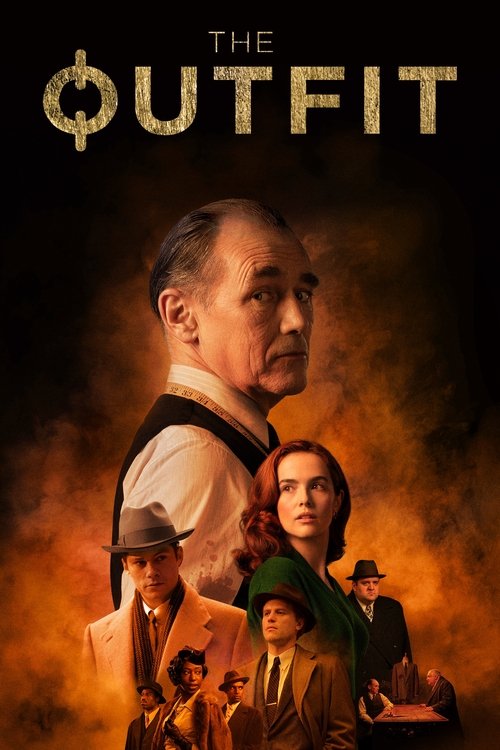
The Outfit
2022 · Graham Moore
For when you want a clever puzzle-box on a quiet night in — comfort viewing for people who like their thrillers built on dialogue and double-crosses rather than car chases.
What it's about
Chicago, 1956: a soft-spoken English tailor — sorry, cutter — runs a quiet shop in a rough neighborhood, making beautiful suits for the local crime family because they're the only ones who can pay. Over the course of one violent night, warring gangsters turn his shop into a battleground, and the mild man with the shears has to talk, stitch, and outmaneuver his way through a lethal standoff. Everything happens in one room.
The experience
A tight, purring mousetrap of a movie — talky in the best way, with reversals that keep snapping shut just when you think you've mapped the room. It's tense without being loud, and immensely satisfying to watch unfold.
Performances
Mark Rylance is mesmerizing in a role built entirely on stillness — every measured word and small gesture doing double duty — and he makes watching a man cut fabric feel like watching a chess master think.
The craft
The single-set staging is the trick and the pleasure: one shop, one night, and a script that keeps finding new angles inside four walls, with the language and ritual of bespoke tailoring woven into the plot's mechanics. Handsome, warm-lit period craft throughout.
Why it matters
An assured directorial debut that proved the classical single-location suspense picture still works, and gave Mark Rylance one of his best screen showcases.
Snapshot
A single-set chamber thriller set in a 1956 Chicago tailor shop, The Outfit confines its entire action to one night and one room in which an unassuming English cutter named Leonard Burling (Mark Rylance) navigates a lethal standoff between warring factions of the Irish-American crime syndicate known as the Chicago Outfit. Graham Moore's directorial debut transplants the classical single-location suspense picture into mid-century organized crime, using the vocabulary of bespoke tailoring — the baste, the cut, the lining — as both structural metaphor and moral grammar. It is a film obsessed with surfaces concealing interior architecture: of suits, of rooms, of men.
Industry & production
The Outfit was produced by FilmNation Entertainment and Actively Moving Forward, distributed theatrically in the United States by Focus Features, and released in March 2022. Graham Moore had established himself as a prestige screenwriter following his Academy Award win for The Imitation Game (2014, dir. Morten Tyldum); this was his debut as a feature director. The screenplay, co-written with Johnathan McClain, is an original work — not an adaptation of a play, though it wears its theatrical inheritance openly. The film was shot almost entirely on a single large set constructed at a studio facility in the United Kingdom, a logistical choice that allowed the production designers meticulous control over period authenticity at the cost of limiting the scale the budget would typically demand. Gemma Jackson served as production designer, constructing a tailor's shop of considerable detail — cutting tables, dress forms, bolts of cloth, a back room and a basement — that had to function simultaneously as a credible workspace and a theatrical arena capable of sustaining ninety-odd minutes of escalating tension. The period setting of 1956 placed the narrative squarely in the twilight of the first-generation American mob, after the Kefauver hearings had begun to publicly expose organized crime and while the FBI's COINTELPRO-era surveillance apparatus was still in formation — context the screenplay uses without over-explaining.
Technology
Shot on 35mm film, The Outfit made a deliberate choice against the digital clarity that dominates contemporary productions. The decision reinforced the period texture and softened the image in ways that aligned with the film's thematic interest in ambiguity and concealment. Dick Pope, the cinematographer, is one of the foremost practitioners of film-stock cinematography in contemporary British filmmaking, and his choice to work in this format on a set-bound production was consistent with his career-long preference for the grain, latitude, and tonal range of celluloid. No significant visual effects or digital augmentation of the set is documented in available production materials; the period environment was achieved entirely through practical design. The film's real-time or near-real-time compression of its narrative into a single night demanded that lighting rigs be capable of subtle shifts to suggest the passage of hours without jarring the spell of confinement. Sound design worked within tight spatial constraints — the acoustic signature of a small urban workshop — which became a tool in itself, making every creak of the floorboards and rustle of fabric legible as potential threat.
Technique
Cinematography
Dick Pope — best known internationally as the long-serving cinematographer of Mike Leigh, having shot Secrets & Lies (1996), All or Nothing (2002), Vera Drake (2004), and Mr. Turner (2014), for which he received an Academy Award nomination — brought to The Outfit an aesthetic rooted in the observation of enclosed human spaces. His work with Leigh is typified by a patient, unostentatious camera that watches behavior accumulate rather than dramatizing individual moments. That sensibility, transposed onto genre material, gives the film a peculiar texture: the camera does not rush to reveal; it waits. The lighting scheme evokes the warm, lamp-lit interiors of mid-century American commercial photography, with deep shadow pools at the frame's edges that recall both film noir and Edward Hopper's treatment of urban interiority. Because the action is almost entirely stationary, Pope's compositional choices do significant dramatic work — who occupies the foreground, who is relegated to background or frame edge, where the camera's eye level places it relative to Leonard's body become the primary vocabulary of power and its reversals.
Editing
William Goldenberg cut the film — a significant credential, given that Goldenberg won the Academy Award for editing Argo (2012, dir. Ben Affleck) and also cut Zero Dark Thirty (2012, dir. Kathryn Bigelow) and, notably, The Imitation Game (Moore's own screenplay). The connection between Moore and Goldenberg thus preceded the director's debut, and the editing sensibility in The Outfit reflects a shared understanding of how to build suspense through withholding and revelation rather than kinetic assembly. The edit is disciplined and spare; cuts are motivated by disclosure — each transition carries new information that reframes what came before. The film's structure imitates the stages of making a bespoke suit (the script explicitly names these as its acts: "the baste," "the cut," "the lining"), and the editing honors those structural thresholds by modulating tempo at each transition, tightening the vice progressively.
Mise-en-scène / staging
The staging is the film's chief technical achievement. Moore and Pope map the tailor shop with a precision that turns spatial knowledge into dramatic currency: the audience comes to understand the room's geography — cutting table, counter, fitting area, back room, basement — at the same pace as they understand the power relations among the characters. Leonard's command of the space mirrors his concealed command of the situation. The film's theatrical DNA is evident in its blocking; characters negotiate the room in patterns that recall stage direction, with territory and proximity used to externalize psychological states. The single set does not feel confining because the staging treats it as genuinely three-dimensional — the basement, in particular, functions as a zone of irreversibility, a below-stage space where consequences accumulate beyond retrieval.
Sound
The sound design exploits the acoustic intimacy of the tailor shop without calling attention to itself. Fabric against scissors, the drape of cloth, the scratch of chalk on wool — these sounds are rendered with unusual clarity, lending the craft sequences an almost sensory immediacy that anchors the film in physical reality before the violence abstracts it. Alexandre Desplat's score is chamber-scale, predominantly strings with periodic solo piano, and operates in the register of suggestion rather than statement. Desplat — a two-time Academy Award winner (The Grand Budapest Hotel, 2014; The Shape of Water, 2017) — is adept at calibrating music to the temperature of a scene rather than enforcing an emotional reading, which suits a film whose entire project is the disciplined management of audience knowledge.
Performance
Mark Rylance's performance is the film's center of gravity and its primary argument. Rylance, who trained at RADA and built his reputation across decades of stage work — including periods as Artistic Director of Shakespeare's Globe — brings to Leonard Burling an economy of expression that reads as deference and gradually reveals itself as mastery. His physicality is entirely devoted to craft: the way he handles cloth and thread communicates character more precisely than dialogue. Rylance had already demonstrated his capacity for this order of contained, interior performance in Bridge of Spies (2015, dir. Steven Spielberg), for which he won the Academy Award for Best Supporting Actor, and in Hilary Mantel's Wolf Hall (BBC, 2015). Here the register is different — quieter, more instrumental — and the theatrical control required to sustain a character whose legibility is the film's central puzzle is considerable. Zoey Deutch as Mable, Leonard's receptionist, provides the film's most emotionally direct performance; her character functions as the audience's surrogate, the person most visibly in jeopardy and most genuinely surprised by events. Johnny Flynn (Francis Kinney), Dylan O'Brien (Richie Boyle), Simon Russell Beale (Roy Boyle), and Nikki Amuka-Bird (LaFontaine) complete an ensemble in which every actor is calibrated to a different frequency of menace and calculation.
Narrative & dramatic mode
The Outfit operates as a near-real-time dramatic puzzle. Its narrative mode is closest to the classical "closed-room mystery" — a tradition in which a fixed cast of characters, a confined space, and a hidden piece of knowledge drive the action. The film's fundamental dramatic irony is that the audience is uncertain for most of the running time whether Leonard is victim, witness, or orchestrator; Moore withholds the terms of this uncertainty while making it felt. The screenplay's structure — explicitly named after tailoring stages — imposes a craft logic on narrative form: each act strips away one layer of pretense to reveal the underlying construction. The film does not resolve into a morality tale; its ending is tonally complex, gesturing toward dark comedy as much as thriller catharsis. The influence of stage drama on the narrative mode is significant: dialogue carries most of the film's intellectual load, and the film's pleasures are primarily those of rhetoric and counter-rhetoric rather than action.
Genre & cycle
The Outfit sits within the tradition of single-location suspense films that runs from Alfred Hitchcock's Rope (1948) and Dial M for Murder (1954) through Sidney Lumet's 12 Angry Men (1957) and into the theatrical two-hander mystery exemplified by Joseph L. Mankiewicz's Sleuth (1972) and Harold Pinter's stage and screen work. More proximately, it participates in a cycle of prestige crime films that recuperated mid-century American organized crime as a space for literary seriousness — a cycle that includes Road to Perdition (2002), Gangs of New York (2002), and, at greater remove, the Coen Brothers' sustained engagement with genre and period. The film's Chicago Outfit setting invokes a specific historical formation — the successor organization to Capone's empire, operating in the Fifties under different leadership and under increasing federal pressure — without reconstructing it documentarily; it uses the setting as a known quantity, assuming audience familiarity with the genre's vocabulary. Within contemporary release patterns, The Outfit represents a strand of mid-budget adult drama that Focus Features has historically championed — films occupying the space between art-house and mainstream that has become increasingly difficult to finance.
Authorship & method
Graham Moore's authorial signature across The Imitation Game and The Outfit is a preoccupation with hidden identity, institutional constraint, and the performance of normalcy as a survival strategy. Both films center on a protagonist whose interior life is radically concealed from those around them, whose expertise in one domain (cryptography, tailoring) becomes a vehicle for navigating hostile social environments. Moore has discussed the structural parallel between a suit and a screenplay — both are constructions designed to fit a body or a story, both conceal their engineering behind a finished surface — and this meta-textual self-consciousness is characteristic of his mode. Dick Pope's contributions have been noted above; his aesthetic of patient observation inflected the film's surface considerably. Alexandre Desplat's score and William Goldenberg's editing complete a collaborative core with deep roots in prestige filmmaking — an ensemble whose combined credits span multiple Oscar cycles and whose shared orientation is toward restraint in service of psychological depth.
Movement / national cinema
The Outfit is nominally an American film in setting and genre heritage, but its production circumstances — UK studio, British director of photography, English lead actor, a director who spent his formative years in Hollywood but trained partly in the structures of British literary adaptation — give it a mid-Atlantic quality that is worth noting. Mark Rylance's presence imports a specifically British theatrical tradition into American genre material; his Leonard Burling is explicitly identified as English, and his foreignness within the Chicago milieu is a condition of the film's dramatic logic. The film has no meaningful relationship to a British national cinema movement, but it does participate in a tradition of British talent migrating into American genre production and inflecting it with theatrical discipline — a tradition that includes figures from Hitchcock onward.
Era / period
The film's diegetic period — Chicago, 1956 — is reconstructed with considerable material care but without fetishization. The period serves the narrative: the specific pressure of FBI surveillance on organized crime in the mid-Fifties, the transitional moment in the Outfit's history, the relative inaccessibility of forensic technology that makes a single incriminating recording so valuable — all of these are load-bearing period elements. The year of release, 2022, places the film in a post-pandemic landscape in which mid-budget theatrical releases faced acute structural pressure; the film's modest commercial footprint was consistent with a broader pattern of adult drama struggling to draw audiences back to cinemas for non-franchise material.
Themes
The film's central thematic preoccupation is craft as moral intelligence: the idea that a genuine mastery of a trade confers a particular kind of epistemological advantage — an ability to read materials, read people, understand the gap between surface and structure. Leonard's tailoring expertise is the film's governing metaphor for a form of wisdom that is patient, tactile, and fundamentally concerned with how things are made rather than how they appear. Allied to this is a sustained interest in the performance of powerlessness as strategy — Leonard's deference, his Englishness, his apparent smallness are all instruments of concealment. The film also engages, somewhat obliquely, with questions of complicity: what it means to service criminal enterprise through legitimate craft, what forms of knowledge are culpable and which are merely observational. Immigration and displacement — Leonard's backstory involves a personal tragedy that drove him from London to Chicago — provide an understated context for his isolation and his self-reinvention.
Reception, canon & influence
The Outfit received generally favorable critical attention upon release, with particular and consistent praise directed at Mark Rylance's performance, which several critics identified as among the finest in his film career. The film's theatrical architecture and its debt to the Hitchcock single-location tradition were widely noted; reviewers drew the expected comparisons to Rope and Sleuth, occasionally to Mamet's House of Games (1987) and to stage-derived thrillers more broadly. Zoey Deutch's performance was also frequently cited. The film did not generate significant awards-season traction despite its craft virtues, and its box office performance — the precise figures for which are not cited here, as they fall below the threshold of data confident enough to reproduce — reflected the structural difficulties facing mid-budget theatrical releases in 2022. As a directorial debut, it established Moore as a filmmaker with a coherent aesthetic and a clear command of performance and space, without yet inviting the larger career claims that a more commercially conspicuous film might have generated. Its place in the longer history of single-location thrillers is secure at the level of craft, though whether it rises to canonical status within that tradition remains to be determined by the usual slow processes of retrospective reassessment. Its most direct influence on the form is difficult to trace this soon after release; it functions more legibly as an inheritor than as a progenitor, a disciplined late entry in a lineage it honors without significantly transforming.
A Deleuzian reading
A man draws a chalk line across a length of wool.
The full Deleuzian reading of The Outfit →
Reception
Premiered at Berlinale and opened in spring 2022 to warm reviews but barely a ripple at the box office — since then it's become a word-of-mouth 'why did nobody see this?' pick, endlessly recommended to fans of contained thrillers.
How The Outfit was received, from release to now →
Influences: the films it descends from and the films it influenced
- Rope (1948) — Hitchcock's foundational single-location near-real-time thriller establishes the theatrical blocking principle where a room's geography becomes a moral diagram; Moore inherits this spatial encoding of guilt and complicity as his primary architectural device.
- Sleuth (1972) — Mankiewicz's two-hander adaptation systematically manipulates audience allegiance through staged identity reversals and privileged disclosure followed by retroactive reframing — the exact structural inheritance Moore deploys across his act-as-tailoring-stage architecture.
- Witness for the Prosecution (1957) — Wilder's adaptation of Christie's play constructs hidden identity as the load-bearing structural engine, staging a final revelation that retroactively reframes all prior dramatic information; Moore applies the same mechanism with the same theatrical ancestry and the same misdirected-sympathy technique.
- 12 Angry Men (1957) — Lumet encodes power dynamics in the camera's vertical axis and proxemic blocking — who stands, who sits, who moves toward whom — rather than cutting away for spatial relief; Moore's grammar of staging-as-hierarchy derives directly from this Lumet tradition.
- Deathtrap (1982) — Lumet's adaptation of Ira Levin's play sustains identity reversals across a single interior, demonstrating how theatrical plotting mechanics generate cinematic suspense through compression rather than expansion; Moore's multi-stage disclosure structure inherits this specific formal argument.
- The Conversation (1974) — Coppola encodes craft expertise (surveillance audio engineering) as simultaneously professional identity and moral burden, making diegetic technical texture the film's primary dramatic substance; Moore's use of tailoring sounds — shears, thread, pressing iron — as ethical register inherits this device directly.
- House of Games (1987) — Mamet's clipped declarative dialogue functions as professional concealment, and confidence expertise becomes an instrument of control; Moore applies this template exactly — his cutter's technical mastery is simultaneously his shield, his weapon, and the audience's misdirection.
- Glengarry Glen Ross (1992) — Foley's transfer of Mamet's play to a working environment demonstrates how professional hierarchy under existential pressure generates theatrical suspense in confined cinematic space; the structure of competence-as-survival that Moore adapts to the tailor's shop is modeled here.
- Miller's Crossing (1990) — The Coens withhold the protagonist's true allegiance through the entire film, making moral intelligence expressed through deflection and indirection the primary viewing experience; Moore adopts this strategy of concealed loyalty as his central narrative and character device.
- Road to Perdition (2002) — Conrad Hall photographed this period organized-crime film explicitly modeling Edward Hopper's paintings — empty rooms, single-source amber light, figures isolated in geometric interior space — a documented artistic decision that Moore and Dick Pope directly echo in The Outfit's visual register.
- The Usual Suspects (1995) — Singer's disclosure-motivated editing architecture retroactively recontextualizes the entire narrative through a single withheld identity revelation; the strategic misdirection of audience perception across the full film's duration is the structural template Moore most precisely inherits for his final act.
- Mr. Turner (2014) — Dick Pope's patient observational camera — trained on a craftsman whose technical work carries moral and spiritual weight — was developed across his Leigh collaboration; Pope applied this same methodology to The Outfit, making the visual grammar of craft-as-interiority a direct cinematographic inheritance rather than a stylistic choice.
- Knives Out (2019) — Johnson inherits the ensemble whodunit's theatrical game-playing tradition — privileged revelations that retroactively reframe prior information, expertise deployed as plot mechanism, the single-location gathering as dramatic arena — and extends it into commercial genre; The Outfit occupies the same lineage node in a more compressed, chamber register.
- Tinker Tailor Soldier Spy (2011) — Mark Rylance's performance in Alfredson's film establishes the economy-of-expression register — minimal gesture carrying maximum information, concealment as the default physiognomic state — that Moore then draws on by casting Rylance as Mack; the patient observational camera that serves this performance style is shared between both films.
- Carnage (2011) — Polanski's single-apartment near-real-time adaptation of Yasmina Reza's play demonstrates theatrical blocking in which character unmasking is encoded in shifting proxemic arrangements and furniture geography; Moore applies the same principle of spatial staging as psychological disclosure within a single working interior.
- Locke (2013) — Knight constructs near-real-time single-location suspense through the sequentially disclosed architecture of withheld information, proving that spatial compression amplifies rather than limits psychological stakes; this is the formal argument Moore makes about the tailor's shop, executed in a different container.
Similar films
- Knives Out (2019) — influence & lineage · same viewing thread
- Rope (1948) — influence & lineage
- Tinker Tailor Soldier Spy (2011) — influence & lineage
- Wake Up Dead Man: A Knives Out Mystery (2025) — same viewing thread
- Relay (2025) — shared sensibility
- Ghostlight (2024) — shared sensibility
- The Mastermind (2025) — shared sensibility
- The Rip (2026) — shared sensibility
All the films related to The Outfit →
Watch it with: curated runs of related films
- Locked In With the Powerful — A run of elegant, twisty chamber pieces where the rich and the powerful gather in one sealed world — an island restaurant, a Greek estate, a gothic mansion, the sealed Vatican — and the social order gets carved up in front of you.