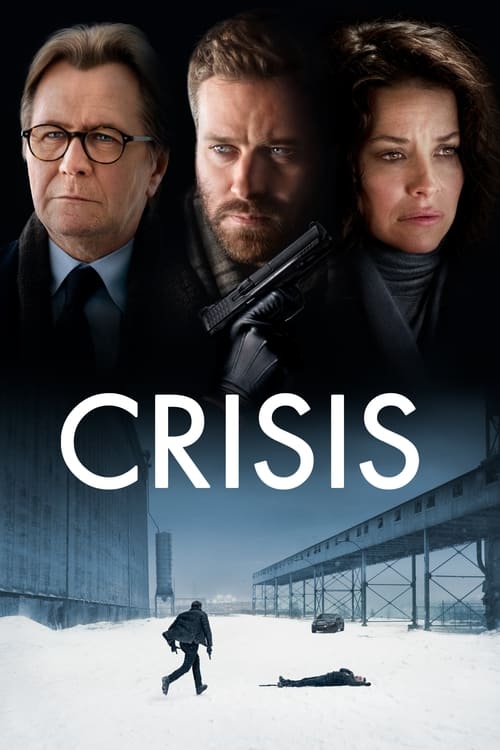
Crisis
2021 · Nicholas Jarecki
For when you want a topical, plot-driven thriller you can follow closely on a weeknight — engaged but not wrecked. Good for viewers who like their crime stories tied to real headlines.
What it's about
Three stories about the opioid epidemic run on a collision course: an undercover agent orchestrates a fentanyl smuggling operation across the U.S.–Canada border, an architect in recovery digs into the truth behind her teenage son's death, and a university professor discovers that the 'non-addictive' painkiller his lab is testing for a pharmaceutical client is anything but. The film maps the crisis as one connected system — cartels, campuses, regulators, and boardrooms.
The experience
A brisk, somber issue thriller — more gripping than deep, moving between suspense, grief, and whistleblower tension with a steady, melancholy pulse. It plays like a procedural with a conscience.
The craft
The three strands are cross-cut to build momentum toward their convergence, each with its own register — sting operation, personal investigation, corporate cover-up — held together by a cool, clinical look. It's built for tension and topicality rather than spectacle; it plays fine at home.
Why it matters
Part of the wave of films reckoning with the opioid crisis, its release was largely overshadowed by controversy around its lead casting — leaving it a footnote in that larger cultural conversation rather than a landmark.
Snapshot
Crisis is a three-strand network thriller about the American opioid epidemic, conceived and directed by Nicholas Jarecki as a deliberate descendant of the issue-driven mosaic film. Across roughly two hours it braids together a DEA agent running a transnational fentanyl sting (Armie Hammer), a recovering architect investigating her teenage son's overdose death (Evangeline Lilly), and a university toxicologist (Gary Oldman) who discovers that a pharmaceutical client's "non-addictive" painkiller is, in his lab's data, worse than the drug it would replace. The film's ambition is systemic rather than personal: it wants to map the opioid crisis as a circuit linking cartels, college laboratories, regulatory agencies, and corporate boardrooms. Its release in late February / early March 2021 was overtaken by the allegations then surfacing against Hammer, and the film's commercial and critical life was effectively foreclosed before it could be assessed on its own terms — a piece of context that now shadows almost any account of it. As a result Crisis survives less as a cultural event than as a case study: a competent, earnest, slightly schematic entry in a prestige-thriller lineage running from Soderbergh's Traffic to Gaghan's Syriana, arriving at the precise moment the genre's economic basis (the mid-budget adult drama) was collapsing into streaming.
Industry & production
Crisis is a mid-budget independent production assembled through international co-financing and shot largely in Canada, with Montreal standing in for several American and cross-border locations and the narrative's Canada–U.S. smuggling corridor giving the geography a degree of literal grounding. It belongs to the category of star-driven independent thrillers that, in the 2010s, were financed on pre-sales and the bankability of a recognizable ensemble — here Gary Oldman, Armie Hammer, Evangeline Lilly, Greg Kinnear, Luke Evans, Michelle Rodriguez, and Lily-Rose Depp.
The film's distribution history is inseparable from its timing. It was released by Quiver Distribution in partnership with a theatrical/on-demand rollout in the early months of 2021, a pandemic window in which theatrical exhibition was minimal and most adult dramas migrated to premium VOD. Days and weeks around its release, public allegations against Armie Hammer — who plays one of the three leads — became a major story, and the surrounding industry response (including the unwinding of several of his other projects) meant Crisis entered the marketplace under conditions no marketing campaign could control. Precise budget and box-office figures for the film are not something I can responsibly state; given the VOD-weighted release and the disrupted moment, conventional grosses are not a meaningful index of its reach in any case. What can be said with confidence is that the convergence of a pandemic release window and an off-screen scandal denied the film the ordinary critical conversation a topical Gary Oldman thriller would normally have received.
Technology
Crisis is a digitally originated, conventionally finished film of its moment: shot on contemporary digital cinema cameras and delivered through a standard 2K/4K digital-intermediate pipeline for theatrical and VOD exhibition. There is no evidence that the production pursued any unusual technological signature — no large-format or celluloid-revival gesture, no stylized capture format — and nothing in the film's surfaces suggests otherwise. Its technological identity is the default professional toolkit of early-2020s independent filmmaking, which is to say it is essentially invisible by design. The one domain where technology becomes a subject rather than a tool is the screenplay's interest in pharmaceutical research instrumentation — animal trials, toxicology assays, data sets — but these are dramatized as plot mechanics, not rendered with any documentary-grade technical specificity.
Technique
Cinematography
The film's images favor a cool, desaturated, institutional palette appropriate to its world of labs, federal offices, suburban kitchens, and snowbound border highways. The cinematography (the camerawork is widely attributed to Canadian cinematographer Nicolas Bolduc, known for his work with Denis Villeneuve on Enemy; readers should treat the specific credit as subject to verification) is handsome and legible rather than expressive — handheld enough to carry urgency in the trafficking strand, composed enough to lend the Oldman material a chillier, more clinical register. Each of the three storylines is given a faintly distinct tonal temperature, a standard strategy in the multi-strand thriller for helping audiences track parallel narratives, but the differentiation here is gentle, never showy. The visual scheme is in the lineage of post-Traffic "serious-issue" cinematography: muted color, available-light realism, a restrained camera that wants to look like reportage rather than style.
Editing
Structurally, the editing is the film's defining technical problem and its defining technical task. Crisis is a parallel-montage machine: it must keep three largely independent plots legible, cross-cutting between them to imply thematic rhyme (the trafficker, the grieving mother, and the scientist are all, in different registers, fighting the same system). The cutting is functional and orderly, prioritizing clarity over the vertiginous interweaving that Soderbergh and Gaghan pushed toward; transitions tend to be clean hand-offs rather than associative collisions. This conservatism is a double-edged choice — it keeps a complex screenplay followable, but it also makes the convergences feel engineered rather than discovered. Specific editorial personnel I will not attribute without certainty.
Mise-en-scène / staging
The film stages its world as a series of charged institutional spaces — the university lab and the dean's office, the federal task-force room, the rehab facility and the morgue — environments coded for authority and complicity. Production design leans toward an unglamorous contemporary realism: this is a film of fluorescent corridors, conference tables, and parking lots. The most pointed staging belongs to the Oldman strand, where the geometry of the academic-corporate meeting — a scientist on one side of a table, the funders of his research on the other — visually literalizes the theme of institutional capture. The trafficking strand, by contrast, is staged for procedural motion: borders, vehicles, drops, surveillance.
Sound
The sound design is naturalistic and unobtrusive, built to support a dialogue- and information-heavy screenplay rather than to generate sensation. The musical score is restrained and tension-sustaining in the manner expected of the contemporary thriller — atmospheric, low-key, pulse-marking under the procedural sequences — and is deployed to bridge the three strands tonally. I do not have a reliably confirmed composer credit to offer and will not invent one; the score's function, rather than its authorship, is what the film foregrounds.
Performance
Performance is where Crisis is strongest and most uneven. Gary Oldman, as the toxicologist Tyrone Brower, gives the most interior and credible work — a portrait of a compromised, self-medicating academic whose conscience is the film's moral fulcrum; Oldman plays the role inward, with weariness rather than grandstanding. Evangeline Lilly's recovering-addict mother carries the film's emotional and revenge-thriller engine, a performance pitched toward grief hardening into resolve. Armie Hammer's undercover agent is the most conventionally genre-bound of the three, and the strand most damaged retrospectively by the off-screen circumstances of the film's release. The supporting ensemble — Greg Kinnear as a university dean, Luke Evans, Michelle Rodriguez, Lily-Rose Depp, and Jarecki himself in a small role — fills out the institutional map. The performances are, collectively, the reason the film holds together as well as it does despite its schematic architecture.
Narrative & dramatic mode
Crisis is a network narrative (in David Bordwell's sense): a multi-protagonist, multi-strand structure in which separate characters who barely or never meet are bound by a common social system, with the audience invited to read the connections the characters cannot see. The dramatic mode is the issue thriller — a hybrid of procedural, melodrama, and exposé in which a real-world crisis supplies both the plot mechanics and the moral stakes. Each strand borrows from a different sub-mode: the Hammer storyline is a sting/procedural, the Lilly storyline a grief-driven amateur-investigation revenge drama, and the Oldman storyline a whistle-blower / institutional-conscience drama. The risk inherent to the form — that breadth comes at the cost of depth, and that the convergences feel authored rather than organic — is one Crisis incurs openly. Its dramatic engine is less suspense about what happens than indignation about how the system works.
Genre & cycle
The film sits inside two overlapping cycles. The first is the mosaic issue film that crystallized around Soderbergh's Traffic (2000) and continued through Paul Haggis's Crash (2004), Stephen Gaghan's Syriana (2005), and the Iñárritu–Arriaga collaborations (Babel, 2006) — prestige dramas that diagram a social problem through interlocking lives. The second is the early-2020s wave of opioid-crisis narratives that also produced the Hulu/Disney limited series Dopesick (2021), the documentary The Crime of the Century (2021), and, later, Netflix's Painkiller (2023), alongside a body of nonfiction (notably Patrick Radden Keefe's Empire of Pain and Beth Macy's Dopesick). Crisis is unusual within that wave for choosing the fiction-feature mosaic over the limited-series exposé, and arrived just as the latter form was proving the more hospitable home for this material — a structural reason, beyond its release misfortune, that it landed softly.
Authorship & method
Nicholas Jarecki is the film's clearest authorial signature: he directed, wrote, and produced it, and appears on screen. His prior narrative feature, Arbitrage (2012), was a financial thriller built around an outwardly respectable man (Richard Gere) whose institutional power masks moral rot — and Crisis extends that same preoccupation from finance to pharmaceuticals: the respectable institution as a machine for laundering harm. Before Arbitrage, Jarecki worked in documentary and producing (including the James Toback portrait The Outsider, 2005), and that nonfiction sensibility surfaces in Crisis as a researcher's appetite for systemic detail. He belongs, too, to a notable filmmaking family — brother to documentarians Andrew Jarecki (Capturing the Friedmans, The Jinx) and Eugene Jarecki, whose The House I Live In (2012) is a major documentary on the American war on drugs. That familial proximity to nonfiction social-issue filmmaking is the most illuminating authorial context for Crisis: it is a fiction film made by someone steeped in the documentary impulse to indict a system.
On collaborators, the record available to me is partial and I will flag it as such: the cinematography is widely credited to Nicolas Bolduc, but I cannot independently confirm the editor or composer credits and decline to assert names I am not certain of. The most secure authorial statement is that Crisis is a writer-director's film, its shape and intent legibly Jarecki's.
Movement / national cinema
Crisis does not belong to a movement so much as to an industrial-aesthetic tradition: the American socially conscious prestige thriller, a Hollywood-adjacent independent mode descended from 1970s paranoia cinema (The Parallax View, All the President's Men) by way of the Soderbergh-era mosaic film. Industrially it is a U.S.–Canada co-production, shot in Canada with substantial Canadian craft labor and the involvement of a Québécois cinematographer, which situates it within the cross-border production economy that supplies much of North American mid-budget filmmaking. Its national identity is therefore double: American in subject and address, partly Canadian in manufacture — a duality the screenplay folds into its very plot, whose drug corridor runs across the same border the production did.
Era / period
The film is firmly of its early-2020s moment in three ways. Topically, it rides the cultural peak of opioid-crisis reckoning — the years of Sackler-family litigation, settlement, and the public re-narration of OxyContin's history — when the epidemic moved from background statistic to foreground drama. Industrially, it embodies the squeeze on the mid-budget adult drama, a film that a decade earlier would have had a real theatrical platform and now found itself dispersed across VOD. And circumstantially, it is a pandemic-release film, launched into a disrupted exhibition landscape in early 2021. Each of these pressures — topical timeliness, industrial marginalization, pandemic disruption — left a mark on the film's reception more decisively than anything internal to it.
Themes
The governing theme is institutional capture: the idea that the systems nominally built to protect people — universities, regulatory agencies, law enforcement, medicine — have been colonized by the profit interests of the pharmaceutical industry. From this stem the film's secondary motifs: the continuity between legal and illegal drugs (the trafficker and the corporation are doing structurally similar work); the moral isolation of the conscience (Oldman's scientist stands almost alone against funded consensus); grief as a route to knowledge (Lilly's mother learns the system by losing a child to it); and the futility and selectivity of the drug war, which criminalizes the street while licensing the boardroom — a thematic kinship with Eugene Jarecki's documentary work on drug policy. The film's controlling conviction is that the opioid epidemic is not an accident or an aberration but an output of how these institutions are designed to function.
Reception, canon & influence
Backward (influences on the film). Crisis is openly a descendant of the post-Traffic mosaic thriller; Soderbergh's Traffic and Gaghan's Syriana are its formal templates, and the 1970s conspiracy thriller its deeper ancestor. Jarecki's own Arbitrage is its most direct predecessor in theme — institutional respectability as a cover for harm — and the family tradition of social-issue documentary supplies its investigative temperament. Its nonfiction substrate is the public record of the OxyContin / Sackler story that journalists and documentarians were excavating in the same period.
Reception. Critical response was muted and mixed, and — crucially — incomplete: the film's release coincided with the public emergence of allegations against Armie Hammer, which dominated whatever coverage the film received and foreclosed a clean critical assessment. Among critics who did engage it, the recurring judgment was that Crisis was earnest, timely, and well-acted but schematic — that its three-strand architecture spread its insights thin and that its convergences felt engineered. I am not in a position to cite specific aggregate scores or quotations reliably, and I will not manufacture them; the safe summary is that the film was received tepidly and discussed briefly, more as the occasion for an off-screen story than as a work in its own right.
Forward (legacy). Crisis has no significant demonstrable influence on subsequent filmmaking, and it would be inaccurate to claim otherwise. Its lasting interest is threefold and largely contextual: as a fiction-feature attempt at material that the limited-series form (Dopesick, Painkiller) would shortly handle to greater cultural effect, making it a useful comparison piece in the study of how the opioid crisis was dramatized; as a late example of the mosaic issue thriller at the point that cycle was waning; and as a case study in release misfortune, where pandemic distribution and an off-screen scandal jointly determined a film's fate. Its place in any canon is minor and is likely to remain so — but as a document of how an industry, a genre, and a national crisis intersected at one disrupted moment in early 2021, it retains a real, if modest, evidentiary value.
A Deleuzian reading
Start with a table.
The full Deleuzian reading of Crisis →
Reception
It arrived in early 2021 to shrugs and pans — critics filed it away as a discount Traffic — and no reappraisal has come; five years on it's remembered less as a film than as a news-cycle footnote.
How Crisis was received, from release to now →
Influences: the films it descends from and the films it influenced
- Traffic (2000) — The direct formal template — color-graded multi-strand architecture, director-operated handheld camera and available-light realism tracing a single drug across enforcement, trafficking, and family tiers that never fully converge.
- Syriana (2005) — Supplies the convergent-web network structure: institutional actors cross-cut elliptically and withhold connective tissue so the system itself, not any character, becomes the antagonist.
- Arbitrage (2012) — Jarecki's own prior blueprint — an outwardly respectable institutional figure whose veneer launders moral rot, shot in cool, controlled prestige-thriller registers later transposed from finance to pharma.
- Contagion (2011) — Donates the desaturated, sterile institutional palette and clinical procedural cross-cutting across labs, agencies, and civilians during a public-health crisis.
- Michael Clayton (2007) — Models the restrained-tension score plus muted naturalist photography around a lone conscience embedded in a malign corporate-legal machine — the institutional-capture thriller in a minor key.
- All the President's Men (1976) — The 1970s investigative-procedural ancestor: patient accumulation of documentary detail and institutional architecture, dread built from paperwork rather than action.
- Z (1969) — Founds the socially-conscious genre thriller by welding urgent montage editing to a real-world indictment, the precedent for dramatizing systemic crime as procedural suspense.
- The Insider (1999) — The corporate-whistleblower template — institutional malfeasance (Big Tobacco) surfaced through performance interiority and procedural dread rather than spectacle.
- Short Cuts (1993) — The structural granddaddy of the mosaic — interweaving strangers' parallel lives so that ensemble breadth, not a single protagonist, carries the film.
- Dopesick (2021) — The limited-series treatment of the identical OxyContin/Sackler material, the multi-strand form that absorbed — and culturally eclipsed — the subject Crisis attempted to compress into a single feature.
- Babel (2006) — A contemporaneous globe-spanning network narrative whose engineered convergences across separate strands define the mosaic cycle Crisis works inside.
- Crash (2004) — The mosaic-issue film at its most schematic — engineered character intersections deployed expressly to argue a social thesis, the mode Crisis inherits and critics flagged in it.
- Dark Waters (2019) — Crisis's closest craft contemporary: a corporate-poisoning legal procedural in a desaturated institutional palette and available light, indicting a respectable company that launders chemical harm.
- The Report (2019) — A Soderbergh-collaborator's austere institutional procedural — desaturated office spaces and a restrained score dramatizing systemic capture through documents and testimony.
- The Big Short (2015) — Converts a systemic scandal into intercut character threads, the issue-mosaic repurposed to make an opaque institutional crime legible to a lay audience.
- Sicario (2015) — The contemporary drug-war institutional thriller — procedural realism across enforcement tiers under a low, restrained dread-score that Crisis's sound design echoes.