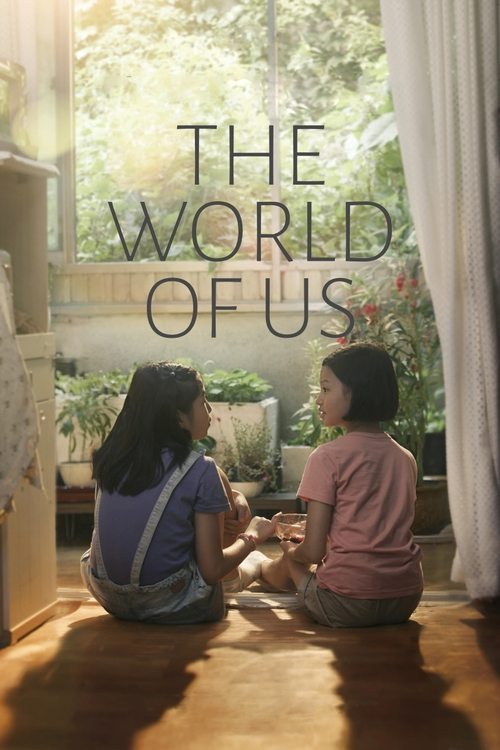
The World of Us
2016 · Yoon Ga-eun
For when you want a small, true film that makes you feel deeply — the kind that reopens memories of being ten and leaves you wanting to call an old friend. A soft watch emotionally sharpened; good for a quiet, thoughtful night.
What it's about
A fourth-grade girl who's always picked last finds a real friend over summer vacation: a transfer student who doesn't yet know her lowly standing in the class. When school resumes and the social order snaps back into place, the friendship comes under quiet, merciless pressure. The whole drama unfolds at the scale of playgrounds, sleepovers, and lunch tables — which is exactly what makes the stakes feel enormous.
The experience
Gentle on its surface and quietly heartbreaking underneath, it captures the politics of childhood with an accuracy that stings — you will recognize these betrayals from your own school years. It's tender, patient, and observant rather than melodramatic.
Performances
The child cast, led by Choi Soo-in as Sun, is astonishingly natural — faces held in close-up doing the exhausting work of pretending not to mind, with nothing that reads as acting.
The craft
Yoon Ga-eun films at kid height, in patient close-ups and unforced naturalistic scenes, trusting small gestures — a shared bracelet, a glance across a classroom — to carry the plot. The direction of child actors is the craft achievement here, and it's remarkable.
Why it matters
Premiering at Berlin, this debut announced Yoon Ga-eun as one of the finest directors of children anywhere and became a touchstone of Korean independent cinema's intimate realist strain.
Snapshot
A fourth-grade girl is left standing when the teams are picked. That is the first shot of Yoon Ga-eun's debut feature, and in a sense it is the whole film: a held close-up on a child's face as she performs the small, exhausting labor of pretending not to mind. The World of Us (우리들, Urideul) follows Sun through a single summer — the vacation friendship she forms with Ji-a, a transfer student who does not yet know Sun's status in the class hierarchy, and the slow, humiliating dissolution of that friendship once the term resumes and the social order reasserts itself.
The film premiered in the Generation Kplus section of the 66th Berlin International Film Festival in early 2016 and opened in South Korea that June, running roughly 95 minutes. It arrived from a director with no commercial features behind her, only a run of prize-winning shorts, and it did what Korean independent cinema rarely does: it converted festival credibility into durable domestic standing, sweeping first-feature and new-director honors on the 2016 Korean awards circuit and installing itself, almost immediately, as the reference text for depicting 왕따 (wangtta) — the ostracized child — on Korean screens.
Its argument is that childhood cruelty is not an aberration of the social world but a working model of it, executed by people who have not yet learned to disguise their methods. Nothing in the film is exaggerated for effect. The escalation is entirely in whispers, seating arrangements, birthday invitations, and the strategic withdrawal of eye contact.
Industry & production
The World of Us is a product of the Korean independent sector as it stood in the mid-2010s: a small, subsidy-dependent ecosystem operating in the shadow of one of the world's most concentrated commercial film industries. Korean production is dominated by a handful of vertically integrated conglomerates — CJ, Lotte, Showbox, NEW — whose ownership of both distribution and exhibition makes screen access, not financing, the decisive bottleneck for a film like this one. Public funding through the Korean Film Council (KOFIC), festival development programs, and the arthouse-branded distribution arms the majors maintained partly under regulatory and reputational pressure formed the narrow channel through which such films reached theaters at all.
Yoon came up through that channel rather than through the commercial apprenticeship track. Her shorts — Guest (2011) and above all Sprout (2013), which took the Crystal Bear in Berlinale's Generation Kplus in 2014 — established both her subject (children navigating adult systems) and her institutional relationships, particularly with Berlin, which premiered Sprout, The World of Us, and later her second feature The House of Us (2019). That festival pipeline functioned as this film's real production infrastructure: it supplied the validation that made a low-budget, star-free, child-led feature financeable and then bookable.
The casting economics are worth noting. The film is carried by non-professional or near-non-professional children — Choi Soo-in as Sun and Seol Hye-in as Ji-a, with Kang Min-jun as Sun's younger brother — supported by a small adult ensemble in which Jang Hye-jin, as Sun's mother, is the most recognizable presence (she would reach a far wider audience three years later in Parasite). Casting children in the lead of a feature is a schedule problem as much as a performance problem: limited daily working hours, mandated rest, and the impossibility of the compressed shooting blocks that make micro-budget Korean production viable. The precise budget and shooting-schedule figures are not in the publicly accessible record, and I will not estimate them; what the finished film demonstrates is a production organized around the children's capacity rather than the crew's convenience.
Technology
The film belongs squarely to the post-celluloid Korean indie, and its aesthetic is unthinkable without digital acquisition. Specific camera, lens, and format details are not reliably documented in accessible sources, so what follows describes conditions rather than specifications.
The decisive technological fact is the collapse of the shooting ratio's cost. Yoon's method with children — described in her interviews as built on games, improvisation, and withheld script information — depends on being able to roll long, roll often, and capture the unrepeatable first instance of a reaction. Under film stock economics, that method is essentially unaffordable at feature length; digital makes it a budgeting footnote. The film's most valuable moments are the ones a child could not deliver twice: the half-second of calculation before Sun lies, the flicker of a smile that arrives too late.
Second, camera scale. Lightweight digital bodies allowed the film to be operated at a child's eye level, handheld, inside genuinely small locations — cramped apartments, stairwells, corridors, the corner of a classroom — without the crew mass that turns a room into a set and a child into a subject under observation. The unobtrusiveness of the apparatus is part of the performance strategy.
Third, sound. Children in this film speak quietly, overlap, trail off, and address one another off-axis; much of the dialogue would be unrecoverable under older on-set recording constraints. Contemporary radio-mic practice and clean digital tracks make the film's near-whispered register possible.
Finally, distribution. DCP delivery and the festival circuit's fully digital pipeline let a film with no stars and no genre hook reach dozens of territories, and subsequent VOD and streaming availability — rather than any conventional theatrical rollout — is how most non-Korean viewers encountered it.
Technique
Cinematography
The film's governing decision is proximity at child height. The camera sits low and stays close, frequently in a shallow-focus medium close-up that isolates a face from the classroom or playground behind it — the visual equivalent of the way an excluded child experiences a crowded room as blur plus one unbearable detail. Adults are routinely decapitated by the frame line or held at the edge of it, present as legs, hands, and voices, which enacts the film's refusal to grant grown-ups the interpretive authority they usually hold in films about bullying.
Handheld work follows children from behind at the shoulder and nape — a Dardennian device, and critics reached for the comparison immediately — but Yoon uses it less for kinetic urgency than for the sensation of accompanying someone. The palette is warm and summer-lit: sunlight through classroom windows, the saturated colors of nail polish and balsam flowers, an image world that stays pretty while the social content curdles. That gap between the beauty of the surface and the brutality of the transaction is the film's most sustained visual irony.
Editing
The cutting is patient and biased toward reaction. Yoon repeatedly holds after the ostensible dramatic beat has passed, staying with a face for the two or three seconds in which a child processes what has just happened to her — the interval where the film's actual drama lives. Scenes tend to begin slightly late and end slightly late, so that we are given aftermath more often than event.
The macro-structure is a rhyme. The film opens on a dodgeball game in which Sun is chosen last and then called out on a disputed line; it closes on another dodgeball game in which Ji-a is accused of stepping over the line and Sun, unprompted, says she did not. Nothing is resolved in dialogue. The entire arc is carried by the recurrence of a shape and the reversal of who defends whom.
Mise-en-scène / staging
Yoon's spatial grammar is a class map drawn in interiors. Sun's home is cramped and worn, her father's drinking a low atmospheric pressure across every scene in it; Ji-a's grandmother's apartment is emptier and better appointed, with the particular chill of a child parked in an adult's life. Between them lies the hagwon — the private cram academy — which functions here as social infrastructure: attendance marks you, non-attendance marks you differently, and the schedule of extracurricular study organizes who can be friends with whom.
Objects carry the plot. Hand-dyed nails stained with garden balsam, a traditional Korean summer ritual freighted with a folk promise about first love; a handmade bracelet; a birthday present bought with money Sun takes from her mother — each is introduced as tenderness and later repurposed as evidence in the girls' war. The staging of school is equally precise: the seating chart, the lunch table, the corridor as a gauntlet.
Sound
The film is scored sparingly and leans on ambient sound — cicadas, fans, television from another room, the acoustic wash of a schoolyard. Yoon's most characteristic sound decision is the use of half-heard speech: the giggle across the room, the sentence that stops when you approach. The film understands that wangtta, in its subtler form (what Korean students call 은따, the quiet freeze-out), is primarily an auditory experience — you know your position by what goes silent when you arrive.
Performance
The performances are the film's technical achievement and the basis of its reputation. Choi Soo-in's Sun is built almost entirely from micro-adjustments: the delayed smile, the recovered posture, the willed brightness that is visibly a decision. Seol Hye-in gives Ji-a the harder assignment — a child whose cruelty is defensive, who has her own concealed history of exclusion and who converts it into fluency in the local hierarchy.
Yoon has described a working method oriented around protecting and enabling children on set: extensive rehearsal and play, information released in fragments rather than as a full script, and a set of ground rules for adult crew conduct toward the child cast. The approach has an obvious kinship with Hirokazu Kore-eda's documented practice on Nobody Knows and I Wish, though the parallel is best read as convergence on a solved problem rather than direct lineage.
Narrative & dramatic mode
The film runs on observational realism with an almost classical dramatic engine underneath. The structure is a friendship in three movements — vacation intimacy, term-time betrayal, mutual retaliation — with the reversal arriving when Sun, having been the victim, becomes an instrument of exclusion herself, exposing Ji-a's secret to the class. This is the film's ethical center of gravity: it declines to sort children into bullies and bullied, showing instead a system that recruits whoever is available.
Crucially, there is no adult rescue. Teachers are well-meaning and useless, parents are preoccupied by their own exhaustion — Sun's family absorbs a grandfather's death and a father's drinking without much bandwidth for a nine-year-old's social ruin. The film's resolution instead arrives via Sun's little brother, who keeps returning to a friend who hits him. Asked why he doesn't retaliate, he answers with the film's most quoted line — in effect: he hits me, I hit him back, he hits me again... then when do we play? Rendered by a small boy with a scratched face, it is the argument the entire film has been building toward, and it lands without a trace of authorial sentiment.
Genre & cycle
Formally this is a children's film that is not a film for children only — the exact remit of Berlinale's Generation strand, which has spent decades legitimizing work aimed at young viewers as serious art cinema. Within Korean cinema, it intervenes in a well-established school cycle. The dominant mode had been masculine and violent: Friend (2001), Once Upon a Time in High School (2004), Bleak Night (2010), a tradition in which school cruelty is dramatized through fists and reaches its resolution in tragedy. A parallel strand handled bullying as social-issue melodrama, typically pivoting on a suicide — Thread of Lies (2014) is the clearest case.
Yoon's move is to relocate the subject to fourth-grade girls, drop the age of onset by roughly a decade, and remove both the violence and the catastrophe. What remains is the mechanism itself. The film also joins the small international genre of the child-scaled moral crisis — the tradition running from Truffaut's Small Change through the Iranian children's cinema of the 1980s and 90s — where the stakes are trivial to adults and total to the protagonist.
Authorship & method
Yoon Ga-eun wrote and directed, and the film reads as a single-authored work in the strictest sense: subject, method, and form all converge on the question of how children are seen. Her shorts had already staked out the territory — Sprout (2013), which won the Crystal Bear at Berlin, and Guest (2011) — and The House of Us (2019) would extend it with the same casting philosophy and the same Berlinale premiere slot.
Her method is the authorship. Working from children's improvisation and games, withholding the full narrative from the cast, and shooting extensively to catch behavior rather than execution, she produces performances that resist the mannerisms of trained child acting. She has been explicit in interviews about treating the ethics of a child-led set as a craft problem, not a compliance one.
On the below-the-line collaborators, the accessible record is genuinely thin: reliable credits for the cinematographer, editor, and composer are not something I can confirm without inventing attributions, and I will not do so. What can be said is that the film's technical signature — low, close, patient camera; reaction-weighted cutting; a near-absent score deferring to ambient sound — is consistent across her shorts and her second feature, which suggests direction rather than a departmental accident.
Movement / national cinema
The film sits at the intersection of two Korean currents. The first is the post-2000 independent sector's turn toward children and adolescents as the register in which social precarity can be examined without polemic: Kim So-yong's Treeless Mountain (2008), Ounie Lecomte's A Brand New Life (2009), Lee Su-jin's Han Gong-ju (2013). The second is the emergence, through the mid-to-late 2010s, of a cohort of women directors making small-scale, formally controlled features about female interiority — a shift that reshaped Korean art cinema's center of gravity within a few years and that The World of Us helped make visible.
Internationally, the film's affinities are Iranian and Belgian: the moral logic and child's-scale ethics of Kiarostami's Where Is the Friend's House? and Panahi's The White Balloon, the following camera and working-class pressure of the Dardennes. These are affinities and critical touchstones rather than documented citations, and it is more accurate to describe a shared solution than a debt.
Era / period
2016 in South Korea was a year of pressure. The political crisis that would culminate in the candlelight protests and a presidential impeachment was gathering; the culture-ministry blacklist scandal, which had covertly penalized artists for political speech, was about to surface. The Sewol ferry disaster of 2014 remained the country's open wound and had reoriented a great deal of Korean art toward the failure of adults to protect the young. Domestically, the educational arms race and the hagwon economy structured childhood itself, and a widening housing-based class divide was becoming the national subject it would fully become with Parasite three years later. 2016 was also the year a new Korean feminist wave broke into mainstream visibility, which shaped both the production conditions and the reception of girl-centered work.
None of this is depicted directly. But the film's core proposition — that a small person's exclusion is enforced by systems the adults around her are too depleted to notice — is legible against that background.
Themes
The Korean title, 우리들, is the plural first person: us, we. Korean uses the collective possessive by default — our house, our country — and the title therefore stakes the film's entire question in one word: who is included in the pronoun. Every scene is an audit of membership.
From there: the transmission of cruelty as an inherited social technology rather than individual malice; class as the invisible substrate of friendship, expressed through hagwon fees, birthday parties, and apartment size; the child's private economy of shame, in which a lie about your father's job is a rational investment; and the specific violence of the freeze-out, which leaves no marks and is therefore invisible to every adult authority in the film. Against all of this the film sets a single counter-proposition, voiced by the youngest character: that retaliation forecloses play, and that the willingness to keep showing up is not weakness but the only available exit.
Reception, canon & influence
Critical reception was strong and unusually consistent. Reviewers domestically and abroad converged on the same set of praises — the calibration of the child performances, the refusal of melodrama, the precision of the social observation — and on the same set of comparisons: Kore-eda, the Dardennes, the Iranian child-centered tradition. The film performed well on the Korean awards circuit for a debut, taking new-director and first-feature recognition, and it traveled widely through the festival system on the strength of its Berlinale Generation premiere. Its theatrical audience in Korea was modest by commercial standards, as is normal for the sector; I don't have reliable admissions figures and won't guess at them.
Backward, the film draws on the child-perspective realist tradition — Truffaut, Kiarostami, Panahi, the Dardennes — and on the Korean indie lineage of Treeless Mountain and A Brand New Life, while defining itself against the country's own violent-school-movie canon.
Forward, its influence runs along three lines. First, within Yoon's own work: The House of Us (2019) is a direct continuation of the method and returned to Berlin's Generation strand. Second, in the wave of Korean women-directed features about girlhood and female interiority that followed — Kim Bora's House of Hummingbird (2018) is the film most often paired with it, and the two are now routinely discussed as a matched set marking a shift in what Korean art cinema was willing to fund and screen. The relationship is best described as precedent and adjacency rather than demonstrable causation, but the sequencing matters: The World of Us proved the audience existed. Third, outside the cinema entirely, the film has been widely taken up in Korean discussion of school ostracism, where its account of exclusion-without-violence supplied a vocabulary that the previous melodramatic mode did not.
Its durable contribution is a demonstration: that the smallest possible social unit — two nine-year-olds and a dodgeball court — is sufficient to model how belonging is manufactured and withdrawn, and that the truest ending available to that model is not reconciliation but a held look across a line.
A Deleuzian reading
Teams are being picked for dodgeball.
The full Deleuzian reading of The World of Us →
Reception
A quiet Berlinale Generation premiere in 2016 that kept climbing: it swept new-director prizes at home, and the Korean Film Archive later named it among the 100 greatest Korean films — one of the few 2010s titles to make the cut.
How The World of Us was received, from release to now →
How to watch The World of Us: what to notice on a first viewing
- Watch the camera stay low, close to child height. The film shoots in shallow focus at a child's eye level, isolating one face from the classroom or playground blurred behind it. You experience a crowded room the way an excluded child does: blur plus one unbearable detail.
- Notice adults cut off at the shoulders by the frame. Grown-ups appear mostly as legs, hands, and voices from off camera, rarely granted a full face or the authority to explain what's happening. No adult ever arrives on screen to interpret this world for you; the children have to do it alone.
- Notice the film hold on a face after something happens. Scenes begin slightly late and end slightly late, so the cutting lingers two or three seconds on a child's face processing what has just happened to her. The film's real drama lives in that pause, not in whatever caused it.
- Listen for a giggle or sentence that stops when someone arrives. The film scores itself sparingly, leaning on cicadas and schoolyard ambience, so half-heard speech, laughter cut short, a conversation that quiets, becomes the loudest signal in the room. You learn where you stand in this world by what goes silent when you walk in.
- Watch for the smile that arrives just a beat too late. Sun's performance is built from small, visible decisions: a delayed smile, a recovered posture, a willed brightness you can watch her choose to put on. You can watch her decide to seem fine, over and over, in real time.
The whole guide to watching The World of Us, with the keys for a rewatch →
Influences: the films it descends from and the films it influenced
- I Was Born, But... (1932) — Establishes the low, child-height camera that stages a schoolyard pecking order as a scale model of adult class hierarchy — the same structural move by which Sightlines' seed maps Sun's father's rank onto who gets picked for dodgeball.
- The 400 Blows (1959) — Sets the template of the unrescued child — adults present only as disciplinary noise — and ends on a held, unresolved look directly at the viewer rather than reconciliation, the exact terminal grammar of the final dodgeball exchange.
- Kes (1969) — Pioneered withholding the script from non-professional child actors and shooting long to catch behavior instead of execution — the working method Yoon adopts wholesale, including games-based rehearsal in place of line readings.
- Where Is the Friend's House? (1987) — Builds an entire feature from one trivial child-scaled errand and frames adults as cropped, off-scale bodies who talk over the child's head — the source of the seed's 'decapitated adults' framing and its refusal to promote adult speech to plot.
- The White Balloon (1995) — Runs near-real-time on a child's transactional quest with no score at all, letting street ambience carry tension — the precedent for the seed's ambient-over-score mix and its half-heard adult dialogue drifting in from offscreen.
- Ponette (1996) — The extreme case of eliciting performance from very young non-professionals through play and prompting rather than direction, producing the micro-adjustment register — a flinch, a delayed blink — that Yoon's reaction-weighted cutting depends on having captured.
- Rosetta (1999) — Codified the handheld camera pinned to the back of the protagonist's neck and the arc in which the excluded protagonist secures her place by betraying the only person who befriended her — both directly inherited in Sun's nape-following coverage and her turn on Jia.
- Nobody Knows (2004) — Shot over a year with children who were fed situations rather than a full narrative, and structurally forecloses adult intervention so the children must administer their own social order — the two operating premises of the seed's set.
- Treeless Mountain (2008) — The Korean indie precedent for holding extreme close-ups on children's faces past the point of narrative usefulness and letting a physical object — the coin bank — carry the accounting of a broken promise, as the seed does with the bracelet and colored pencils.
- A Brand New Life (2009) — Korean-set proof that a child's institutional abandonment can be filmed without a single melodramatic cue, restricting information strictly to what the child can see and mishear — the epistemic rule the seed applies to every adult conversation.
- Sprout (2013) — Yoon's own Crystal Bear short where the low patient camera, the near-absent score and the games-derived child performance were first assembled; the feature is that short's method scaled, not a new one.
- House of Hummingbird (2018) — Extends the seed's class-mapped interiors and hagwon-as-social-infrastructure staging into adolescence, building scenes around a girl's micro-reactions to half-heard family speech rather than around events; the two are now programd as a matched pair.
- The House of Us (2019) — Yoon's direct continuation — same casting philosophy, same reaction-weighted cutting, same Berlinale Generation slot — with children again improvising the domestic labor that absent adults have abandoned.
- Playground (2021) — The most literal extension: the entire film is shot at a seven-year-old's eye level with adults systematically decapitated by the frame, and it repeats the victim-becomes-perpetrator turn as the schoolyard's basic economy rather than as a twist.
- Close (2022) — Builds its rupture entirely from ostracism-without-violence — a chair moved, a look withheld — and cuts on the excluded child's reaction rather than on the act, the editing logic the seed established for wangtta.
- Tomboy (2011) — Films children's group play as the actual mechanism of inclusion and expulsion, camera at their height and locked to the body, so that a change in who passes the ball reads as a change in social standing — identical to the dodgeball bookend's function.
- The Florida Project (2017) — Keeps the lens at kid height in a saturated summer palette while adults are cropped to torsos and background arguments, and denies any adult rescue at the climax — the same warm-surface/cold-structure contrast the seed runs across its summer break.
- Moving On (2019) — Part of the same Korean women-directed wave the seed made fundable, and shares the technique of letting household objects and room thresholds do the exposition that dialogue refuses, with ambient summer sound in place of score.
Similar films
- Nobody Knows (2004) — influence & lineage
- Close (2022) — influence & lineage
- House of Hummingbird (2019) — shared sensibility
- Monster (2023) — shared sensibility
- Soulmate (2023) — shared sensibility
- 20th Century Girl (2022) — shared sensibility
- The Secret World of Arrietty (2010) — shared sensibility
- Our Little Sister (2015) — shared sensibility