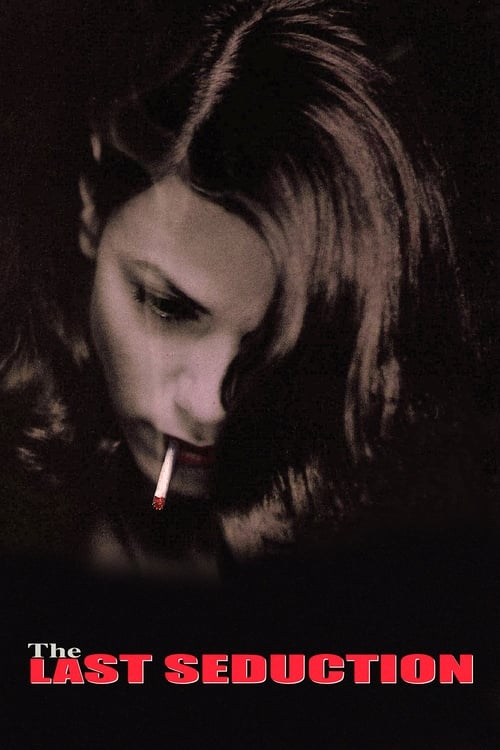
The Last Seduction
1994 · John Dahl
When you're in the mood for something deliciously amoral — a sharp, sexy crime picture where the bad guy wins your heart. Comfort viewing for people whose comfort is watching a con work perfectly.
What it's about
Bridget Gregory walks out on her husband with the proceeds of his pharmaceutical-cocaine deal and goes to ground in a small upstate New York town under a false name. There she picks up Mike, a local guy desperate to prove he's bigger than his hometown, and sizes him up as exactly the instrument she needs to deal with her husband permanently. It's a cat-and-mouse crime story where the cat never once pretends to be anything else.
The experience
Wickedly funny and nasty in the best way — fast, hard-boiled, and powered by the pure pleasure of watching someone smarter than everyone else run the table. You know you shouldn't root for her, and you do anyway.
Performances
Linda Fiorentino gives one of the great unrepentant performances of the decade — husky, contemptuous, never softened for a second — famously ineligible for the Oscar only because the film premiered on cable. Bill Pullman and Peter Berg are perfectly cast as the men who keep underestimating her.
The craft
Steve Barancik's script is a machine of hairpin reversals and quotable venom, and John Dahl directs it lean and low-budget, with a smoky neo-noir look that winks at the 1940s without ever turning into pastiche. The dialogue is the special effect here.
Why it matters
The most cited femme-fatale film of the 1990s and the peak of the decade's neo-noir revival — notable for refusing to punish its heroine the way classic noir always did.
Snapshot
The Last Seduction is a low-budget American neo-noir that became the most cited femme-fatale film of the 1990s. Linda Fiorentino plays Bridget Gregory, a New York telemarketing manager. She steals the money her husband Clay (Bill Pullman), a doctor, has made selling pharmaceutical cocaine, and runs. She ends up in Beston, a small town in upstate New York, where she takes a false name and starts an affair with Mike Swale (Peter Berg). Mike is a local man desperate to prove he is bigger than his town. Bridget sees in him the tool she needs to rid herself of her husband for good. The script is by Steve Barancik and the director is John Dahl.
The film differs from the classical noir it borrows from in one main way: it refuses to punish its heroine. In the 1940s the femme fatale was usually destroyed or contained by the last reel. Bridget is never contained. She controls every situation, and the film ends on her triumph. That moral structure, Fiorentino's widely praised performance, and an odd distribution history made the film a reference point for the 1990s neo-noir revival. The distribution history in brief: it premiered on cable television, was released theatrically afterwards, and so was barred from Academy Award consideration.
Industry & production
The film was produced by ITC Entertainment, with Jonathan Shestack as producer, and made on a modest budget. As initially conceived, it was a film for television: it premiered on HBO in 1994. Only after that broadcast did it get a theatrical release in the United States, through October Films, one of the independent distributors that grew up in the indie boom of the early 1990s.
Dahl's previous film had followed almost the same path. Red Rock West (1993) was first released on cable and video. Its distribution was then rescued by a San Francisco theatrical exhibitor after strong local response, and it played art houses. With The Last Seduction, Dahl became a kind of case study in how a film's commercial future could be revised after release in the era of cable and home video.
The production history had a well-known consequence. Fiorentino's performance drew enough critical attention to be talked about as an awards contender. Because the film had already been shown on television, it was ruled ineligible for the Academy Awards. Efforts to challenge that ruling did not succeed. The episode became a talking point about Academy eligibility rules and the blurred line between "television film" and "feature film" in the 1990s. The British Academy had different rules, and Fiorentino received a BAFTA nomination for Best Actress.
The story is set in New York City and the fictional town of Beston, and the film uses the contrast between metropolitan anonymity and small-town closeness. Detailed records of shooting locations and schedule are less fully documented in standard sources than the film's distribution history, and this account does not try to pin them down.
Technology
This is a conventionally made 35mm feature of its period. It has no notable technical innovation. Its technological interest lies in how it was distributed. It is one of the clearest early-1990s examples of a film produced with cable television as its first window, then given a second life in theatres and on home video. The film's use of telephones, including a speakerphone, call-recording and a 911 line kept open as evidence, ties its plot to the communications technology of the early 1990s. That technology, it turns out, is central to how Bridget engineers her final scheme.
Technique
Cinematography
The cinematographer, Jeffrey Jur, does not imitate the expressionist low-key lighting of 1940s noir. The film takes place largely in ordinary, often well-lit spaces: offices, apartments, a small-town bar, a modest rented house. This is a deliberate choice. It places noir in the everyday, unglamorous America of the 1990s rather than in an atmospheric world of wet streets and venetian-blind shadows. Some scenes, especially in the city, do use darker, high-contrast lighting. Even so, the film's visual style is closer to the plain look of contemporary crime drama than to pastiche, and that suits a protagonist who has no need for mystique.
Editing
The editor, Eric L. Beason, cuts the film tightly and economically. It moves quickly from Bridget's theft to her flight and then into the small-town plot, without much setup. The rhythm follows Bridget's own efficiency. Scenes tend to end once she has got what she wanted from them. Telephone scenes, crosscut between locations, are a key editing device: they let the film show Bridget handling several men at once from a distance.
Mise-en-scène / staging
The staging is built around Bridget's command of space. She dominates rooms and bars, and she controls whatever room she is in, turning bars, beds and offices into places where she negotiates. The film sets the anonymous, crowded city (where Bridget's telemarketing floor shows her as a ruthless manager of persuasion) against Beston's openness, where everyone knows everyone. The small town's friendliness is the very thing Bridget exploits, and she can barely hide her contempt for it.
Her alias, "Wendy Kroy," is a visual and verbal joke that reveals her origins: it is built from "New York" scrambled. The detail sums up the film's playful but pointed treatment of disguise.
Sound
The score, by Joseph Vitarelli, is jazz-inflected. It draws on noir's long association with jazz while keeping a light, sardonic tone and avoiding portentousness. The music often plays against the film's darker events, which reinforces its black-comic register. The sound design also gives unusual dramatic weight to telephone audio. Voices over the line, recordings, and the open emergency line all matter to the plot, and the climax depends on what is heard rather than what is seen.
Performance
Fiorentino's performance is the film's centre and the main reason for its reputation. She plays Bridget with flat, unhurried contempt and a deadpan wit, and she never invites the audience to sympathize with her. She also never signals the character's villainy in a way that would comfort the viewer. Critics compared the performance to Barbara Stanwyck's in Double Indemnity (1944). Most also noted that Fiorentino went further than the old Production Code-era performances could: her Bridget is openly sexual, crude in language, and without remorse.
Peter Berg plays Mike as a decent but vain man whose wish to escape his town makes him easy to manipulate. Bill Pullman's Clay is violent and grasping but finally outmatched; the film enjoys letting Bridget beat him. Bill Nunn plays Harlan, the private detective Clay hires to track her down, and J.T. Walsh plays Frank Griffith, Bridget's lawyer. Walsh, an actor closely tied to 1990s crime films, brings a smooth cynicism that matches Bridget's own.
Narrative & dramatic mode
The film is built as a sequence of cons. Each scheme makes room for the next, and the audience is slowly let in on how far ahead Bridget has planned. Its dramatic mode mixes thriller suspense with black comedy. Much of the pleasure comes from watching Bridget out-think everyone around her, and the film does not look for the moral disapproval that classical noir eventually provides.
A key element is Mike's backstory. Before the film begins he went to Buffalo and briefly married a woman, Trish, who turned out to be transgender. Bridget discovers this and uses it against him. Later critics have discussed this plot element as a period-bound treatment of a transgender character as a source of male shame, and many find it dated or troubling.
The climax is a carefully designed trap. Bridget goads Mike into an act of sexual violence while an emergency line is open, and turns events so that Mike, not she, is held responsible for Clay's death. The film ends with Bridget free and wealthy, destroying the last piece of evidence that could connect her to the crime. Ending without punishing the protagonist is the film's central dramatic choice and the main source of its reputation.
Genre & cycle
The Last Seduction belongs to the neo-noir cycle that began with Lawrence Kasdan's Body Heat (1981) and grew in the early 1990s with the erotic thriller. Films such as Basic Instinct (1992), Final Analysis (1992) and Body of Evidence (1993) set the commercial template of the "erotic thriller" built around a dangerous woman. Dahl's film is a lower-budget, more ironic counterpart to those studio productions. It keeps their sexual frankness but is less interested in titillation than in the mechanics of the con.
Within Dahl's own work, the film is the third of his loose trilogy of contemporary noirs, after Kill Me Again (1989) and Red Rock West (1993). All three take the conventions of 1940s crime fiction into contemporary, often provincial American settings. Of the three, The Last Seduction most directly engages with the femme fatale and most clearly rewrites her fate.
Authorship & method
John Dahl (director) came out of the generation of American filmmakers who worked through cable, video and independent distribution in the late 1980s and early 1990s. His early features show a sustained interest in noir conventions, in moral ambiguity, and in characters trapped by their own greed. In the following years he moved toward other genres, for example the poker drama Rounders (1998) and the road thriller Joy Ride (2001), and later directed widely for television. The Last Seduction is generally regarded as the peak of his noir period.
Steve Barancik (writer) wrote the original screenplay. Its sharp, profane dialogue and intricate structure were widely credited with giving Fiorentino the material for her performance. The script's refusal to redeem or punish Bridget is its defining authorial gesture.
Jeffrey Jur (cinematographer) gave the film a contemporary, unmannered look rather than a period pastiche.
Joseph Vitarelli (composer) wrote a jazz-tinged score that sets the film's sardonic tone.
Eric L. Beason (editor) kept the cutting tight, giving the film its brisk, economical drive.
Jonathan Shestack (producer), with ITC Entertainment, guided the production through its unusual path from cable premiere to theatrical release.
Movement / national cinema
This is American independent cinema of the early 1990s, though it sits at the commercial, genre-minded end of that field rather than with the more personal, art-house strands associated with the Sundance generation. Its route through cable and then specialist theatrical distribution (via October Films) shows how porous the border between "independent" and "television" film was in this period. The film belongs to a group of modestly budgeted genre films of the time, including Carl Franklin's One False Move (1992), that critics read as reviving noir through regional settings and smaller production models.
Era / period
The film is set firmly in the early 1990s: the telemarketing office, the drug money, the phone technologies and the economic anxieties of a small town are all specific to that moment. It reached audiences during the height of the erotic thriller and of renewed critical interest in film noir, and in the same year as Pulp Fiction (1994), when American crime cinema was becoming more ironic and self-aware. Bridget's ruthless pursuit of money and freedom has often been read alongside the decade's anxieties about ambition, gender and economic self-interest. She is a figure of late-twentieth-century individualism as much as a revival of the 1940s archetype.
Themes
- The femme fatale, unpunished. The film's central theme is the femme fatale freed from classical noir's moral machinery. Bridget is never redeemed, exposed or destroyed. The film invites both admiration and unease at her success.
- Manipulation and persuasion. Bridget is first seen as a telemarketing manager driving her staff to sell more. The film presents her schemes as an extension of that professional skill: she reads people, finds their weak points and closes the deal.
- Masculine vanity. The men around Bridget are undone by their own self-regard. Mike wants to believe he is special, Clay believes he can overpower her, and Harlan believes he can bargain with her. The film treats male fantasies of control as the femme fatale's real raw material.
- City and province. The film sets urban cynicism against small-town decency and is cruelly funny about both. Bridget's contempt for Beston is part of the film's comedy, but it also shows a real division in American life.
- Gender and sexuality. Bridget's sexual frankness, her use of sex as a tool and the plot use of a transgender character have made the film a frequent subject in feminist and queer criticism. Readings range from celebrating Bridget as a transgressive figure to criticizing the film for reproducing misogynist and transphobic tropes in new forms.
Reception, canon & influence
Critical reception. The film was very well received when it opened in theatres in 1994 and 1995, and reviewers singled out Fiorentino's performance. She won major critics' awards, including the New York Film Critics Circle's Best Actress prize, and was nominated for the BAFTA for Best Actress. Her Oscar ineligibility became a widely reported controversy and arguably raised the film's profile. Critics in general praised the film's wit, its economy and its refusal of moral comfort. Some found its cynicism cold or its heroine too monstrous, but the dominant reaction was enthusiastic.
Influences on the film (backward). The film's most obvious ancestor is Billy Wilder's Double Indemnity (1944): a woman uses sex to recruit a man into killing her husband, and Stanwyck's Phyllis Dietrichson is the archetype behind Bridget. The wider tradition of 1940s noir femmes fatales, from Out of the Past (1947) to The Postman Always Rings Twice (1946), stands behind the film too, as does the hardboiled fiction of James M. Cain and his contemporaries. In the more recent past, Body Heat (1981) had already updated the Double Indemnity scenario and let its femme fatale escape, which makes it a direct precedent. Basic Instinct (1992) set the commercial stakes for the erotic thriller of the early 1990s.
Legacy (forward). The Last Seduction is regularly ranked among the best neo-noirs of the 1990s and is a standard example in academic discussion of the femme fatale's changing meanings. It established Fiorentino as a leading screen presence, though her later career did not entirely build on that promise. A direct-to-video sequel, The Last Seduction II (1999), with a different director and cast, carried the Bridget character forward with little critical success. The original's main influence was on how filmmakers and critics thought about the femme fatale. It showed that a crime film could end in its heroine's unpunished triumph, and that the triumph could be satisfying and disquieting at once. The film's path from cable premiere to theatrical acclaim, and the Academy eligibility dispute it caused, also became a reference point in debates over the boundary between television and film. Those debates became more pressing in later decades as premium cable and streaming platforms produced more and more prestige features.
Influences: the films it descends from and the films it influenced
- Double Indemnity (1944) — Barancik's script reuses the Wilder–Chandler setup of a woman who coolly talks a sexually hooked man into killing her husband for money, and gives it the same quick, insinuating, quotable back-and-forth.
- The Postman Always Rings Twice (1946) — This Cain adaptation is a model for the film's provincial setting, where a bored woman stuck in a dead-end town turns a passing drifter's lust into a murder plot.
- Out of the Past (1947) — Jane Greer's Kathie, who changes loyalties with a calm face and reads every man's weakness ahead of time, is the template for Bridget's flat, unreadable manipulation, which shows no effort.
- Body Heat (1981) — Kasdan updated Double Indemnity in modern color and ended with the femme fatale escaping with the money while the patsy goes to prison, and Dahl's ending takes over that structure directly.
- Blood Simple (1984) — The Coens showed that an American indie could make Cain-style noir as black comedy, with a chain of misunderstandings and double-crosses in a small town, set in plain contemporary light instead of mock-1940s shadow.
- Basic Instinct (1992) — Joe Eszterhas's script made the sexually dominant, unpunished, smarter-than-the-man heroine bankable, and Dahl's film strips that commercial erotic-thriller formula of its gloss and makes it sardonic.
- The Grifters (1990) — Donald Westlake's Thompson adaptation builds its plot from stacked cons run by unsentimental women (Huston, Bening) whose calm control over the men around them carries the film's black-comic cruelty.
- The Postman Always Rings Twice (1981) — Late neo-noir that distills the femme-fatale-driven conspiracy-to-murder-the-husband structure Cain originated and Postman revived, pushing the fatalistic-naturalism into 1990s cynicism.
- Bound (1996) — It reworks the Cain heist-and-seduction formula around a woman who plans the scheme and walks away with the money unpunished, and like Dahl's film it lets the femme fatale's win play as a satisfying payoff.
- Fargo (1996) — Like Dahl's film, it plays the city-versus-province culture clash for black comedy inside a crime plot, and its provincial locals are both condescended to and quietly sharper than they look.
- Wild Things (1998) — It extends the erotic thriller built as a sequence of cons, with each reveal flipping who is using whom, and ends with the most cold-blooded woman getting away clean.
- Femme Fatale (2002) — Rebecca Romijn's Laure is a self-aware Stanwyck heir, a con artist who changes identity and uses men without remorse, and like Bridget she ends the film free of the noir punishment the genre traditionally demands.
- Gone Girl (2014) — Gillian Flynn's script makes the planning, unpunished woman the film's ruling intelligence, gives her deadpan narration while she manipulates police and a weak husband, and ends with her in control, a disquieting triumph like Bridget's.
- Lady Macbeth (2016) — Florence Pugh's unreadable, flat performance as a provincial wife who goes through lover and household by cold calculation and ends unpunished carries on Fiorentino's affectless femme fatale in a period setting.
- Kill Me Again (1989) — Dahl's first feature works out his method with a double-crossing woman (Joanne Whalley) who uses a small-time detective to fake her death and flee with mob money, staged in flat daylight on desert locations.
- Red Rock West (1993) — Shot by the same team in the same flat daylight, it relies on the same mechanism: a wife (Lara Flynn Boyle) offers a stranger mistaken for a hitman money to kill her husband, and the plot runs as a series of escalating cons in a one-street town.
- After Dark, My Sweet (1990) — This Jim Thompson adaptation from the same cable/indie neo-noir wave sets its noir seduction and kidnap scheme in sunbaked, unglamorous locations, and its drifter is steered by a woman whose motives stay out of reach.
- Body of Evidence (1993) — Released at the same moment in the early-'90s erotic-thriller cycle, it puts the Stanwyck-style seductress on trial in a sexualized courtroom plot and shows the glossy, punitive version of the formula that Dahl's deadpan approach rejects.
- The Usual Suspects (1995) — Dahl's neo-noir deploys a protagonist whose entire performance is a confidence-trick identity construction, working within the same Hollywood-independent, Sundance-adjacent production context and hard-edged procedural staging that defines the mid-1990s crime renaissance Singer inhabits.
Similar films
- Fargo (1996) — influence & lineage · same viewing thread
- Body Heat (1981) — influence & lineage · same viewing thread
- Double Indemnity (1944) — influence & lineage
- Out of the Past (1947) — influence & lineage
- The Postman Always Rings Twice (1946) — influence & lineage
- Basic Instinct (1992) — influence & lineage
- The Grifters (1990) — influence & lineage
- Pulp Fiction (1994) — same viewing thread
All the films related to The Last Seduction →
Watch it with: curated runs of related films
- The Great American Crime Film — A run through the seductions and wreckage of American crime — mob epics that span a whole life beside capers that unravel over a weekend, all told with the same eye for how ordinary greed curdles into violence.
- The Long Shadow of M — A run from Lang's Weimar crime films through their noir and neo-noir children — killers, con men, masterminds, and manhunts — where you can watch expressionist menace mutate step by step into the modern thriller.