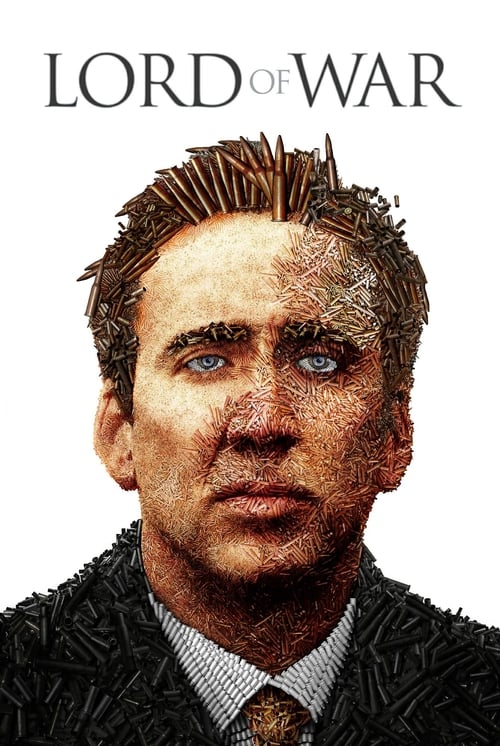
Lord of War
2005 · Andrew Niccol
For when you want something smart and cynical with real momentum — a rise-and-fall story that entertains you and then leaves you arguing about the world on the way to bed. More provocation than comfort.
What it's about
Yuri Orlov, a Ukrainian-American kid from Brooklyn, discovers his one great talent: selling guns. The film follows his rise from small-time hustler to arms dealer for dictators and warlords across the post–Cold War world, narrating his own story with a salesman's charm while a dogged Interpol agent closes in and the human cost of his trade piles up just outside his field of vision.
The experience
Slick, fast, and bitterly funny — it goes down like a caper while quietly turning your stomach. The charm is the point: you enjoy Yuri's company right up until you catch yourself doing it.
Performances
Nicolas Cage is ideally cast, playing Yuri with a deadpan, seen-it-all charisma that makes the voice-over sing — one of his most controlled and quotable performances.
The craft
Andrew Niccol writes it as an ironic confession, the breezy narration constantly undercut by what the camera shows, and the film opens with a bravura sequence following a single bullet from factory to battlefield. The globe-hopping production and needle-drop wit give it real visual swagger.
Why it matters
It became the definitive movie about the modern arms trade, endlessly quoted and referenced whenever gun-running makes the news, and marked Niccol's move from speculative fiction into brutal present-day satire.
Snapshot
Lord of War is a globe-spanning satire about the international small-arms trade, structured as the picaresque confession of Yuri Orlov (Nicolas Cage), a Ukrainian émigré from Brooklyn's Little Odessa who rises from selling guns on the block to outfitting dictators and insurgents across the post–Cold War world. Written and directed by Andrew Niccol — the New Zealand–born screenwriter-director of Gattaca (1997) and the writer of The Truman Show (1998) — the film departs from his characteristic near-future science fiction to take on a recognizably present, brutally factual subject. Its method is ironic counterpoint: a charming, voice-over-narrating protagonist guides us through a moral abyss with the breezy patter of a salesman, while the camera registers the human cost he refuses to see. The film opens with one of the decade's most-discussed expository sequences — "the life of a bullet," tracing a single round from a factory in the former Eastern Bloc to the skull of an African boy — and closes on a sobering title card noting that the world's largest arms suppliers are the five permanent members of the United Nations Security Council. Between those bookends sits a film that is at once a star vehicle, a black comedy, and a piece of advocacy cinema.
Industry & production
Lord of War was an independently financed production, notable at the time for the scale of its budget relative to its non-studio origins; it was distributed in North America by Lionsgate, then in its ascendancy as a maverick mid-major. The independent financing mattered creatively: it allowed Niccol to retain final cut and to keep a morally unresolved, commercially risky protagonist at the center without the softening a major studio might have demanded. Nicolas Cage served as a producer as well as star, and the package was built around his name in a period when his commercial standing could anchor international pre-sales — a financing model in which foreign-territory rights are sold in advance to fund production.
The production's most widely circulated anecdote concerns its props. To stage scenes involving large quantities of Kalashnikov-pattern rifles, the production reportedly found it cheaper to acquire real (deactivated or available) weapons than to manufacture convincing replicas, and likewise rented real tanks rather than build them. This blurring of the film's subject and its means — a movie about the easy availability of weapons that found weapons easy to obtain — became part of its publicity and its thematic argument. As with any production legend, the precise commercial details are hard to verify independently, and the figures cited in press coverage should be treated with some caution; the broad fact of real ordnance on set is well attested.
Principal photography took place largely in South Africa, which doubled for numerous African settings, with additional work in other locations standing in for the film's many datelines. Human-rights organizations engaged with the film around its release as an awareness vehicle for the arms-trade issue, an alignment that reflected the picture's advocacy dimension. Commercially, the film performed modestly in North American theaters relative to its cost and recovered more of its standing internationally and on home video; I'll avoid citing specific grosses, as the reported figures vary by source.
Technology
Shot photochemically on 35mm in the mid-2000s, before digital capture had displaced film for features of this scale, Lord of War is a conventional celluloid production in its core technology. Its technical interest lies less in capture format than in two areas. First, the opening bullet sequence is an effects-and-compositing set piece: the journey of a single cartridge through stamping, packing, shipping, loading, and firing is realized through a chain of macro photography, miniature and motion-control–style staging, and digital compositing to create the illusion of continuous point-of-view travel from the round's perspective. It is a controlled, almost industrial-process aesthetic that mirrors the film's thesis about guns as a manufactured commodity. Second, the production's use of authentic weaponry and vehicles is itself a "technology" choice in the sense of physical production design — the texture of real metal, real tanks, and crates of real rifles gives the film a documentary weight that prop armories rarely achieve.
Technique
Cinematography
The cinematography is by Amir Mokri, a director of photography with a background in glossy, high-contrast commercial and studio work. His images for Lord of War are clean, saturated, and widescreen, favoring strong silhouettes, hard light in the African and Eastern European exteriors, and a polished surface that deliberately renders the arms trade as seductive and well-lit rather than grimy. This is a key strategic decision: the film's visual glamour is complicit with Yuri's salesmanship, seducing the viewer with the same allure that seduces the character. The "life of a bullet" opening is the showpiece — a sustained, motion-driven sequence built around the bullet's eye — but the wider film also uses tableau compositions (most memorably an aerial image of an immense field of arms or a fallen plane being stripped to nothing by villagers) that read as single, legible visual arguments. Where the record on the film's lensing choices is genuinely thin in published interviews, I'll refrain from attributing specific intentions to individual shots beyond what the images plainly show.
Editing
The film was cut by Zach Staenberg, best known as the Oscar-winning editor of The Matrix (1999). The editing carries an unusually heavy structural burden because the screenplay is built as a retrospective voice-over confession spanning roughly two decades and many countries. Staenberg's cutting keeps the picaresque moving through compressed montage, dateline-jumping ellipses, and rhythmic alignment of image to Yuri's narration, so that the film advances like an illustrated monologue. The montage sensibility — collapsing years of deals into propulsive sequences — is essential to sustaining the satirical tone, since dwelling too long on any single atrocity would break the film's mordant comic register.
Mise-en-scène / staging
Production design moves the film through a catalog of contrasts: the cramped émigré world of Little Odessa, the antiseptic luxury of Yuri's success, the chaos of African conflict zones, and the cavernous post-Soviet depots where surplus stockpiles are sold off by the ton. The staging repeatedly visualizes scale and commodity — pallets, crates, hangars, fields of weaponry — to make the abstraction of "the arms trade" concrete and physical. Costume and setting track Yuri's assimilation into transnational wealth, while the recurring imagery of weapons as ordinary goods (boxed, shipped, inventoried) underwrites the film's argument that mass death is, logistically, a business like any other.
Sound
The score is by the Brazilian composer Antonio Pinto, whose international profile rose with City of God (2002). His music for Lord of War blends propulsive, percussive cues with more reflective textures, supporting the film's swerves between caper energy and moral reckoning. The soundtrack also leans on pointed needle-drops and source music used with editorial irony — pop and rock cues juxtaposed against scenes of trafficking and violence, a technique that sharpens the satire. Sound design contributes the visceral mechanical specificity of weapons handling, which keeps the comedy grounded in lethal reality.
Performance
Nicolas Cage anchors the film in a register of controlled, ingratiating cool that is notably restrained by his standards — the performance lives in the narration's wry detachment and in Yuri's refusal of conscience rather than in outsized gesture. Jared Leto plays his brother Vitaly as the conscience the film otherwise withholds, his deterioration providing the moral counterweight Yuri suppresses. Ethan Hawke plays the dogged Interpol agent Jack Valentine, the incorruptible foil who cannot, structurally, win. Bridget Moynahan is Yuri's trophy wife, whose willed ignorance mirrors the audience's seduction, and Eamonn Walker delivers a chilling turn as the warlord Andre Baptiste — a figure broadly evoking the Liberian strongman Charles Taylor. Ian Holm appears as a rival dealer. The ensemble is calibrated so that only the doomed or the defeated carry moral clarity.
Narrative & dramatic mode
The film's dominant mode is the ironic, first-person picaresque: a rogue's progress narrated in retrospect by a protagonist who is articulate, self-aware, and unrepentant. Voice-over is not incidental but constitutive — Yuri's confessional patter is the film's spine, and its seductive reasonableness is the point. This places Lord of War in the lineage of the morally ambiguous criminal-narrator film, where the audience is implicated through identification with a charming guide to a corrupt world. The dramatic engine is less plot than accumulation: episodes of escalating deals, each more compromised than the last, punctuated by the pursuit subplot (Valentine) and the family subplot (Vitaly, Ava). The ending pointedly denies catharsis — Yuri is neither redeemed nor punished — and the closing title card converts the personal story into a systemic indictment, reframing the protagonist as a small functionary of state power rather than a rogue exception.
Genre & cycle
Generically the film sits at the intersection of crime drama, political thriller, and satire. It belongs to a mid-2000s cycle of globalized, issue-driven thrillers that used genre machinery to dramatize transnational systems — the trade in conflict commodities, the machinery of geopolitics, the complicity of the developed world — a cycle that includes contemporaneous films treating diamonds, oil, and the pharmaceutical and intelligence industries. Its satirical, commodity-tracing impulse also links it to films that anatomize an illicit business from the inside. The picture's tonal signature — comedy riding atop atrocity — distinguishes it from the more earnest entries in that cycle and aligns it with a darker satirical tradition about war profiteering.
Authorship & method
Lord of War is firmly an authored film: Andrew Niccol wrote and directed it, and it bears his recurring preoccupations even as it abandons his usual science-fiction setting. Across Gattaca, The Truman Show, S1m0ne, and later In Time, Niccol returns to protagonists caught inside engineered systems and to the gap between a polished surface and the human truth beneath it. Here the "system" is the global arms economy, and the polished surface is Yuri's salesmanship and the film's own glamour. Niccol's method is to let an unreliable, charismatic narrator seduce the audience into complicity, then to puncture that seduction — a strategy of ironic distance rather than melodramatic denunciation.
The key collaborators reinforce this approach: cinematographer Amir Mokri supplies the seductive, high-gloss imagery; editor Zach Staenberg provides the montage architecture that turns a decades-spanning confession into propulsive cinema; composer Antonio Pinto supplies the tonal bridge between caper and tragedy. Niccol has described the central character as a composite drawn from research into real arms dealers rather than a portrait of any single individual; viewers and critics have frequently associated Yuri with notorious real-world traffickers, but the film is careful to present an amalgam, and the safest reading of the record is that Orlov is invented from documented patterns rather than a roman à clef of one person.
Movement / national cinema
The film does not belong to a national-cinema movement in any strict sense. It is a product of transnational, independently financed English-language filmmaking, shot largely in South Africa with an international cast and a Brazilian composer, helmed by a New Zealand expatriate working within American industry structures. If it has a "movement" affiliation, it is to the loose tendency of mid-2000s globally minded political cinema described above — films that are American-financed and -distributed but deliberately deterritorialized in setting and subject, using the resources of Hollywood to critique the systems Hollywood's home nation underwrites.
Era / period
Lord of War is a creature of the immediate post–Cold War and early–War-on-Terror moment. Its narrative pivots on the collapse of the Soviet Union as the great enabling event of the modern small-arms glut: the unsupervised dispersal of Eastern Bloc stockpiles is the historical engine that makes Yuri's fortune. Released in 2005, the film also speaks to a mid-decade American public newly attentive to the machinery of foreign intervention and the moral economics of war, and its closing indictment of great-power complicity reads as a comment on the geopolitics of its own moment. The film thus straddles two eras — the 1980s–90s it depicts and the post-2001 present it addresses.
Themes
The governing theme is complicity: the film insists that the arms dealer is not an aberration but a node in a system that runs from factories to governments to consumers, and it implicates the viewer through identification with Yuri. Adjacent themes include the commodification of death (guns rendered as ordinary, inventoried merchandise); the immigrant's pursuit of the American dream turned monstrous (Yuri's assimilation purchased with blood); willed ignorance as moral strategy (Ava, and the audience); and the impotence of individual conscience against systemic incentives (Valentine cannot win; Vitaly's conscience destroys only himself). The film's persistent irony — comedy laid over carnage — is itself thematic, dramatizing the psychic distancing that makes the trade possible. Its final move, the Security Council title card, universalizes the theme from one man's guilt to the structure of the international order.
Reception, canon & influence
Critical reception was mixed-to-positive, with admiration concentrated on the opening bullet sequence, Cage's controlled lead performance, and the audacity of building a film around an unredeemed protagonist; reservations clustered around the film's reliance on voice-over and a perceived tension between its slick entertainment surface and the gravity of its subject — the very tension the film courts deliberately. Commercially it was not a major theatrical success in North America, though it gained a substantial afterlife on home video and in repertory and classroom contexts as an accessible primer on the arms trade.
The influences on the film run backward to the tradition of the charismatic-criminal voice-over narrative and to the lineage of war-profiteer satire, refracted through Niccol's own system-critiquing authorship. Its legacy forward is twofold. Within film culture, it stands as a touchstone of the mid-2000s globalized issue-thriller and is regularly cited as a key entry in Cage's filmography and as Niccol's most successful move outside science fiction. Beyond the cinema, the film acquired an unusual second life as an advocacy and educational text on small-arms proliferation, frequently invoked in public discussion of the arms trade — a durability owed substantially to its closing statistic about Security Council members. Where claims about its precise real-world policy impact circulate, the record is thin and largely anecdotal, and such claims should be treated as cultural reputation rather than documented effect.
A Deleuzian reading
Start with the bullet, because the film does.
The full Deleuzian reading of Lord of War →
Reception
A modest box-office performer with mixed reviews in 2005, it's since been rediscovered as one of Nicolas Cage's best 'serious' performances — and got a fresh wave of attention in 2022 when Viktor Bout, the real arms dealer who partly inspired it, was back in the news via the Brittney Griner prisoner swap.
How Lord of War was received, from release to now →
Influences: the films it descends from and the films it influenced
- GoodFellas (1990) — The template for Yuri's whole mode of address: a charismatic-criminal first-person voiceover that confesses a decades-spanning rise as propulsive freeze-frame-and-montage cinema, with pop needle-drops deployed to ironize the glamour rather than condemn it.
- A Clockwork Orange (1971) — Pioneers the seductive, articulate first-person narrator who charms the audience into complicity with his violence, sealed by ironic classical scoring — Niccol's core strategy of seduction-then-puncture.
- The Third Man (1949) — The Harry Lime model of the charming, amoral black-market profiteer whose salesman's wit indicts a complicit postwar order — the genial racketeer as moral test for the viewer.
- Dr. Strangelove (1964) — Attacks the apparatus of mass death through cool ironic comedy and distance rather than melodramatic denunciation, the satirical register Niccol adopts toward the arms trade.
- Catch-22 (1970) — Milo Minderbinder's war-profiteering syndicate literalizes the commodification of war as a market, the satirical lineage of the businessman who sells to all sides that Yuri inherits directly.
- Wall Street (1987) — Builds a film around a seductive amoral salesman of capitalism — the high-gloss glamorization of greed staged so the audience is courted before being morally punctured.
- Casino (1995) — Supplies the process-montage grammar — narrated, clinical sequences anatomizing how an illicit business physically operates — that Niccol echoes in the bullet's manufacture-to-victim journey.
- In Time (2011) — Niccol again literalizes commodification as system-critique, making a unit of life (time-as-currency) into traded merchandise exactly as Lord of War makes death a product line.
- Blood Diamond (2006) — Extends the conflict-commodity thriller to an African supply chain, staging the commodification of death by tracing a single object (a diamond) from extraction to luxury consumer, mirroring the bullet's journey.
- The Wolf of Wall Street (2013) — Pushes the amoral-salesman confessional voiceover to its glossiest extreme — direct-address seduction and excess that implicate the viewer's appetite before any reckoning arrives.
- War Dogs (2016) — The most direct heir: an arms-dealer picaresque told through charismatic confessional voiceover and GoodFellas-style ironic needle-drops, explicitly reworking Yuri's salesman-of-weapons archetype.
- The Big Short (2015) — Inherits the ironic narrator who decodes a lethal, opaque system for a complicit audience using montage, direct address and music — Niccol's didactic-yet-entertaining issue-film form turned toward finance.
- Gattaca (1997) — Niccol's own authorial signature: a cool, measured voiceover narrator embedded inside an engineered system, photographed with seductive high-gloss surface that masks the human cost beneath.
- The Truman Show (1998) — The defining Niccol gap between a polished, constructed surface and the human truth it conceals — here the staged 'world' is the arms economy's salesmanship rather than a TV set.
- Thank You for Smoking (2005) — A satire constructed around the charming, self-aware salesman-of-death whose voiceover spin actively seduces the audience — the same complicity machine aimed at tobacco instead of weapons.
- Syriana (2005) — The mid-2000s globalized issue-thriller mapping diffuse, systemic complicity across a commodity economy (oil), the cycle's parallel attempt to dramatize a borderless corrupt market.
Similar films
- Syriana (2005) — influence & lineage
- Casino (1995) — influence & lineage · often watched together
- GoodFellas (1990) — influence & lineage · often watched together
- The Third Man (1949) — influence & lineage · often watched together
- The Truman Show (1998) — influence & lineage · often watched together
- Nightcrawler (2014) — often watched together
- Jack Reacher (2012) — often watched together
- The Man from U.N.C.L.E. (2015) — shared sensibility