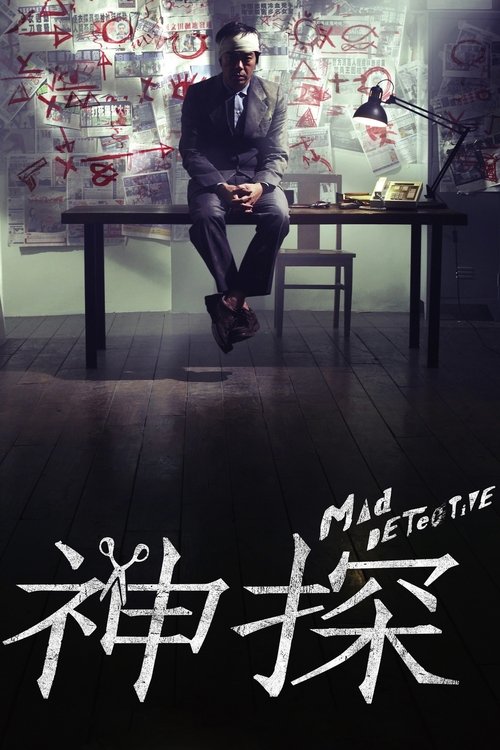
Mad Detective
2007 · Wai Ka-fai
When you want a crime film that plays games with your head — a lean, strange, 90-minute puzzle for viewers bored of standard police procedurals. More challenge than comfort, but a wildly entertaining one.
What it's about
Bun, a retired Hong Kong police inspector with a shattered mind and an impossible gift — he can see the hidden 'inner personalities' people carry inside them — is pulled back by a rookie detective to crack the case of a missing officer and his suspect partner. The catch: the film shows you the world as Bun sees it, where one suspect walks around as several different people at once.
The experience
Disorienting, wiry, and blackly funny, then suddenly ferocious. You're never quite sure whether you're watching reality or Bun's delusion, and that instability becomes the thrill — it keeps you leaning forward, reassembling the case in your head right up to a bravura finale.
Performances
Lau Ching-wan is extraordinary as Bun — twitchy, pitiable, and weirdly noble, selling both the madness and the genius without ever winking at the audience.
The craft
The central conceit is executed with total commitment: hidden selves appear on screen as separate flesh-and-blood actors, so a single suspect can fill a frame with a whole committee of personalities. The staging is razor-sharp Hong Kong genre craft, capped by a mirror-maze shootout of unforgettable geometry.
Why it matters
A high point of Hong Kong's Milkyway Image school of inventive crime cinema, it became a cult touchstone for how radically a police thriller can bend point of view.
Snapshot
Mad Detective is a Hong Kong crime thriller that literalises the phenomenology of schizophrenic perception, treating subjective vision not as expressionist flourish but as the film's structuring epistemological problem. Chan Kwai-bun, a retired police inspector of extraordinary but destabilising gifts, can see the "inner personalities" — hidden psychological selves — that ordinary people carry inside them. When a rookie detective drags him out of retirement to solve the disappearance of a colleague and the suspected corruption of a serving officer, the film commits fully to Bun's distorted sight-lines: the inner personalities materialize on screen as distinct, simultaneously present human figures, collapsing the boundary between subjective and objective reality for audience and protagonist alike. The result is a genre film that doubles as a formal treatise on the limits of perception and the violence of certainty.
Industry & production
Mad Detective is a Milkyway Image production, the Hong Kong company founded in 1996 by Johnnie To Kei-fung and Wai Ka-fai. The film is a genuine co-direction: both men are credited directors, though the division of labor broadly follows the established Milkyway pattern — Wai as primary author of the script and narrative architecture, To as the dominant orchestrator of spatial and visual composition. This attribution is widely reported by critics and collaborators, though neither director has been particularly systematic about codifying their respective roles in interviews. The two had made approximately a dozen films together by this point, and the collaboration had matured into something close to a single integrated sensibility.
Milkyway's production model — small budgets, tight schedules, an in-house repertory company of actors and technicians — had by 2007 given the studio an unusual consistency of quality and house style for a Hong Kong commercial outfit. The company had survived the severe contraction of the local film industry in the 1990s and resisted the mainland co-production pressures that were reshaping the wider industry, maintaining a distinctly Hong Kong inflection in subject matter and urban geography. Mad Detective was shot on location in Hong Kong, and the city's specific architectural textures — cramped apartment blocks, abandoned industrial space, the visual clutter of a dense subtropical metropolis — are integral to the film's mise-en-scène rather than incidental backdrop.
Technology
Mad Detective was shot on 35mm film, consistent with Milkyway Image's practice through the mid-2000s. The digital acquisition transition was well advanced in Hong Kong commercial cinema by 2007, but the studio's investment in celluloid grain and optical depth remained audible in the image's texture. The mirror-maze finale — the film's most technically demanding sequence — was achieved practically, using actual reflective surfaces rather than post-production compositing to multiply the seven inner personalities simultaneously within a single frame. This practical approach gives the sequence a spatial coherence and a slight physical uncanniness that digital insertion would have flattened; the slight distortion of reflected images across multiple mirrors becomes part of the film's argument about refracted, unreliable vision.
Technique
Cinematography
The film's cinematography — widely attributed to Cheng Siu-keung, Milkyway Image's long-standing director of photography — deploys a characteristically restrained visual grammar that periodically ruptures into disorienting subjective passages without stylistic fanfare. For much of its running time, the image is cool, functional, almost procedural: the camera observes rather than editorialises. This neutrality is deliberate. When Bun's second sight kicks in and the inner personalities manifest, the shift in register is subtle rather than spectacular — the same flat, composed framing simply contains more people than it should, and the audience absorbs the impossibility before the logic catches up. Cheng and the directors resist the temptation to mark Bun's visions with a change of stock, a color grade, or a lens shift; the horror inheres in the fact that his perception looks exactly like ours.
Editing
The editing handles the film's central formal challenge with considerable sophistication. Scenes involving the inner personalities must cut between Bun's view — in which Ko Chi-wai's partner is surrounded by seven distinct personality-figures — and Ho Ka-on's view, in which there is only one man. The editing establishes and maintains these two simultaneously active perceptual regimes without ever becoming confusing, a feat that depends on precise geography and consistent eyeline management. The cutting in the finale is more aggressive, using the proliferating mirror images to produce a genuine spatial disorientation that collapses the film's accumulated perceptual layers into a single vertiginous event.
Mise-en-scène / staging
The staging of the inner personalities is the film's central formal invention. Seven distinct actors embody the competing selves of the suspect Ko Chi-wai; they are present, in various configurations, in virtually every scene involving him. Their simultaneous presence is treated not as surrealism but as reportage — Bun simply perceives what is there to be perceived. The blocking accommodates all seven figures within the frame, requiring an unusual degree of choreographic complexity in scenes that must otherwise read as mundane procedural exchanges. The film's most celebrated staging is the finale in an abandoned building, where the mirrored walls multiply both the inner personalities and the investigators, creating a mise-en-abyme of reflected identity in which the distinction between "real" and "projected" self becomes genuinely impossible to maintain. It is among the most formally intricate set pieces in Hong Kong cinema of the decade.
Sound
The sound design operates in productive tension with the film's visual logic. Bun's perception is shown but not, for the most part, aurally amplified — the inner personalities move through the world with the same sonic presence as "real" figures, which is both economical and philosophically consistent with the film's refusal to pathologise his sight. The score — the specifics of its composer attribution are not fully documented in the major critical sources — is sparse and functional rather than expressive, resisting the temptation to cue the audience emotionally during the film's more destabilising passages.
Performance
Lau Ching-wan's performance as Bun is among the finest of his career and ranks with the strongest work produced within Hong Kong's genre cinema in the 2000s. The role requires Lau to play a man of absolute conviction operating in a social and institutional world that regards him as broken; he locates the character's gravity in a combination of physical certainty — Bun moves through spaces as though the inner personalities are solid obstacles — and a quality of pained lucidity in his eyes that keeps the performance from tipping into caricature. Lau had played a somewhat analogous figure, endowed with supernatural perception and suffering for it, in the To-Wai film Running on Karma (2003); the two films form an informal diptych around the theme of a man condemned by his capacity to see what others cannot. Andy On, as the rookie detective Ho Ka-on, functions largely as the audience's surrogate — the skeptical but increasingly unsettled normative point of view — and handles the weight of reactive performance competently without approaching Lau's register.
Narrative & dramatic mode
The film operates as a procedural crime narrative whose genre furniture — the cold case, the corrupt cop, the reluctant specialist — is systematically undermined by its epistemological premise. The procedural mode depends on a shared evidential reality; Mad Detective collapses that shared reality almost from the outset. We see what Bun sees, which means we are as unable as he is to be certain what is "there" and what is "perceived." The film's ending, in which the mystery is resolved but the resolution carries a specific moral weight about the cost of seeing clearly, refuses the procedural's customary satisfaction. The dramatic mode is, finally, tragic — Bun's gifts are inseparable from his destruction, and the film is structured so that his vindication and his unraveling are the same event.
Genre & cycle
Mad Detective belongs to the cycle of Milkyway Image neo-noir that dominated internationally visible Hong Kong genre production from the late 1990s through the 2010s. This cycle — including The Mission (1999), PTU (2003), Election (2005), Exiled (2006), and Drug War (2012) — reworked the conventions of the Hong Kong police procedural and triad film through a cooler, more elliptical aesthetic inherited as much from European art cinema as from the classical Hollywood genre tradition. Within this cycle, Mad Detective occupies a specific sub-variant: the psychologically destabilised investigator, a figure who appears across a range of films in the period (the Hong Kong industry was, by this point, well acquainted with the commercial appeal of the unreliable or exceptional detective). The film's treatment of multiple personality as a literally visible phenomenon also connects it, more loosely, to the international cycle of psychological thrillers in the 1990s and 2000s that used perceptual instability as a narrative motor.
Authorship & method
The To-Wai authorial model is unusual in Hong Kong cinema precisely because it is a genuine collaboration between two credited directors rather than the conventional auteur-and-metteur-en-scène hierarchy. Wai Ka-fai's screenwriting is among the most formally inventive in Hong Kong commercial cinema of the period; his scripts characteristically work by building an apparently conventional genre premise to the point at which it collapses under the weight of its own internal logic. Mad Detective's script is a strong example: the "detective with supernatural gifts" premise is genre standard, but Wai's development of it — through the commitment to make Bun's perception fully and literally visible — transforms it into something formally destabilising. Cheng Siu-keung's cinematography provides the visual texture through which this destabilisation is delivered; his collaboration with To on spatial composition across multiple Milkyway productions had, by 2007, developed into a working shorthand that allowed the complex staging of the inner-personality sequences to be executed with efficiency.
Movement / national cinema
Mad Detective is firmly situated within Hong Kong cinema's post-handover period, when the territory's film industry was navigating a tension between commercial pressure toward mainland co-production and a residual civic and aesthetic identity rooted in specifically Hong Kong urban experience. Milkyway Image was, in this period, one of the most visible institutional expressions of a Hong Kong distinctiveness in genre filmmaking — operating at a relatively small scale, addressing local urban environments and social textures, and maintaining a genre grammar that remained more indebted to the territory's own cinematic tradition than to mainland aesthetic or thematic norms. The film engages only tangentially with the political anxieties of the handover period, but the figure of an authority figure who sees clearly and is dismissed as mad carries its own legible resonance.
Era / period
The film belongs to the mature phase of the Milkyway Image project, the years between Election (2005) and Vengeance (2009) when the studio's international critical reputation was at its highest. This was simultaneously a moment of significant institutional pressure on Hong Kong cinema as a whole: local box office had contracted severely, and the structural incentives to pursue mainland Chinese funding and audiences were intensifying. The quality and consistency of Milkyway's output in this period was in some respects a holding action — maintaining the conditions of possibility for a certain kind of Hong Kong film.
Themes
The film's governing concern is the politics of perception: who is authorized to claim knowledge of what is real, and what happens to those whose vision exceeds the consensual frame. Bun's madness is inseparable from his accuracy — his diagnoses of the inner personalities are consistently correct, and the film's mystery resolves in his favour — but the social and institutional world cannot accommodate a knowledge that is not communicable through normal evidential channels. The film is also, with some precision, about the violence that attends certainty: Bun's absolute confidence in his perceptions has destroyed his career and his domestic life, and the film is careful to show that the cost of his correctness is borne partly by those around him. The multiple-personality structure extends this into a meditation on identity as fragmented and socially determined — the inner personalities are not secret truths but social performances that have hardened into autonomous selves.
Reception, canon & influence
Mad Detective received strong critical reception on its international festival and distribution circuit, with Lau Ching-wan's performance and the finale's formal audacity most frequently cited. The film consolidated the international reputation of the To-Wai partnership and is regularly included in retrospective assessments of Hong Kong cinema in the 2000s. Specific award records from the festival circuit are not fully documented in the major critical sources, and claims about box-office performance should not be offered without reliable figures.
The film's influences reach back to a range of predecessors without being straightforwardly derivative of any single one. Kurosawa's Rashomon (1950) and its descendants in the unreliable-narrator tradition are relevant precedent; so are the psychological thrillers of Roman Polanski, particularly Repulsion (1965) and The Tenant (1976), which treat subjective distortion as both symptom and formal method. Adrian Lyne's Jacob's Ladder (1990) offers a Hollywood genre analog for the literalised perception conceit. Within Hong Kong cinema, the film extends the tradition of the extraordinary or supernaturally gifted investigator that runs from various Category III-adjacent genre exercises through to Running on Karma itself.
Its legacy within subsequent Hong Kong and wider Asian genre cinema is difficult to trace with precision, partly because Milkyway Image's influence operated more through example and critical esteem than through direct imitation — the studio's aesthetic is recognizable enough to be difficult to copy without appearing derivative. The mirror-maze finale has been cited by a number of critics as a touchstone for the staging of psychological revelation through spatial multiplication, and the film remains a standard reference point in scholarly and critical discussions of unreliable perception as a narrative and formal strategy in contemporary genre cinema.
A Deleuzian reading
Picture a plain interrogation room.
The full Deleuzian reading of Mad Detective →
Reception
It premiered as the surprise competition entry at Venice 2007 — a splashy festival debut that made it an instant critics' darling — and it has since settled into cult status as maybe the wildest, most beloved of the Johnnie To/Wai Ka-fai co-directions.
How Mad Detective was received, from release to now →
Influences: the films it descends from and the films it influenced
- The Lady from Shanghai (1947) — Welles's mirror-maze shoot-out is the direct formal template for Mad Detective's finale: practical reflections multiply figures across space so that spatial coherence and identity coherence collapse simultaneously through mise-en-scène alone, without optical effects.
- Rashomon (1950) — Kurosawa establishes the precedent for presenting contradictory perceptual accounts with cinematographically equal authority — no visual hierarchy distinguishes the 'true' version — which Mad Detective inherits as the foundational grammar for its dual-perceptual regime.
- Repulsion (1965) — Polanski renders Carole's hallucinations (cracking walls, hands through plaster, attacking men) with the same flat, neutral cinematographic texture as objective events, establishing the perceptual-neutrality technique that Mad Detective applies to Bun's visions of inner personalities.
- Persona (1966) — Bergman literalizes two-self merger through staging — two women sharing a single face in the composite mirror shot — and films the simultaneous monologue from two angles as if both inhabit the same moment, directly prefiguring Mad Detective's technique of placing inner personalities as spatially present figures within one frame.
- The Tenant (1976) — Polanski stages paranoid self-multiplication — the protagonist seeing himself occupy another body across a courtyard — without expressionist distortion, treating the vision as spatially plausible; this commitment to spatial plausibility over visual signposting is the precise method Mad Detective inherits.
- Jacob's Ladder (1990) — Lyne cuts between hallucinated and real registers within continuous scenes using matched eyelines and unbroken camera grammar, so the viewer cannot determine which perceptual register applies; Mad Detective's editing/dual-perceptual-regime applies this same eyeline-management discipline to the genre procedural.
- Running on Karma (2003) — The immediate formal prototype: same To-Wai co-direction, same lead actor (Lau Ching-wan), same Milkyway production context, same conceit of an investigator whose extraordinary perceptual gift is rendered as literal diegetic event rather than stylized subjective insert — the structural mold Mad Detective refines.
- Shutter Island (2010) — Scorsese applies the procedural-epistemological-collapse grammar to a Hollywood genre production: the detective investigation exists structurally to deliver the investigator's own perceptual unreliability, with accumulated genre conventions held in place until the epistemic inversion — the same architecture as Mad Detective scaled to studio form.
- Black Swan (2010) — Aronofsky adopts perceptual-neutrality for body-horror: the handheld camera presents psychotic visions with identical cinematographic grammar to objective events, so hallucination and reality are indistinguishable throughout — the same non-signposted subjective experience that Mad Detective codified in the genre-procedural context.
- Vengeance (2009) — To and Cheng Siu-keung extend Mad Detective's perceptual-collapse grammar into memory: the hitman-protagonist's degenerating recall becomes the narrative's epistemological instability, delivered through the same Milkyway spatial staging and deep-focus compositional grammar developed across the To-Wai productions.
- I Saw the Devil (2010) — Kim Jee-woon extends the detective-whose-investigation-corrupts-his-perception strand: the special agent's methodological violence progressively destabilizes his own perceptual and moral position, staged through escalating genre spectacle that gradually makes the investigator's POV the source of horror rather than its instrument.
- Memento (2000) — Nolan externalizes the detective-protagonist's perceptual dysfunction through editing architecture (reversed chronology) that forces the viewer into an identical epistemological position to the investigator, achieving through temporal structure what Mad Detective achieves through simultaneous spatial staging.
- Mulholland Drive (2001) — Lynch applies perceptual-neutrality across the film's two halves — dream registers as reality and reality as dream with no cinematographic hierarchy — and uses detective investigation as the vehicle through which perceptual collapse is delivered, the same structural logic as Mad Detective.
- PTU (2003) — To and Cheng Siu-keung develop the specific deep-focus nighttime composition and precision actor-blocking grammar that carries directly into Mad Detective's procedural sequences; the film is the clearest Milkyway craft-continuity case, sharing director, DoP, and production infrastructure.
- A Tale of Two Sisters (2003) — Kim Jee-woon commits to the same perceptual-neutrality: the camera adopts the disturbed narrator's reality as cinematically neutral with no visual signposting, placing viewers in the protagonist's epistemological position — the identical formal commitment that structures Mad Detective's staging of Bun's visions.
Similar films
- Mulholland Drive (2001) — influence & lineage
- Memento (2000) — influence & lineage
- PTU (2003) — influence & lineage
- Shutter Island (2010) — influence & lineage
- Memoir of a Murderer (2017) — shared sensibility
- Infernal Affairs (2002) — shared sensibility
- The Mission (1999) — shared sensibility
- Fallen Angels (1995) — shared sensibility