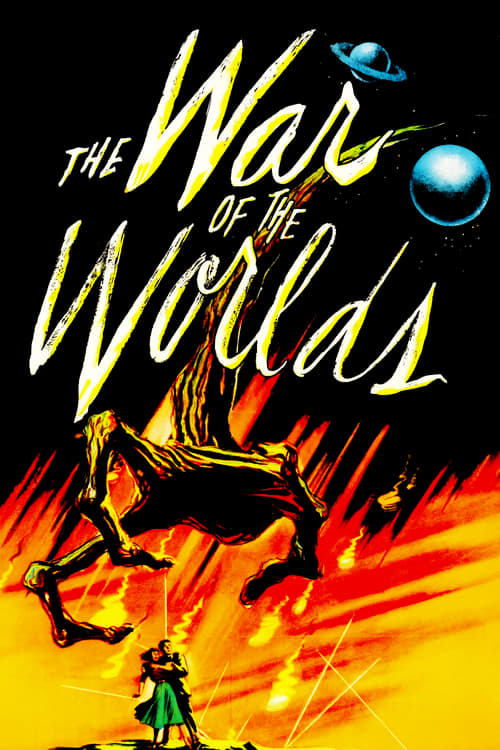
The War of the Worlds
1953 · Byron Haskin
For a classic sci-fi night when you want old-school spectacle with real atmosphere — matinee comfort viewing that turns unexpectedly apocalyptic. Perfect gateway film for anyone curious about golden-age science fiction.
What it's about
A flaming object crashes into the hills outside a small California town, and the locals treat it as a curiosity — until it opens. It's the first of a wave of Martian machines, sleek hovering craft that shrug off everything humanity throws at them, up to and including the atomic bomb. A scientist and the woman he meets in the chaos flee across a collapsing Southern California as civilization comes apart around them.
The experience
Brisk, eerie, and genuinely awe-struck — the invasion scenes still carry a charge, from the slow reveal at the crash site to the sound of those machines powering up. The humans are thin by design; the film's real pulse is the spectacle of a world being methodically dismantled.
The craft
The Oscar-winning special effects are the star: the manta-shaped, cobra-necked war machines remain some of the most elegant alien designs ever put on screen, rendered in saturated Technicolor with sound design — that pulsing heat-ray shriek — that burned itself into pop culture. George Pal's production values were lavish for 1950s science fiction, and it still rewards good speakers.
Why it matters
It taught American science fiction how to stage an alien invasion, defined the Cold War era's anxieties on screen, and its designs and sounds echo through decades of invasion movies since.
Snapshot
George Pal's production of The War of the Worlds is the film that taught American science fiction how to look at the sky. Released by Paramount in the late summer of 1953, it transposes H. G. Wells's 1898 novel of Martian invasion from late-Victorian Surrey to postwar Southern California, replaces Wells's tripod war machines with hovering manta-shaped cobra-headed craft, and — crucially — reframes an anti-imperialist satire as a Cold War civil-defense parable culminating in overt Christian consolation. It is a film of spectacular surfaces and thin characters, and it knows it: the human protagonists are functionaries whose job is to be present at the right places while the world is dismantled around them.
What survives is the dismantling. The Academy Award for Best Special Effects went to The War of the Worlds, and the recognition was earned on a compressed schedule and a budget that its effects team stretched by ingenuity rather than volume. The film's core images — the ash-gray heat ray, the wobbling green shimmer of the machines' shields, the pulverized Los Angeles City Hall, the crowds streaming out of a doomed city — became the visual grammar of alien invasion for decades. It is also one of the purest artifacts of the 1950s atomic anxiety cycle: a film in which the A-bomb is deployed against the enemy on screen, in daylight, and fails. That single narrative beat did more to define the decade's science fiction than any amount of flying-saucer iconography.
Industry & production
The film belongs less to its director than to its producer. George Pal, Hungarian-born, had come to Hollywood via animation — his Puppetoons stop-motion shorts for Paramount in the 1940s — and reinvented himself in the postwar years as the industry's most committed science-fiction producer. Destination Moon (1950), made at Eagle-Lion, had established that a technically serious, effects-forward space picture could find an audience; When Worlds Collide (1951), at Paramount, confirmed it and won its own effects Oscar. The War of the Worlds was the third leg of that run, and it consolidated Pal's method: a pre-sold literary or scientific property, a modest star budget, and a disproportionate share of resources routed into the effects department.
Paramount had held rights to the Wells novel since the 1920s, and the property had circulated for years without producing a film. The most storied of the unmade versions is the treatment Sergei Eisenstein was said to have considered during his abortive Paramount period around 1930, and there were later flirtations — the studio's development history for the title is thick with abandoned approaches. It is worth being precise here rather than repeating legend: the documentary record on these early attempts is uneven and much of what circulates in popular accounts is secondhand. What is firmly established is that Pal took an old, dormant studio property and made it viable by proposing to modernize it.
Byron Haskin, the director, was in his own way an effects man first. He had run Warner Bros.' special effects department in the 1930s and received multiple Academy Award nominations in that capacity before moving fully into direction in the late 1940s. He and Pal would collaborate repeatedly afterward — The Naked Jungle (1954), Conquest of Space (1955), The Power (1968) — and Haskin's willingness to subordinate performance to the mechanics of a shot suited a production whose real protagonist was the apparatus.
The screenplay is credited to Barré Lyndon, an English-born writer with a background in stage melodrama and in Hollywood suspense (The Lodger, Hangover Square). Lyndon's chief structural task was relocation: Wells's first-person Surrey narrator becomes Dr. Clayton Forrester, a Pacific Tech nuclear physicist, and the novel's serialized wandering becomes a linear sequence of escalating institutional failures — local, military, national, global. The film was shot in Technicolor with substantial location work in and around Los Angeles, standing in for the fictional Linda Rosa and then, in the last act, for itself.
Production was demanding on the effects side and cheap on the human side. The stars, Gene Barry and Ann Robinson, were not expensive names; Barry was a stage and television actor whose film career was still forming, and Robinson was a Paramount contract player. The money went where the audience would look. Contemporary accounts of the shoot emphasize the labor of the miniature and wire work — the war machines were suspended on wires that proved persistently visible and required extensive optical concealment, a problem that consumed schedule and budget and that remains faintly detectable in some shots.
Technology
Three technical decisions define the film.
The first is Technicolor. Science fiction in 1953 was overwhelmingly a black-and-white, second-feature genre; The War of the Worlds was an A-picture in three-strip color, and color is doing specific work. The heat ray is not simply destructive, it is chromatic: the green-white beam, the orange-red bloom of ignition, the sickly green glow of the machines' protective blisters. The Martian blood, glimpsed when the alien is wounded, registers as color information — the film's biology is conveyed through a palette. Pal's team also used color to distinguish the Martian technology from everything terrestrial: the human world is dusty tan, khaki, and asphalt gray, and the invaders arrive saturated.
The second is the design and rigging of the war machines themselves. Wells's tripods were abandoned early. Accounts from the production consistently indicate that mechanical walking legs were attempted and could not be made to work convincingly, and the solution — manta-ray hulls floating on invisible support, with an articulated gooseneck emitter rising from the back — was a practical answer to an intractable engineering problem. The machines were built as wired miniatures with copper-wire "legs" that were meant to register as electrical support beams and largely read, in the finished film, as burn marks on the ground beneath. The wires that actually held the models were the perennial headache; the effects unit fought them with careful lighting, black backing, and optical work.
The third is the compositing itself. The film is a dense stack of matte paintings, glass shots, rear projection, traveling mattes, and in-camera pyrotechnics. The destruction of Los Angeles is achieved almost entirely through miniatures and matte art, with foreground crowds staged separately. The Academy Award for Special Effects went to Gordon Jennings — who died shortly before the ceremony — with the credited effects team including Wallace Kelley, Paul Lerpae, Ivyl Burks, Jan Domela, and Irmin Roberts, working under Pal's supervision alongside Chesley Bonestell's astronomical art for the opening survey of the solar system. Bonestell's involvement is significant: he was the era's preeminent space illustrator, and his participation gave Pal's productions a visual claim to scientific seriousness that the scripts rarely matched.
Technique
Cinematography
George Barnes, an established Hollywood cinematographer whose career reached back to the silent era and included Rebecca, shot the film. His work here is functional in the dialogue scenes and inventive in the set pieces. The most-discussed passage is the farmhouse sequence, in which Forrester and Sylvia van Buren are trapped in a partly collapsed house while a Martian probe — a serpentine electronic eye on a stalk — searches the rooms. Barnes lights this in fragments: beams of the probe's light sweeping across debris, faces caught in slivers, deep shadow occupying most of the frame. It is the only sustained horror sequence in the film and the only one that generates suspense from withholding rather than from display.
Elsewhere the compositional logic is scale-driven. Barnes and Haskin repeatedly frame the machines in low-angle wide shots with human figures small in the lower register, and cut to human-height views in which the machines are entirely out of frame and their presence is registered only by light and reaction. This alternation — see the object, then see only its effect — is the film's basic visual rhythm and is far more efficient than the sustained looking that a modern effects film would attempt.
Editing
Everett Douglas cut the film to a tight running time of roughly eighty-five minutes, and the compression is a real virtue. The structure is a descending staircase: each act is a new institution attempting to solve the problem and failing. The editing accelerates as the film proceeds, and the Los Angeles evacuation sequence is assembled from short, overlapping fragments — crowds, vehicles, collapsing façades, machine POVs — with almost no continuity of individual action. It is montage in the impressionist sense, an accumulation of the same event witnessed from many angles, and it produces a documentary-adjacent texture that the character scenes never reach.
The film also uses a newsreel register directly: sequences of global reportage, narrated, that compress the worldwide invasion into a few minutes. This is a Wellsian inheritance — the novel's narrator is a chronicler — but the film's specific idiom is postwar broadcast journalism, a device Orson Welles's 1938 radio adaptation had already exploited with famous results.
Mise-en-scène / staging
Cedric Gibbons is not here; the art direction is Hal Pereira and Albert Nozaki, and Nozaki is the crucial figure. A Japanese American designer who had been interned during the Second World War, Nozaki is generally credited with the manta-ray design of the war machines — one of the most durable pieces of production design in the genre. The machine reads as organic and mechanical at once: a hooded cobra, a ray, a lamp. It is not humanoid, not saucer-shaped, and not a tripod, and its refusal of all three available templates is why it still looks strange.
The staging of the human world is deliberately ordinary — square dances, town meetings, a church congregation, a Pacific Tech laboratory. This is a film about the domestic middle distance of American life being subjected to a force it cannot process, and the mise-en-scène insists on the banality of what is destroyed. The final act's staging in and around the churches of downtown Los Angeles converts that ordinariness into liturgy.
Sound
The sound design is the film's most enduring technical contribution and arguably outlasts its images. The heat-ray effect — a sustained, resonant, almost vocal pulse — and the war machines' rising hum were built by Paramount's sound department from manipulated recordings, and the specific composite of guitar strings, air-conditioning, and reversed and layered elements has passed into folklore with more confidence than the documentary record fully supports. What is not in dispute is the result: these sounds were reused across decades of film and television and remain instantly identifiable. The Martian "war cry" and the pulsing electronic throb do more to establish the aliens' unknowability than any visual.
Leith Stevens's score works in the same register, with an emphasis on brass clusters and dissonant harmony rather than the theremin-and-strings idiom that The Day the Earth Stood Still had established two years earlier. Stevens, a Pal regular, keeps the score comparatively restrained during the effects sequences, letting the sound effects carry them, and reserves full orchestral statement for the opening and the ending.
Performance
The performances are the film's weakest element and were understood as such at the time. Gene Barry's Forrester is a competent, unruffled technocrat — the decade's standard-issue scientist-hero, in tweed and spectacles, whose function is to explain and to be believed. Ann Robinson's Sylvia van Buren has more to do than most 1950s genre heroines but is still principally a register of terror; her scream in the farmhouse sequence is the film's most effective piece of acting because it is the one moment when the script permits an unmediated reaction. Les Tremayne's General Mann provides military exposition with a professional's economy. Sir Cedric Hardwicke's opening narration lends the prologue a gravity the drama does not sustain.
The flatness is partly structural. Wells's novel has no heroes either; its narrator survives by accident. The film keeps that logic — nobody defeats the Martians — but grafts a romance onto it, and the romance has nothing to do while the world ends.
Narrative & dramatic mode
The dramatic mode is procedural catastrophe. The film advances by escalation of institutional response: curious townspeople, then local police, then the National Guard, then the regular Army, then the Air Force with an atomic weapon, then nothing. Each escalation is granted its own scene of preparation and its own scene of failure, and the pattern is legible enough that the audience is a step ahead of the characters — which is the point. Suspense derives not from whether the response will work but from watching competent people exhaust their competence.
The ending is the film's most-debated choice. Wells's Martians die of terrestrial bacteria, and the novel frames this as a grim irony of evolutionary biology: the invaders are killed by the smallest things on the planet they came to take. The film retains the bacteria but recontextualizes them theologically. Forrester searches the ruins for Sylvia and finds her in a church; the machines fall as congregations pray; and Hardwicke's closing narration attributes the deliverance to God having placed the microbes on Earth "in His wisdom." The bacteria are the same; the causality is reassigned. Whether this is a betrayal of Wells or a coherent adaptation of him to 1953 America is the standing critical question about the film, and both readings are defensible — Wells's own line about the "humblest things" carries a residue of providence that the film simply makes explicit and doctrinal.
Genre & cycle
The War of the Worlds sits near the center of the 1950s American science-fiction cycle, a body of roughly a hundred films that ran from about 1950 to about 1958 and that has been read, more or less since it was current, as a displaced processing of nuclear fear, communist infiltration anxiety, and the postwar reorganization of scientific authority. Within that cycle, the film belongs specifically to the invasion-from-outside strand — as against the mutation strand (Them!, The Beast from 20,000 Fathoms) and the infiltration strand (Invasion of the Body Snatchers, It Came from Outer Space).
Its immediate generic peers are The Thing from Another World and The Day the Earth Stood Still, both 1951. Against those, its distinguishing feature is total, unnegotiable hostility. Klaatu can be reasoned with; the Thing can be fought and killed by resourceful humans; the Martians can be neither. The film's ideological position on military response is more ambivalent than usually credited: the Army is portrayed as competent, brave, and organized, and it is annihilated anyway. That the atomic bomb — dropped on screen, in a sequence built around the flying-wing bomber and a real-looking blast — accomplishes nothing is the single most striking generic gesture in the film, and it cuts against the reading of 1950s science fiction as uncomplicatedly militarist.
Authorship & method
Authorship here is genuinely distributed, and pretending otherwise misdescribes the film. Haskin directs with efficiency and a technician's eye but leaves no signature that distinguishes this film from his other work with Pal; his best-remembered picture, Robinson Crusoe on Mars (1964), is more personal. Pal is the organizing intelligence: the choice of property, the modernization, the allocation of resources to effects, the tonal decision to play the material straight and reverently.
The key collaborators are therefore below the line. Albert Nozaki's production design gives the film its one indelible object. Gordon Jennings's effects unit gives it its spectacle. Barré Lyndon's screenplay gives it its staircase structure and its theology. George Barnes's photography gives it the farmhouse sequence. Leith Stevens's score and the Paramount sound department give it a soundscape that outlived the film's images. Everett Douglas's cutting keeps it moving. The film is a studio product in the most literal sense — a demonstration of what a well-run department system could assemble around a producer with a clear idea.
Movement / national cinema
This is Hollywood studio filmmaking at a moment of institutional strain. The Paramount consent decrees had begun forcing the separation of production from exhibition, television was pulling audiences, and the studios were responding with technological differentiation — color, widescreen, stereophonic sound, 3-D. The War of the Worlds is a color A-picture in a genre that had been a B-picture genre, and that upgrade is itself an industrial argument: spectacle you cannot get at home.
It is also, unmistakably, a Los Angeles film. Its final act destroys the city in which it was made, filming real streets and real landmarks, and it participates in a specifically Californian imagination of apocalypse that runs from the 1930s disaster picture through Kiss Me Deadly and forward to the late-century blockbuster. The choice to end in downtown churches rather than in Wells's London gives the film its distinctly American religious frame.
Era / period
1953 is the year of the hydrogen bomb's public arrival into consciousness, of the Rosenberg executions, of the Korean armistice, of the height of McCarthy's influence. It is also a peak year for civil-defense messaging: evacuation planning, duck-and-cover pedagogy, the routinization of thinking about urban annihilation. The Los Angeles evacuation sequence is legible as a civil-defense film that has decided to tell the truth — the orderly plan collapses into panic, looting, and the destruction of the very scientific equipment that might have saved everyone.
The religious ending belongs equally to its moment. The early 1950s saw a documented surge in American church affiliation and public religiosity, and the addition of "under God" to the Pledge of Allegiance in 1954 sits a year after this film. Reading the ending as merely a sop misses that it is an accurate rendering of how a large part of the film's audience understood the relationship between national survival and divine favor.
Themes
The failure of expertise and force. Every human system in the film performs correctly and loses. This is not anti-intellectualism — Forrester is right about everything — it is a statement that correctness is insufficient against a sufficiently superior adversary.
The obsolescence of the atomic deterrent. The film's most radical proposition is that the ultimate weapon is not ultimate. In 1953 this was a live anxiety rather than an abstraction.
Contagion and the smallness of the decisive cause. Wells's biological irony survives intact even under the theological overlay: the world is saved by something too small to see, which no one planned and no one deployed.
Community and dispersal. The film tracks a social unit — a town, then a city — being unmade. Its emotional structure is about people losing each other in crowds, and its resolution is the reconstitution of a couple inside a congregation.
Vision and the unseen. The Martians see through a probe; the humans see through telescopes, binoculars, and periscopes. The film is preoccupied with mediated looking, and its scariest moment is a hand on a shoulder that turns out to be an alien's.
Reception, canon & influence
The film was a commercial success on release and was well received as spectacle; the effects Oscar, awarded at the 1954 ceremony, formalized that judgment, and the film also received nominations in editing and sound. Contemporary criticism largely praised the visual achievement while noting the thinness of the human drama — a split verdict that has proven durable. Later critical writing has taken the film more seriously as an ideological document than as a drama, and it appears consistently in the standard scholarly accounts of 1950s science fiction. The Library of Congress selected it for the National Film Registry in 2011.
Backward. The film's primary inheritance is Wells's 1898 novel, but its mediating text is Orson Welles's 1938 Mercury Theatre broadcast, which had already demonstrated that the story's power lay in the reportage register and in American relocation. Pal's own Destination Moon and When Worlds Collide establish the production template. Chesley Bonestell's astronomical illustration supplies the prologue's visual authority. The disaster-picture tradition and wartime combat and newsreel footage supply the grammar of the evacuation and battle sequences. Wells's anti-imperial argument — the invaders do to England what England did to Tasmania — is present in the novel and almost entirely absent from the film, which is the most consequential thing the adaptation drops.
Forward. The film established the visual and narrative template for the alien-invasion spectacle: the object that lands, the failed emissaries, the escalating military response, the useless superweapon, the mass evacuation, the deus-ex-microbe. Independence Day (1996) is essentially a remake of its structure with the ending's agency handed back to humans. Steven Spielberg's 2005 War of the Worlds returns to the novel's ground-level first-person terror while explicitly acknowledging the 1953 film, casting Gene Barry and Ann Robinson in cameo roles. The sound effects have been recycled continuously across science-fiction film and television. Nozaki's machine design remains one of the most copied silhouettes in the genre. A television series continuation ran from 1988, taking the 1953 film as its direct antecedent.
The film's deepest legacy, though, is tonal. It proved that science fiction could be produced at A-picture scale with straight-faced conviction and full studio resources, and that audiences would accept the annihilation of American cities as mass entertainment. Nearly every subsequent invasion film is arguing with it, extending it, or paying it back.
A Deleuzian reading
The bomb goes off in daylight.
The full Deleuzian reading of The War of the Worlds →
Reception
A genuine hit in 1953 — it won the Oscar for special effects and was one of the year's biggest sci-fi draws — and unlike most of its atomic-age peers it never needed rescuing: it went straight into the canon and was added to the National Film Registry in 2011.
How The War of the Worlds was received, from release to now →
How to watch The War of the Worlds: what to notice on a first viewing
- Watch the shots where the machine is out of frame. Barnes and Haskin alternate two setups. A low wide angle with the craft above and people small along the bottom, then an eye-level view where the machine is gone and you get only light on faces and what people do next. Half the invasion is delivered by reaction alone, which is why it plays far bigger than the budget that paid for it.
- Look at the colors that arrive with the machines. The human world is tan, khaki, asphalt gray. The invaders come in saturated: green-white beam, orange bloom, the sick green of the shields. Science fiction in 1953 was a black-and-white genre and this was shot in Technicolor. Color separates two orders of being. You can tell what belongs to Earth by how drab it is.
- Listen to the heat ray's pulse and the machines' rising hum. Paramount's sound department built these out of manipulated recordings, and they do more than the images to make the Martians unreadable. Leith Stevens keeps the brass score out of the way during the set pieces. The aliens are established as unknowable through sound. Nothing you hear from them resembles anything you can place.
- Count the institutions that try and fail, one by one. Curious townspeople, then police, then the National Guard, then the Army, then the Air Force. Each rung gets its own scene of preparation and its own scene of failure, in that order, without variation. The suspense is not whether the response will work. It is watching capable people run out of things they know how to do.
- Watch the square dance and the town meeting scenes. Before anything happens the film spends real time on ordinary American routine: a dance, a meeting, a church, a lab at Pacific Tech. Nothing about these scenes is heightened or strange. The film establishes exactly how ordinary the thing being dismantled is, so the scale of the machines has something to measure against.
The whole guide to watching The War of the Worlds, with the keys for a rewatch →
Influences: the films it descends from and the films it influenced
- Things to Come (1936) — The first big-budget Wells adaptation built as a production designer's film, where pre-drawn continuity governs the shot and Arthur Bliss's through-composed brass carries a wordless aerial-bombardment montage — the exact division of labor (design and score over drama) that Pal reproduces with Nozaki and Leith Stevens.
- San Francisco (1936) — Slavko Vorkapich's destruction montage — miniature collapse intercut with tilted composites and crowd fragments cut on the impact rather than on continuity — is the working model for Everett Douglas's impressionist city-in-ruins cutting.
- Prelude to War (1942) — Supplies the prologue's grammar wholesale: omniscient narration over animated globes and marching maps, spliced to combat stock footage, which the 1953 film uses to certify the invasion as reportage before a frame of fiction is shown.
- Destination Moon (1950) — Establishes the Pal production template that WOTW inherits intact — Chesley Bonestell astronomical paintings used simultaneously as pre-production art and as Technicolor matte backings, hardware photographed documentary-straight, and the effects budget treated as the picture's star.
- When Worlds Collide (1951) — Same Pal / Gordon Jennings / Farciot Edouart effects unit, and the same procedural-catastrophe staircase — astronomical warning, official disbelief, mass evacuation, matte-painted cataclysm — that Barré Lyndon simply re-times for an invasion.
- The Thing from Another World (1951) — Hawks's overlapping-dialogue ensemble of technicians arguing about the specimen in a single room turns the scientist-versus-military debate into work talk, the register Lyndon compresses into the film's briefing and Pacific Tech scenes.
- The Day the Earth Stood Still (1951) — Sets the landing-craft-in-a-public-space blocking and the failed-emissary beat, and Herrmann's non-melodic cluster scoring (theremin over low brass) is the sonic problem Leith Stevens answers with dissonant brass rather than electronics.
- Earth vs. the Flying Saucers (1956) — Lifts the escalation architecture beat for beat — object lands, emissaries are destroyed, superweapon fails, landmarks fall — while substituting Harryhausen's stop-motion armatures for Jennings's wire-rigged, copper-wire-arced miniatures.
- The Time Machine (1960) — Pal's second Wells adaptation carries the exact production logic forward — miniature-and-matte set pieces, straight-faced reverence toward the source, another effects Oscar — with stop-motion time-lapse dissolves replacing the heat ray as the film's signature trick.
- Robinson Crusoe on Mars (1964) — Haskin reuses the actual manta-ray war machine props and Bonestell-derived Martian vistas, converting the procedural-catastrophe structure into procedural survival — the technocrat hero solving oxygen and water instead of microbiology.
- Close Encounters of the Third Kind (1977) — Inverts the 1953 vocabulary item by item: wire-suspended, front-lit craft photographed from low angles against banal American middle-distance, and the farmhouse probe sequence — fragmented beams searching a domestic interior — restaged as wonder rather than threat.
- Independence Day (1996) — A structural remake that preserves the whole staircase — silent object arrives, emissaries are massacred, the nuclear option fails against the shield, cities evacuate — and even keeps the deus-ex-microbe by recoding the pathogen as a computer virus authored by humans.
- Mars Attacks! (1996) — Parodies the specific devices rather than the theme — the peace-delegation massacre, the alarm-brass cluster score, the ululating ray-weapon sound design — and resolves on an arbitrary biological weakness that is a direct joke at the microbe ending's expense.
- Signs (2002) — Expands the farmhouse sequence into a feature: unseen threat kept off-screen, partial and keyholed views, probe-fragment lighting sweeping a domestic interior, rural middle-distance held in static wide shots, closing on the same arbitrary biological vulnerability.
- War of the Worlds (2005) — Explicitly settles the debt — Gene Barry and Ann Robinson are cast in the final scene — while replacing the 1953 film's omniscient reportage and impressionist montage with unbroken handheld long takes locked to a single civilian's sightline.
- The Darkest Hour (2011) — Originates the energy-/force-field alien whose power is rendered as glowing electrical discharge — the non-corporeal, current-based menace The Darkest Hour rebuilds around electromagnetic design.
- Invaders from Mars (1953) — Menzies builds forced-perspective sets and shoots from a low, up-tilted eyeline so that an ordinary American sandlot reads as monumental — the same low-angle scale device George Barnes uses to give the war machines height they don't physically have.
- Them! (1954) — Extends the procedural-catastrophe form into semi-documentary policework — evidence, lab consultation, escalating jurisdictional response, martial law — with the creature reported and withheld before it is ever shown.
- Conquest of Space (1955) — The same Pal/Haskin/Jennings unit reruns the method one more time: wire-suspended miniatures shot against optically composited Bonestell skies, with the astronomical art again functioning as the film's claim to authority.
Similar films
- War of the Worlds (2005) — influence & lineage · same viewing thread
- The Day the Earth Stood Still (1951) — influence & lineage
- Independence Day (1996) — influence & lineage
- Close Encounters of the Third Kind (1977) — influence & lineage
- Invasion of the Body Snatchers (1956) — same viewing thread
- The Incredible Shrinking Man (1957) — same viewing thread
- Forbidden Planet (1956) — shared sensibility
- Aliens (1986) — shared sensibility
All the films related to The War of the Worlds →
Watch it with: curated runs of related films
- The Shadow of the Bomb — Watch these when you want the Cold War's dread the way it actually landed — not in war rooms but at kitchen tables — the same annihilation refracted from pulp sci-fi to a submarine standoff to a retired couple brewing tea as the fallout arrives.