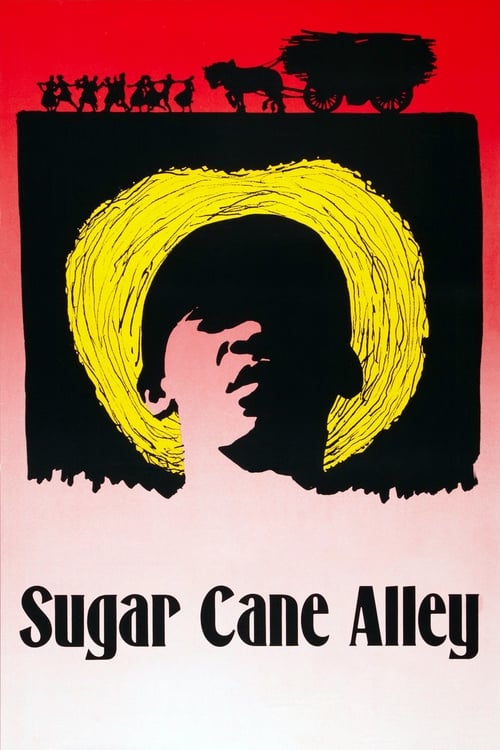
Sugar Cane Alley
1983 · Euzhan Palcy
For when you want a film with a big heart that earns its emotion honestly — a story about sacrifice and gratitude that may well leave you thinking about whoever paid for your own chances. Comforting in tone, quietly devastating in effect.
What it's about
Martinique in the early 1930s, where nearly everyone in a small village works the sugar cane for wages that never stretch far enough and an overseer can fine away a day's pay for the smallest slip. Eleven-year-old José lives with his grandmother M'man Tine, who has decided the boy will not follow her into the fields. School is the one way out, and when José earns a place to study in the capital, the cost of that chance falls on the woman who has already given everything.
The experience
Warm and unhurried, full of village life, children's mischief, and elders' stories, but with a steady ache underneath — you feel the weight of the cane fields in every scene of rest. It's tender without being soft, and the bond between grandmother and grandson sneaks up on you until it's the whole film.
Performances
Darling Légitimus is unforgettable as M'man Tine — proud, worn, ferociously loving — a late-career performance that was honored at Venice, opposite the wonderfully open young Garry Cadenat as José.
The craft
Euzhan Palcy, in her first feature, adapts Joseph Zobel's autobiographical novel with a sure sense of place: the shacks, the cane rows, and the ritual of work are rendered in earthy, sun-baked tones that make poverty concrete rather than picturesque. The storytelling is classical and clear, trusting faces and daily routine over speeches.
Why it matters
A landmark as one of the first features by a Black woman director to reach a wide international audience — and the first by a Martinican woman — it announced Palcy on the world stage after its prize-winning premiere at Venice in 1983. It remains a touchstone of Caribbean cinema and of stories about colonial plantation life told from the inside.
Snapshot
Rue Cases-Nègres — released in English as Sugar Cane Alley and in some territories as Black Shack Alley — is Euzhan Palcy's first feature, adapted from Joseph Zobel's 1950 autobiographical novel of the same title. It is set in Martinique in the early 1930s, in the sugar plantation economy that persisted on the island in the century after emancipation, and it follows José Hassam, an eleven-year-old boy raised by his grandmother M'man Tine, as schooling becomes the one available exit from the cane fields.
The film matters for at least three reasons that historians of cinema tend to name together. First, it is one of the earliest features made by a Black woman director to reach a wide international audience, and the first feature by a Martinican woman. Second, it arrived at the Venice Film Festival in 1983 and won the Silver Lion, with Darling Légitimus taking the Volpi Cup for her performance as M'man Tine — a pairing of prizes that gave a first-time Caribbean director both critical legitimacy and distribution. Third, it stands as the most widely seen narrative film of the French Antilles, and effectively created a reference point where there had been almost no feature-film tradition of Martinican self-representation on screen.
The film's method is worth stating plainly at the outset, because it explains much of its critical reception. Palcy works in a register of restrained observational realism rather than polemic. The plantation's violence is largely structural — wages that cannot cover food, fines levied at the overseer's discretion, a scholarship that covers only part of a fee — and the film's political argument emerges from accumulated material detail rather than from confrontation scenes. Its emotional center is not the injustice of the system in the abstract but the specific labor of one old woman who works herself to exhaustion so that a child will not have to.
Industry & production
The production history is a well-documented instance of French state and public-broadcast funding reaching a subject that the commercial French industry had ignored. Palcy, born in Martinique in 1958, had made a television film for the French overseas broadcaster (ORTF's Antilles service) while still very young, then moved to Paris to study — film at the Sorbonne and the Louis Lumière school — before assembling Rue Cases-Nègres. François Truffaut is repeatedly credited in accounts of Palcy's career as having encouraged the project and helped open doors to French financing; Palcy has spoken about this in interviews over the years, though the precise scope of his practical involvement is described inconsistently in the record and is best treated as advocacy and mentorship rather than a formal production role.
The film was made on a modest budget with French support, including participation from French public television, and shot on location in Martinique — a decision with consequences far beyond authenticity. Shooting in the actual landscape of cane fields, plantation housing, and Fort-de-France streets meant the production was working in a place with no established feature-film infrastructure. Much of the cast was drawn locally and non-professionally, most importantly Garry Cadenat as José, and the Creole-inflected French of the dialogue was recorded rather than dubbed into standard metropolitan French — a choice French distributors of the period would not have taken for granted.
The Venice awards in 1983 changed the film's commercial trajectory. Silver Lion status carried it into art-house distribution in Europe and then into the United States, where it circulated through the mid-1980s and, crucially, into university and secondary-school curricula in French, Caribbean studies, African diaspora studies, and postcolonial literature. That educational afterlife — sustained by the film's pairing with Zobel's novel, a set text in the French Caribbean — has given it a durability in circulation that its original theatrical run alone would not have produced. Precise budget and box-office figures are not reliably established in the public record, and this dossier does not supply them.
Palcy's subsequent career is itself part of the film's industrial significance. The visibility of Rue Cases-Nègres led to A Dry White Season (1989) at MGM, making Palcy the first Black woman to direct a film produced by a major Hollywood studio — a fact usually cited to mark both the achievement and the narrowness of the opening, since Palcy's feature output afterward was sparse relative to her critical standing.
Technology
The film is a conventional 35mm color production of its period, shot on location with largely available and augmented natural light. Nothing about its technical base is experimental; the interest lies in what the technology of the early 1980s made possible for a low-budget location shoot in the tropics. Faster color negative stocks by this date could hold detail in high-contrast conditions — the blown-out glare of open cane fields at midday against deep shade inside the wooden shacks — without the heavy fill lighting that would have flattened interiors a generation earlier. The film's characteristic look, in which the dark interiors of Rue Cases-Nègres retain texture while the fields outside burn bright, depends on that latitude.
Location sound recording in Creole-inflected French, with post-synchronization used sparingly, is likewise a technological choice with a cultural payload: the texture of the spoken language is preserved rather than replaced. The film is also, in a small way, a document of period-specific production economics — it demonstrates that a first feature could be mounted in a territory without studios, labs, or a technical crew base, provided a metropolitan post-production chain was available.
Technique
Cinematography
Photographed by Dominique Chapuis, the film organizes itself around a sustained contrast between two visual registers. The cane fields are shot in wide, open, sun-flattened compositions where human figures are small against a horizon of green and the repetitive geometry of planted rows — a landscape that reads as beautiful and as a machine for consuming labor at the same time. The village of Rue Cases-Nègres, by contrast, is filmed in tight, enclosed, wood-toned interiors and narrow exterior lanes, with light entering through doorways and gaps in the planking.
Chapuis favors relatively static or gently mobile framing and eye-level camera positions, especially in scenes centered on José, which keeps the film at a child's scale without resorting to the trick of a persistently low camera. The palette is warm and earth-weighted — ochres, browns, the bleached whites of laundered cloth, the greens of the cane — and the film generally avoids the saturated postcard tropicality that Caribbean settings invite. When the story moves to Fort-de-France in the second half, the visual scheme shifts to harder architecture, straighter lines, and a colder, more institutional light, so that the geographic move registers visually as a change of world rather than merely a change of address.
Editing
The cutting is unhurried and essentially classical, built on scenes that are allowed to play out to their emotional conclusion rather than compressed. The overall structure is episodic in the manner of the source novel: a sequence of incidents in village life — a burned shack, a stolen bowl of food, a punishment, a lesson — accumulating into a portrait rather than driving a single plot engine. The film's forward pressure comes almost entirely from the school-exam thread, which functions as a spine holding the episodes in tension.
Two structural moves are worth marking. The film's rhythm slows markedly around M'man Tine's labor, letting the repetition of work register as duration rather than summarizing it in montage — a decision that makes her exhaustion legible as accumulated time. And the transition to Fort-de-France is handled without fanfare, so the second movement of the film begins almost before the viewer registers that the first has ended, which mirrors José's own experience of a displacement he did not choose.
Mise-en-scène / staging
The film's production design reconstructs the plantation village as a coherent social geography: the row of wooden cases with their shared yard, the plantation house and its distance, the fields, the schoolhouse, the store where credit is extended and withdrawn. Staging repeatedly places characters within this geography in ways that make hierarchy visible without a line of dialogue — the overseer on horseback or standing above seated workers, the béké landowner glimpsed at a remove, the children in a cleared yard that belongs to no one.
Two figures anchor the film's moral staging outside the school system. Médouze, the old man who tells José about Africa, the middle passage, and the unfinished promise of emancipation, is consistently staged at night, at a fire, in a space of speech rather than labor — the film's repository of historical memory. Léopold, the mixed-race boy who discovers that his béké father will not give him his name, occupies the film's other structural position, that of a child destroyed by the color and legitimacy hierarchies the plantation encodes. Palcy stages both threads with the same evenness she brings to the domestic scenes, so that the film's political content arrives inside its ordinary texture.
Sound
The soundtrack is dominated by the ambient world — wind through cane, tools, insects, the sounds of the village — with music used selectively rather than continuously. The score, credited to Groupe Malavoi, draws on Martinican musical idiom, and its presence anchors the film in a specific Caribbean musical culture rather than a generic "world cinema" scoring. The film uses song and communal sound as markers of collective life, in contrast to the near-silence of solitary labor.
The most consequential sound decision is linguistic. The film moves between Creole and French, and the tension between them is a subject rather than a texture: the schoolmaster's insistence on French, the humiliation attached to Creole speech in institutional settings, and the intimacy of Creole in the household make language itself a site of colonial administration. José's advancement is conducted in the language of the colonizer, and the film registers the cost of that without ever stating it as a thesis.
Performance
Darling Légitimus's M'man Tine is the film's central performance and its Volpi Cup. Légitimus, a veteran French Antillean performer then in her seventies, plays the grandmother as physically weathered and emotionally undemonstrative — her love expressed as work, her authority as scolding, her tenderness withheld until it costs her something. The performance avoids both saintliness and folkloric warmth, which is precisely why it carries the film's argument: her sacrifice is legible as labor, not as sentiment.
Garry Cadenat, a non-professional, plays José with an alert watchfulness rather than precocity; much of the film consists of his observing adults and drawing conclusions, and Palcy directs him toward stillness. Douta Seck's Médouze supplies the film's oral-historical register with a gravity that grounds the film's mythic material, and the supporting cast — largely local performers — sustains an ensemble texture in which the village reads as a community rather than a backdrop.
Narrative & dramatic mode
The film is a récit d'enfance — a childhood narrative — in the tradition of the first-person novel of formation, adapted into a third-person cinematic account that stays close to the child's vantage without adopting a subjective camera. Its mode is realist and observational; it does not use voice-over narration to install a retrospective adult voice, and so the meaning of events must be assembled by the viewer from what José sees.
Structurally it is a bildungsroman with an unusual moral asymmetry. In the classic form, the protagonist's education is a gain. Here, education is unambiguously an escape, and the film is precise about what escape costs: it separates José from the community that raised him, it is purchased with M'man Tine's body, and it is conducted through an institution that requires the abandonment of his own language. The film neither disowns nor celebrates this bargain. Its ending — José's future opened, the world that produced him closing behind him — is a resolution and a loss at once, and Palcy declines to resolve the ambivalence.
The episodic construction inherited from Zobel serves this: because the film accumulates rather than builds, the plantation's constraints register as a condition of life rather than as obstacles in a plot to be overcome. What appears to be a slow first act is in fact the film's central argument being laid down.
Genre & cycle
By genre labels the film is a drama and, in the loosest sense, a family film — it is centrally about a child and is regularly taught to young audiences — but neither label captures its position. It belongs more usefully to three overlapping cycles.
The first is the international art-house childhood film of the 1970s and 1980s, in which a child's-eye view is used to make a political or historical situation legible: the lineage that runs through neorealism's children and includes works as varied as The Spirit of the Beehive (1973), Pixote (1980), and later Au revoir les enfants (1987). Rue Cases-Nègres was received in Europe within this frame.
The second is the literary adaptation of the postcolonial novel of formation — a cycle more visible in African and Caribbean cinema and letters than in Euro-American film history, where the source text carries canonical status in its own literary tradition and the film functions partly as its transmission.
The third, and the one that most shapes the film's afterlife, is Black diasporic and African cinema of the period. Rue Cases-Nègres is habitually discussed alongside the Francophone African features of Ousmane Sembène and Med Hondo, and alongside the emergent Black British and African-American independent cinemas of the same decade. It is not a member of any of those national movements, but it entered the same festival and academic circuits and was read through them.
Authorship & method
Palcy's authorship here is defined by an act of adaptation and a governing restraint. She had encountered Zobel's novel as a young reader in Martinique and has described the shock of recognition at seeing her own world in print — a formative experience she has connected in interviews to her decision to make films about a place that cinema had not represented. The adaptation is faithful in incident and setting while making structural changes, most notably in giving Léopold's storyline a fuller and more pointed presence, so that the film addresses the color and legitimacy hierarchies of Antillean society more directly than a straight condensation of the novel would have.
Her method throughout is anti-rhetorical. There are no speeches summarizing the film's politics, no scenes of confrontation between oppressor and oppressed staged for catharsis, and no score cues instructing the viewer how to feel about injustice. The camera observes; the political content is in the material facts.
The key collaborators are worth naming. Dominique Chapuis's cinematography supplies the field/village visual dialectic described above; his work here is central to the film's refusal of picturesque tropicality. The score by Groupe Malavoi, a Martinican ensemble, roots the film in local musical practice rather than in imported scoring conventions. Palcy wrote the screenplay herself from Zobel's novel. Editing credit for the film is documented in the standard databases but is not a matter of significant critical commentary, and this dossier will not manufacture an account of it; what can be said is that the cutting serves the episodic-accumulative structure rather than imposing a tighter dramatic shape on it.
Movement / national cinema
The film's most consequential context is that it entered a near-void. Martinique and Guadeloupe, as French overseas départements, had been the subject of French documentary and occasional fiction filmmaking, but there was no established Antillean feature-film industry and very little narrative cinema in which Martinicans represented themselves. Rue Cases-Nègres is therefore usually described as a founding work of French Antillean cinema — not the beginning of a large national movement, since the production base remained thin, but the establishment of a possibility and a reference point.
Intellectually the film sits inside the Martinican tradition of Aimé Césaire's négritude and, more proximately, the antillanité articulated by Édouard Glissant — a turn from the pan-African orientation of négritude toward the specific, creolized, historically layered reality of the Caribbean. Médouze's transmission of African memory and the film's insistence on Creole speech and Martinican music together stage exactly this tension between an African origin and a Caribbean present. Zobel's novel is itself a canonical text of this tradition; the film is one of the primary means by which it reached beyond readers of French.
In festival and academic terms the film was absorbed into the wider category of Third Cinema and Black diaspora film, and it is regularly taught alongside Sembène, Hondo, and later Caribbean and Black British work — a placement that is accurate about its politics and reception, if slightly imprecise about its production context, which was French.
Era / period
Two periods are in play. The depicted period — Martinique in the early 1930s — is the film's historical subject: nearly a century after the 1848 abolition of slavery in the French colonies, and roughly a decade before departmentalization in 1946, in an economy still organized around sugar and still structured by the racial hierarchy the plantation produced. The film's argument depends on this interval. The workers are not enslaved; they are paid, they are formally free, and their lives are nonetheless organized by the same land, the same crop, the same families, and the same enforced dependence. The film's quiet insistence on this continuity is its sharpest historical claim.
The period of production — the early 1980s — matters equally. This was the moment when postcolonial critique was consolidating in the French and Anglophone academy, when African and diasporic cinema was gaining festival visibility, and when the questions of who was permitted to represent the formerly colonized world were being asked with new force. A first feature by a young Martinican woman, in Creole-inflected French, winning at Venice, landed exactly where those currents met — which accounts for both the warmth of its reception and the speed of its adoption into curricula.
Themes
Education as escape and as severance. The film's organizing theme. Schooling is genuinely liberating and genuinely costly; it removes José from the cane fields and from his community in a single motion, and it is conducted in a language and an institution that ask him to devalue his own.
Labor and the body. M'man Tine's work is the film's material substrate. The film measures her sacrifice in physical wear, and it insists that the boy's future is literally purchased with an old woman's body.
Historical memory and its transmission. Médouze carries the memory of Africa and of slavery, and his function is to give José a past that neither the plantation nor the school will supply. The film treats oral transmission as a form of historical knowledge under threat.
Colorism, legitimacy, and the color line. Léopold's story isolates the specific Antillean structure by which whiteness confers name, property, and legitimacy, and by which a mixed-race child can be simultaneously acknowledged and disowned.
Language as colonial administration. The Creole/French divide runs through the film as a marker of who may speak, where, and at what cost.
Community and its dissolution. The village functions as a real collective — shared food, shared child-rearing, shared punishment — and the film's trajectory is toward José's departure from it. What is gained is individual; what is lost is common.
Reception, canon & influence
The film's critical reception was strong and durable. The Venice Silver Lion and Darling Légitimus's Volpi Cup in 1983 established it immediately, and the film was widely and favorably reviewed in Europe and, on its American release, in the U.S. press. Critics consistently praised its refusal of melodrama, the Légitimus performance, and its handling of the child's perspective; where reservations appeared, they generally concerned the film's deliberate pace and its relatively conventional formal approach to radical material — a criticism that has aged into a description of its method rather than a complaint about it. The film also collected French recognition, including a César for Best First Feature, and it remains the most awarded and most widely seen French Antillean film.
Influences on the film (backward). The primary source is Joseph Zobel's novel, and the film should be understood first as an adaptation faithful to a canonical Caribbean literary text. Beyond that, three lineages inform it. Italian neorealism — location shooting, non-professional performers, a child's perspective on adult economic hardship, the moral seriousness of everyday material detail — is the clearest formal inheritance, filtered through the French art cinema in which Palcy trained. The French tradition of the childhood film, with Truffaut's The 400 Blows (1959) as the touchstone, informs the film's treatment of a watchful boy negotiating institutions. And the Francophone African cinema of Sembène in particular offered a model of politically serious, formally restrained narrative filmmaking in which colonialism's structures are shown rather than argued. Intellectually, Césaire's négritude and Glissant's antillanité supply the film's frame of reference for Caribbean identity.
Legacy (forward). The film's influence operates on several registers. Within the French Antilles, it established the possibility of Martinican and Guadeloupean feature filmmaking and remains the canonical Antillean film — subsequent Caribbean French-language features are routinely positioned in relation to it. Internationally, it became one of the standard teaching texts for Caribbean, Francophone, postcolonial, and African-diaspora film courses, a status it has held for four decades; its pairing with Zobel's novel in classrooms has kept both in circulation. For Black women filmmakers specifically, Palcy's trajectory from this film to A Dry White Season is a frequently cited precedent, and Palcy has been the subject of renewed attention in the twenty-first century — including a career retrospective and honorary recognition — as the history of Black women's direction has been more systematically written. Restoration and reissue in recent years have brought the film to new audiences and consolidated its canonical position.
The honest qualification is that the film's influence is more visible in canon-formation, curricula, and the opening of institutional possibility than in traceable stylistic imitation. Few later films look like Rue Cases-Nègres. What it changed was what could be made, by whom, and about where — and that is the form its legacy takes.
A Deleuzian reading
A doorway in a wooden shack.
The full Deleuzian reading of Sugar Cane Alley →
Reception
An instant success — it won the Silver Lion at Venice in 1983 and became a genuine hit in France — but then spent decades hard to see abroad, before restoration and Palcy's 2022 honorary Oscar re-centred it as a foundational classic of Caribbean cinema.
How Sugar Cane Alley was received, from release to now →
How to watch Sugar Cane Alley: what to notice on a first viewing
- Watch the cane fields turn sun-bleached white and open. Chapuis shoots the fields in flattened, open sunlight while the village stays wood-toned and enclosed, light entering only through doorways and gaps in the planking. The two textures keep marking which world is meant to consume labor and which one shelters it.
- Notice the camera staying at José's own height. Chapuis keeps the framing steady and eye-level in José's scenes rather than dropping the camera low for a cute child's-eye trick. You get his scale without the film making a show of giving it to you.
- Watch how long the film holds on ordinary work. The rhythm slows around M'man Tine's cane-cutting and washing, letting the repetition register as duration instead of being compressed into a quick montage. Her exhaustion becomes something you have actually sat through, not just been told about.
- Listen for the switch between Creole and French. The household speaks Creole with warmth and ease, while the schoolroom insists on French, and the film keeps marking which language each space allows. You can hear exactly which world José is required to enter, and what he has to set aside to enter it.
- Notice Médouze always speaking to José by firelight. The old man is staged at night, at a fire, in a space set apart from the day's labor, telling José about Africa and what came before the plantation. His stories give José a past that neither the fields nor the school will ever supply him.
The whole guide to watching Sugar Cane Alley, with the keys for a rewatch →
Influences: the films it descends from and the films it influenced
- Bicycle Thieves (1948) — Supplies the template Palcy works from — non-professional performers cast for physiognomy and gait, location shooting in real working districts, and a small boy positioned as the silent witness whose eye-level view registers an adult's economic humiliation before he can name it.
- Umberto D. (1952) — The maid's uninterrupted morning routine — grinding, water, the ant on the wall — is the direct precedent for Palcy's editing of labor as duration, where cane-cutting and M'man Tine's washing are held long past narrative necessity so that the work itself, not a plot point about the work, becomes the scene's content.
- The 400 Blows (1959) — Establishes the récit d'enfance grammar Palcy adapts: camera pinned to the child's height, the classroom and the disciplinary institution shot as a fixed frontal geography the boy must learn to navigate, and an episodic drift of incidents rather than a causal plot, ending on the child's face rather than a resolution.
- Pather Panchali (1955) — Demonstrates neorealist method transposed to a colonized village economy — accumulation of small domestic incidents over seasons, an old woman's body as the film's clock, and the grandmother/child dyad as the vehicle for transmitting a threatened way of life, the exact structural load M'man Tine and José carry.
- Black Girl (La Noire de…) (1966) — Models the anti-rhetorical showing of colonial structure — no speeches, the hierarchy legible purely from who occupies which room and who is permitted to speak French — and pioneers the split between spoken French on the soundtrack and an interior vernacular consciousness that Palcy rebuilds as Creole/French diglossia.
- Mandabi (1968) — The decisive precedent for making the vernacular the film's primary language and treating French as the bureaucratic tongue that extracts and excludes; Palcy's schoolroom scenes, where Creole is punished and French is the price of mobility, are the same sound design applied to education instead of the post office.
- Sambizanga (1972) — Maldoror's method of filming anticolonial politics entirely through domestic and village geography — a woman walking prison to prison, repression registered as spatial obstruction rather than depicted violence — is the staging principle behind Palcy's plantation, where the béké house, the overseer's shop and the cases are laid out as a map of power.
- The Last Supper (1976) — Films the sugar mill as an integrated social machine — cane field, boiling house, master's table shot as one continuous economy — the Caribbean plantation cinematography Palcy inherits in her cane-field-versus-village contrast, where the horizontal green field and the cramped shack row are cut against each other as two halves of one system.
- West Indies (1979) — The immediately preceding Antillean-subject feature and the aesthetic Palcy defines herself against — Hondo's Brechtian slave-ship musical argues the colonial economy in declamation and choreography, and Rue Cases-Nègres answers with the same historical thesis delivered entirely through unaccented behavior and location detail.
- Chocolat (1988) — Takes the colonial récit d'enfance into French Africa with Palcy's staging intact — a watchful child reads the racial order off household spatial arrangement (who enters which room, who eats where, who sleeps outside), with the hierarchy never spoken aloud and the adult's shame carried in framing rather than dialogue.
- A Dry White Season (1989) — Palcy carries her own anti-rhetorical method into a studio political thriller — apartheid shown through the geography of township, courtroom and suburb and through what characters are permitted to see rather than through argument — proving the plantation-mapping technique scaled to a foreign system and a professional cast.
- Siméon (1992) — Palcy's direct extension of the Malavoi score into a film built on Antillean music itself, promoting the Creole musical idiom from underscore to subject and making explicit the claim latent in Rue Cases-Nègres that Antillean cultural transmission runs through sound and elders rather than through schools.
- Biguine (2004) — Martinican feature made in the space Palcy opened — Creole-language dialogue, period Saint-Pierre reconstructed as a stratified social map of color and class, and a traditional musical form treated as historical evidence, with Chamoiseau's scripting continuing the Zobel-to-screen literary adaptation line.
- Le Bonheur d'Elza (2011) — A Guadeloupean woman's first feature that returns literally to the cane field as the site of inherited legitimacy and paternity, restaging Palcy's color-and-filiation subplot (Léopold's disowned name) as the central narrative and keeping the eye-level, non-declarative handling of race in the Antilles.
- Small Axe: Education (2020) — Applies the education-as-escape structure to the Caribbean diaspora in London — a bright boy sorted out of learning by an institution that treats his speech as deficiency — with McQueen holding on the child's face in classroom and assessment scenes exactly as Palcy holds on José, and letting the system indict itself without commentary.
- Killer of Sheep (1977) — A parallel solution to the same formal problem: episodic accumulation with no plot engine, non-professional cast, wage labor filmed in real duration, and children observed at their own height in the interstices — Black working-class life rendered as texture and repetition rather than as an issue to be dramatized.
- Daughters of the Dust (1991) — Builds the same two devices on the Gullah islands: a creolized language spoken untranslated as the film's default register, and an elder as the sole conduit of pre-slavery memory delivered in a fire-lit oral-history set piece — Nana Peazant's function is Médouze's, transposed to the Sea Islands.
Similar films
- Chocolat (1988) — influence & lineage
- Pather Panchali (1955) — influence & lineage
- The 400 Blows (1959) — influence & lineage
- Black Girl (1966) — shared sensibility
- Sambizanga (1973) — shared sensibility
- Emitaï (1973) — shared sensibility
- El Norte (1983) — shared sensibility
- Sweet Charity (1969) — shared sensibility