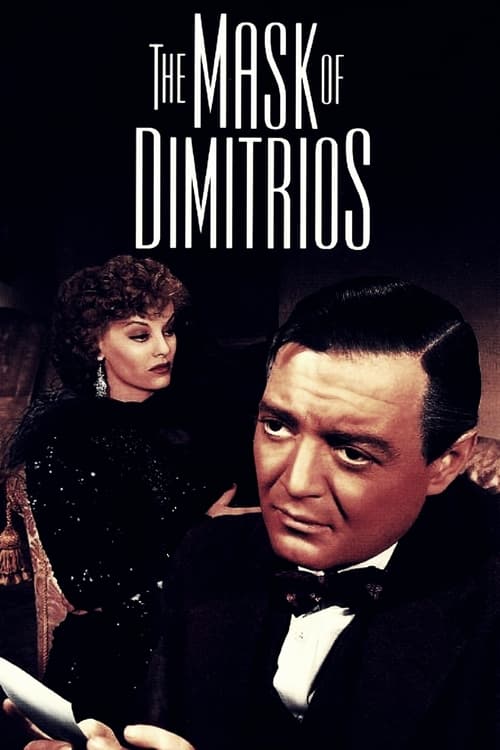
The Mask of Dimitrios
1944 · Jean Negulesco
For a rainy-night armchair mystery — when you want atmosphere, double-crosses, and great character actors purring at each other rather than car chases. Comfort viewing for lovers of shadows.
What it's about
A mild-mannered mystery novelist in Istanbul is shown the corpse of Dimitrios, a notorious swindler and killer fished out of the Bosphorus, and becomes obsessed with a question: how is such a man made? Following the dead criminal's trail backward across interwar Europe — Athens, Sofia, Geneva, Paris — he's joined by the courtly, watchful Mr. Peters, whose interest in Dimitrios is anything but literary.
The experience
A pleasurably sinister slow burn — all fog, train compartments, and silky conversations where every pleasantry hides a threat. It's the cozy-menacing register of classic noir: more insinuation than action, and all the more absorbing for it.
Performances
Peter Lorre, for once the gentle hero, is wonderfully sly as the curious novelist, and Sydney Greenstreet's Mr. Peters — enormous, genial, and quietly dangerous — is one of the great screen-partnership turns; their scenes together are the film.
The craft
Adapted from Eric Ambler's landmark spy novel, it unfolds in flashbacks that assemble a villain's biography piece by piece — an unusual, elegant structure for its era. The shadowy Warner Bros. photography drapes every border town and hotel room in noir atmosphere.
Why it matters
A key early example of the cynical, realist spy story on screen and a showcase for the Lorre–Greenstreet pairing, it helped push the espionage film away from heroics and toward moral murk.
Snapshot
The Mask of Dimitrios is a Warner Bros. crime-mystery adapted from Eric Ambler's 1939 novel (published in Britain as The Mask of Dimitrios and in the United States as A Coffin for Dimitrios). It follows a mild Dutch mystery novelist, Cornelius Leyden (Peter Lorre), who becomes fascinated by the corpse of a notorious international criminal, Dimitrios Makropoulos (Zachary Scott, in his screen debut), fished out of the Bosphorus near Istanbul. Leyden's antiquarian curiosity about "how such a man is made" leads him backward through Dimitrios's career across interwar Europe, an inquiry that entangles him with the genial, dangerous Mr. Peters (Sydney Greenstreet). The film is significant on three counts: as a prestige showcase for the Lorre–Greenstreet pairing that Warner had cultivated since The Maltese Falcon (1941); as one of the more literate entries in the emerging American film noir; and as an early feature-directing credit for Jean Negulesco, previously a montage and second-unit specialist at the studio. It remains a connoisseur's noir — admired more than widely seen — prized for its cynical continental atmosphere and its unusual investigative structure.
Industry & production
The film was a product of the Warner Bros. studio system at its wartime peak, made on the studio's soundstages under producer Henry Blanke, one of Warner's most reliable prestige hands. Its casting logic is transparently that of a studio maximizing assets it already owned: Lorre and Greenstreet had become a bankable "menace" duo across The Maltese Falcon, Casablanca (1942), and Background to Danger (1943), and Warner reunited them repeatedly through the mid-1940s. The Mask of Dimitrios inverts their usual dynamic — here Lorre is the film's moral center and near-hero, Greenstreet the ambiguous partner — which was itself a selling point.
The production is also notable as a launching pad. Zachary Scott made his film debut as Dimitrios and was groomed by Warner into a specialist in silky villainy on the strength of it. Negulesco, a Romanian émigré who had worked for years as an assistant, storyboard artist, and montage director, received one of his first major solo feature assignments; the film helped establish the polished, European-inflected craftsmanship that would carry him to Humoresque (1946), Johnny Belinda (1948), and beyond. Beyond these broad facts, the granular production record — shooting schedule, budget, and box-office returns — is not something I can document reliably, and I will not invent figures.
Technology
Technologically the film is conventional for a 1944 studio release: 35mm black-and-white photography, the standard Academy aspect ratio, and optical monaural sound, all executed within Warner's controlled soundstage environment. There is no evidence of technical innovation at the level of equipment or process; the film's interest lies entirely in how thoroughly it exploits mature studio tools rather than in extending them. Interwar Europe — Istanbul, Sofia, Belgrade, Geneva, Paris — is conjured through built sets, matte and process work, and lighting rather than location shooting, a fabrication that suits the film's storybook-of-crime conceit. The picture belongs to the tradition of studio "Europe" assembled on the backlot, and its persuasiveness is a function of design and photography, not of any new capture technology.
Technique
Cinematography
The photography is by Arthur Edeson, whose credits already included The Maltese Falcon and Casablanca, and his contribution is central to the film's reputation. Edeson works in a low-key register — pools of light in dark rooms, faces half in shadow, deep blacks — that aligns the film with the visual vocabulary later codified as noir. The style is functional as well as decorative: because the story is largely a chain of recollections about a man glimpsed obliquely by others, the photography keeps Dimitrios himself partially obscured, a figure assembled from fragments and half-lit encounters. Edeson favors compositions that isolate figures within cluttered, atmospheric interiors, reinforcing the sense of a continent of watchers, informers, and interested parties.
Editing
The editing (credited to Frederick Richards) is organized around the film's nested flashback architecture. The present-tense frame — Leyden's inquiry — repeatedly hands off to embedded testimonies, so the cutting must manage transitions between narrators and time frames without losing the audience. The film leans on the classical Warner grammar of dissolves and framed narration to move between episodes in Dimitrios's rise, each recounted by a different witness. The result is a portrait built in installments, closer in logic to an investigation than to a linear thriller.
Mise-en-scène / staging
Art direction by Ted Smith gives the film its densely furnished continental look: hotel rooms, cafés, gambling dens, and bureaus that read as a cross-section of interwar Europe's demimonde. Staging tends to place characters in intimate two-person confrontations — Leyden with a witness, Leyden with Peters — where information is exchanged and menace is implied rather than acted out. The film's violence is largely offscreen or recounted; the drama is conversational, and the staging is calibrated to make talk suspenseful. Costuming and set dressing carry much of the geographic storytelling, since the "travel" across Europe is mostly implied.
Sound
The score is by Adolph Deutsch, a Warner staff composer whose work on The Maltese Falcon and High Sierra had already helped define the studio's hard-edged crime sound. Deutsch supplies a restrained, tension-oriented accompaniment that services the mystery rather than swamping it, with continental color appropriate to the settings. Dialogue is foregrounded — this is a film that lives on Lorre's soft inquiries and Greenstreet's rolling, insinuating cadences — and the sound design generally subordinates effects and music to speech.
Performance
Performance is the film's chief pleasure. Lorre, so often cast as a neurotic or a grotesque, is here quiet, curious, and humane; his Leyden is a spectator drawn into a moral education, and Lorre plays him with an understated decency that anchors the picture. Greenstreet's Mr. Peters is a masterclass in genial threat — courtly, sentimental, and lethal by turns — and the interplay between the two actors, now cast as reluctant allies rather than adversaries, is the reason the film endures. Zachary Scott, in his debut as Dimitrios, projects a cold, opportunistic charm; because the character is glimpsed mostly through others' accounts, Scott must register as an idea of evil as much as a person, and he supplies the requisite reptilian poise. Faye Emerson and Victor Francen lead a supporting gallery of the corrupted and the used.
Narrative & dramatic mode
The film's most distinctive feature is its structure. It is a mystery in which the central figure is already dead and the "detective" is a novelist with no professional stake — an inquiry driven by curiosity rather than justice. The narrative unfolds as a series of embedded flashbacks: Leyden collects testimonies from people who crossed Dimitrios at various stations of his rise, and the film reconstructs the criminal's biography backward and in pieces. This retrospective, testimonial architecture invites comparison to the investigative form of Citizen Kane (1941) — a life assembled from the partial, interested memories of those who knew fragments of it — though Dimitrios pursues a criminal career rather than a psychological enigma. The dramatic mode is thus closer to anatomy than to conventional suspense: the pleasure is in watching a portrait accumulate, and in the slow revelation that the frame story itself carries a hidden agenda in the person of Mr. Peters.
Genre & cycle
The Mask of Dimitrios sits at the intersection of several cycles. It is routinely included in the film noir canon by virtue of its release date, its Warner pedigree, its low-key photography, and its morally soured European milieu. It is equally a descendant of the literate spy-and-crime thriller that Eric Ambler had helped modernize in the 1930s — a genre concerned less with heroics than with the seedy machinery of espionage, blackmail, and finance. And it belongs to the wartime and postwar vogue for continental-intrigue pictures that Warner in particular cultivated around Lorre and Greenstreet. Within noir, it is an atypical, "cerebral" entry: light on action and romance, heavy on talk, retrospection, and moral inquiry.
Authorship & method
Negulesco directs with an emphasis on atmosphere, performance, and pictorial polish rather than kinetic set pieces — an approach consonant with his background as a visual craftsman and montage specialist, and with his later reputation for elegant, actor-centered studio filmmaking. The screenplay is credited to Frank Gruber, himself a prolific pulp novelist, who compresses Ambler's dense geopolitical novel into a series of dramatized encounters and reframes the protagonist from the novel's English academic Charles Latimer into the Dutch novelist Cornelius Leyden, tailored to Lorre. The key collaborators form a recognizable Warner crime unit: Arthur Edeson's shadowed photography, Adolph Deutsch's spare score, and Ted Smith's continental sets, overseen by producer Henry Blanke. The film is best understood as a system product in which authorship is distributed across a practiced ensemble of studio craftsmen rather than centralized in a single directorial signature — though Negulesco's taste for controlled, European sophistication is legible throughout.
Movement / national cinema
This is Hollywood studio cinema, but of a distinctly cosmopolitan cast. Its sensibility is shaped by émigré talent — Lorre and Negulesco among them — and by a source novel steeped in the anxieties of interwar Europe. The film participates in the broader mid-1940s American absorption of Central European style and personnel into what would be theorized as film noir, a current in which German and Middle-European expatriates brought a darker visual and moral palette to American genre filmmaking. It is not part of any organized movement; rather, it exemplifies how the Hollywood studio absorbed continental talent and subject matter and reprocessed them for a domestic audience.
Era / period
Released in 1944, the film is a wartime production that pointedly looks backward to the interwar years — the 1920s and 1930s of assassinations, currency schemes, and stateless intrigue that formed the world of Ambler's novel. That doubled temporality is part of its meaning: made while Europe was being destroyed, it dramatizes the corrupt, opportunistic Europe that preceded the catastrophe, offering the figure of Dimitrios as a kind of case study in the amorality that flourished in the pre-war order. Within film history it belongs to the classical studio era at its craft peak and to the formative moment of American noir, before the cycle's conventions had fully hardened.
Themes
The film's governing theme is the anatomy of evil as a social and economic product rather than an individual aberration. Dimitrios is presented less as a monster than as a logical outgrowth of his world — his crimes shade from murder and betrayal into espionage, political assassination, and high finance, drawing an explicit line between organized criminality and respectable capital. The film is preoccupied with the permeability of the boundary between the criminal and the legitimate: Dimitrios rises by treating loyalty, nationality, and human life as tradable commodities. Secondary themes include curiosity and complicity — Leyden's detached, aesthetic interest in evil is gradually implicated in it — and the unreliability of reputation and memory, since Dimitrios exists only in the contradictory accounts of those he used. Beneath it runs a melancholy portrait of interwar Europe as a marketplace of betrayals.
Reception, canon & influence
On release the film was received as a well-crafted, literate entry in Warner's crime output, notable especially for reuniting Lorre and Greenstreet and for launching Zachary Scott; the specifics of contemporary reviews and commercial performance are not something I can quote or quantify without risk of invention, and I decline to do so. Its backward influences are clear and documentable: Eric Ambler's novel, a landmark in the realistic, politically literate thriller; the investigative, multiple-flashback biographical structure that Citizen Kane had recently made prominent; and the house style of the Warner crime film, particularly the visual and personnel legacy of The Maltese Falcon. Its forward influence is more diffuse. The film has been steadily reclaimed by noir historians and cinephiles as a distinctive, talk-driven, morally serious example of the cycle, and it stands as a key link in the chain of Ambler screen adaptations and of the Lorre–Greenstreet screen partnership. It is frequently cited as evidence of noir's literary and European dimensions, and as an early demonstration of Negulesco's craftsmanship and of Zachary Scott's screen persona. It did not spawn a school or a wave; its legacy is that of an admired, oft-revisited touchstone for those tracing the intellectual and continental strain of American crime cinema rather than a broadly imitated model.
Reception
In 1944 it was a well-liked but modest Warner Bros programmer — the studio testing whether its two great scene-stealers could headline without Bogart. Today noir devotees treat it as a buried treasure, one of the most-recommended deep cuts of the classic cycle.
How The Mask of Dimitrios was received, from release to now →
Influences: the films it descends from and the films it influenced
- Citizen Kane (1941) — Supplies the film's armature: a dead/absent man reconstructed as a testimonial biography assembled from serial witness accounts and nested flashbacks rather than shown in linear chronology.
- The Maltese Falcon (1941) — Establishes the Warner crime unit the film inherits wholesale — the Lorre–Greenstreet pairing plus Arthur Edeson's shadowed, low-key photography of two-person confrontations.
- M (1931) — Forges Peter Lorre's soft-voiced, morally queasy criminal persona and the expressionist under-lit close-up as the visual grammar for an 'anatomy of evil.'
- Dr. Mabuse, der Spieler (1922) — Originates the master-criminal-as-financial-predator whose reach maps an entire corrupt society — the crime-and-capital template Dimitrios rises through across interwar Europe.
- Foreign Correspondent (1940) — Models the literate, politically-aware continental spy-thriller in which espionage is conveyed through conversation and atmosphere over set-piece spectacle.
- The Killers (1946) — Carries the Kane-derived testimonial structure into full noir: an investigator reconstructs a dead criminal's life through the multiple, contradictory flashbacks of those who knew him.
- Out of the Past (1947) — Extends the nested-flashback recounting of a doomed criminal past narrated to a listener, wrapped in the same low-key shadow photography.
- The Third Man (1949) — Reworks the core device — a writer chasing an elusive racketeer he reconstructs entirely from witness testimony across a corrupt postwar Europe — from a literate Greene/Ambler thriller lineage.
- The Stranger (1946) — Turns the 'anatomy of evil' into a pursuit as an investigator patiently exposes a hidden man of monstrous history concealed behind respectability.
- Topkapi (1964) — A later adaptation of Ambler (The Light of Day) that continues the Ambler screen line and its cosmopolitan Levantine-intrigue milieu.
- The Spy Who Came in from the Cold (1965) — Consummates the Ambler strain of talk-driven, anti-glamour, morally serious espionage shot in grim monochrome, where politics and betrayal replace heroics.
- Casablanca (1942) — Shares the émigré-ensemble casting method — Lorre and Greenstreet slotted into a continental intrigue populated by exiled European character actors on Warner soundstages.
- Background to Danger (1943) — The immediately prior Warner adaptation of an Eric Ambler novel, already using Greenstreet and Lorre in Balkan/Levantine spy machinery.
- Journey into Fear (1943) — A contemporaneous Ambler adaptation dramatizing his signature ordinary-man-adrift-in-geopolitics through claustrophobic two-person menace rather than action.
- The Conspirators (1944) — Negulesco's adjacent Warner picture reusing the same émigré cast and the Lorre/Greenstreet chemistry with the same pictorial, actor-centered restraint.
- Three Strangers (1946) — Negulesco again builds a talk-driven Warner crime piece around the Lorre–Greenstreet pairing, extending the same low-key, dialogue-foregrounded staging.
- The Verdict (1946) — The final Lorre–Greenstreet vehicle, prolonging the pairing and the shadowed Warner low-key look into a fog-bound Victorian crime setting.
- Ministry of Fear (1944) — The parallel émigré-noir adaptation of a serious literary thriller (Graham Greene), rendering wartime European paranoia through Lang's expressionist low-key lighting.
Similar films
- Out of the Past (1947) — influence & lineage
- The Maltese Falcon (1941) — influence & lineage
- The Third Man (1949) — influence & lineage
- M (1931) — influence & lineage
- Murder, My Sweet (1944) — shared sensibility
- Le Doulos (1962) — shared sensibility
- Le Samouraï (1967) — shared sensibility
- Murder on the Orient Express (1974) — shared sensibility